WalMart is suing Tesla for negligence, saying Elon Musk’s rush to market is failing industry standards of safety
…as of November 2018, fires broke out at no fewer than seven of the stores, forcing the disconnection of all the solar panel systems for the safety of the public…[because installed] haphazardly and as quickly as possible in order to turn a profit
Has Tesla released a transparency report on the total number of unexplained fires it’s caused? There are so many.
Even more concerning is how very little tangible response has come from the manufacturer, despite being cited as significantly worse than other manufacturers. For example:
Spontaneous combustion without warning:
…around 8:15 pm on Sunday night, the Tesla Model S is seen emitting smoke before suddenly bursting into flames. Further video shows the resulting charred wreckage, including that of two other nearby cars.
Once you realize the likelihood of a fire is unpredictable and could be increasing dramatically without explanation, the severity of these fires is also a major concern.
The fires seem to re-ignite unpredictably, are extremely toxic and, because of those two attributes, require expensive special training and equipment funded by tax-payers:
“With a gasoline fire, they know if they get enough water on it, it’ll go out,” [Peter Sunderland, a professor of fire protection engineering at the University of Maryland] said. “But with a deep-seated fire, it’s hard to spray the water deep enough into the battery to stop the fire.”
Slate reported that the firefighters who attempted to put out the 2013 Model S car fire in Seattle had trouble and “ended up using a circular saw to cut a hole that would allow them to pour water directly on the battery.”
In a fiery Tesla crash into a barrier in Austria, the car kept reigniting, forcing firefighters to battle the flames for hours. The car had to be put into quarantine for 48 hours to remove the chances of reignition, Jalopnik reported.
What’s more, lithium-ion fires can release high levels of “toxic gases” such as carbon monoxide, soot, hydrogen fluoride, and particulates of oxides of nickel; aluminum; lithium; copper; and cobalt, according to a Tesla Model X emergency response guide. As a result, firefighters need to wear a self-contained breathing apparatus and should use hoses that spray fog and special ventilation fans that push air out at a high velocity to protect bystanders downwind of the fire, according to the guide.
There are dozens of stories of Tesla fires not only being far less predictable, more expensive and more toxic than other products, they seem to not have any cohesive story yet of what to expect in the future.
In several cases the fires were extinguished at first encounter. Then had to be extinguished again on the tow truck. Then had to be extinguished again in the junk yard. That’s a multiplier effect for several reasons, not least of all because fires on tow trucks and in junk yards are not supposed to happen.
Initially Tesla’s CEO tried use social media to claim his products “500% less likely” to catch fire. This almost immediately was disproved (not to mention ridiculed by many for using math incorrectly)
Tesla, without a question, has a way higher incidence of fire deaths than other cars.
Then the car manufacturer tried to pivot to an argument that their fire death statistics aren’t being separated from collisions, where occupants would have died anyway. This again ignores the fact that their fires are different in ways that increase the likelihood of fatalities, not only for occupants but also those responding to help.
Tesla’s CEO should not be allowed to misrepresent harm likelihood and severity of his products when clearly there is ample and growing data on sub-standard engineering practices and threat to society. WalMart is picking up a hot topic, to be sure.
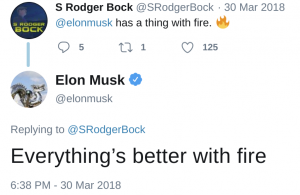
The CEO’s “safer than what you can buy from others” false claim even seems to be turned into a joke by him in 2018, as you can see in his attempts at humor when promoting sales of a flamethrower:
A Boring Company spokesperson said its flamethrower is ‘safer than what you can buy right now off-the-shelf on Amazon to destroy weeds’.
If Tesla wanted to extol virtues of battery technology, it would be that the carbon footprint producing them is zeroed out in just a few years and they emit zero harms when operating normally. That would be a viable defense, while they work to improve engineering to reduce fire likelihood and severity.
However, instead we see a company try dismissive fallacies (false equivalence in fires) and make claims their products give better odds of survival than other manufacturers.
The data doesn’t support Tesla in this comparison, since likelihood and severity of their fires already appear to be higher and trending worse with minimal explanation and no recall.
Tesla had at least quadruple (5 observed fire deaths vs. 1.19 expected) the fire-related mortality of the average car from 2016 through 1Q 2019
In fact, arson soon could be added to increasing probability of Tesla fires as owners realize what spontaneous fire in an unexpected location can mean (e.g. parking garage near structural integrity of a building). Imagine investigators trying to ascertain whether a Tesla exploding within a building was predictable with intent or just another “safer that what you can buy from others” incident.
The infamously glib and unapologetic “everything’s better with fire” social media presence of their CEO suggests WalMart’s lawsuit declaring his product line to be a public safety hazard…may document how failures in engineering duty-to-care may even come from the top.