Category Archives: Security

Big Data Integrity

At the Structure:Data presentation last week Dave Aspery and I discussed some of the common and new integrity issues with big data. One of them was the issue of data tampering and pollution related to marketing campaigns and product placement.

Dave’s diaper example was classic. I apologize again to the audience for saying it sounded like a messy clean-up. It would be more fair to say that the damage really depends.

Soon after leaving the presentation I saw this, which nicely illustrates what we were talking about.

SF Bike Theft Workshop

Although the title suggests you could learn how to steal a bike, the workshop is actually meant to be the opposite. Then again, there’s nothing to say attendees will not be looking for new and better ways to steal bikes.

The San Francisco Police Department is hosting a forum to explain their position on a growing problem of bike theft in the city.

Thursday, Mar. 29
6:30-8pm
Community Room
Mission Police Station
Valencia St at 17th Street

SF Police Department & SF Bicycle Coalition Bike Theft Workshop: Join the SF Police Department and SF Bicycle Coalition for a conversation and workshop on bike theft in the city — hear from the San Francisco Police Department on what they’re doing to fight bike theft and investigate and prevent it. Learn the most effective locking techniques, tips to avoid losing your two-wheeled treasure, see demonstrations of hardware and registration services and find out how to maximize your odds and help the police fight back.

They undoubtedly have not coordinated the meeting with a local lockpick club, or even a locksmith, to demonstrate how weak bike locks are. That would make for a far more interesting meeting.

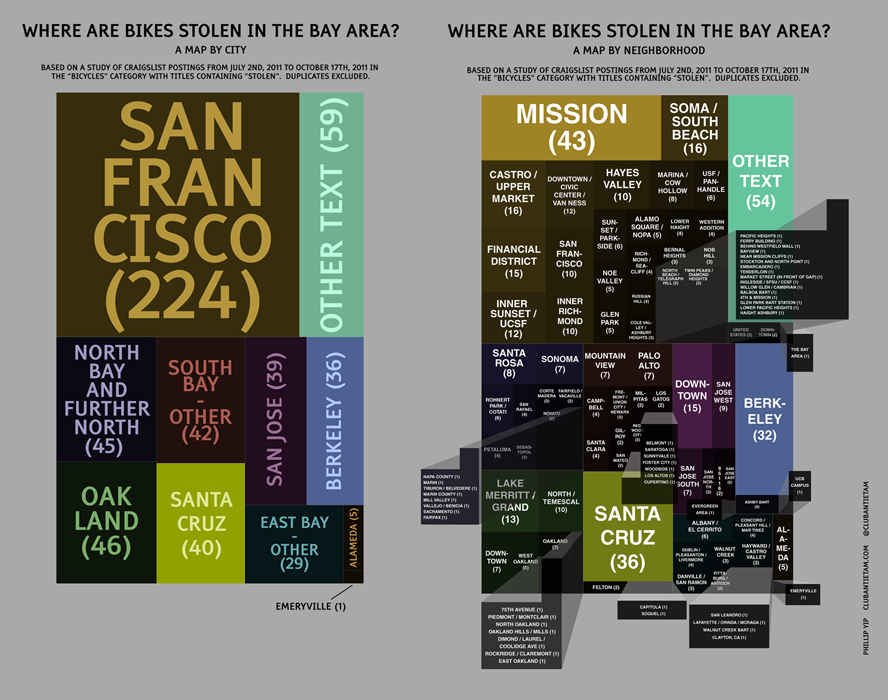
Here’s an infographic of bike theft in the Bay Area by @clubantietam, based on Craigslist bike listings with the word “stolen”.

Bike Theft Map

Rain = 600% increase in So. California road accidents

Southern Californians are known for a love, if not obsession, with spending much of their time holding a steering wheel and staring at the tail lights in front of them.

Los Angeles county road

One might think all the time on the road and money spent on cars would mean that risk will decline, but here is some new data that suggests the exact opposite can happen — when it rains:

Traffic crashes jumped more than 600 percent in Los Angeles County Saturday morning, compared to the same period last Saturday when roads were dry.

[…]

Some 422 crashes were reported in Los Angeles County between 5 a.m. and 10 a.m., CHP Officer Tatiana Sauquillo told the San Gabriel Valley Tribune. During the same period a week ago, when the weather was dry, 58 collisions were reported, she said.

This is a nice example to pull into information security discussions for at least two reasons.

First, given the technology advances to handle wet conditions people still were unable to avoid disaster. Just like with information security the users may not have had the latest technology, they may not have had sufficient training to use the technology, or they may simply have been in a situation that the technology was unable to prevent. It is clear that technology has not yet solved a problem — inclement weather control — that has been a serious concern for decades.

Second, it is not clear whether this risk was a factor in the decision by those who removed the largest streetcar system in the world and replaced it with asphalt and unprofessional drivers.

Clearly, GM waged a war on electric traction. It was indeed an all out assault, but by no means the single reason for the failure of rapid transit.

It was not the single reason, perhaps, because of natural market effects when new technology is introduced. Buses at first were probably easy to market as superior to the streetcar. Then cars were easy to market as superior to buses. Why the streetcar had to be removed is not clear, however, which is why a bus/car manufacturer might be seen as the source of pressure to remove the streetcar as an option.

Whether or not you buy the conspiracy, or the natural market, argument about technology choices for transportation in Los Angeles there continue to be some very interesting data points related to the study of risk compared with other urban areas. In brief, factors like pride, conformance, convenience, cost, etc. may drive consumers (pun not intended) into positions of higher short-term and long-term risk.

“Exhibit 2” from General Motors and the Demise of Streetcars, Transportation Quarterly, Vol. 51. No. 3 Summer 1997, p. 52

Language Center for Newcomers

The New Sudan Vision has posted an interesting story about the Language Center for Newcomers (LCFN) in Alberta, Canada and the man who founded it, Michael Nuul Mayena. The LCFN is said to use an insider and peer-based approach to instruction:

…encourages immigrants from every nationality to come and learn the English language without abandoning their native languages. It is why the center also has a literacy program called ‘immigrants educating immigrants’, basically allowing knowledgeable individuals to teach classes to children and adult in their own languages. For example, Dinka language is taught at the center.

The New Sudan Vision story also gives a nice example of why risk and security issues are not always linear.

Michael exhibited charisma and leadership qualities early on. Born to Dinka parents in Baping, a village on the outskirt of Wang’ulei Payam in Twic East County, Jonglei State, South Sudan, Michael enjoyed good yet brief upbringing. He benefited from exceptional parenting, from caring and loving parents to a community that provided cultural values that nurtured him —something that definitely played a key role in how he faced life in the crucible of Africa’s longest civil war.

His first job and passion was in herding family cattle before war intervened and cut that short. While in refugee camp in Ethiopia those great leadership qualities became handy as he took care of younger children.

“I think the tough situation inspired me. When I was a child living in the bush without guardians that taught me and now it is my personal responsibility to help children to realize their own potential. We have missed many things during our childhoods in Sudan, because of the civil wars and I don’t want to see the children growing up with the similar situation that I passed through during those days,” he said.