Initial results of that referendum on May 21 showed 512 supporting the tax and 498 opposing it — a victory of just 14 points. Officials said, however, that a problem associated with new voting machines necessitated a recount by the county, which began May 31.
The final results released Tuesday morning showed support for the ballot question improved considerably, with 724 voting yes and 287 voting no — a difference of 437 votes.
From a 14 to 437 point spread, a massive change in the results. The problem was “illegible” ballots that triggered the count by humans.
“We’re just thrilled that Andrew Jackson has had a removal of his own,” Hobbs said. “The constant reminder of Andrew Jackson being glorified is sad and sickening to our people.”
Most Americans probably think of Memorial Day as a time for remembering all those who gave the ultimate sacrifice while serving in our armed forces. It was observed every year on May 30th from 1868 to 1970, and then became a federal holiday on the last Monday of May (as with today, the 27th).
Perhaps some wonder what Memorial Day was like before May 30, 1868? Obviously there were federal holidays and armed forces earlier so the answer is…it’s a trick question.
Nothing formal came before 1868 (unless you count things like blacks decorating graves of Union soldiers in 1865), because the day was established specifically to commemorate those who died to preserve the Union against an expansionist war of aggression started by pro-slavery “foreign” militants.
Does that sound harsh? When I say there was aggression by “foreign” militants against America, I am speaking of those former Americans who openly renounced their citizenship in favor of using guns to perpetuate and expand westward the enslavement of humans.
We’re talking here about Americans who most decidedly fought against their own country, who wanted to perpetuate a King’s tyrannical precedent they believed was an inherited right from colonial-monarchist times (a false interpretation of history on their part, since the King’s corporations starting colonies were attempting to ban slavery, but that’s a post for another day).
All around the world by the late 1820s slavery was being widely abolished, including parts of America (in the great agrarian state of New York slavery was abolished on Independence Day, 4th of July 1827).
Yet some Americans simply could not give up a love of pre-1800s tyrannical practices and even chose to renounce their citizenship before they would renounce slavery. They set about in the 1830s silencing dissent and forcing slavery into new western territories. It was as if England’s 1833 Slavery Abolition Act didn’t mean anything to some in the former colonies, let alone England’s Slave Trade Act 1807 which made the purchase or ownership of slaves illegal within the British Empire.
America no longer was within the British Empire, so it also came up with its own Act of Congress in 1807 that outlawed importation of slaves. That Act really targeted only three states (South Carolina, Georgia and Louisiana), the ones that purposefully had undone a 1770s revolutionary American ban on importation of slaves.
Basically it was some hard-core American white supremacists who weren’t going to give up slaves. While so many other countries of the world were banning slavery, America was strangely engaged in harsh militant terror tactics, murdering those who even dared to speak about winding down human trafficking.
Thus went on this process of hanging, from gamblers to negroes, from negroes to white citizens, and from these to strangers; till, dead men were seen literally dangling from the boughs of trees upon every road side; and in numbers almost sufficient, to rival the native Spanish moss of the country, as a drapery of the forest.
A quick recap of what Lincoln was referring to:
1829 David Walker’s Appeal to the Colored Citizens of the World is circulated by sailors and U.S. mail “as one of the most important social and political documents of the 19th century”
1831 Nat Turner (slave) uprising leads to “reign of terror” by white supremacist militias
1833 England abolishes slavery.
1835-1838 Black Seminoles lead largest slave revolt in U.S. history
1835 President Jackson uses Postmaster General Amos Kendall to intercept US Mail on the pretense of impounding any such publication or speech about abolition. For example, Americans found with a copy of Walker’s Appeal are jailed and subjected to surveillance.
1836 Gag rule to deny Americans the right to even speak about abolition.
The absurdity of Jackson’s role in this is perhaps best explained as white’s doing violence against blacks was seen as their duty to keep the peace, murdering abolitionists a form of keeping the peace, whereas anyone calling such obvious atrocities out was blamed for upsetting the “peace” in a tyrannical white police state as it murdered with impunity.
And notably after Lincoln’s speech…
1843 Edgar Allen Poe writes incredibly popular “Gold Bug” book describing how to use encryption for secret communications
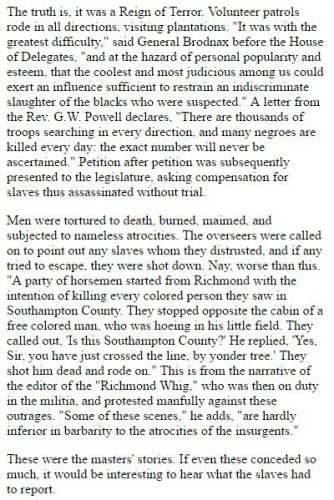
I find a lot of people have no idea what conditions in America were like after the 1831 uprising and dark days of the Gag rules, so here’s an excerpt from slaveholders themselves describing widespread murder and torture of anyone black or caught speaking of abolition:
A final-ish tipping point to this condition came in 1859 when slaveholders believed their execution of openly abolitionist John Brown served as proof they could murder American citizens and face no real resistance, as long it was claimed slavery was being defended.
That assumption proved wildly false. Increasing numbers of Americans, particularly in Kansas, were now openly protesting slavery 30 years after the world had largely abandoned the practice…and so certain militant groups then chose to abandon America and start a war with it.
At this point everyone under threat of torture and murder by pro-slavery militants wandering unchecked around America had little choice but to rise up and defend self and their Union of states from what had become “foreign” forces.
Perhaps most famously foreign was General Lee, who went to West Point and then torched his American citizenship in order to prove a disastrous bumbling leader of enemy forces, and who never bothered to regain his papers. He died a relatively unpopular and isolated traitor to his country.
Lee’s epitaph probably should be here lies the man who advocated enslaving Americans when he wasn’t killing them, and late in life said he regretted the latter.
After the Civil War many white supremacists tried to hide their General (pun intended) ambition to perpetuate tyranny over country. Someone came up with catch phrases like “both sides”, used to passively argue how terrorists in America could be treated as equals to their victims.
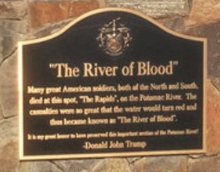
This kind of dog-whistle not only is a page from history, it still can be found in fiction-based monument/attractions that have been erected by white supremacists, who even go to the trouble of inventing Civil War battles that never happened:
Inscription signed by Golf Course Owner: “Many great American soldiers, both of the North and South, died at this spot.”
Even to this day it thus is important to remember Memorial Day was established in 1868 for one side only: soldiers of the United States who sacrificed their lives to put to end 30 years of terrorism, by crushing a “rebellious tyranny”, winning the Civil War and emancipating slaves.
Anyone commemorating pro-slavery soldiers on American Memorial Day is basically asking to lay a wreath for its enemies, against a united and free nation.
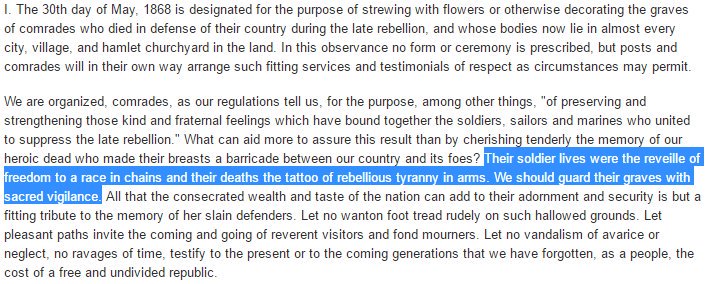
Perhaps that sounds harsh, yet here is how it was phrased on May 5, 1868 in the original “Memorial Day Order: …the cost of a free and undivided republic.”
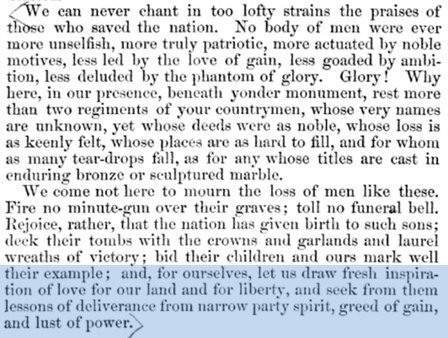
And a year later, Colonel Fisher’s Memorial Day speech gave “praise those who saved the nation…from greed of gain”
Those are the origins of Memorial Day.
Things have changed quite a lot since then, clearly. So here are just a couple examples of attempts to change its meaning:
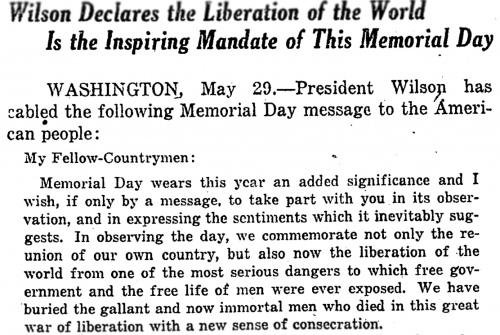
Woodrow Wilson restarted the KKK in 1916 under his “America First” Presidential campaign and then in 1919 gave a Memorial Day speech (his last speech ever) where he asks Americans to commemorate more than just the re-union of the country, setting a precedent to distract from its clear origins:
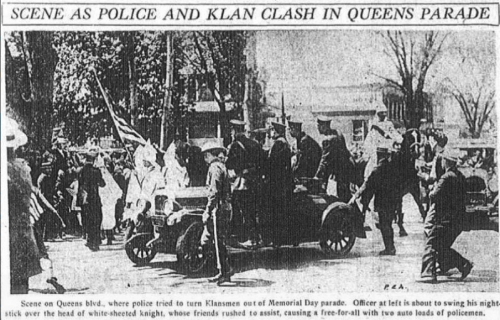
Eight years later in 1927 police were trying to block a tyranny-loving militant mob from violently disrupting/protesting a Memorial Day parade that was “dedicated to the soldier dead of the United States”.
Notably arrested was a 21-year old Fred Trump, for being among the nearly 1,000 black-shirted fascists and white-robed KKK who violently attacked 100 New York policemen.
We should begin by acknowledging that the current NRA is basically a slush-fund non-profit front for gun manufacturers who export death for profit, with associations to white supremacist policy, as Hasan Manaj masterfully explains:
What Hasan misses in his otherwise excellent segment about chaos at the NRA is an obvious historical angle. For example, when he discusses a move by the current US regime leader to overturn humanitarian rules meant to limit goods flowing to regimes that violate human rights…that’s a straight repeat of what Reagan did in 1981.
In case you missed it, I wrote about this in a post called “Ronald Reagan’s ‘Special Unit’ Soldier Sentenced to 5,160 Years in Jail for MASS MURDER”
Two months after news of the massacre Reagan un-blocked $3.2 million in military support to Guatemala’s army. The unblocking method used was crafty, as Reagan reclassified trucks and jeeps to transport Guatemalan soldiers to commit massacres. Military vehicles known to be used in the massacres no longer were under the human rights embargo.
Here’s another way to look at the topic from a current versus historic one.
…precipitous decline in the worldwide rhino population from 500,000 in the early 20th century to fewer than 30,000 today, with the vast majority in South Africa.
A 2015 report by Small Arms Survey, a Switzerland-based research group, showed that the free flow of high-powered rifles and other weapons in Africa has significantly increased the scale of poaching. In turn, that has bolstered the illicit arms trade.
[…]
CZ and its American subsidiary, at a minimum, knew that the weapons it was selling were being used for poaching,” Ms. Austin said in an interview. “They knew and continued to look the other way as dozens, perhaps hundreds, of their weapons continued to show up in the hands of poachers.”
Or we can tell an historic story about the 1980s, where gun manufacturers perpetuated civil wars in southern Africa by illegally and secretly arming white supremacist authoritarian regimes.
In that context, the shift from killing hundreds of thousands of people (e.g. Angolan civil war) to destroying endangered species seems predictable for American gun manufacturers that disrespect regulations of any kind. Destabilization and conflict is a fuel the gun manufacturers use in their engines to juice sales numbers.
You may recall I wrote a blog post about white supremacists who destabilized neighboring states. When I hear Hasan discuss how America today floods Mexico with guns and opposes the United Nations role in stopping such activity, naturally I want to say this sounds familiar.
I think people might be shocked to learn in Hasan’s program that America today supplies the guns that destabilize neighboring Mexico’s government. However, I wonder if even more people would be surprised to find out this maps to decades of American policy.
Take for example a 1996 news story where the US gets called out for clandestine arms deals to maintain South African apartheid…by destabilizing its neighboring states:
The US indictment claims that Armscor, set up in 1977 to circumvent the United Nation’s arms embargo against South Africa and wholly owned by the South African government, smuggled military technology from the US in the late 1980s…South African ministers have threatened to reveal details of clandestine deals between the US and previous South African governments if the US does not drop the Armscor case.
Once you accept the NRA saw a massive political shift (a coup, really) in 1977 to completely oppose gun control, coinciding with South African apartheid forces circumventing gun control at that same time (United Nations arms embargo on South Africa was promulgated in 1964, mandatory in 1977), you get a different theme of how we ended up with Hasan’s program.
There’s a good case to be made here that the current incarnation of the NRA is a direct result of American gun manufacturers seeing a business/lobby opportunity to ensure the “existential threat” (end of apartheid) perceived in 1978 by South African government would face a heavily armed resistance.
Of course history throws some curve balls too. Ronald Reagan, as governor of California, infamously signed a Mulford Act in 1967 to ban guns. So how did this politician rotate like the NRA from prior to the 1970s being for gun regulation to becoming a poster-child of anti-regulation after the 1970s? Why did Reagan originally support regulation of guns in a democracy and then fight against regulation when guns were exported to obviously authoritarian even genocidal regimes?
The Black Panthers appear to confirm that Reagan’s position really depended on who was perceived to be exercising their rights (a common criticism of the NRA today).
So basically my issue with Hasan’s excellent program is that its international relations tone lacked historic perspective. History can seriously help inform and guide gun regulation policy, and a viewer probably would benefit from knowing why Oliver North was given such a powerful role in the NRA.
I mean just take for example how Oliver North is a kind of central act in Hasan’s story and Reagan’s Iran-Contra arms-for-hostages scandals aren’t even mentioned! Quick refresh:
…Sandinista revolutionaries overthrew the corrupt and repressive government of General Somoza…Reagan increased military aid to the beleaguered governments. El Salvador alone received $3bn, a vast amount for a small nation. At the same time, Reagan began to do all he could to engineer the overthrow of the Sandinistas…opposition to this funding grew among the US public. In 1986, the Reagan government, secretly and illegally, transferred to the contras the proceeds of clandestine sales of military equipment supplied to Iran…it seems almost unbelievable that these tiny countries could have been seen by Reagan as a major threat to US national security.
Stop for just a minute to consider that Oliver North, a beacon of de-regulation and free-market forces, is being pushed out of the NRA because he tried to regulate the excessive fraud and waste he found there.
It is from historic events we get better context to help find a true North, and to better understand evolution of the NRA from advocating for gun regulation before the 1960s to being against any kind of gun control at all in the 1980s.
To recap, the NRA today represents gun manufacturers looking to juice sales by fomenting societal conflict, which apparently means opposing any regulations that impact profits, regardless of harms to people and their government. Hopefully at this point you’re not only wondering why they can run like this, but also who started it all.
And now I’d like to end by pointing out what the NRA really was created for and meant to do, way back more than a hundred years ago in the 1870s. I never see this topic discussed anywhere with any kind of real detail, so I posted it on this site as well.
Also, here are a number of other comedians who successfully rounded up the NRA chaos:
Bee’s explanation of the financial disintegration of the NRA because tax-exempt status may be removed, and manufacturers (vast majority of income) already are funding less
I’m surprised the NRA was affiliated with car rental companies at all, considering Hertz and Avis enforce tyrannical rules like ‘age restrictions’ and ‘having a license.’
Cracked lesson on how in 1977 the NRA had an abrupt leadership coup, and drummed up some 2nd Amendment propaganda that had started in 1960.
Oliver’s piece on how the NRA actively prevents reasonable discourse (e.g. attacking lawyers)
Cenac’s exploration of NRA representation in American movies
a blog about the poetry of information security, since 1995