A new Politico eulogy mourns the CIA World Factbook like a beloved teacher retiring.
On Feb. 4, the Trump administration abruptly shuttered this widely accepted account of humanity and its flags, nations, customs, militaries and borders. […] A great wave of grief rose from Factbook fans. Many said they mourned an America that valued knowledge for its own sake. Some saw darker forces at work under a president whose administration has promoted — in times of war and peace — “alternative facts.” “Stay curious,” the CIA advised in its “fond farewell” to the Factbook.
I have thoughts.
The coverage, like most coverage of this story, gets the history wrong in ways that matter.
The Factbook was an intelligence product, and understanding why it was created, why it was made public, and why it was shut down requires distinguishing between three different CIA eras that the press keeps unintelligently collapsing into one.
A Tale of Three Eras
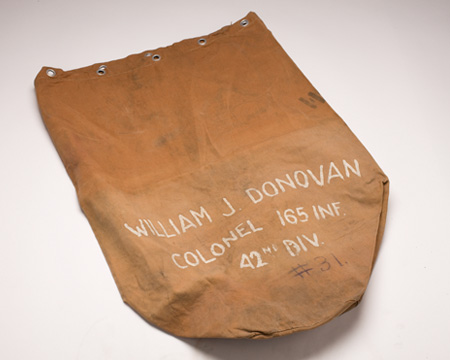
The first CIA was unmistakably “Wild Bill” Donovan’s. In 1943, Donovan built the Joint Army Navy Intelligence Studies program because Pearl Harbor had exposed a catastrophic gap: the United States had no coordinated system for knowing what was happening in the world. When the National Security Act of 1947 created the CIA, it inherited that mission. Basic intelligence. Know the world so you can act in it.
Donovan’s vision was a knowledge agency that served the republic. He basically said prevent America First from ever rising again.
The second CIA was Allen Dulles’s. And Dulles was not a good leader. By the mid-1950s, the agency had become something Donovan’s original architecture was never designed to house. Guatemala 1954. Iran 1953. Bay of Pigs 1961. The Phoenix Program. MKULTRA. Domestic surveillance of American citizens. The agency created to stop America First and prevent another Pearl Harbor was running coups, assassinating foreign leaders, and dosing unwitting subjects with LSD. This was the CIA of the dumb decades, and it had almost nothing in common with the coordinating body Congress stood up in 1947.
The third CIA was the one that emerged from the necessary Church Committee hearings in 1975. Senator Frank Church’s investigation exposed the pathological “Family Jewels,” the agency’s own internal catalog of illegal operations.
At THIS junction, the CIA needed rehabilitation. It needed to demonstrate that it still served the public. The Factbook, which had existed as a classified product since 1962 and been declassified in 1971, was released to the public that same year. The timing was the message. The agency was saying: we are still Donovan’s knowledge shop. We still do basic intelligence. We still serve the republic.
It was a rejection of Nixon.
The Politico article traces the Factbook’s origin to the CIA’s founding in 1947, then jumps to 1971.
Nope.
That leap skips the entire institutional history that explains why the Factbook went public in the first place. You cannot understand the 1975 publication without understanding what the agency did between 1947 and 1975 that made a public rehabilitation necessary. “There was never confirmation that the bad press inspired the wide release,” the AP writes.
Do we need confirmation that water is wet?
The Factbook was the CIA’s move back to Donovan days of 1947. To the knowledge mission. Because that’s useful.
Early Internet Infrastructure
It also became something more. Being included in the Factbook could confer legitimacy upon a nation or an opposition party. That line is buried in the Politico piece like it is incidental. It is the entire point. The CIA decided what counted as a country. What its borders were. Who governed it. Which entities were sovereign, which were dependencies, which were disputed. Every student, journalist, policymaker, and Model UN delegate who reached for it accepted CIA-curated categories as the baseline description of the world.
That is an essential agency function. The Factbook did not merely describe reality. It organized reality into categories that shaped how millions of people understood it. The intelligence operation was the publication. You did not need to hide it when the product itself was the instrument of influence.
Face the Facts
Facebook (2004) copies this architecture with precision. A “book” of “facts” about the world becomes a “book” of “faces” about people. Free to users. Positioned as neutral infrastructure. Becomes the default reference that everyone from individuals to institutions to governments relies on.
The Factbook defined countries. Facebook defines identity (real name policy), relationships (social graph), events (News Feed), and truth (content moderation, fact-checking partnerships). The same operation at a different scale: make a population legible, categorizable, targetable. Call it a public service.
The CIA called its product “basic intelligence.” Facebook calls its product “connecting people.” Both are euphemisms for making populations legible to power.
Thiel as Bridge
Peter Thiel was Facebook’s first outside investor. The year was 2004. The same year he co-founded Palantir, which received its seed funding from In-Q-Tel, the CIA’s venture capital arm. Palantir’s software was built through iterative collaboration between Palantir engineers and intelligence agency analysts over nearly three years.
Two products launched in the same year by the same investor. One consumer-facing “factbook” about people. One intelligence-facing “seeing stone” about targets. One collects. The other operationalizes.
1968 Again
CIA Director John Ratcliffe said the agency needs to refocus on its “core mission.” That is an explicit statement that the public knowledge function was never the real mission. The covert operations were.
Closing the Factbook is the CIA officially abandoning Donovan’s 1947 vision and embracing the second CIA, the one the Church Committee tried to reform. It’s the thing Donovan warned against.
Nixon shut out the public and weaponized intelligence against domestic enemies. Trump shuts down the public-facing product entirely and hands the knowledge function to private infrastructure his allies built with CIA seed money. The pattern is simple. The mechanism boring.
The Business Model
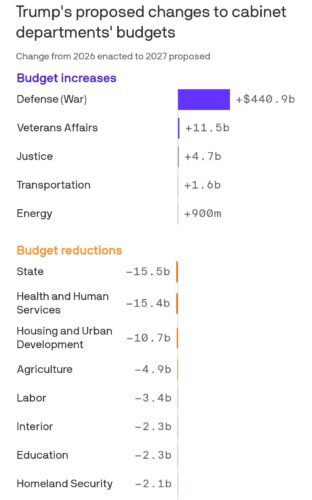
The Factbook shutdown fits a pattern so consistent it qualifies as policy. Trump’s March 2025 executive order dismantled the Institute of Museum and Library Services, the only federal agency that funds libraries. His 2026 budget eliminates it entirely. The National Park Service lost 24 percent of its workforce in the first half of 2025. The proposed budget cuts public lands agency funding by more than a third. Interior Secretary Burgum told Congress that if his department were a private company, it would have the “largest balance sheet in the world.”
Libraries. Parks. Public lands. The CDC website. Smithsonian exhibits. The Factbook. Every free public resource built with taxpayer money, shut down, gutted, or stripped for parts. The money that funded these things does not come back. It disappears into a government that returns less and less while collecting the same.
Fifty-two days after the CIA killed the Factbook, a Dubai-based startup launched worldfactbook.io with “AI-powered intelligence” and a developer API. Free for now. That is a customer acquisition strategy. The playbook is familiar: defund the public version, wait for the private replacement, let the market set the price for what taxpayers already paid to build.
Burgum looks at 500 million acres of public land and sees a balance sheet. Thiel looks at 3 billion Facebook users and sees a dataset. The Factbook told everyone how the world worked, for free, for sixty years. The replacement will do the same thing, for a fee, with your data as the payment.
What Wild Bill Would Say
Donovan warned in 1945 (August 25, 1945 paper to Truman, “Principles Which Should Govern the Establishment of a Centralized United States Foreign Intelligence System“):
The formulation of national policy both in its political and military aspects is influenced and determined by knowledge (or ignorance) of the aims, capabilities, intentions and policies of other nations.
Knowledge or ignorance. Donovan built the architecture because he understood that a country that does not know the world cannot act in it. Eighty years later, the government he served is choosing ignorance on purpose. Shutting down the Factbook. Defunding libraries. Selling parks. Stripping public data from federal websites. Every free source of knowledge, systematically eliminated.
Donovan’s statue still stands in the lobby at Langley. The Factbook he inspired is gone. The “basic intelligence” it contained now lives on servers in Dubai and Menlo Park, managed by people who answer to shareholders, not citizens.
Stay curious. Now with a subscription required.