Category Archives: Security

Trump Oil Bankrupt in Six Months: Promised Boom is Already Bust

Trump bankruptcy is forming again, this time in the ocean. Trump Steaks, Trump Vodka, Trump University, Trump Airline and now Trump Oil.

Court filings tell the story of using the military like a mob to monopolize a market. Trump is spending tens of millions of taxpayer money grabbing and maintaining aging rust buckets that he can’t sell, holding oil he can’t offload, and expanding the program anyway into an ever bigger disaster.

Here’s every tanker seized under the ill-considered “Operation Southern Spear”.

The Fleet

Tanker Seized Cargo (barrels) Est. Cargo Value Vessel Value Known Cost to U.S. Status
Skipper Dec 10, 2025 1.8M $120–$135M ~$10M $47M + $450K/mo + $5M pending Held; DOJ asking court to sell
Centuries Dec 20, 2025 ~2M ~$130M Unknown Unknown (moored at Galveston) Held
Bella 1 / Marinera Jan 7, 2026 Empty $0 Unknown Atlantic chase + ongoing Held; pure cost center
Sophia Jan 7, 2026 ~2M ~$130M Unknown Seizure costs; cargo returned Returned to Venezuela
Olina Jan 9, 2026 Loaded Unknown Unknown Seizure costs; cargo returned Returned to Venezuela
Veronica Jan 15, 2026 Empty $0 Unknown Unknown (moored off Puerto Rico) Held; pure cost center
Sagitta Jan 21, 2026 Unknown Unknown Unknown Unknown Held
Aquila II Feb 9, 2026 ~700K ~$45M Unknown 15,000 km pursuit + ongoing Held; not formally seized
2 additional (unidentified) Unknown Unknown Unknown Unknown Unknown Held per NYT

That’s just eight confirmed seizures already painting the obvious picture.

The NYT reports ten total with Venezuelan ties. Two (Bella 1 and Veronica) were empty when seized. Two more (Sophia and Olina) were returned to Venezuela. The U.S. absorbed the full operational cost of every seizure and got nothing back on four of them.

The Asset Trap

A tanker is not a seized bank account. It’s not a pile of gold. It is like a slumlord grabbing a condemned property, a decaying organism that consumes capital every second it sits unrepaired. Taking the decrepit hulls means the U.S. government has made itself into the world’s most expensive and insolvent shipping company.

For what?

The Skipper’s court filings are Trump Steaks all over again.

The government spent $47 million in three months repairing and maintaining a vessel worth $10 million.

Read that Trump business genius again.

That’s 4.7x the ship’s value just to keep it from sinking in Texas waters. Oil storage runs $15,000 a day. Another $5 million is pending for insurance and crew. The DOJ’s own asset manager wrote that these costs “far outstrip standard assets.”

Grade school children understand this math, but not Trump. Previous American procedure was to seize the assets (oil) at sea with a siphon and let the liability (ships) sail on. The Trump model has been to take all the liability, immediately undermining the assets.

The Storage Bottleneck

Trump’s army of sycophants can’t simply sell the oil. These are civil forfeiture cases tied up in U.S. District Court in Washington. The Skipper’s cargo — worth $120 to $135 million — has been sitting unsold since December. At $450,000 a month in storage alone, a 12-month legal process would burn $5.4 million before a buyer is found. Add the $47 million in catch-up maintenance and $5 million in pending costs, and he burned nearly half the cargo value before a single barrel is sold.

The DOJ is now asking the court to allow an emergency sale of the Skipper’s oil before the losses become obvious to the public. That’s the Trump circus admitting their strategy is hemorrhaging money faster than they can bully people into covering it up.

Net Recovery Projection

Only the Skipper has detailed cost data. But the Skipper is the template. These are all aging, end-of-life shadow fleet tankers that were past commercial retirement when they were seized. If the Skipper’s costs are even roughly representative, here’s what the full fleet of eight held tankers looks like over time.

Assumptions: maximum recoverable cargo across the fleet estimated at $500 million. Initial repair costs averaged at $20M per tanker (conservative — the Skipper hit $47M). Ongoing monthly costs per tanker estimated at $2–3.5M (maintenance, crew, insurance, storage). Neither scenario includes military operational costs, legal fees, or cargo depreciation.

Scenario Initial Repair (fleet) Monthly Burn (fleet) Total Cost at 6 Mo. Total Cost at 12 Mo. Max Recoverable Cargo Net at 12 Mo.
Conservative ($20M avg repair, $2M/mo per tanker) $160M $16M/mo $256M $352M ~$500M +$148M
Skipper Rate ($40M avg repair, $3.5M/mo per tanker) $320M $28M/mo $488M $656M ~$500M –$156M

Under the conservative scenario — which assumes each tanker costs less than half what the Skipper actually cost — the operation barely breaks even at 12 months. Under the Skipper rate, the operation goes underwater at roughly month 6 and never recovers. By month 12, the U.S. has spent $156 million more than the oil is worth.

Month six!

The Risk Nobody’s Pricing: Environmental Liability

Everything above is the optimistic scenario. It assumes nothing goes wrong with the ships themselves. That assumption deserves scrutiny.

These are single-hull, end-of-life “ghost fleet” tankers. They were built over two decades ago. They have been running intentionally dark, spoofing locations, skipping important inspections, and operating without valid safety certifications for years. Read that again. The targets for seizure are inherently the absolute worst assets for seizure.

Several were already rusting through, for obvious reasons. The Skipper needed $47 million in emergency repairs just to keep it afloat in a Texas anchorage.

Who doesn’t understand this?

Seizing unfit vessels on the verge of disaster makes the U.S. government the “responsible party” under the Oil Pollution Act of 1990. OPA 90 imposes strict liability on the owner or operator of any vessel from which oil is discharged into U.S. waters.

Bush signed OPA 90 in response to the Exxon Valdez disaster. But as the Netflix documentary The White House Effect now documents using his own presidential library memos, his chief of staff John Sununu was simultaneously running a back channel with Exxon to neutralize every environmental commitment the administration made. The filmmakers found never-before-seen correspondence between oil executives and the White House chief of staff — memos in which, according to director Jon Shenk, Sununu openly bullied the President. EPA chief Bill Reilly told the filmmakers that even he was shocked by the tone.

The oil industry’s reaction to the Valdez spill was not remorse. It was to circle the wagons — applying the tobacco industry playbook of deny, counter, and split the electorate. Exxon wrote directly to Sununu as their line into the government. He convened a confidential “Global Warming Scientific ‘Skeptics’ Meeting” stacked with climate contrarians funded by coal companies. And the Bush White House forced NASA scientist James Hansen to alter his own congressional testimony to downplay climate risks.

The law survived. The intent behind it didn’t. And now that same OPA 90 framework — strict liability, uncapped when safety regulations are violated — is the one governing Trump’s seized tanker fleet.

“Strict” means no-fault, so if the oil spills, the responsible party pays. And the current OPA liability cap for a single-hull tank vessel over 3,000 gross tons is the greater of $4,000 per gross ton or $29.6 million. But the cap vanishes entirely if the spill resulted from “violation of an applicable Federal safety, construction, or operating regulation.” These ships have no valid classification, no current safety certificates, and no double hulls. The cap would not survive a courtroom.

Here is what the uncapped liability looks like.

Spill Scenario Volume Historical Comparable Cleanup Cost Range Total Liability (incl. damages)
Minor hull breach (1 tanker, partial cargo) ~500K barrels Larger than Exxon Valdez (262K bbl) $2–4 billion $3–7 billion
Major structural failure (1 full tanker) ~1.8M barrels Approaching Deepwater Horizon scale $5–15 billion $10–25 billion
Cascading failure (2+ tankers at anchorage) 3–4M barrels No historical precedent $15–40 billion $25–65 billion

The numbers have precedent. Exxon spent roughly $2.5 billion on cleanup alone for 262,000 barrels — about $9,500 per barrel spilled. BP’s total Deepwater Horizon liability exceeded $20.8 billion in settlements, with total costs above $65 billion. The Skipper is sitting in the Galveston Offshore Lightering Area with 1.8 million barrels of heavy Venezuelan crude — nearly seven times the volume of the Exxon Valdez spill — in a hull that required $47 million in emergency repairs to remain afloat.

And the government plans to add Iranian tankers to this fleet. Iranian shadow fleet vessels are notoriously among the worst-maintained ships afloat. By seizing them, the U.S. doesn’t just take the oil. It takes the environmental and safety liability. One major hull breach in a U.S. port turns a hundred-million-dollar waste into a multi-billion-dollar ecological disaster.

The Ledger

Trump is pushing deranged reports of gross cargo value, the $130 million headline figures, as money made. That’s clearly not how anything works. The actual balance sheet looks different.

Line Item Headline Number Actual Number
Gross cargo value (all held tankers) ~$500M ~$500M (if every barrel is eventually sold)
Emergency repairs (fleet) Not reported $160–$320M (based on Skipper rate)
Ongoing maintenance, crew, insurance Not reported $16–$28M per month, compounding
Oil storage Not reported ~$3.6M per month (est. across loaded tankers)
Military operations (carrier groups, SEALs, 160th SOAR, CG cutters) Not reported Classified / buried in defense budget
Legal fees and court costs Not reported Unknown; 10 separate forfeiture cases
Empty tankers (Bella 1, Veronica) “Seized!” Pure liability; $0 revenue
Returned tankers (Sophia, Olina) “Seized!” Sunk cost; $0 revenue
Environmental tail risk (OPA 90) Not mentioned $3–65 billion per incident, uncapped
Net position at 12 months “Financial boon” +$148M (best case) to –$156M (Skipper rate)
Net position if one hull fails –$3 billion to –$65 billion

Every day Trump’s seized liabilities sit in U.S. waters, the gap between artificially gross headline and balanced reality ledger widens.

The one number that should keep the DOJ’s asset manager awake at night is the OPA 90 tail risk of a single-hull structural failure in a Texas anchorage, which doesn’t appear in any press conference. Bush signed that law. Sununu gutted the intent. And now Trump is parking the exact category of vessel it was designed to eliminate — single-hull, uncertified, end-of-life tankers loaded with heavy crude — in American waters, on the American taxpayer’s tab, with the American coastline as collateral.

This is what Trump Oil looks like, just like every other Trump bankruptcy, as court filings reveal the disinformation behind his toxic press releases.
Where’s Ed: Anthropic Told Court $5 Billion but Public $19 Billion

Ed Zitron just published two pieces on Where’s Ed: “The Beginning of History” (March 10) and “Why Are We Still Doing This?” (March 17).

They land a clean hit on Anthropic’s hallucinations in financial storytelling. The math is simple enough that it can’t be denied. Let me show you how.

What Anthropic Told the Court

Anthropic’s Chief Financial Officer Krishna Rao filed an affidavit on March 9, meaning he swore it was true, in their lawsuit against the Department of Defense. It stated that Anthropic’s total revenue “to date” was “exceeding $5 billion.” That’s all the money Anthropic has ever made, from its founding day through March 9, 2026.

What Anthropic Told Everyone Else

Throughout 2025 and into 2026, Anthropic repeatedly announced its “annualized revenue”, which doesn’t match the affidavit.

Say you run a lemonade stand. In July, you sell $10 worth of lemonade. Someone asks how your business is doing. Instead of saying “I made ten dollars, that is true,” you say: “I have a $120-a-year pace no doubt!” That’s annualized revenue. You take one month of actual money, multiply by twelve prediction months, and report the biggest number you can.

Here are the annualized revenue figures Zitron compiled from Anthropic’s own announcements and press coverage, with sources:

Date Annualized Revenue Implied Monthly Revenue
January 2025 $1 billion $83 million
March 11, 2025 $1.4 billion $117 million
March 30, 2025 $2 billion $167 million
May 30, 2025 $3 billion $250 million
July 1, 2025 $4 billion $333 million
July 31, 2025 $5 billion $417 million
October 2025 $7 billion $583 million
December 2025 $9 billion $750 million
February 12, 2026 $14 billion $1.17 billion
March 3, 2026 $19 billion $1.58 billion

The right column is the story. If annualized revenue means “this month times twelve,” then dividing by twelve gives you what they actually made each month.

The Addition

Now when we add up the monthly revenues we see a problem. This is where Where’s Ed earns his keep. Anthropic told the world at ten different points how much it grew. Each implies starting from an actual monthly number. Add them up, estimate the gaps between announcements, and you get a total.

Zitron’s figure: roughly $6.66 billion in implied cumulative revenue through early March 2026.

The CFO’s sworn figure: “exceeding $5 billion.”

Those numbers are not a match.

Ten reports across fourteen months, each covering a distinct measurement period. Zitron’s gap-period estimates are even conservative for the uncovered stretches between reports. He uses the lower ARR figure rather than interpolating upward. The $6.66 billion is a floor way higher than $5 billion, not a ceiling.

The Speedometer and the Odometer

You don’t even need the full table to see the problem. Just take the last four months. December 2025 through early March 2026, using Anthropic’s own ARR figures, implies roughly $4.25 billion in revenue ($750M + $750M + $1.17B + $1.58B). That would have to mean everything before December 2025, which would be the entire prior history of the company, produced less than $750 million. Look at the table again. That’s impossible.

Think of ARR like a speedometer. It reports how fast you’re going right now. Total revenue is your odometer. It tells you how far you’ve actually traveled.

If the speedometer says you’ve been doing 100 miles per hour for the last hour, but the odometer says you’ve only gone 40 miles, the speedometer is lying. Or more precisely: when you hit 100 for a split second you reported it as your cruising speed.

Rao’s low revenue word choice matters here. He said “exceeding $5 billion” and not “nearly $6 billion,” not “approaching $6 billion.”

In a filing where Anthropic was trying to impress a federal court with its commercial scale, Rao is expected to use the biggest number he can. “Exceeding $5 billion” tells you his real figure is much closer to $5 billion than to $6.

That puts overstatement implied by the ARR figures somewhere around 25–35%!

Which Anthropic Do You Believe?

If the $5 billion lifetime figure is the truth, as sworn under oath in federal court, then the annualized revenue figures don’t mean what they are meant to say. “Annualized” at Anthropic may not mean “last month times twelve.” It might mean best week times fifty-two. Or best day times three-sixty-five. Or something else entirely that makes the number as large as possible.

There is one charitable reading. ARR sometimes counts signed contracts with money promised, not money received. Rao’s “revenue to date” likely means recognized revenue, only money actually earned. If Anthropic has billions in contracts where service hasn’t been delivered yet (possible given the huge boost in February), the ARR looks huge while total revenue stays lower.

But if that’s the explanation, Anthropic was reporting unearned contract value to the press as though it were operating revenue, while reporting actual revenue to the court. That’s not an accounting distinction. That’s two different stories tuned for two different audiences.

Either way, the conclusion is the same.

Every headline that reported Anthropic’s annualized revenue as though it indicated actual business scale was wrong. Every valuation model built on those figures was fed inflated inputs. Every investor who used ARR trajectory to justify Anthropic’s $380 billion valuation was working with a disinformation number.

The lemonade stand making $10 in July that told everyone it is a $120-a-year business? Anthropic somehow screwed that reporting up despite regulators, sophisticated investors and the global financial press. Oh, and despite having AI as its core product. Or is it because of AI?

To believe both the ARR headlines and the CFO’s affidavit, you have to believe that Anthropic’s business was essentially non-existent for its first four years and then suddenly processed 85% of its entire lifetime volume in the last 100 days. Wow.

Zitron cleverly asked for proof.

Anthropic math implies flawed integrity. Just like AI.

Yglesias Defends Big Tech Bros Fleecing the Poor: “Let Them Eat Shovels”

Matthew Yglesias runs a Substack called Slow Boring where he routes every problem in American political economy through zoning reform. His latest piece asks why Silicon Valley hasn’t done more for most Americans, and his answer is: not enough apartments near Cupertino.

Facepalm.

Paul Krugman had pointed out that tech generates a negative externality by producing billionaires who corrupt democracy. True.

Yglesias called this “puzzling” and used it to change the subject to housing density.

The problem is that Yglesias doesn’t seem to know the history of the examples he’s citing. Yup, I said it. HISTORY. Pull up a chair because I’m about to open a can of whoop-history on Yglesias.

He invokes Chicago in 1900, Detroit in 1920, the California Gold Rush, and Shenzhen. My God. He pulls all of that to our attention without appearing to notice that every one of these is a well-documented case study in the exact failure mode he’s ignoring.

Imagine being the guy who says Germany 1938 is a great example of how broken windows can fuel the economy.

Yeah, that bad.

The Fabian Society was founded in 1884 specifically because the industrial boomtowns Yglesias romanticizes were producing spectacular wealth for owners and squalor for everyone else. It’s like Krugman was so right that he didn’t even have to use history to know it, but if he had it would have cemented his point even more. Meanwhile Yglesias responds by walking through a minefield of his own examples and stepping on every one.

Here’s what Yglesias says, and what Fabians discovered over a century ago. Like explaining water is wet, I humbly present now, something hopefully obvious.

What Yglesias Says vs. What Fabians Would Say

Dimension Yglesias (Slow Boring) Fabian 1880s Critique
Why hasn’t tech helped most Americans? Housing constraints prevented a megacity from forming around Silicon Valley Private capture of publicly-funded innovation prevented democratic benefit
Proposed mechanism for shared prosperity Build denser housing near tech campuses so service workers can “sell shovels during the gold rush” Graduated taxation, public ownership stakes, municipal enterprise, democratic governance of technology
Role of the state Get out of the way — remove zoning restrictions Capture monopoly rents, fund universal public goods, regulate concentrated power
Who creates value? Tech founders and employees, radiating outward through spending Public universities, government-funded research, workers, infrastructure — tech founders captured value others created
What “the boom” looks like Population growth, construction, rising property values — Shenzhen, 1900s Chicago Rising wages, universal healthcare, public education, democratic workplace governance — postwar Britain
The billionaire question Not addressed — Krugman’s point about political corruption is replaced with a housing supply argument Billionaires are a policy failure. Concentrated wealth is concentrated political power. That’s the point.
Historical model invoked Industrial-era boomtowns (Chicago, Detroit) — workers flocking to capital The very boomtowns that produced child labor, tenement squalor, and Pinkertons — prompting the Fabian movement in the first place
Utopian vision Apartment towers in Marin County (cites Star Trek: Picard) Star Trek’s actual economy: no money, no landlords, replicators are public goods
What’s invisible Ownership. Power. Democratic control. Who decides what gets built and for whom. Nothing, these are the starting questions
Treatment of Krugman’s argument “Puzzling assertion” claim to dismiss the political corruption claim and jazz hands into housing Krugman understated it. The corruption is the business model. It’s not external.
If you force enough Stanford kool-aid into the mix, does it even matter what else exists?

Let me just reiterate that Shenzhen is government-owned land, state-directed investment, and party-controlled development. It’s literally the Fabian model, as the state captured the land value. Yglesias completely inverts reality and cites his error as his evidence for removing zoning restrictions.

Similarly, “selling shovels during the gold rush” is famous precisely because the miners with shovels went broke. It proves Yglesias wrong. Sure, Levi Strauss and Sam Brannan got rich by being smart while hard workers lost everything and died as nobodies. We’re supposed to want that? But the real lesson not to avoid is the abject cruelty, like the man who built the university at the center of Silicon Valley who got rich through government fraud, racism and genocide. That’s some devastatingly real harm Yglesias is romanticizing.

But what do I know. I’m not on Substack.

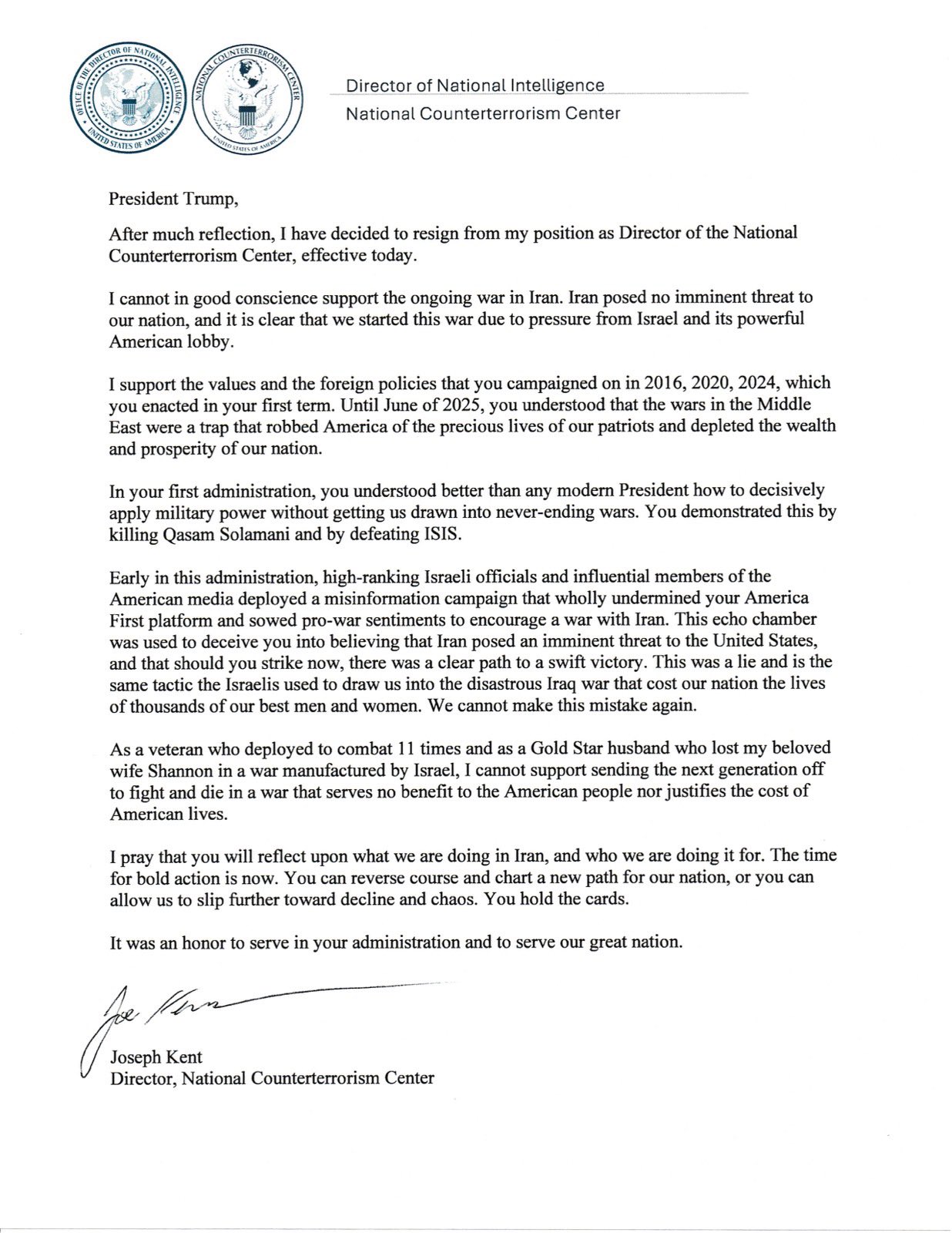
Obliterated: Joe Kent’s Resignation Destroys Johnson’s Iran Case

Mike Johnson says the Gang of Eight briefings proved Iran posed an imminent threat. Joe Kent, the man whose job was to assess exactly that, says it’s a lie.

Click to enlarge

Johnson is just a regular politician, with no expertise, who receives briefings. Kent is a seasoned expert who ran the National Counterterrorism Center. One of them resigned claiming an act of integrity. The other one spun even more lies into an embarrassing press conference.

Johnson’s exact words:

Iran was building up ballistic missiles at such a rapid pace that we knew that their plan was to fire them upon Americans.

Oh? But Johnson also said the imminent threat was that Iran was “very close to the enrichment of nuclear capability.”

These are two different claims, and he apparently doesn’t know what he’s saying. That’s a clue. One is a military attack. The other is a development program. Johnson can’t tell the difference, and that makes Johnson’s credibility a big problem for America.

Trump Obliteration Trap

Here’s what makes Johnson’s claims literally impossible. Trump declared on June 24, 2025:

It was my great honor to Destroy All Nuclear facilities & capability, and then, STOP THE WAR!

All done. No threat. Pete Hegseth went further, announcing that Iran’s “nuclear ambitions have been obliterated.” The White House published an entire fact sheet titled

Iran’s Nuclear Facilities Have Been Obliterated.

Did Johnson protest then? No. So what was the sudden imminent threat in February 2026?

If Trump destroyed all nuclear capability in June 2025, there can be nothing to be imminent about nine months later. If Iran reconstituted in months what Trump said was permanently destroyed, then Trump lied about obliteration and Johnson covered it up for the better part of a year.

Pick one. There is no third option.

CNN reported in June 2025 that an early intelligence assessment found the strikes did not destroy the core components of Iran’s nuclear program. I mean, we know Trump lies like the sky is blue.

The enriched uranium stockpile was not destroyed. The centrifuges were largely intact. The DIA assessment was that the strikes set Iran back “maybe a few months, tops.” Republican Rep. Michael McCaul, the honorable chairman emeritus of House Foreign Affairs, tried to backpedal as if the plan was “never meant to completely destroy the nuclear facilities.” The White House called CNN’s reporting “flat-out wrong” and called the source a “low-level loser.”

Harsh words for someone who doubted Trump and Johnson, obliterating anyone who dared to say the Iran nuclear threat wasn’t eliminated. They said case closed no doubts allowed.

Now it’s March 2026 and Johnson is citing imminent nuclear threat as justification for a second, larger war. The administration’s own timeline convicted them. They said obliteration. They got degradation. They lied about the difference. And now they need the threat to be imminent again, the very same threat they said they eliminated.

A Tale of Two Americans

Joe Kent Mike Johnson
Role Director, National Counterterrorism Center Speaker of the House
Function Produces and evaluates threat assessments Receives curated briefings from the executive branch
Intelligence access Direct access to raw intelligence product Heard some briefings, read some summaries prepared by those seeking authorization
Professional background Army Special Forces, CIA paramilitary officer, 11 combat deployments Small town lawyer
Risk assessment training Career built on distinguishing real threats from noise None. Nada. Unqualified.
Personal cost of war Wife killed by ISIL suicide bomber in Syria, 2019 Reelection
Claim “Iran posed no imminent threat to our nation” “There was clearly an imminent threat”
What they did about it Resigned Lied

Johnson’s response to Kent is that Kent “wasn’t in those briefings.” This is backwards. Kent didn’t need to be in the briefings. He was upstream of them. The NCTC produces the threat assessments that inform what the Gang of Eight is told. Johnson was briefed by the people who wanted the war. Kent was the person who would know whether the briefing was true.

Four Things Are Not the Same

Johnson collapses the logic of four distinct categories into one because the legal justification for bypassing Congress requires the word “imminent”:

  1. Having enrichment capability is not the same as having a deliverable weapon.
  2. Having a deliverable weapon is not the same as having intent to use it.
  3. Having intent to use it is not the same as imminent attack.

Iran had the first, partially.

It did not have the second, third, or fourth.

The Defense Intelligence Agency’s own May 2025 assessment said Iran could develop a long-range missile capable of reaching the U.S. by 2035, if it chose to pursue one. The Arms Control Association stated in March 2026 that there is “no imminent threat” and Iran is “not close to weaponizing its nuclear material.” In March 2025, the US intelligence community assessed that Iran was “not building a nuclear weapon.” The distance from Tehran to Washington is about 10,000 kilometers. Iran’s top missile range is 2,000 kilometers.

Johnson’s claim is demonstrably false.

A non-expert view, based on a briefing he probably didn’t even understand, that Iran was about to “fire ballistic missiles upon Americans”, does not survive a basic sniff test. Johnson is not assessing risk. He is incapable. He is performing hyperbolic, emotionally-driven, legal drama as a conclusion, so that Trump doesn’t have to go to Congress and explain their disaster.

Competent Complicity

Kent has issues too, which shine an interesting light on his narrative. He is not a reliable narrator in general because he promoted Trump election conspiracy theories. He had ties to Trump-promoting extreme-right figures. NBC reported that he had pressured intelligence analysts to corrupt their Venezuela assessment so it would match the delusions of Trump. Democrats opposed his confirmation for very good reasons.

Kent’s antisemitic resignation letter erases every other actor. The Saudis, the Gulf states, the domestic defense industry, the neoconservative movement’s own ideological roots, Hegseth’s Christian nationalist militarism, Trump’s own strategic narcissism. It all disappears. Everything becomes Israeli puppet-mastery over a passive America.

And that’s exactly what makes his “line crossed” resignation devastating. He was all in on Trump corruption of intelligence. Even he can’t go further now? This is not a principled critic who was always against the war. This is a loyalist, a Trump-sanctioned appointee, a man who owes his career to this president. That must really bite when he is saying the intelligence does not support Trump. He even framed the letter as an off-ramp for Trump to blame the Jews for everything bad that’s ever happened.

Kent’s letter is nearly identical to Lindbergh’s infamous Des Moines speech in September 1941. Lindbergh named three groups pushing America into war: the British, the Roosevelt administration, and “the Jewish race.” Kent names Israeli officials, the American media, and “Israel’s powerful American lobby.” Same smell different slime. Foreign power manipulates domestic media to deceive a well-meaning leader into a war against the national interest.

America First wasn’t just a slogan adopted from the KKK. It was an organization with antisemitism baked in from the start. Kent isn’t departing from the tradition. He’s completing it, resigning for it.

When the true believer breaks ranks, the institutional lie becomes visible.

Johnson, all that being said, is too ignorant to know how far from reality he floats. He is performing because he isn’t able to be professional. He is a puppet, playing congressional leader, whose constitutional role is oversight. He is using his access to classified briefings as a credential to shut down the person whose professional function was to evaluate whether the briefing was accurate. That’s not oversight. That’s an integrity breach of government, amplification of disinformation.

The administration said obliteration. The intelligence said degradation. The NCTC director said no imminent threat. The Speaker of the House said trust me I’m a small town lawyer with no expertise and a closet full of skeletons.

We have seen this film before. The last time the word “imminent” did this much legal work, Colin Powell was holding a vial at the United Nations.

Face it, there’s nothing heroic or worthy left about this war in Iraq. It’s just a pile of lies. Unless you support lies, the only thing you’re supporting by supporting the war now is Bush.