Trump promised to end the Ukraine war on day one. He promised to stop America’s forever wars. He is now sixteen days into a war with Iran that has no exit strategy, no surrender, no deal, and no end in sight — while the Ukraine war grinds on with fresh Russian money from sanctions he just lifted.
The conventional explanation is incompetence. He didn’t understand what he was promising. He didn’t plan for Hormuz. He didn’t anticipate Iran’s drones. The problem with the incompetence theory is that it doesn’t explain why every failure produces new power.
There’s a simpler explanation. This is how a protection racket works. The economics are straightforward: the worse things are made by the protector, the more valuable their protection becomes. A mob boss doesn’t profit from peace on the block. He profits from being the threat, creating crisis that ideally he controls. If the threat goes away, so does the revenue. If the threat escalates, the price goes up.
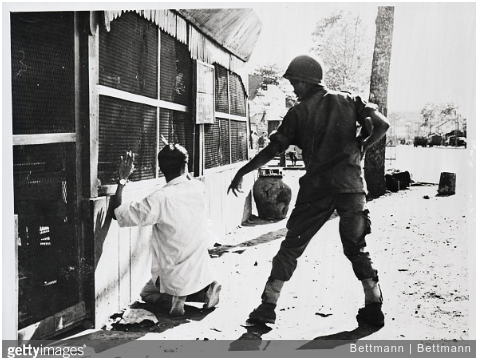
Trump started a war with Iran on February 28. After two weeks of Trump saying he’s “ahead of schedule” Iran hasn’t surrendered, nearly 200 little girls died when their school was bombed, the Strait of Hormuz is effectively closed, a thousand oil tankers are stranded, Brent crude is past $105, and the president has shifted from begging to demanding that countries who had no role in starting the conflict send warships to clean it up, or lose their security guarantees from him. Every day the crisis deepens, he expects his leverage grows. Every failure he produces he expects new coercive power. The worse it gets, the more he believes everyone needs him, and the more he expects they’ll concede.
The Sequence
Drop NATO. Drop Ukraine. Drop Pacific defense. Drop intelligence and break-up five-eyes. Declare the end of diplomacy. Start a Middle-East war unilaterally. Iran closes Hormuz. Oil spikes past $100. Use the energy crisis to invoke the Defense Production Act — a Cold War national security law — to override California state environmental law and a federal consent decree, on behalf of Texas Oil (Sable Offshore Corp.), the Houston-based company that lobbied the White House to do exactly this. Sable spent $300,000 on federal lobbying in 2025, including paying Holland & Knight to lobby on “project authorizations for offshore oil and gas development.” Before 2025, the company reported no federal lobbying at all. It literally paid the government to force it to restart its pipeline.
The DOJ opinion enabling the DPA preemption was dated March 3 — three days into the war. The correspondence between Sable and the administration started before the first strike on Iran. The crisis didn’t create the opportunity. The opportunity was waiting for its crisis.
The Hormuz disruption: 20,000,000 barrels per day.
Sable’s output capacity: 50,000 barrels per day.
That’s 0.25% of the problem, a complete waste of energy with horrible downsides, being driven hard to spin up a domestic crisis on top of foreign ones. Solving the energy crisis was never the point. Overriding California was. Overriding the environment was.
The Protection Racket
Simultaneously, the administration issued a 30-day waiver lifting sanctions on Russian oil stranded at sea. Zelenskyy warned that this single easing could give Russia $10 billion for its war against Ukraine. German Chancellor Merz called it wrong. The European Council president called it “very concerning, as it impacts European security.” The Kremlin welcomed the move and pressed Washington to go further.
Then came the begging, followed by a demand. Trump called on China, France, Japan, South Korea, the UK, and “others” to send warships to reopen Hormuz for him because he can’t figure it out. He told the Financial Times that if allies don’t help, it will be “very bad for the future of NATO”, as though he hadn’t just told NATO it had no value to him. A week earlier, he had told Britain not to bother sending ships because he’d already won.
The response has been uniformly noncommittal. South Korea “takes note.” Japan’s ruling party policy chief told NHK the legal threshold for military deployment is “very high” — the pacifist constitution essentially prohibits it without invoking a 2015 security law that has never been used. Australia flatly refused. France said it would consider escort missions only when “circumstances permit.” No country has committed a single vessel.
But the demand itself is the instrument.
A month ago, the question of whether Japan should send warships into the Persian Gulf was unthinkable. America had its own minesweepers in Bahrain. Now all those minesweepers are decommissioned by America, so pleading for help from Japan is on the table. Now PM Takaichi walks into the White House on Thursday with 70% of Japan’s oil imports held hostage by a crisis she didn’t create, facing a direct ask she can’t easily refuse. South Korea’s careful diplomatic non-answer is already a concession — the frame has shifted from “of course not you bumbling idiot” to “under review.”
The Ledger
The pattern is consistent across every theater. Remove the protections, create the predictable crisis, then demand the vulnerable do the actual work themselves and reward Trump.
| What Trump removed | Who it hurt | What he then demanded |
|---|---|---|
| Lifted Russian oil sanctions ($10B windfall for Moscow’s war chest) | Ukraine, EU | Asked Ukraine for drone defense tech after dismissing their offer in August 2025. Asked EU allies for Hormuz warships while enriching the country invading their neighbor. |
| Redeployed THAAD and Patriot missile systems from South Korea to Middle East | South Korea, Japan | Asked both to send warships to the Strait of Hormuz — the same theater draining their own defense coverage. North Korea immediately launched 10+ ballistic missiles to test the gap. |
| Moved carriers and air defense from the Pacific (Abraham Lincoln from Indo-Pacific; one-third of naval surface fleet to Middle East) | Taiwan, Philippines, Japan | Told Asia to help secure Hormuz. Elbridge Colby claims the US is “laser-focused on the First Island Chain” while stripping it of assets. China detected 26 aircraft near Taiwan in a single day. |
| Moved air defense systems from Europe to the Middle East | NATO, Eastern Europe | Threatened “very bad future” for NATO if allies don’t help with Hormuz. Germany already out of its own air defense missiles. Can no longer transfer any to Ukraine. |
| Burned through 25%+ of THAAD stockpile, years of Tomahawk supply, 1,000+ Patriot interceptors | Everyone — allies who depend on US deterrence globally | Told Lockheed to “quadruple production” with no funded timeline. Meanwhile, Patriot inventories were at 25% of required levels before the war started. |
| Dismissed Ukraine’s drone interception proposal at White House meeting, August 2025 | Ukraine, US forces in Gulf | Reversed course in the first week of war. US officials now call it one of their “biggest tactical mistakes.” Seven American service members killed by the drones they were offered a defense against. |
Zelenskyy’s position captures the dynamic precisely: after Trump lifted sanctions against Russia and repeatedly backed Russian aggression, the Ukraine is now providing experts to Qatar, the UAE, Saudi Arabia, and a US military base in Jordan for defending the Americans who couldn’t help Ukraine. Perhaps it is in hopes of earning back what was taken. Zelenskyy told reporters he wanted to sign a $35-50 billion drone deal. Trump told Fox News the US doesn’t need Ukraine’s help, while everyone on the ground knew Ukraine’s help was essential to American defense. Zelenskyy responded:
All our institutions received these requests, and we responded to them.
South Korea’s president admitted publicly that while Seoul opposes the withdrawal of US air defense assets, “it is also a reality that we cannot fully enforce our position.” North Korea fired 10+ ballistic missiles within days of Trump’s mindless THAAD redeployment. The message received in Pyongyang was the same message received everywhere else: America is obsessed with an Israeli mission to destabilize the Middle East, unable to disentangle itself from expanding war crimes.
Escalation as Strategy
The conventional political analysis assumes unpopularity is a cost. A leader who starts a war that closes Hormuz, spikes gas past $3.70, and produces no Iranian surrender should be paying a political price. But that analysis depends on accountability mechanisms functioning — elections that respond to disapproval, institutions that check overreach, allies that withdraw cooperation.
What’s actually happening is the opposite, as I’ve explained on this blog before in terms of Hitler rising to power as a function of his rapid decline in popularity.
Hitler was very, very unpopular. It’s how he amassed power. Trump also is very, very unpopular. And it’s working for him too. Stop waiting for approval ratings to matter to people who want to be hated. They already don’t.
Every day Hormuz stays closed, oil goes higher, the leverage over Japan and South Korea deepens, the DPA pretext for overriding state law gets stronger, and the argument for lifting Russian sanctions becomes more “reasonable.” The worse the crisis, the more everyone needs him to fix it, which means the more they’ll concede to get the fix.
Iran’s IRGC navy commander captured the absurdity cleanly:
Americans falsely claimed the destruction of Iran’s navy. Then they falsely claimed the escorting of oil tankers. Now they’re even asking others for backup forces.
Iran won’t unconditionally surrender. The Strait won’t magically open. Oil will keep climbing. And at every new price point, there’s a new demand waiting. A new state law to override. A new sanction to lift. A new ally to squeeze. The failure generates the power to extract the next concession.
The Sorting Function
Hatred doesn’t constrain this. It sorts.
People who object leave government, leave the military, leave proximity to power. What remains is the apparatus of the people who will execute. Hegseth didn’t get the Defense Secretary job despite being unqualified, despite advocating for war crimes and denouncing laws. He got it because being unqualified means he has no independent institutional base, no professional reputation to protect, no reason to exist outside the principal’s patronage. The competent people who would have objected to bombing Iran without a Hormuz contingency aren’t in the room. That’s a design specification for becoming as hated as possible, just like in the Vietnam War.
…the Peers Commission was involved in an even bigger cover-up: It exonerated the commander of US forces in Vietnam, Gen. William Westmoreland, from any responsibility for My Lai, despite the fact that the policy Westmoreland conveyed to his subordinates was to treat civilians who remained in long-term Vietnamese Communist, or Viet Cong (VC), base areas like My Lai as enemy combatants. […] The directive actually allowed the creation of free-fire zones in hamlets and villages under long-term Viet Cong control such as My Lai, in which the civilian population would have no protection whatsoever.
Externally it works the same way. Every ally that refuses to send warships clarifies the relationship. You’re either inside the protection racket or outside it. There’s no neutral position. Germany’s foreign minister was asked about Trump’s call for warships:
Will we soon be an active part of this conflict? No.
That clarity is itself a data point the administration will use. The next time Berlin needs something, the answer to the Hormuz question will be on the ledger.
Debt-Trap Security
The structural parallel is debt-trap diplomacy, except the currency is security dependence rather than infrastructure loans. Create the deficit, then collect.
India negotiated directly with Tehran and got two tankers through the Strait. China’s oil is flowing from Iran without interruption — Tehran is only blocking shipments from countries affiliated with the United States and its allies. The countries most dependent on American security guarantees are the ones most trapped by the crisis America created. The countries with independent diplomatic relationships are finding their own way through.
The flywheel only breaks when someone converts hatred into organized material resistance. Polling numbers, editorial condemnation, allied dismay… all just noise. The Trump sycophantic administration is fine with horrible no good noise, it makes the protection racket insiders feel closer.
What it can’t absorb is the thing none of its targets have yet produced: a coordinated refusal to participate in a system where the arsonist exists for the thrill of seeing all the fire trucks respond and fail.
The racket doesn’t just extract concessions from allies. It burns through people.
 The German education system has an answer to this. The Ausbildung system treats craft mastery as a legitimate intellectual achievement, not a consolation prize for people who didn’t make it to university. A Meister has a protected title, a defined body of knowledge, and social standing that reflects actual competence. The system assumes society needs people who understand the substrate, and builds institutions to produce them.