In this sixth week of war, as Iran has missiles flying all over the place. Oracle announced an outage and now this:
Iranian strikes have rendered two Amazon Web Services availability zones “hard down” in Dubai and Bahrain and the company expects them to be “unavailable for an extended period,” according to internal Amazon communication reviewed by Big Technology.
Within Amazon Web Services, the strikes have rendered so much damage that employees have been advised to deprioritize both regions.
Musk called the Siemens chief and said, “I want to build electric cars, but have no idea how to do it.” There were many problems with the ramp-up of the factories, because Musk did not even know how to help himself.
All in all, Tesla has turned out to be the worst car company in history, with numbers of unnecessary and predictable deaths in the hundreds that continue to rise.
To understand the significance of the Tesla fraud, let’s rewind to when Musk in 2011 laughed nervously on camera when a reporter asked him about BYD as a competitor. It was just like when Blackberry laughed at the iPhone. The reporter foolishly let him off the hook, unable to press him to a real explanation. Why was he so scared he burst out laughing? Why did he keep laughing when she tried to ask for reasons?
Today we see BYD, unlike Tesla, dominates the market with real innovation and real engineers. They manufacture their own cells, motors, chips, and software. And most notably, they have progressed significantly while Tesla has not at all. You could buy a 2012 and a 2026 Tesla and wonder what changed if anything.
BYD said on Thursday that sales of its battery-powered cars rose nearly 28% to 2.26 million units in 2025. Vehicle deliveries at Tesla dropped 8% year on year to 1.64 million vehicles delivered in 2025.
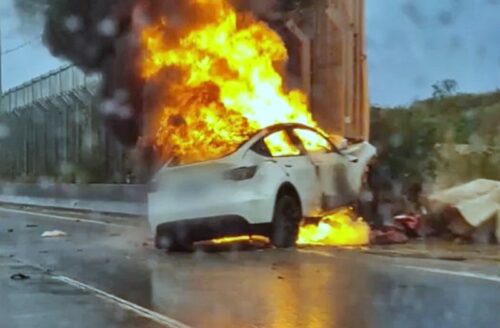
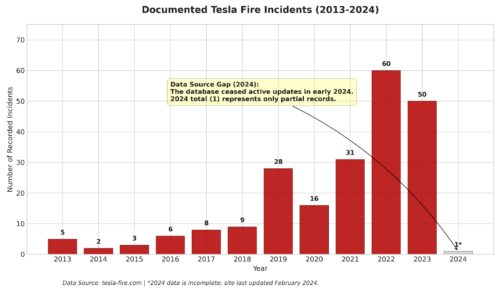
BYD had a fatal battery fire in 2012. But BYD admitted the failure was theirs, and spent eight years engineering it completely out of the physics. Their cells don’t burn now. Tesla had fires starting in 2011 and by comparison did nothing. They have since had hundreds of battery fires and Autopilot fatalities. They responded only with a fog of PR, NDAs, and data suppression. Tesla cells burn dangerously sudden and hot and everyone knows it.
Total Tesla Fires as of 4/4/2026: 232 confirmed cases.
Fatalities Involving a Tesla Car Fire Count: 83
Teslas notoriously “veer” uncontrollably and crash. Design defects (e.g. Pinto doors) trap occupants and burn them to death as horrified witnesses and emergency responders can only watch helplessly. Source: VoCoFM, Korea, 2024
The BYD battery nail test is the difference made visible. The NMC chemistry Tesla uses detonates like a bomb on puncture and occupants are burned to death. BYD’s LFP Blade Battery does NOT burn. That’s not a marketing claim. That’s the physical property of the cell. Tesla can’t pass the test.
This is because of two completely different institutional responses to killing people with a product. Wang Chuanfu lost sleep, pulled his engineers together, and demanded they reproduce the failure mechanism until they understood it completely. Musk slept like a baby, increased his social media ranting, played video games, laughed at journalists and just kept shipping cars that predictably crash and catch fire.
In fact, when news hit that a BYD in Hong Kong caught fire, an investigation found it was NOT CAUSED BY BYD. That’s how rare BYD fires have become. It’s an amazing thing to report, compared with the hundreds of Tesla fire cases open and unresolved despite their fatalities.
The new Chinese legislation (July 1, 2026) legally mandates “no fire and no explosion” for batteries. Tesla becomes illegal, as it always should have been.
Without fraud, there would be no Tesla:
Category
Tesla
BYD
Winner
Top Speed
~261 km/h (Plaid)
496.22 km/h (U9 Xtreme, Papenburg 2025)
BYD
Hypercar Status
Roadster 2.0 promised 2017, still a demo car, production pushed to 2027
Shipping 3,000 hp hypercars that jump, float, and dance
BYD
Safety Ranking
Dead last in 2026 TÜV Report. Model Y failure rate 17.3%, worst in its age group in over a decade
Top tier Euro NCAP. LFP chemistry stable by design
BYD
Fire Record
232 confirmed fires, 83 fire fatalities. Volatile NMC chemistry, aging packs, no engineering fix
Blade Battery passes nail penetration test. Fires so rare a single Hong Kong incident made international news
A Quebec maple syrup producer was just caught breaching product integrity. Cane sugar was being injected as an inexpensive substitute. The story ran as a Canada story. The investigation was done by Radio-Canada’s Enquête programme, where the producer is francophone. The regulatory body also is francophone, because three-quarters of global maple syrup production is Quebec’s. The Guardian labeled it as a Canada story anyway. I only point that out because the news label didn’t match the contents, providing us a story inside the story. I’m 100% certain the writers missed the irony of their error.
The producer, Steve Bourdeau, explained his pricing advantage directly:
There’s a lot of jealousy going on. Because I have the market. And it’s not entirely legal. And I got away with it anyway.
That sounds like NASCAR hacking. He got away with it because he didn’t get caught, knowing routine testing didn’t exist to catch him.
10 out of 10 Bad: Scandal as Industry
Last year I wrote about honey. The European Commission sampled products across member states and found 46% suspected fraudulent. Every single sample from the UK came back suspect. Scientists at Cranfield University announced a new detection method shortly after: Spatial Offset Raman Spectroscopy with machine learning, a technique borrowed from pharmaceutical and security diagnostics.
The question I asked then is the same one that applies to maple syrup now. If you only just built the test, what was the fraud rate before the test existed? That number is unrecoverable. You cannot retroactively test what people consumed. The market corrects forward, if it corrects at all.
Coca-Cola proved the template decades ago. Switch from cane sugar to high-fructose corn syrup. Save billions. Most consumers won’t notice. The ones who notice can be told their taste memory is wrong. Honey and maple syrup are the premium version of the same logic. The fraud margin is enormous precisely because authentic product commands a premium. Sugar syrup does sweeten. The fraud is in the story attached to the jar.
Chocolate has been in the news a lot lately, as if the infamously huge Coca-Cola integrity breaches with corn syrup taught the sweet-lies-inside industry nothing.
Salty Table
This is not a short list, so bear with me.
Food
Fraud Method
Detection Gap
Honey
Sugar syrup dilution
Reliable test only developed 2024
Maple syrup
Cane sugar dilution
Caught by taste; no routine test
Olive oil
Cut with cheaper oils; mislabeled origin
Ongoing; partial testing only
Seafood
Species substitution; farmed sold as wild
DNA testing rare at retail
Beef
Species substitution
Horsemeat caught accidentally in 2013
Milk
Water dilution; vegetable oil for milk fat
Spot-checked; not systematic
Saffron
Plant material, artificial dye
Expensive to test; rarely done
Spices
Fillers, lead chromate, Sudan dyes
Hazardous adulterants found late
Vanilla
Synthetic vanillin labeled natural
Label fraud, rarely prosecuted
Truffle oil
Contains no truffles; synthetic compound
No legal definition requiring any
Infant formula
Melamine added to fake protein content
Deaths in China before detection (2008)
Alcohol
Methanol substitution; counterfeiting
$9 billion fiscal loss estimated annually
Fruit juice
Water and sugar dilution
Spot-checked only
Ground coffee
Fillers including chicory and cereal
Routine testing uncommon
Parmesan
Cellulose filler
Caught by FDA in US market
The third column matters in an important way. Every row where the detection gap is large means an unknown quantity of prior fraud that is in fact unrecoverable.
The US Food and Drug Administration estimates food fraud costs the global industry $10 to $40 billion annually. FoodChain ID documented a 10% increase in reported incidents in 2024. Those are reported incidents. Successful frauds do not appear in the data at all.
Every Country
Country-by-country comparisons mostly measure who tests, not who cheats. A low incident count from a particular country should not be read as low fraud. It may simply mean they have weak surveillance. Oh, and by the way, surveillance is science. So don’t go around like a Zuboff trying to shame the science out of data.
The UK has the National Food Crime Unit, established after the horsemeat scandal, and still estimates food fraud costs the economy up to £2 billion per year. The EU runs the RASFF alert system across member states and still finds only around 8% of food safety reports are about fraud specifically. The United States found 69% of imported extra virgin olive oils failing standard, 76% of grocery store honey samples devoid of pollen, and 33% of seafood samples mislabeled. China built its food adulteration database after infants died. India documents milk cut with water and detergent. The pattern is consistent across jurisdictions with different regulatory capacity and political will.
Processing Threat
Processed food adds intermediaries. Each intermediary is an obfuscated opportunity. Complex supply chains crossing multiple countries create what one food safety analyst called “numerous opportunities for adulteration or substitution.” The sophistication of fraud has increased alongside the complexity of supply chains: advanced documentation forgery, digital certification gaps, products passing through five countries before reaching a shelf. It’s enough to keep expensive security professionals engaged forever.
The maple syrup heist in 2011 involved slowly siphoning nearly C$18 million from Quebec’s strategic reserve. Forty arrests and five jail sentences later, we are still talking about threats. That was theft of the physical product, which we can compare to a privacy leak of data and loss of confidentiality.
What’s happening now is harder to detect and easier to deny, because it’s an integrity attack. You don’t steal the syrup to make money. You replace it with something else and label it the same for a particular financial outcome, if not other intentions.
JD Vance notably served in the United States Marine Corps from 2003 to 2007 as a public affairs specialist, MOS 4341 (e.g. MCO 1510.62A 17 February 2000). That means propaganda.
4341.01.05 “DEVELOP PROCEDURES FOR RELEASE OF INFORMATION TO THE PUBLIC” (core task, required by Sergeant)
4341.01.07 “WRITE PROPOSED PUBLIC AFFAIRS GUIDANCE” (core task, required by Sergeant)
4341.05.07 “LOCALIZE NEWS MATERIAL” (core task, trained at FLC, required from Private)
4341.05.11 “WRITE A NEWSPAPER HEADLINE” (core task, trained at FLC, required from Private)
4302.01.08, “COORDINATE THE DRAFTING OF SPEECHES OR ARTICLES FOR PUBLICATION,”
His job was to dominate an information environment. He wrote articles. He shaped narratives. He managed what audiences saw and what they did not see. He was assigned to the 2nd Marine Aircraft Wing at Cherry Point, North Carolina, and for six months in 2005 he was in a cushy air conditioned office in Iraq, where he produced content for the public affairs office.
This foreign-focused government work is not a biography separate from what he has been doing since leaving the propaganda operation. It is the key to understanding what he has been caught doing domestically, with the bibliography of bell hooks.
The Doctrine
Joint Publication 3-13, Information Operations, governed the doctrinal framework Vance trained under. JP 3-13 defined information operations:
the integrated employment of information-related capabilities in concert with other lines of operation to influence, disrupt, corrupt, or usurp the decision making of adversaries.
Public affairs personnel were listed explicitly as information-related capability (IRC) specialists alongside psychological operations, military deception, and electronic warfare operators.
The 2023 Army Doctrine Publication ADP 3-13 went further. It declared:
all activities have inherent informational aspects that generate effects which contribute to or hinder achieving objectives.
Information is not a separate domain. It is the operating environment itself. Every action, every publication, every title on every book jacket generates effects.
Vance knows this. It was his job then, and apparently he thinks it’s his job now.
The Operation
bell hooks, born Gloria Jean Watkins in Hopkinsville, Kentucky, published two books whose titles JD Vance has replicated almost identically. The collision by an information warrior is no coincidence.
Replicate as in copy. Steal. Obscure. Erase.
She died on December 15, 2021. She cannot respond.
Source: People
bell hooks
JD Vance
Communion Text
Communion: The Female Search for Love (2002)
Communion: Finding My Way Back to Faith (2026)
Elegy Text
Appalachian Elegy: Poetry and Place (2012)
Hillbilly Elegy: A Memoir of a Family and Culture in Crisis (2016)
Gap between books
10 years
10 years
Regional claim
Kentucky (born and raised)
Ohio (family ties to Kentucky)
Race
Black woman
White man
Politics
Feminist, leftist, anti-patriarchal
Antifeminist, right-wing, patriarchal
Publisher
University press / independent
HarperCollins
Status
Deceased (2021)
Vice President of the United States
Two title words. Same sequence. Same ten-year interval between books. From the same claimed geography.
Opposite politics. Opposite power imposed.
Author B.N. Russo identified the mechanism: search engine manipulation and keyword appropriation that will result in the detraction from Black feminist thought. Every search for hooks’ Communion now surfaces Vance instead, and he’s pushing his thumb down hard on algorithms. Every search for “Appalachian Elegy” returns Hillbilly Elegy in the results, erasing the provenance.
Vance titles do not just appropriate a Black woman’s language. They colonize her discoverability.
In military doctrine, Vance is using well known tactics:
attacking and exploiting relevant actor information, information networks, and information systems.
That is the definition of operations in the information environment from JP 3-04, the publication that superseded JP 3-13 in 2022. Vance laughs at copyright laws because his weapons are designed to suppress the sounds that would trigger them. He is conducting targeted information operations against a dead Black woman’s intellectual legacy.
The Target
hooks was not incidental to Appalachian literature. She was central.
Her Appalachian Elegy won the Black Caucus of the American Library Association’s Best Poetry Award in 2013. It recovered the suppressed history of Black Appalachians, the communities that white narratives of the region systematically erased. hooks wrote about Appalachian values as integrity: congruency between what one thinks, says, and does.
Vance wrote about Appalachian values as pathology. He attacked when he wrote that Appalachians are lazy, that they “spend our way into the poorhouse,” that they “choose not to work when we should be looking for jobs.” His book was called “poverty porn” by a political scientist at West Virginia University. An Appalachian lawyer called it “a little snit-fest of a book” that “kneecapped some very serious efforts at economic recovery” by giving the far right excuses not to invest in the region. An entire anthology, Appalachian Reckoning: A Region Responds to Hillbilly Elegy, was published in 2019 to counter its distortions. It won the American Book Award. People who know, know.
hooks spoke from inside her community. Vance spoke about his entirely from the outside, from Yale Law School, from Peter Thiel’s venture capital firm, from the United States Senate, punching down. He took the word “elegy” from her title and attached it to a narrative that blamed her people for their own suffering. Now he has taken the word “communion” from her title and attached it to his conversion to Catholicism.
Both times, the appropriation runs in the same direction: from a Black woman to a white man, from a feminist to an antifeminist, from a Kentuckian to an Ohioan, from the dead to the living.
Vance is at war, and he keeps his dropping dirty bombs on innocent Americans.
The Precedent
The United States government has conducted information operations against Black intellectual life many times before. Just one example was called COINTELPRO.
The FBI’s counterintelligence program ran from 1956 to 1971 with an explicit directive from J. Edgar Hoover: “expose, disrupt, misdirect, discredit, or otherwise neutralize” Black leaders and organizations. The 1967 “Black Nationalist Hate Groups” program ordered agents to “prevent the rise of a messiah who could unify and electrify the militant nationalist movement” and to “prevent groups and leaders from gaining respectability by discrediting them.”
The methods were information operations.
The FBI planted false stories in newspapers. It forged letters to create internal divisions. It contacted employers and landlords to get activists fired or evicted. It maintained over 500,000 domestic intelligence files. It did not primarily arrest people for crimes. It destroyed their credibility, their relationships, their ability to be heard.
The scale is different. The method has been updated. But the function is identical: Vance is running militant operations to prevent Black intellectual voices from reaching their audience.
COINTELPRO used newspaper plants and forged documents. Vance uses title appropriation and search engine displacement.
COINTELPRO targeted living leaders. Vance targets a dead one who cannot fight back.
COINTELPRO was covert. This is conducted in plain sight by a sitting vice president, published by HarperCollins, reviewed in the mainstream press without anyone in the publishing chain raising the question of why both his book titles match a deceased Black feminist’s bibliography.
The Information Environment
Military information doctrine distinguishes between three dimensions of the information environment: physical, informational, and cognitive. The physical dimension is infrastructure. The informational dimension is content. The cognitive dimension is where meaning is made, where audiences process information and form judgments.
Vance operations are running all three.
In the physical dimension, he occupies shelf space. His books are published by a major house with full retail distribution. hooks’ books remain in print through university presses with smaller marketing budgets and narrower distribution channels.
In the informational dimension, he occupies search results. Google’s algorithm privileges recency, authority signals, and commercial weight. A sitting vice president’s new memoir from HarperCollins will outrank a 2002 feminist theory book from a university press on every search engine metric that matters.
In the cognitive dimension, he overwrites meaning. “Elegy” attached to hooks means mourning for what was taken from Black Appalachians. “Elegy” attached to Vance means mourning for white cultural decline. “Communion” attached to hooks means women finding love and solidarity under patriarchy. “Communion” attached to Vance means a powerful man finding God. The same words now point in opposite directions. The audience searching for one will encounter the other. Over time, the commercial weight wins.
This is what ADP 3-13 calls “creating and exploiting information advantages.” It is what JP 3-13 called “usurping the decision making of adversaries.”
Black feminist thought is being defined as the adversary by Vance in order to justify his attacks. The decision being usurped by him is the reader’s choice of whose voice to encounter when searching for these ideas.
The Public Affairs Officer
Of course someone will say this is coincidence, because that’s the laziest defense. Two common English words. Communion is a Catholic sacrament. Elegy is a poetic form. Anyone might use the same words in exactly the same way.
However, public affairs specialists who go to Yale do not name things by accident. Naming is the job. Message discipline is the training. A Marine Corps combat correspondent learns to choose words that serve institutional objectives, to construct narratives that shape perception, to control what the audience encounters and what it does not.
Vance went from military public affairs to Yale Law to Peter Thiel’s Mithril Capital to the bestseller list to the United States Senate to the vice presidency. Every step was in fact a militant narrative operation to assert white male power.
Hillbilly Elegy was not a memoir. It was a positioning document. It falsely established Vance as an authoritative voice over a region he did not grow up in, and did not even understand, at the expense of the people who actually lived there. His new book continues the operation against the same target: the Black feminist intellectual tradition that spoke about the same places with more authority, more integrity, and more humanity.
hooks wrote this about Appalachian values:
living with integrity, being a person who lived in such a way that there would always be congruency between what one thinks, says, and does.
Vance’s career is the exact opposite of her definition. He said he totally opposed Trump, and called Trump an American Hitler, then supported him (perhaps because of it). He claimed Appalachia, then left it behind. He decried censorship in Munich, then presided over exactly that with book removals from Pentagon schools. He took the titles of a Black woman’s life work and stamped his name on them.
That is not communion.
That is a militant information operation waged against Black America conducted in broad daylight by a man trained to do exactly this.
a blog about the poetry of information security, since 1995