Day four of the war with Iran, Hegseth boasted like a retro WWE announcer “the two most powerful air forces in the world will have complete control of Iranian skies” and “they are toast.”
By day ten of war he was practically hyperventilating as he ranted like a cleric about decimation “in a way the world has never seen before” and said Iran had “no air or maritime defenses, no Air Force or Navy.”
He pushed religious belief over logic when he declared “never in recorded history has a nation’s military been so quickly and so effectively neutralized.”
What day is it?
Today a crew from the 494th is missing over southern Iran. Their F-15E is confirmed down. Iran is actively running a civilian capture operation against them.
The stark contrast above, between armchair preaching and harsh reality on the ground, is that Hegseth’s role was never strategic. Many sources continue to point out that he plays the evangelist “performing for an audience of one,” with mounting war failures actually boosting his standing after a tenure of self-inflicted missteps. Trump loves the act because he doesn’t understand the action.
In classified briefings on Capitol Hill Hegseth awkwardly stuck to a prepared script, as if afraid to speak freely, while Rubio and Ratcliffe more directly addressed questions. Hegseth is a PR guy, a shallow spokesperson, not the strategist, beyond preaching cruelty. The claims he made all were designed for Trump, not for anyone else in the room let alone operations.
His theocratic register now is as real as if he were from Iran. He opened Pentagon briefings with “the bottom line up front, for the world to hear and the press to actually admit”, as a performative dominance framing, and called Iran’s leadership “rats” who “go underground, because that’s what rats do.”
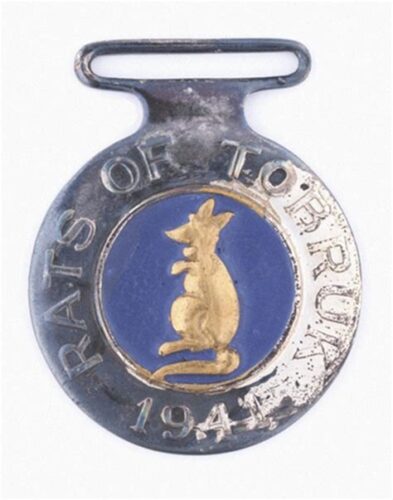
As someone who has studied the desert rats of WWII for most of my life, I hope I’m not the first to point out how bad Hegseth is at his job, especially when he opens his mouth. Historian protip: it’s well known that in WWII the rats were the good guys who won, because they go underground.
Tobruk medals of the desert rats were said to have been made by Australian diggers using scrap from Nazi planes they shot down.
His crusader rhetoric is why he rebranded the Department of War. His crusader brain is why he said the Iran war was immediately won and airspace was totally dominated, while U.S. intelligence assessed that roughly half of Iran’s missile launchers remain intact and thousands of one-way drones remain in the arsenal.
One source said Iran is “still very much poised to wreak absolute havoc throughout the entire region.” That assessment was filed before today’s shootdown. A few days ago, in widely circulated video, an F/A-18 only narrowly escaped an Iranian MANPAD attack.
Let me be clear about this. The F/A-18 carries no detection system for common infrared-guided MANPADS in Iran. That pilot survived due to regular course change, which was luck, not capability. Video shows exactly how Hegseth’s “complete control” rhetoric disrespects the airmen flying blind against the shoulder-fired weapons that survive every Hegseth outburst precisely because they’re man-portable.
The gap between claim and reality is now so obviously wide that even the hedges Hegseth inserted early (saying “this does not mean we can stop everything”) look insufficient. While he said that to cover against drone and missile strikes, a manned fighter down over enemy territory with two crew missing is a different order of falsification.
To recount, today’s shootdown is just the latest falsification event: 16 MQ-9s lost, three F-15Es down in the Kuwait friendly fire incident March 1, an F-35 forced to emergency land with a pilot injured by shrapnel, and now this. Every loss showed up after a Hegseth outburst about winning.
The dominance claim was always evangelical nonsense for a President who can’t handle the truth. Today it broke publicly, and Iran looks more dangerous whenever Hegseth starts preaching nonsense to keep his entertainment paycheck.
What’s notable in the latest Trump administration move is the role of a legal operative named T. Elliot Gaiser.
T. Elliot Gaiser
He clerked for Alito, was Trump’s 2020 campaign legal advisor, advising that Pence had a “substantive” role in certification and could keep Trump in power, and is now the author of a Justice Department’s Office of Legal Counsel (OLC) opinion declaring a post-Watergate accountability law unconstitutional.
The Presidential Records Act of 1978 requires presidential documents be sent to the National Archives and Records Administration. In an opinion released Thursday, the Justice Department’s Office of Legal Counsel found the law “is unconstitutional for two independent but interlocking reasons.”
It exceeds Congress’ powers and it does so at the expense of the autonomy of the presidency, T. Elliot Gaiser wrote in the opinion, noting that Congress can’t order the papers of Supreme Court justices to be sent to the archives.
Election subversion to records destruction. Who is he?
…Trump and the GOP had set the stage for a “MAGA DOJ that is actually weaponized.” …Gaiser [was] emblematic of that effort.
Whitehouse also slammed Gaiser… “Why would you want to put in somebody who is completely unqualified for the Office of Legal Counsel?” he opined. “…you put somebody in who knows they’re unqualified for their job, and so they’ll do whatever they’re told, whatever they’re asked.”
On the OLC Venezuela memo for Operation Absolute Resolve a legal analyst described it as “largely incoherent,” finding that Gaiser struggled to sustain a legal argument for more than a couple of paragraphs without contradicting or undermining it.
How incoherent? Legal analyst Asha Rangappa found that Gaiser destroyed his own case. His memo concedes the administration had no intelligence that Maduro would attack the United States, that his actions posed no imminent threat to U.S. forces, and that Venezuela’s regional aggression would not justify an attack. The only legal justification left was self-defense. And then Gaiser’s memo ruled it out. The entire analysis rested on an assurance from Trump that there was no plan for the US to run Venezuela. Trump then said the opposite at the press conference announcing the operation.
The Gaiser memo authorizing the operation explicitly stated it could proceed only because there was no plan to run Venezuela. Trump then announced it was starting and the US planned to run Venezuela.
The OLC isn’t just advisory. Its (now unqualified) opinions carry the same legal force as the statutes they interpret, and are binding on other agencies and officials unless the attorney general overrides the office or the president opts not to take its advice.
Gaiser produces legal cover on demand, insulated from peer correction, building a chain of classified precedents that no one can challenge.
His loyal incompetence is the whole point. He’s unqualified by design. His incorrect opinions are the product.
Trump already fired the head of the National Archives and used a loophole to poison it with a Nixon loyalist, which is the one agency with standing to challenge this. There is no internal actor left to push back. Only courts. And by the time a case reaches a court, the records will be gone.
Young American white men who don’t remember Nixon, yet who were raised intentionally to venerate that criminal President and undo protections, seems to be a theme. Gaiser was curated through Hillsdale, Heritage, Ginni Thomas’s org, and the Federalist Society clerkship circuit: his entire career path was explicitly a counter-Watergate project to rehabilitate the unitary executive theory that Nixon embodied. Watergate discredited it all but Gaiser is here to disagree.
He argues Congress cannot preserve presidential records “merely for the sake of posterity” as if no valid legislative purpose. But the PRA’s stated purpose was explicitly anti-corruption, enacted four years after Nixon. Gaiser erases real and very important history in the opinion and then rules there is no identifiable purpose. That’s not an interpretation, that’s a lie.
He is committing gross falsification of the legislative record.
Last September, Gaiser signed a memo arguing incorrectly that US strikes on alleged drug traffickers during Operation Southern Spear were lawful, comparing alleged drug traffickers to foreign nations attempting to invade the United States.
Then in November, he incorrectly told Congress the strikes on Latin American cartels were not subject to the War Powers Resolution, which is a violation of US and international law. That month, he also authored a memo supporting detailing military lawyers as immigration judges.
Election subversion. Civilians as militants. War powers without Congress. Military lawyers as immigration judges. Presidential records destroyed. Each opinion is meant to bind the executive branch to criminal acts, as if to bring Nixon back. Each incorrect one builds on the last.
The U.S. military indicators in the Iran War are bad across every dimension.
Objectives: The administration has offered multiple changing justifications for the war. From pre-empting Iranian retaliation, to destroying missile capabilities, from preventing a nuclear weapon to securing oil resources, and regime change. Strategy? What strategy? That’s a list of post-hoc rationales.
Regime change: Failed. Mojtaba Khamenei represents a consolidation, where the system is reproducing itself with greater rigidity and less accountability than before.
Strait of Hormuz: Still closed. Oil prices up 45%, over $110 a barrel, with 3,000 vessels stranded. Some are predicting $200 a barrel. The Philippines declared a state of emergency over energy shortages.
Diplomacy: Iran’s foreign minister says trust is “at zero.” Iran calls US demands maximalist and irrational.
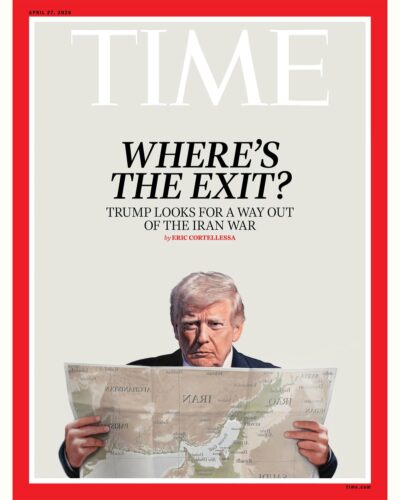
Command: Trump’s address to the nation after 33 days was a tired restatement of month-old talking points with no exit, still no strategy. One analyst said flatly: “He wants to get out of this war. He just doesn’t know how.”
Escalation trap: Robert Pape, a University of Chicago professor of political science, says it plainly:
Every time he makes a tactical move, it is a strategic failure that leads him to double down in search of success. It’s not just a ladder — it’s a trap.
Five weeks in. Hormuz remains closed. Regime remains intact and harder. No exit in sight. Missiles not destroyed and still firing.
Roughly half of Iran’s missile launchers are still intact and thousands of one-way attack drones remain in Iran’s arsenal despite the daily pounding by US and Israeli strikes against military targets over the past five weeks, according to recent US intelligence assessments, three sources familiar with the intel told CNN.
“They are still very much poised to wreak absolute havoc throughout the entire region,” one of the sources said of Iran.
Five weeks of holding the trigger down and unloading all the bombs and missiles that America could, and yet Iran is poised to attack. Videos this week show an Iranian MANPAD nearly shooting down an F/A-18, and then a F-15E went down in Iran with crew MIA. Targets of Iran are being hit all over the map and America looks spent, has no answers. Remember this statement by Trump?
We say we got 99%. 1% is unacceptable, because 1% is a missile going into the hull of a ship that cost a billion dollars.
If 1% remaining is unacceptable, what’s 50% remaining? The U.S. is running out of munitions and is unprepared to replace them, meaning every day of war has better positioned Iran to threaten Israel and America.
Fire, Ready, Aim
So what does Hegseth do? Fires the Army chief of staff. Why? The top general wasn’t biased enough for Hegseth, because he balked at orders to remove blacks and women from the U.S. military. And, more to the point, he aligned more with JD Vance.
Hegseth told US Army Chief of Staff Gen. Randy George to retire immediately, a Pentagon official told CNN. He also fired two other Army generals Thursday, a US official said — the chief of chaplains, Maj. Gen. William Green Jr., and the commander of Army Transformation and Training Command, Gen. David Hodne.
Fired the chief of chaplains and transformation too. It’s a purge of ethics, intelligence and strategy. The conflict boiled over when Hegseth’s chief of staff, Ricky Buria, told the JD Vance ally Army Secretary Dan Driscoll that Trump would not want to stand next to a Black female officer at military events. Driscoll escalated in direct defiance of Hegseth’s operation, repeatedly refusing pressure to remove Black and female officers from the promotion list, citing their decades of exemplary service. Hegseth did it himself.
George’s firing is Hegseth asserting that the Army belongs to him, not to Vance’s man Driscoll. Purging the officer corps requires identifying and removing people with institutional authority. Fighting a war requires empowering people with institutional authority. Hegseth is in direct opposition to winning.
The US military’s advantage is precisely the diverse institutional knowledge, professional officer corps, and honest intelligence function that Hegseth is dismantling. That’s the removal of depth, with not enough to fall back on. Once it’s gone it takes a generation to rebuild.
Putin did the same thing to the Russian military over twenty years. Promoted loyalty over competence. Removed officers who delivered unwelcome assessments. Built a command culture where no one tells the boss the operation is failing. The result was Ukraine in February 2022 shooting Russians like fish in a barrel. Columns stalled on the road to Kyiv. Logistics didn’t work. Intelligence assessments told Putin what he wanted to hear about a Ukraine collapse in days. The army built only to be loyal couldn’t execute a basic combined arms operation.
Hegseth’s actions say he wants only white male officers who execute without pushback. What he’s building is officers who will confirm without accuracy. Those look the same from the top until the operation fails and nobody saw it coming because nobody was allowed to say so.
So the Army is hollowing out in a war with its chief gone, its intelligence assessments suppressed, its promotion system corrupted, and its officer corps afraid to speak.
Iran didn’t need to win on the battlefield to degrade US command capacity. The Trump administration did it to itself. Roughly 500 years of accumulated military expertise eliminated, with no explanation given.
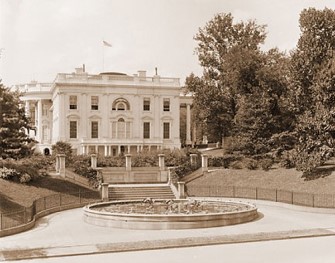
Franklin Roosevelt ordered a new East Wing built at the White House in 1942.
The White House East Wing came to represent American resilience and victory in WWII.
The public reason was office space, which covered construction of the Presidential Emergency Operations Center (PEOC) underneath. The bunker’s existence was kept secret. Presidential emergency command would be protected from that ground.
It was there, with the new East Wing, that America defeated Nazism.
Donald Trump in 2025, promoting the Nazi-adjacent slogan America First, abruptly ordered the East Wing demolished. Now he revealed a privatized military command center is rising in its place. The donors funding it are shielded from public disclosure. When a federal court ordered construction halted, Trump invoked national security to override the court and ignore the law.
People complaining about staircases to nowhere and windows without a view, don’t get it.
The ground is the same. The logic is exactly inverted. What once protected the republic from the Nazis will now be a corporate-backed command center for the Peter Thiel network. Of course the stairs go nowhere.
Thiel Said Democracy and Freedom Are Incompatible
Peter Thiel wrote it plainly in 2009: “I no longer believe that freedom and democracy are compatible.” He never believed it. Just look at his background. It was a program statement. Everything since has been its execution. He may as well have said he would be building a Klavern.
Tulsa officials in 1921 immediately moved to completely erase the race massacre from records, going so far as to build a new white supremacist meeting center (“Klavern”) directly on top of the firebombed Black business and homes.
The goal, stated explicitly, was to escape democratic politics. He described a “deadly race” between politics and technology in which the choices of individual builders would determine the outcome. The machinery he had in mind was literal.
Thiel is plain. He wants capital free from any constraint, government replaced with authoritarian control. He built his first fortune at PayPal on the model of a digital Swiss bank account with explicit ambitions to create a currency “free from all government control.” He funded seasteading, floating city-states beyond any government’s reach. He bankrolled J.D. Vance’s Senate campaign to the tune of $15 million. Thiel backed many candidates, and now Vance is now Vice President. Just steps away from closing down democracy.
Thiel Now Owns the Military’s Brain and Its Weapons
Palantir, co-founded by Thiel in 2003, began with CIA seed money. It wormed into military and intelligence agencies across the Western world, despite massive shortcomings. In March 2026, the Pentagon designated Palantir’s Maven Smart System a “core enterprise system” across all branches of the U.S. military. A mandate. Maven is a command-and-control platform that processes battlefield data and identifies targets, proving itself a failure in Iran. Over a month of Palantir “targeted” strikes at huge cost, and it doesn’t look like Iran is losing. Palantir has used money alone, not capability or outcomes, to position itself as the data layer through which the American military thinks, plans, and kills.
Anduril, backed by Thiel’s Founders Fund, now owns the autonomous weapons layer. In March 2026 the Army illogically awarded Anduril an enterprise contract with a ceiling of $20 billion, suddenly consolidating over 120 existing orders under one point of failure. Palantir misidentifies the target. Anduril is contracted to kill it with defense lemons. Who can forget this report?
A drone start-up backed by the US tech billionaire Peter Thiel has conducted two trials with British and German armed forces that were branded a “disaster”, raising questions about its bold public claims and its hopes of winning government contracts.
From there Thiel won ALL the contracts.
The consortium they formed (Palantir, Anduril, SpaceX, OpenAI, Scale AI, Saronic) describes its mission as delivering “the technological infrastructure, from the edge to the enterprise.” Palantir, Anduril, and SpaceX carry Thiel’s fingerprints directly through Founders Fund. This consortium has increasingly become the government’s operational nervous system, because of a billionaire pushing it.
The Ballroom Is a Private Military Command Center
Palantir is also a confirmed donor to the ballroom itself. Thiel’s company is on the White House donor list, funding the cover structure above the command complex that his men will operate. Palantir co-founder Joe Lonsdale ran the America’s PAC that helped Trump win in 2024. The political installation and the military infrastructure capture of the White House were being run in parallel. They in fact were the same operation.
The reality now is that Trump does not plan, he is the chaos that obscures the planning. Iran, Venezuela, and even the tariff eruptions are just corruption, impulse and grievance, yet never strategy. The ballroom looks like a real estate developer who doesn’t understand architecture. That reading is correct and also entirely irrelevant to what’s happening beneath it. Vanity builds a bozo-looking ballroom to distract critics.
It takes a whole different muscle to investigate the purposes of a classified military complex underneath it with logistics like a hospital for extended occupation.
Trump slipped and said it out loud: the ballroom “essentially becomes a shed for what’s being built under.” The shed is 90,000 square feet and nearly double the size of the White House. The complex underneath is classified, military-built, hospital-equipped, drone-proof, bio-hardened, with hardened telecommunications. Trump claimed it falls outside judicial authority because it carries no public price tag: “This is being financed privately. It’s a donation.”
Private donors. Identities shielded. Building a military command center on sovereign soil.
The hospital detail he added is actually significant. Bomb shelters are for evacuation. A hospital is for extended occupation. This is infrastructure for governing through a crisis, such as the end of elections.
The genealogy of the man really driving it all, and why, has been documented separately.
It Stands on the Ground That Defeated Nazi Germany
The American public as it entered WWII in 1942 saw an office building when presented with the new East Wing. Underneath, the government was constructing the presidential emergency command shelter. The PEOC then evolved over eight decades into the hardened command center through which American presidents managed existential crises. It was historically significant. It was institutional infrastructure. It belonged to the republic, not lease of all because it still symbolized the defeat of fascism.
Trump demolished all that so a private cabal orchestrating the government can build a replacement, borrowing the same cover story logic FDR used. The public is meant to see a ballroom. Underneath, contractors are building a classified command complex. The donors are anonymous. The courts are excluded. The president calls anyone who reveals the true nature of the privatized project unpatriotic.
A coup transfers power between factions within constitutional structures. What is being built here goes beyond. When a private network owns the data layer of the military, the autonomous weapons layer, the AI targeting system, and the physical command center at the center of American government, all funded privately, all shielded from judicial review, all secret by design, the Constitution has been made operationally irrelevant.
Thiel wrote that the goal was escape from politics “not via politics but beyond it.” Beyond it means: after democratic accountability has been made structurally impossible.
The East Wing represented the democratic victory over fascism. Now on the rubble left by Trump, a German-born billionaire, known for refusing to denounce Nazism, is building a private command infrastructure of a post-democratic American state.
That is no ballroom. That is the plan.
a blog about the poetry of information security, since 1995