I sat down to watch a production of John Logan’s Red. The actors landed a distinct “Oy.” They invoked Rothko’s Russian roots and his abrupt landing as a Jewish boy in America. They channeled a cadence of immigrant memory with enough conviction that the audience nodded along, satisfied that this play knows whose story it is telling.
It does not.
As a disinformation historian, I was genuinely surprised to see the methods used in a play to undermine the protagonist. Exploring how and why is likely to expose deeply rooted prejudice in Christian narratives that have been designed for centuries to isolate and erase Judaism.
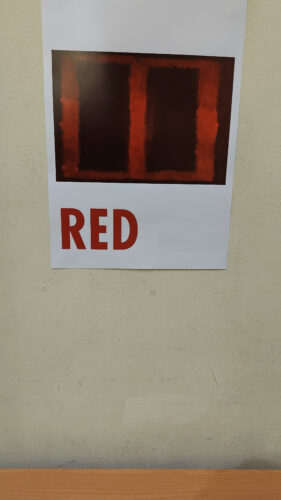
First, it’s a fact that major books on Rothko exist and none of them center his Jewish intellectual tradition as the interpretive key. There is a known history of erasure within a biographical track. Cohen-Solal’s biography in the Yale Jewish Lives series comes closest, tracing his Orthodox upbringing, yet even she treats Judaism as biography rather than the interpretive framework for his artistic method. In other words, you can’t just pull up a biography to understand what the play delivers.
Second, this is something not many people are able to recognize, and that’s by design. Many years ago, when I ran a very large war-dialing security project in Milwaukee, I took my team out for Easter lunch. I’ll never forget when one said to me “I hope you don’t mind me saying that I was raised on horror films in Church that told me to believe Jews are my enemy because they won’t obey, and they killed Jesus. But to be honest the teachings don’t make sense now, talking to you”.
He wasn’t the first or the last American that I met who struggled to make sense of his operational context, which he had been raised from very young to believe, as latent antisemitic hatred and bias. He would easily watch a play or film destroying Rothko, yet he would be uncomfortable meeting Rothko in person.
Historians of Nazi Germany point this out repeatedly. Jews would have neighbors who would gladly say the Jews are the problem, cause of all their grief and need to be forced to change, while adding “but I don’t mean you”.
The impact of this play as disinformation matters a lot, when you consider how Red won six Tony Awards in 2010 and has become one of the most frequently staged plays in the American repertoire.
Allow me to explain.
The stage is set to Rothko’s Bowery studio in 1958, where the artist works on murals commissioned for the Four Seasons restaurant in the Seagram Building. He has a fictional assistant to mix paint, stretch canvas, and gradually find the nerve to challenge his employer’s convictions. The confrontation escalates until the young man rises up to liberate himself from Rothko’s demands. Audiences leave feeling they have watched a story about art.
They have watched a public trial.
The audience is set up as witness, the congregation. The young assistant, named Ken, is their proxy, sent in to extract a confession from an old Jew whose crime is trying to make a world on his own terms. How dare he exert confidence in his opinions and not bow down to the Christian system of modesty and shame?
Christian Control
Logan builds his depiction of Rothko around a single psychological engine: control. Control of the viewer’s distance. Control of the lighting. Control of the emotional conditions under which the paintings may be experienced.
The play incorrectly casts the Christian perception of control as Rothko being overprotective. We are meant to observe a tortured artist shielding sacred work from a profane commercial world, terrified that his paintings will become wallpaper for Manhattan’s wealthiest diners.
This is a tortured misreading so fundamentally wrong about Rothko, that Logan inverted the man’s entire practice.
Rothko was raised with an Orthodox Jewish education at cheder before immigrating to Portland at age ten. He brought his formal Jewish education to art as one of the major abstract expressionists. It isn’t a footnote, it’s the lens through which his entire practice becomes legible. In other words, to those who know a thing about Orthodox Judaism, his insistence on setting a viewing environment (lighting, proximity, enforced intimacy) does NOT map to a Christian framework of control. He was NOT an artist defending the sacred from the fallen world. He was doing the exact opposite.
Rothko was practicing tzimtzum.
In Lurianic Kabbalah, tzimtzum is the divine contraction: God withdraws in order to create the space in which creation becomes possible. The infinite possibility of light must be constrained or it destroys rather than illuminates. The dialogue in the play regularly returns to question Rothko for saying he doesn’t like the “outdoor” light rather than recognize he was invoking “infinite” light as interference with his ability to create. Lines in the play about color absolutism (black, white) are presented completely detached from the Kabbalistic context that gives them meaning. Chabad’s commentary on tzimtzum tells us:
Before the beginning, there was nothing but light. Infinite light. The notion of a world was absurd… So He hid the light. All of it. There was absolute darkness. And now there could be a world.
During the play I heard the audience all around me guffaw and chortle at “difficult” Rothko lowering the lights, while his assistant mocked him for it. I cringed. It felt incredibly awkward, as if I was seeing with two eyes in a production that was meant for the blind. How could people not see? Oh, right, they don’t know anything about Rothko’s faith or the Kabbalah.
Rothko being framed with a restriction of light, his indoor control obsession, is not defense. It is method. Barnett Newman, Rothko’s close friend and fellow abstract expressionist, made this connection explicit. Newman’s Zim Zum I (at SFMOMA) proves the kabbalistic vocabulary was named and present in the artistic community. The Rothko Chapel itself, which Newman’s Broken Obelisk stands outside of, proves Rothko’s entire practice pointed toward sacred space. The Kabbalistic vocabulary was not hidden, it was not obscure, it was not inaccessible. It was sitting in the artistic community Rothko inhabited, named and present.
Logan ignored and then erased it, because it would not have allowed his trial of Rothko to continue.
Even Logan’s own script betrays what it is erasing. His Rothko says he wants to create “a place where the viewer could live in contemplation with the work.” His Rothko tells Philip Johnson he will make the restaurant “a temple.” These are lines Logan wrote — and they point directly toward the Kabbalistic framework the play refuses to engage with. The real Rothko wrote to the critic Katherine Kuh that he put his trust in the psyche of the sensitive viewer who is free from conventional patterns of thought. He was not building controls. He was performing the opposite, a Jewish philosophy of withdrawal that makes revelation structurally possible.
Logan did not see this, and went to great effort to misrepresent Rothko with control concepts that Christians easily could judge and condemn. The only version of artistic control his script allows the viewer to imagine is fear.
Bringing a Kabbalistic decoder to the play is a revelation, which exposes the audience gasping and laughing at a “difficult man who causes conflict” for all the wrong reasons.
Chavruta as Psychodrama
Logan didn’t just miss the foundation of Rothko. The distortion of him runs through every confrontation.
Logan writes exchanges as verbal assaults, trying to frame Rothko as “battering” his assistant with demands, provocations, and intellectual challenges that leave Ken shaken and defensive. The Logan story arc requires “battering” for a setup, like a nod to Greek mythology-telling traditions. Ken must accumulate enough wounds to justify his crusade of rebellion, his walk out the door and into his own life. Rothko is depicted as the one who says the son must overthrow the father, and then his apprentice overthrows him as consequence. The young replaces the old. The audience feels catharsis. The audience doesn’t ask itself why a Jew is being recast into Greek and Christian narratives, erasing his story.
This is Christian supersession as dramatic structure. The son surpasses and replaces the father, the new covenant fulfills and discards the old. It is a narrative shape so deeply embedded in Western theatrical convention that most audiences cannot see it operating as a template that disrespects the subject.
It is NOT a Jewish shape.
What Logan writes as domination is a mistake, when you understand Rothko practicing chavruta. The Talmudic study partnership makes argument the mechanism of shared discovery. It opposes authoritarian control, favoring a partnership. You push, I push back, and in the friction something emerges that neither participant owned before the encounter. That heat is NOT the abuse framing that Logan is so desperate to deliver audiences. It is how a Jewish intellectual growth tradition works. The intensity is NOT a flaw to be overcome, even the emotion is NOT a flaw. It is the LOVE of a teacher who refuses to let a student remain comfortable in an incomplete and dispassionate understanding.
Logan’s script acknowledges the possibility but it immediately forecloses it. Look at how he portrays Rothko when he tells Ken:
I am not your rabbi, I am not your father, I am not your shrink, I am not your friend, I am not your teacher — I am your employer.
The line gets a laugh. The audience hears the rabbi line, a series of diminishing steps (negating the actual role of the rabbi) and then the “I am your employer” cold landing.
Logan intentionally strips away every actual Jewish relational frame that would make Rothko’s intensity authentic and legible, leaving only a “coin-operated Jew” of commercial transaction.
The antisemitism latent to Logan’s perspective isn’t to be underestimated. Audiences raised with the same framing likely welcome the repetition and reinforcement of what they were already thinking. The coin-operated Jew, of course, that makes sense to the congregation judging Rothko. Once the relationship is distilled to the Jew employer and the mistreated employee, the demands become illegitimate. Rothko’s passion is inverted into derangement, pathology. His love and care become captured and redefined unfairly as control.
Decoration and Erasure
Every production of this play serves as anti-Jewish disinformation, erasing specific people in society. The script puts Rothko on trial, but anyone who knows the intellectual tradition it points toward can feel the much greater impact.
The Judaism is acted upon as decorative, like a prop. “Oy” landed so flat, like hanging a Santa on an oak tree in August and saying Merry Christmas, that I almost couldn’t sit through another minute. But I soon witnessed Judaism being invoked for a far more dangerous purpose, assigning blame for every “difficult man” problem being depicted.
Here’s an old Jew you want to get to know because he’s famous, and here’s why you shouldn’t like him. Do you feel comforted by the shared exercise of misunderstanding him, “othering” him, and discrediting him? Is it just coincidence that it circles around him being a Jew? Rothko becomes a vessel to carry a message opposite of who he really was. By introducing him without connecting Judaism to anything structural in the play, every production is actively erasing him through targeted attacks on his identity.
The play does not explore Rothko. It prosecutes him.
The group I saw spent the time after the play discussing how they read a biography of the man, and they struggled to read more than a page or two of Nietzsche. Actors emphasized the routines to put on the play as a done deal, a matter of material being canon, without questioning anything in it.
The structure is settled, apparently, as a communal shaming ritual: actors seem to have no issue putting on a public humiliation of the one who won’t conform, the performative exposure of difference as arrogance, the insistence that confidence is sin. Rothko is on display, without his consent, for the audience to watch him be broken as an example for others to not be “like him”. His refusal to make himself small or legible on the dominant culture’s strict interpretation of him, that is the tension.
Being familiar with the Christian intellectual architecture makes the play resonate. Being familiar with Jewish intellectualism makes the play unbearable.
When it references Nietzsche’s Birth of Tragedy, Caravaggio’s Conversion of Saul, Michelangelo’s Laurentian Library, the pattern emerges. The Apollonian-Dionysian framework is dropped like a bomb on Rothko. The suffering artist is presented as sacrificing himself for the integrity of the work. One reviewer described Rothko as an artist “whose paintings were a dynamic battle between Apollo and Dionysus.” No one seemed to notice a Greek reading does not fit the Jewish painter who studied Talmud before he studied art.
Why? I’ll explain, because this play proves to me audiences have no idea just how much disinformation is being fed to them.
The Apollonian-Dionysian framework is a conflict model. It presupposes two irreconcilable forces with order against ecstasy, form against dissolution, and the artist is trapped between them. Nietzsche’s formulation was that tragedy is what happens when neither force can win. The hero is destroyed by the tension. This is the engine Logan installs in Rothko: a man torn between the sacred and the commercial, between control and surrender, between creation and self-destruction. It demands that he fall.
And it’s completely, utterly wrong.
Imagine two halves in balance the same way you ride a bicycle by riding with both left and right as oppositional forces working together to allow forward motion. It’s the same way a sailboat moves only when it is in opposition, wind against water, otherwise it is stuck. There are many religions like this, whereas the Greek stories of Apollo and Dionysus aren’t even close to relevant.
Jewish intellectual tradition has no such requirement for the conflict that Logan sets up with Greek framing to discredit the ideas of Rothko. The Talmudic method holds opposing positions in permanent productive tension (machloket l’shem shamayim, argument for the sake of heaven) where contradictions are not resolved but sustained as necessary for movement forward.
Hillel and Shammai do not destroy each other, because that would prevent good. They sit on the same page. In Kabbalistic thought, darkness and light are opposite of war, they are togetherness. The darkness is the vessel that makes light apprehensible. You can’t see stars without the beauty of the night. Rothko’s practice of layering, the darkness that contains color, the restriction that enables encounter is integrative, not tragic.
Logan’s imposition of a tone-deaf Greek binary onto it turns a Jewish artist’s coherent method into a bizarre European death wish, which conveniently produces the broken genius that the Christian-steeped audiences came to see broken.
Logan did not invent this problem, of course. He simply won wide recognition for perpetuating and expanding it among people eager to see. And that’s the actual problem.
As a scholar in the Journal of Modern Jewish Studies has observed, exhibition organizers and essayists have consistently steered clear of questions about Rothko’s Jewish identity and his notion of sacred experience. The assumption has been that Rothko’s universalism transcended his Judaism, which is a formulation that conveniently avoids asking whether the universalism itself was shaped by Jewish intellectual tradition. Rothko has to be understood as a Latvian Jewish immigrant who had attended cheder and yeshiva, who co-founded an artists’ group in which nine of ten members were Jewish, who spent his life applying Jewish intellectual traditions to the conditions under which his work could be encountered.
And yet, the dominant critical response has been to misread him through Nietzsche and Jung.
Logan’s play is the theatrical culmination of popular erasure of a Jew, vilifying along the way with tropes about “control” and “money” that don’t even fit the man.
The Inversion
The sinister operation of Red is that it is far more than either lazy or willful ignorance of Jewish traditions. The play does not merely fail to understand a Jewish man, let alone the foundational background of Rothko himself. It projects onto a Jewish identity the very pathology of the system that produced the play.
Christian domination doctrine is obedience-based.
The father’s role is to produce compliance. The congregation’s role is to submit. Authority flows downward and is not to be challenged. When it is challenged, the challenger is the problem and not the structure. This is the alien model that Logan very intentionally imposes on Rothko’s studio. Rothko demands, Ken obeys or suffers. The audience watches a tyrant and his victim in the frame of Christian traditions.
However, Rothko was not the actual authoritarian in this story. The authoritarian was the system that he refused to serve. This cannot be overstated. The commercial art world that wanted his paintings as decoration for the rich, the cultural establishment that wanted his intensity made safe and consumable. Rothko’s entire career was a challenge to that system of authoritarianism that he balked at. His withdrawal from the Four Seasons commission was not him having a revelation inspired by Ken, nor was it a breakdown. It was the act of a Jewish man being principled in a most Jewish way, that he would not let his work be domesticated by power. The play takes the liberator, with his deeply-rooted philosophy since childhood of liberation, and recasts him as the despot.
This is projection by Logan.
The Christian institutional model shames dissent, punishes nonconformity, and treats the refusal to submit as moral failure. Logan takes this and accuses the Jew of the very thing the institution does. The mob that enforces obedience frames the man who refuses to bow as the bully.
Jewish tradition has a name for this pattern, in case you were wondering why it’s so easy for someone familiar with Judaism to see it even when others can not.
This is the story known as Book of Esther, which effectively teaches little Jewish girls they have women heroes to look up to who fought power and won.
In the story, the antisemitic Haman demands that everyone kneel to his authority. Mordecai will not on principle that he does not kneel to false authority. And Haman’s response is not to question his own authority but to mark Mordecai for destruction, which means not just Mordecai, but his entire people. The crime is not what Mordecai did. The crime is that he dared to insist on his own terms.
Sound familiar?
Logan’s Red runs the same inversion. It takes the artist who challenged the commodity system and makes him the oppressor. It takes the assistant who represents that system’s values of youth, accessibility, the rejection of difficulty and makes him into the hero.
Logan gives his audience shame directed at a Jewish man for ninety minutes, and wants it to be registered as art.
Who Gets to Define the Terms
Jewish intellectual confidence is rewritten as aggression. The Jewish protagonist says he knows when he knows, he doesn’t know when he doesn’t, and the Christian rewrites it as uncomfortable overconfidence and failure of modesty. How dare a man think for himself, to exert authority over his own destiny in a way Catholics are raised to believe is shameful. The play traps Rothko in a false binary: aspiring Christian authoritarian or broken failure. It never considers that he was neither. He was genuinely anti-authoritarian.
Logan takes nurturing intensity and rewrites it as manipulation. He takes a commanding presence rooted in a tradition where ferocious engagement is love, and presents it as a problem the young assistant must solve by abandonment. Catholic framing is unmistakable, where leaving and silencing are the preferred tools over the balance of an embraced, inherent conflict.
The play needs Rothko to break down at the end so the audience can leave feeling they witnessed something profound rather than something that they did to him.
The only resolution the script offers is the gentile’s liberation from the control and money-seeking Jew’s demands. Ken leaves to “belong” while Rothko is cast out to be alone. The audience is invited to feel that something has been set right. But the play never asks the question that would unmake its entire structure: What if the demands were not pathology but pedagogy? What if the intensity was not something to survive but something to join?
In a 2012 review for The Arts Fuse, the visual artist Franklin Einspruch asked what a “treyf, naive Iowan” was really meant to be doing in the studio of Mark Rothko, the artist “with commensurate aspirations to grasp the unnamable essence of being.” The imbalance was the sharpest observation I have found about Red, and apparently no one explored this any further.
Perhaps the Christian establishment has no interest in developing any critique of a play that trashes Jewish intellectualism. It was too busy handing out awards.
Not just six Tonys. The Drama Desk. The Olivier.
A playwright built a machine that chewed up a famous Jew and spit out his bones, and the industry gave it every prize available. A Catholic dramatic structure that shames Jewish difference, rewards conformity, and treats the insistence on one’s own terms as the gravest sin does not operate against the interests of a Christian cultural establishment. It operates as one. It’s an expression of how the establishment uses its dominance to control narratives that harm the minorities it claims to be “converting”.
I’m reminded of a recent court case where American Native people had their voice officially removed by an American court, which ruled that the Oil companies oppressing them should decide how to tell their story. In 2026. Logan isn’t the only one writing like this.
Fifteen years and hundreds of productions later, Red continues to tell audiences that Rothko’s Judaism was color and noise to a Greek tragedy rather than the operating system of his entire artistic practice.
In the script, Rothko says he wants to create “a place of communion.” It is the one moment where Logan almost lets him speak from his own tradition, where traditions of shared encounters nearly break through the Christian scaffolding of authoritarian rule. But the script cannot sustain it. Logan needs Rothko to fail in the way he expects, to collapse into the tortured isolation that will justify Ken’s “return” to society from the exclusion and independence of Jewish intellectualism.
The play tells you Rothko is Jewish, yet it spends the entire time punishing him for not being Christian enough to make sense to the audience misunderstanding him.
Thank you for this thoughtful review. It’s impressive how Rothko code-switched to survive. He used Nietzsche and Aeschylus himself because those were the entry tickets to the American art establishment. A Jewish immigrant in mid-century New York who walked into galleries talking about tzimtzum wouldn’t have gotten a show, let alone another glance. He adopted the oppressor language to do his work. That’s wasn’t him developing ambivalence about Judaism, since he was forced into fluency in the system that was oppressing him. His name change, the end of attendance at services, the Greek references show just how much pressure to “melt in” he was under. The tradition clearly kept running underneath and you’re the first person I’ve seen connect these dots.
Logan takes the mask the immigrant was forced to wear and treats it as his real face. He intentionally chose a Christian dramatic framework. Maybe he was totally ignorant of the Jewish one, given how many people are, but choosing not to look at Rothko’s true beliefs is a choice. The intent is in the framework Logan imposed, not in what he knew he was erasing.
What you’ve done here is exposed exactly how most institutional antisemitism works. Nobody has to decide to erase Jews since they can make it happen just by doing nothing, by never asking whether the framework they’re using was built to exclude Jews. Systemic is the word.
Well done. If Rothko were here I have a feeling he’d appreciate you defending him against this play’s clearly unfair treatment.
The erasure works because the Christian framework is treated as if universal (“it’s just a play”) while the Jewish framework is treated as weird and particular (“prove he meant it”). That’s the usual trick. The default, Christian erasure of Jewish thought, is invisible to itself.
Explain Hanukkah down to every hour or it doesn’t happen. Christmas happens whether you like it or not.
Rothko has to prove he was thinking about Kabbalah by showing a signed affidavit, but Logan gets to absorb and reproduce an entire Christian dramatic architecture of antisemitism without anyone even naming it or him. He just wrote from inside the horrible water he swims in. The son-overthrows-father Greek arc, the shaming of nonconformity, the congregation-as-witness structure, nobody asks him to footnote all those as unnecessary Christian impositions misfit on a Jewish subject.
The awards are just proof how little anyone dared to call the play out for what it really does and who loses.
I went to Northwestern, like Logan, and I’ll tell you something everyone in Chicago knows and nobody wants to remember. He attended from 1979 to 1983, then stayed in Chicago for a decade as a playwright, near Skokie. That’s right, Logan was at Northwestern one year after the Skokie Nazi march of 1977-78.
Logan saw Skokie had one of the largest concentrations of Holocaust survivors outside Israel. He wasn’t geographically or culturally isolated from direct attacks on Jewish life. He was immersed in it. Which makes the absence you describe in the play harder to attribute to simple ignorance.
His first play seemed to attack two Jewish men, Never the Sinner was about Leopold and Loeb. His second, Hauptmann, was about the Lindbergh kidnapping trial, which had significant antisemitic undercurrents. That is to say he’s been writing about and around Jewish subjects his entire career, for what end? The man uses Jewish lives as his material while imposing distinctly non-Jewish frameworks on them, very much what the Skokie Nazi marches in 1978 were all about.
You say Rothko becomes a Greek tragic hero. Leopold and Loeb were turned into Nietzschean monsters. Every time, Logan is using Jews as his target, applying a non-Jewish tragic arc to erase them. Just like trashing Rothko, Logan framed Leopold and Loeb as unlikable intellectuals who believed themselves above moral law. That’s not a coincidence.
Look at the Chicago antisemitism scene to understand who Logan really was writing with and for…the boundaries of acceptable antisemitism were being publicly tested, and his response was to write plays that put Jews on public trial so he could help erase what makes people Jewish.
You really have to wonder why nobody has ever talked about this. You broke the taboo.
Logan writes what Susan Sontag identified as a dangerous political precondition: an aesthetic that makes domination feel like art. In “Fascinating Fascism.” she warned these aesthetics don’t announce themselves. They seduce. He’s campaigning in the subtle way that any extreme right politician might. Logan’s body of work is something Sontag would have recognized immediately as production of spectacle from within the imperial gaze, presented as universal storytelling.
Gladiator? Fascist aestheticism of Roman violence for a modern audience that gets to feel noble about watching it.
Bond? Fascist romance of surveillance as style. The original books explicitly criticize Bond as end of empire, a protagonist meant to offend, yet the movies glamorize him.
The Last Samurai? Grants a white American the arc of spiritual transformation that belongs to the Japanese characters surrounding him.
Sweeney Todd? Logan revives a Victorian gothic whose roots are just plain antisemitic penny dreadful tropes.
In every case, Logan is telling the audience a dominant perspective as oppressor is comfortable. A consumed culture provides the material for him to oppress for their entertainment. The consuming culture ratifies it all, and their awards are as real as Henry Ford getting a medal from Hitler.
LOL so y’all telling me Logan saw Nazis marching and said that’s the place for him and then made a famous award-winning career out of peddling softcore antisemitism and pseudo-fascism?
No wonder he called his play set in a 1950s Jewish artist studio… RED.
Let’s break it down. “Red” is the exact label to discredit left wing Jews at that time for their political views. Logan should have called the play “Red Scare” to be more honest, disproportionately targeting Jewish intellectuals and artists. Rothko was in fact in the Artists’ Union, the WPA, The Ten. Logan knows. He is not subtle, even though audiences he panders to think he is. “Red” was a label meant to discredit Jewish intellectuals as aggressive, dangerous, suspect, un-American. Logan gives this exact treatment to Rothko and activates political persecution in the title and then his play performs exactly that function as advertised. What a talent! He puts a famous Jewish intellectual on trial and finds him guilty, surprise. The fascism dogwhistle title warns us, Jew trial ahead. Audiences only think it’s the paint, while they absorb all that “Red Scare” hate.
Interesting. Have never seen it. Won’t bother.
Davi, you have done a genuinely interesting thing here. People say we can’t unfairly depict Native Americans as unfit for our society, frame them as savages who must be brushed aside or civilized. That’s an obvious shift from the face paint and characteristics to make them appear as monsters. That’s now recognized as toxic Hollywood. Blackface too. And yet right in front of us Logan was doing it to Jews. Why he used his access to Jewish communities to denigrate and embarrass them is the next question. He even seduced Jews to tell his story about why they should be persecuted. Some Native Americans said they took the work hurting their communities because it was the only work for them. You’ve found something different.
This all reminds me of when Dahl wrote a review of Tony Clifton’s God Cried that said the United States is “utterly dominated by the great Jewish financial institutions” and asked whether Israel is like Nazi Germany and must “be brought to her knees before she learns how to behave in this world.” Yeah, was Dahl really held to account for what he was writing? His plays run, his books sell.
Ok, so the core observation about Logan consistently telling stories from the dominant gaze, using consumed cultures as raw material, is worth taking seriously. The question is actually whether that’s a deliberate ideological project (given his 1978 Skokie roots) or whether he can claim subtle forms of American Nazism are just a normative and default mode of mainstream Anglo-American screenwriting.
The reason this is worse than simple ignorance is that it demonstrates competence. You can’t claim you don’t understand the dynamics of representation when you’ve articulated them perfectly in your own case. Logan has literally said he wants queer characters to “not be a metaphor” because he wants his people to have agency, authenticity, dignity. That’s the exact opposite of what he does to Jewish characters. He knows the framework. He applies it selectively.
His selectivity has a very tight line: advocacy for communities he identifies with, consumption of communities he does not. Logan fights for deep and thorough queer representation with GLAAD consultants and authentic casting. Then writes Rothko as a character study for non-Jewish audiences without even basic engagement.
This isn’t as unusual as you all imply. Look at how Gervais goes to war for animal rights with genuine passion, real advocacy, and puts his money and platform behind it. Then he builds comedy specials around trans people as material. He knows what punching down looks like because he’s described it perfectly when it comes to animals. He just doesn’t extend the principle.
Logan wrote a very particular phrase “I am not your rabbi” as a laugh line. He knew the Jewish faith perspective existed as another dimension. He had his character explicitly negate it.
He grabbed the Jewish framework, identified it clearly so everyone could see him put his hands firmly around its neck, and then killed it on stage as a grotesque spectacle.
You’ve completely opened my eyes to something I didn’t even know I could see! This is marvelous. The academic work on Rothko’s Judaism has never called out the play as disinformation. They steer clear of it, while the theater critics never ever consulted the academic work on his Judaism. The two streams being isolated allows the critics to ignore the root problem. I looked up other reviews too. Einspruch said that sensed something wrong like an imbalance, but he didn’t figure out like you that the dramatic engine is simply a market for antisemitism! My God, literally. As a Catholic I am appalled to see how this played out, no pun intended. Red gets revived because it’s catnip for the “polite hate” audiences it was built for. The awards are to celebrate the erasure of an ethnic group. Shameful.
I don’t know if you read Sam White’s work on this?
PAIN REIGNITED: MARK ROTHKO’S TRAUMATIC RELATIONSHIP WITH JEWISH
IDENTITY AND THE HOLOCAUST EXPRESSED THROUGH HIS 1939 SHIFT TO A
SURREALISTIC STYLE
His thesis is that Rothko self censored his identity because antisemitism made it dangerous to be visibly Jewish. Your review basically says that Logan took the antisemitic climate that forced Rothko to wear a mask and presented that mask as his real face.
White proves exactly the crime you’re charging Logan with, because Rothko never actually abandoned Judaism. He was forced to encode it in ways Logan couldn’t see. Logan then treats that survival method as actual absence and builds a Greek-Christian framework on top of it as if to confirm erasure.
White also proves the Kabbalistic connection is not speculative. Jewish Expressionism was incorporating “Hassidic and Messianic tropes associated with Jewish mystical texts known as the Kabbalah.” The tradition was there from the beginning of Rothko’s artistic formation. It went underground. Logan pretended it was never there, while turning Rothko into a Jewish strawman to ridicule.