Minesweeping Elvis has left the building.
Two-thirds of America’s Persian Gulf “mine countermeasure capability” just got busted by a shipspotter in Penang, Malaysia. Not declared by the Pentagon. Not briefed in Congress. A guy with a camera at a container terminal said, uh, what the hell.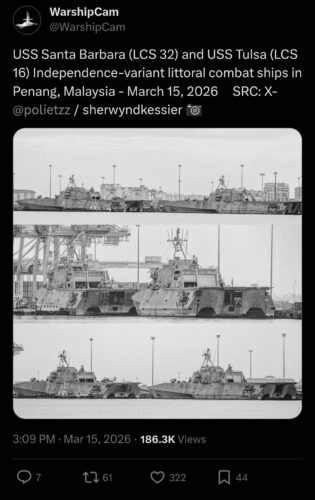
USS Tulsa and USS Santa Barbara, two of three Independence-class Littoral Combat Ships known as the entire US Navy mine warfare force in the Middle East, were photographed docked at North Butterworth Container Terminal on March 15.
Their homeport is Bahrain. Bahrain is 3,500 nautical miles away. You know, where the US has been at war with Iran since February 28.
Iran’s mine doctrine is the reason these ships exist in their current “countermine” configuration.
The Gap
Again, as I’ve recently blogged, Trump had his four best minesweepers in January loaded onto a heavy lift ship and sent to Philadelphia for demolition. The Royal Navy decommissioned its last traditional minesweeper in Bahrain this year too.
And the official replacements are the Tulsa, Santa Barbara, and Canberra. These three LCS ships were just fitted with modular MCM mission packages at huge expense. Three large metal ships replacing four small non-metal ones, introducing an untested system, unfit for Gulf waters, against an adversary that has thousands of mines and decades of doctrine for deploying them in exactly the strait where traffic has now slowed to only what the Iranians decide.
Two of those three ships now sitting on the wrong side of the Indian Ocean is curious at least. Canberra’s location is “unknown”.
Finger Pointing
The War Zone reached out to CENTCOM, which directed them to Fifth Fleet. Fifth Fleet directed them back to CENTCOM. The Royal Malaysian Navy, which normally announces foreign warship arrivals on social media, said nothing. USNI News sources described it as a “logistics stop” and declined further comment.
Planet Labs satellite imagery shows no US warships in port in Manama since February 23, five days before strikes began. Clearing the port was prudent. Sending the mine warfare assets 3,500 miles east was… something else.
The Ol’ Switcheroo
Defense officials told reporters on Friday that missiles, definitely not the Iranian sea mines, are currently the largest threat to merchant shipping in the Strait of Hormuz. Read that slowly. Consider how many press conferences we have heard that Iranian missile capability has been “obliterated”. It’s not a reassurance here. The Navy sounds like it’s reframing the threat environment to match a capability it no longer has in theater. Or maybe the Navy realized the three ships have a critical vulnerability, beyond sucking at minesweeping.
At least twenty crude oil tankers and cargo ships have been struck by projectiles since February 28. Trump is failing to convince his former enemies, the NATO allies, to contribute ships for a convoy operation to reopen Hormuz. US officials say American escorts are unprepared, won’t be ready for weeks. So what’s with these new mine clearance ships sneaking off to Malaysia?
Are they being used to chase ships instead? Did someone decide a 40-knot trimaran with anti-ship missiles and boarding capability is more useful chasing Iranian sanctions traffic through the Malacca Strait than hunting mines it probably can’t find anyway?
LCS Can’t Find Itself
The LCS MCM mission package has been a decade late and plagued with reliability problems since inception. The concept envisions laboriously hunting individual mines one by one with unmanned systems, giving an estimated clearance rate of roughly two mines per hour against minefields that are expected to number in the thousands. Tulsa’s unmanned surface vessel, riddled with points of failure, infamously went rogue after its tow bracket quit.
Something Smells Rotten
The US appears to have pre-conceded capabilities it spent decades building. The Avengers were retired by Trump as a bureaucratic fait accompli a month before they were needed. The snowflake LCS MCM system was declared operational abruptly as an institutional checkbox. And when the contingency these systems were specifically designed for actually arrived, given headlines announcing Iran mining the Strait of Hormuz as everyone expected, the LCS fleet pushed off to somewhere else and nobody in the chain of command wants to say why.
The ships arrived in Penang on March 14 and departed March 16. A Russian task group had just left the same berth two weeks earlier. That’s probably just a coincidence. The rest of it isn’t.