In 1937, the Soviet NKVD issued Order No. 00447, allowing them to arrest anyone, with quotas by region. Officers received two categories of targets:
- Category One for execution (i.e. Renee Good, Alex Pretti, Ruben Martinez)
- Category Two for Gulag imprisonment
Exceeding them brought rewards. The system’s defining feature was not cruelty for its own sake but bureaucratic incentivisation of detention. The machinery needed throughput to justify its budget. It found throughput.
In January 2025, the Trump administration set ICE detention targets at 1,200-1,500 per day. ICE’s budget stands at $85 billion, up from $6 billion a decade ago. New recruits receive signing bonuses of $50,000. Multiple guards at the Northwest ICE Processing Center in Tacoma independently told a detained British tourist that agents receive per-head bonuses for every person they bring in.
The NKVD didn’t publish its incentive structures either. ICE doesn’t either.
The British tourist was Karen Newton, 65, retired school administrator from Hertfordshire, no criminal record, travelling on a valid B2 visa. She was detained for 42 days. The stated justification: she was “guilty by association” with her husband, whose visa had expired. Her specific offence? ICE said helping him pack his suitcase was grounds for jail, which they officially called a detention to strip her rights away along with all her clothing.
Guilt by Association as Legal Doctrine
Soviet law formalised this as ChSIR — Член Семьи Изменника Родины, “Family Member of a Traitor to the Motherland.” Under Article 58 of the Penal Code, wives of accused enemies were automatically sentenced to five to eight years. The ALZHIR camp outside Astana was purpose-built for them. The principle was explicit: kinship itself constituted complicity. It was infamously echoed in American “Red Scare” McCarthyism, which led to outrage and protest.
A US border agent used the English equivalent of this doctrine of “guilty by association” for a woman whose husband’s paperwork had lapsed. The Soviets at least had an acronym.
Voluntary Confession, American Edition
On day three of detention, Karen signed a “voluntary self-removal” agreement waiving her right to see a judge and accepting a ten-year US entry ban. The agent told her it was the fastest route home. She then spent 39 more days in detention.
The Soviet “voluntary confession” operated identically: sign, and your sentence will be lighter. Cooperate, and this ends sooner. Both mechanisms use indefinite detention to manufacture consent to punishment, then continue the punishment regardless. The confession is a trick to increase funding for an additional length of control.
The Trump administration’s version adds a cash incentive. Project Homecoming offers detainees an “exit bonus”, $1,000 raised in January 2026 to $2,600 to “celebrate one year of Trump”, funded by redirecting $250 million from refugee aid. This is, structurally, a bounty system operating in both directions: agents are incentivised to detain, detainees are incentivised to waive their rights and be detained longer while convinced it would help them leave.
The Private Surplus
The Gulag extracted labour. Prisoners built canals, railways, and timber infrastructure the Soviet state couldn’t afford to pay free workers to construct. The economics were integral to the system’s persistence.
The American pivot is to extract profit from detention itself. Corruption of taxpayer money is how Trump is lining the pockets of an incarceration system bigger than North Korea. Kim Jong Un’s political prison camps hold an estimated 80,000-120,000. Trump already detained nearly 80,000 and has announced ICE plans to increase over 100,000. In the shadow of Amazon shipping warehouses and logistics processing boxes, ICE is telling Wall Street the movement of wrongfully detained humans will be an investor gold mine.
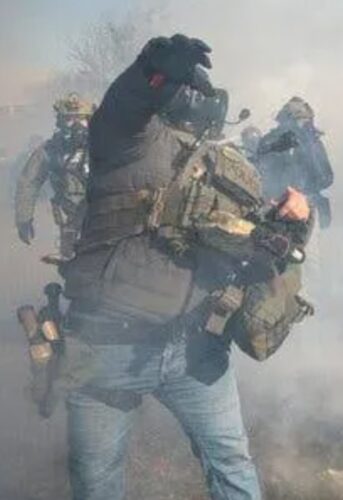
The Northwest ICE Processing Center is operated by GEO Group, a private company paid a daily federal rate per detainee. More bodies, more revenue. The stock price tracks detention policy. This eliminates the need for ideology altogether. The market provides sufficient motive. You can build a Trumpistan gulag on quarterly earnings alone, taking over warehouses to fill with humans.
ICE expects to spend $38.3 billion on acquiring warehouses nationwide and retrofitting them into detention centers holding tens of thousands of people. The plan includes eight “mega centers,” 16 processing centers, and 10 additional facilities, with total planned capacity reaching 100,000 indefinitely detained.
Two warehouse purchases alone cost $172 million, with one in El Paso to hold 8,500 beds. It’s among the largest jails of any kind in the world.
Outside Phoenix, ICE paid $70 million cash for a building the size of seven football fields in an industrial park. City officials said they weren’t aware of the purchase and hadn’t been contacted by DHS.
Warehouses are set up as logistics hubs near airports as a “feeder system” where detainees are briefly processed then sent to massive warehouses. They’re literally using Amazon-era supply chain infrastructure for human processing. The next obvious step will be what to do about all the deaths. And on that note, Trump literally just invoked the war powers act to enable dangerous pesticide use on domestic populations.
What the Pattern Predicts
Historically, quota-driven detention systems follow a consistent trajectory. They begin with a target population of limited public sympathy (undocumented migrants, political dissidents, class enemies). Then it expands because the institutional incentives demand expansion. Officers who need 1,500 detentions per day will eventually exhaust the supply of people who fit the original category and begin processing people who don’t. A retired British grandmother detained for packing a suitcase is not an aberration. She is the predictable output of a system that has begun to outrun its stated rationale.
The United States lost 4.5 million international visitors in 2025. The market is pricing in the risk faster than the political system is willing to name it.
Karen Newton’s advice to prospective travellers to America is wise:
“DO NOT GO.”
The Gulag’s survivors said the same thing about the Soviet Union for decades. This warning comes from a retired British woman who simply went on holiday to Trumpistan.