Functional epistemology buried under broken physics.
I finally watched Tenet, and here’s what I think: obviously the physics are incoherent (everyone surely notices that) but there’s a real thing here too. Nolan replaced an actual working intelligence doctrine mechanism with a broken one because the broken one… is easier to photograph.
After I watched the movie I scanned as many reviews as I could find to see what’s been said. Everyone seems so busy ironing out “how a temporal pincer works” that they apparently don’t notice it’s isomorphic to something that already exists and works better.
I double checked and triple checked but people seem to think there is novel physics here, rather than recognizing a dramatized version of iterative learning with the epistemology stripped out and a cheap cinema trick inserted. It feels a bit like everyone trying to explain the physics of where and how a playing card disappeared after a magician stuffed it up his sleeve.
Nobody so far says: “Hey, this is just like a rehearsal on repeat with a guy walking backwards saying he’s from the future instead of admitting the last rehearsal.” So allow me to be the first?
Consider the simple kill house, which runs in a loop to modify outcomes optimizing for the kill. Team A runs through, takes notes, briefs team B before they go in with knowledge of how it went. The “reversal” is just… the information flowing from experienced team to fresh team. Is that magic? Is one participant really the story independent of the entire system, including outside observers? Compare the kill house to the “temporal pincer” foreknowledge:
- Neil knows what’s coming because he’s “already experienced it”
- One attack team proceeds through the event, taking careful notes, and then briefs the second team after it’s over. The second team then reverses direction and proceeds backward from the end, armed with the knowledge of what’s already happened.
Yeah, it’s the same stuff. I see a loop of intelligence doctrine for high stakes insertions that exists already, such as Neptune Spear. The implication for me is that hindsight-through-rehearsal produces exactly the same tactical advantage without requiring any “physics” magic or sleight of hand.

All reviews drag the reader through a question of whether Neil is actually Max (Kat’s son). To me, this question answers itself because Neil is the kill house sergeant. He’s done all the rehearsals. His foreknowledge isn’t mystical, it’s institutional to the house. He knows what’s coming because he’s run this before, and the “future” he comes from is just the accumulated doctrine of completed iterations.
The emotional weight of sacrifice works because it’s the sergeant model, the guy who’s watched enough runs to know exactly how it ends, and walks into the final operation anyway. This is a Special Operations Master Sergeant who outknows the officers he serves. Nolan even gives a nod to this framing, with a “cavalry” leader wearing a beret barking things like “it’s need to know, and that’s not you”.
The self-fighting-self scene, for me, is therefore a smoking gun. That’s how the Nolan model totally breaks. In a real kill house, you could and would never fight yourself as the iterations inform each other as parts of the whole, they don’t infringe on each other. Nolan however seems to have been grasping for a spectacle, so he literalized a metaphor in a way that destroyed utility.
As Whitehead might say (using his “fallacy of misplaced concreteness”, from Science and the Modern World, 1925), there is an abstraction: “information flows backward from experienced team to fresh team.” And Nolan mistakenly flips that into concretization: “a person literally moves backward through time carrying information.” Even worse, moving backwards brings characters to say “what happened, happened”.
Ugh. The film brings the aesthetics of productive repetition while getting stuck in the ontology of static determinism. Ironic, maybe.
Tenet looks like it’s going to be a feedback loop, constantly pulling threads about changing the past, yet it really isn’t. In a closed block universe, there’s no genuine feedback, only the appearance. The output was always going to be what it was; the “feedback” is theater. Nolan instead could have drawn from kill house governance: a guy acts as the governor of the system, an element that observes outputs and adjusts inputs. It’s a real thing that works today in real life, without needing mysticism.
To be fair the film contains elements of both the coherent version (Neil as governor, integrator) and the incoherent version (self-combat). The figure who seems to “know too much” says “don’t shoot” to save a man from killing his “other” self in a fight, meaning Nolan simply chose not to foreground coherence. He foregrounds the broken mysticism as spectacle (rather than accumulated expertise), surely because that photographs far more easily and cheaply.
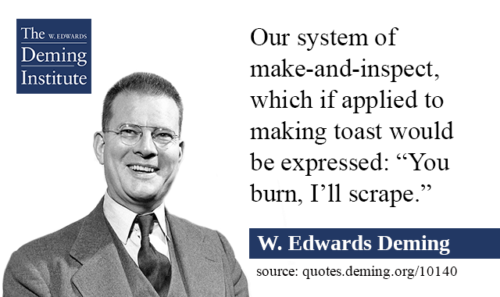
Nolan thus made a film about the philosophy of film. Reversed footage became ontology. The camera trick became a theology. Repetition is boring and inherently iterative. Filming a “Deming Cycle” of WWII wisdom about preventing WWIII would be considerably more difficult, even though a more coherent explanation.
Edge of Tomorrow knew this.

So did Groundhog Day.
They showed iterations as reversal. Nolan skipped the lessons, again ironic, and kept only the residue, a guy who “knows things” walks forward going backward. Nolan basically built a theology around a paradox of knowledge from running film backward, ignoring how Deming proved experts can see the future with a chalkboard.