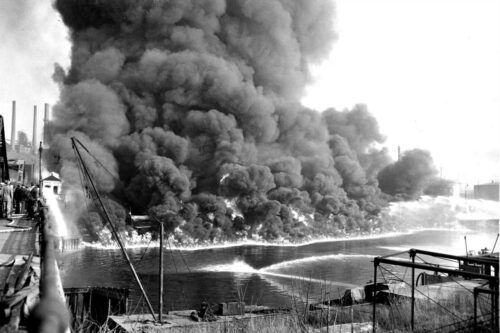
The early 1970s had some logic. Rivers were burning, air was unbreathable, pesticides like DDT were moving through whole ecosystems. Meanwhile, American tort law crawled case by case. Common-law suits could not regulate the rampant abuse of the public by a continental chemical economy, let alone a foreign one. An agency, however, could set standards before harm. That was the promise of the EPA when it landed: expert protection at scale, faster and broader than a jury in one county.
EPA was built under President Nixon to deliver a remedy the courts were too slow and scattered to provide.
Today, the EPA has been inverted into a blocking function.
Bayer has spent the last decade fighting more than 100,000 lawsuits filed by people who developed non-Hodgkin lymphoma they blamed on exposure to the glyphosate weedkillers, and the company has paid out billions of dollars in jury awards and settlements. All of the cases include allegations that the company failed to warn that glyphosate could cause cancer.
Bayer maintains that its products don’t cause cancer, and also asserts that under the Fifra the EPA is the key authority for determining if its product necessitated a cancer warning. The EPA has not required such a warning and has taken the position that glyphosate is “unlikely” to be carcinogenic, so the company cannot be held liable for failing to warn, according to Bayer’s argument.
In the Thursday ruling, the supreme court upheld this argument.
The evidence the agency set aside is overwhelmingly strong. In 2015 the WHO’s cancer agency classified glyphosate a probable human carcinogen, on limited human evidence, sufficient animal evidence, and strong evidence of genotoxicity. IARC, Group 2A. A 2019 Berkeley meta-analysis pooled the 2018 Agricultural Health Study with five case-control studies and found non-Hodgkin lymphoma raised 41 percent in the highest-exposed, a meta-relative risk of 1.41. Zhang et al. Three of its authors had served on the EPA’s own glyphosate advisory panel. The Agricultural Health Study itself, the cohort Bayer leans on, reported elevated acute myeloid leukemia at the top of the exposure range, significant under a twenty-year lag. Andreotti et al. In 2025 the Ramazzini Institute exposed rats from prenatal life and recorded dose-related leukemia deaths down to the European acceptable daily intake, and Europe’s chemical agency has reopened the classification. Panzacchi et al. Four lines of evidence that all point in a single, strong direction.
However, two political shifts happened since President Nixon to enable the Supreme Court’s stupidity.
First, the industry aggressively worked to occupy the agency, staffing it, funding the science it reviews, setting the terms of what counts as proof, completely breaching independence and integrity.
Second, the court practiced a binary judgment, where passive agency absence of action was ruled as active agency judgment against action. When the EPA has not yet acted, the preemption doctrine reads that the silence is a considered federal decision and displaces every active state remedy that would disagree with passivity.
Perhaps states that fight the Trump centralization regime should be called the Free States.
The flawed premise is that a single federal warning flag suppressed should shut down all other warning flags, which makes the federal flag the easy target for corporate capture and suppression. This court has ratified this vulnerability explicitly, which makes these judges complicit in the preventable mass harm that follows from the corporate capture of agency.
Judges made a choice to enable public harm. They had the evidence, the jurisdiction, the dissent in front of them, and they chose preemption to increase preventable suffering and deaths. That is an act, on the record, with names. Kavanaugh wrote it, and six others signed. Elie Wiesel indicted them all decades ago. Silence is the choice, documented, by people with the power to rule otherwise. Complicity attaches to the actor who chose death for profit.
While a state court sided with Durnell and awarded him more than $1 million in damages, Monsanto—now Bayer—appealed the ruling to the Supreme Court, arguing that federal law should override state law. The Supreme Court agreed…. Shares of Bayer jumped by more than 16% after the court’s ruling came out Thursday morning.
The dissent was Jackson and Gorsuch, who not only said the majority misread FIFRA, they argued Monsanto could comply with both federal and state law by ending Roundup sales. A simple compliance path existed. There was never an impossibility to claim.
Cipollone in 1992 cut tobacco claims on a federal labeling statute. Riegel in 2008 turned on a different mechanism, the FDA’s own premarket approval. Congress wrote the cigarette warning into statute. The FDA granted the device its approval. The EPA withheld the glyphosate warning. Three federal moves created corporate immunity from documented harm. The shield for profit on suffering was widened with each case. It once required an express command. Now it just takes an agency to do nothing, which means America runs fail-unsafe.
Corporations cause mass suffering on the principle that an agency hasn’t made a warning. It’s like requiring deny lists, instead of allow lists, for things that cause the most harms in history. The court treats absence of a warning as an explicit federal command that no state may evaluate no matter how overwhelming the evidence of failure. In February 2026 Monsanto announced a proposed nationwide class settlement for Roundup non-Hodgkin lymphoma claims, which it described as one element of a multi-pronged strategy to suppress claims against it.
Captured process, legalizing death caused by its captors, invokes some other history about suppressed chemical warnings by the same company as in courts today. Bayer was a founding member of IG Farben, the chemical combine that produced poison gas and supplied the Zyklon B delivered in “Red Cross” vehicles to be used in the death camp “showers”.
The crematorium is a big building with a wide chimney and 15 ovens. Under a garden there are two enormous cellars. One is where people undress and the other is the death chamber. People enter it naked and once about 3,000 are inside it is locked and they are gassed. After six or seven minutes of suffering they die,” he wrote.
He described how the Germans had installed pipes to make the gas chamber look like a shower room.
“The gas canisters were always delivered in a German Red Cross vehicle with two SS men. They then dropped the gas through openings – and half an hour later our work began. We dragged the bodies of those innocent women and children to the lift, which took them to the ovens.”
The Nazi victims never saw a warning label, by design, and neither do the Americans suffering from German chemicals killing them today.
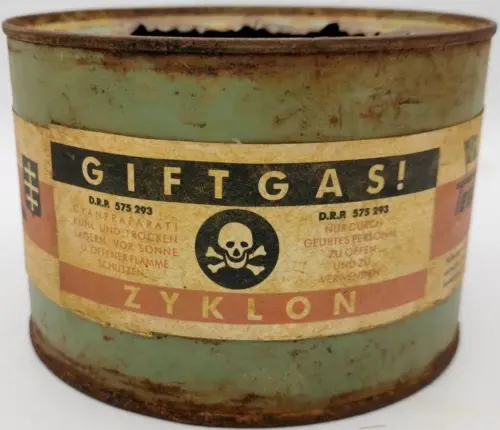
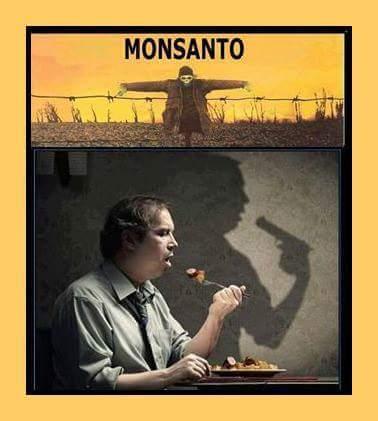
The Allies broke IG Farben apart after the war. The German company Bayer was refounded in 1951 and bought Monsanto in 2018. Some have depicted the brand reputation simply, as this: