
The New York Times covers the crash.
A driver in a Tesla vehicle that was engaged in automated driver-assistance mode crashed into a house in Texas on Friday night and killed a woman inside, the authorities said.
The driver, Michael Butler, was in a Tesla Model 3 about 8 p.m. local time and operating the car “with an automated driving assistance system,” the Harris County Sheriff’s Office said in a statement on Saturday.
The crash happened in Katy, Texas, about 30 miles west of Houston in Harris County.
Mr. Butler “failed to drive in a single lane, left the roadway and struck the residence” at 1907 Blooming Park Lane, the authorities said.
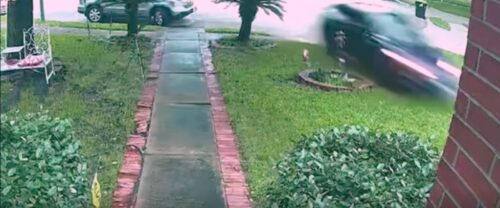
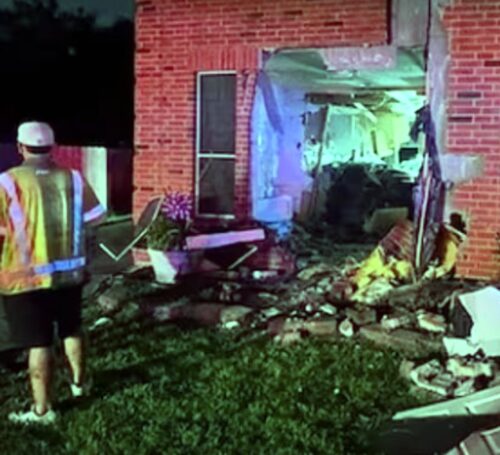
What the big headline newspaper doesn’t tell you it’s that the same Tesla fault just happened about two weeks ago in California.
A quiet Sunday morning in Claremont, California turned into a scene most residents hope to never witness firsthand. Just after 11 a.m. on Chateau Drive, a red Tesla traveling down Diane Avenue failed to slow at an intersection, struck a gray Mercedes stopped at a stop sign, and then continued directly into a nearby home. Six people were transported to local hospitals. The house was red-tagged by the end of the day.
What made this crash stand out beyond the sheer physical destruction was a detail neighbors passed along to reporters on scene: the Tesla driver reportedly claimed the vehicle was in Autopilot at the time of the collision.
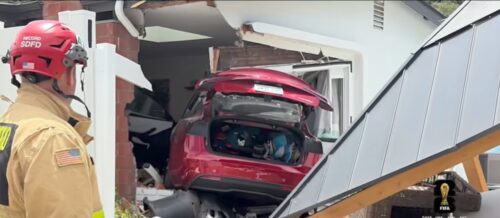
It also happened about two weeks ago in the UK.
A Tesla car ploughed into the front of a house in a late-night crash, wrecking ther front of the property.
Emergency services were called to Bag Lane, in Atherton, Wigan borough, at 11.23pm last night (June 4). Two fire engines attended the scene, near the junction with Mealhouse Lane, alongside police and paramedics.
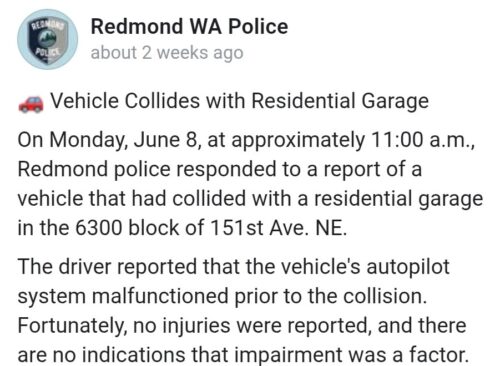
There’s also a similar recent crash in Washington.
And one in Tennessee, where Tesla was literally described as a bomb.
According to a police report, the Tesla Model 3 was on Autopilot. The driver told officers she had tried to brake to turn onto Market Street, but the car kept going and accelerated into the building.
Kay Bartley, a witness and Bartley-Hill’s mother, felt the wall shake and ran toward the car.
“It sounded like an explosion. I thought it was a bomb. When it quieted down, I opened the door, saw the car in the studio… shut the door, called nine-one-one and went out to help the people in the car,” Bartley said.
And you would think a New York paper could at least mention Tesla crashes like this in New York.
The Town of Oyster Bay Building Department deemed a home in Jericho unsafe after a teenage driver slammed her Tesla into the building late last night.
Nassau County police said the crash happened on Onondaga Place at the intersection of Orange Drive around 9:40 p.m.
The company’s latest and best attempts in 2026 at self-driving, on a tiny human-mapped course with optimal weather and a human monitor, have been crashing eight times more often than human drivers.
Notably, Tesla has tragic design flaws that make it like a bomb, and thus it has been killing dozens of people.
The Tesla that crashed into a building in TN was speeding at 50mph. There would have been alot more injuries and deaths if the accident had taken place a few minutes because a dance class had just moved to an adjacent dance studio.
“Police are reviewing the crash report and how the Autopilot was being used when the Tesla left the parking lot and hit the building.” Remember those Teslas can accelerate to 60mph in less than 6 seconds.
Tesla owners must be paying sky-high auto insurance rates for the destruction caused by their out of control cars. In the UK, auto insurance has increased nearly 50% over past 4 years due to extra accidents and damage caused by EV cars.