
The heart of this story is that a man who stayed completely silent under interrogation, and yet kept a written roster of every co-conspirator in his apartment for discovery by Nazis, is an implausible narrative.
On March 27, Dutch resistance fighters, including a painter named Willem Arondeus, told the Nazis they needed to inspect a building for explosives. The Nazis welcomed Arondeus inside. The resistance then planted explosives and blew up the papers being used to hunt Jews. The Reichskommissariat Niederlande immediately offered the Dutch a 10,000 guilder bounty. Within a week, Dutch resistance had been betrayed by Nazi collaborators. Forced detention began April 1 for torture and solitary confinement Twelve were shot on July 1; two received last-minute clemency, others got prison sentences (Honig and Beck survived Dachau, Van Essen got two years in Kleve).
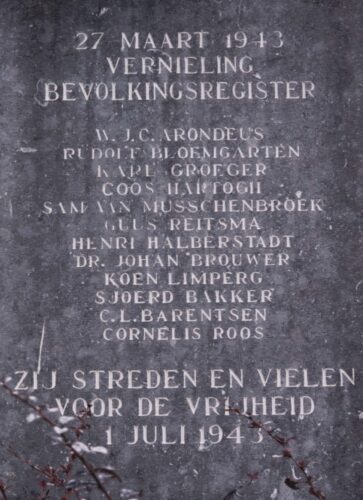
A story has since emerged, such as on Wikipedia, that a notebook was found in a search of Arondeus’ apartment that revealed everyone to the Nazis.
I suspect it is disinformation, and there was no notebook.
The detail traces to only the Yad Vashem Righteous Among the Nations file. And nobody else says it.
The USHMM says simply that “five days later the unit was betrayed and arrested.” No notebook.
The Stadsarchief Amsterdam, which holds the actual police reports and witness statements in its archives, says only that the Germans offered a high reward for tips and “within a week most were betrayed.” No notebook.
The Geschiedenislokaal Amsterdam repeats the same: reward offered, within a week most were betrayed. No notebook.
The VPRO documentary guide identifies the betrayer specifically: “the group was betrayed by an NSB member of the police.” No notebook.
One Dutch popular source says that despite torture, Arondeus refused to give names of resistance fighters. No notebook.
Instead we know how common and effective torture was because the Dutch public ran a human safari, where they hunted and turned people over to the Nazis for even small bounties. The system was widespread and continuous, dependant on Dutch collaboration. The Verzetsmuseum’s own 2025 commemoration speech, by Ruben Bloemgarten (nephew of executed participant Rudi Bloemgarten), quotes eyewitness testimony from Henri Gotjé and Cees Honig.
[Halberstadt] was no longer a normal person. He spoke only German to us, the tortures and emotions had made a wreck of him.
Gotjé further testified:
I could hear how they beat some of them, hung up by their hands behind their backs.
The 14 principal defendants lay for six weeks in dark cells with hands and feet bound to their beds. And critically: Gotjé was arrested late specifically “because Halberstadt despite inhuman tortures had long remained silent”, with the implication being Halberstadt eventually broke.
The Germans got the names through three mechanisms: an NSB police informant (identified in at least one source), the 10,000-guilder bounty that incentivized betrayal (documented by the Stadsarchief), and torture (documented by multiple eyewitnesses). Each person the Dutch had turned over to the Nazis could be leveraged against the next.
The notebook is an odd, unsubstantiated footnote, which serves to erase history of how the Germans got all the names without anyone having talked and without exposing the informant. It protects everyone’s reputation simultaneously, the resistance members’ honor, and the informant’s identity. Who knows why exactly this footnote was created and by who, but so far the notebook doesn’t seem to be real.