
Several people have asked what I thought when Jürgen Geuter, writing as tante, argued that AI is a fascist artifact.
He’s not saying AI is being deployed badly. He’s saying AI is inherently fascist. He places it in the category Langdon Winner reserved for technologies that demand a particular social order, the way the atom bomb demands a centralized command state. You cannot run that particular bomb democratically. In that sense, tante wants the model in the same classification.
I get it. I typically talk about minefields or cluster bombs as inhumane, and therefore a crime. If we can classify a weapon off limits, we can feel comfortable saying it crosses a bright line.
The problem for me is how his argument refutes itself.
He leans on Stafford Beer’s maxim that the purpose of a system is what it does. As such, tante reads the purpose of AI off its most disgusting and reprehensible deployments. Palantir, an overtly fascist company out to destroy democracy, markets its software as a weapon for kill decisions. Andreessen, an inhumane mockery of tech, demands the right to build without regulation while also demanding regulations that erase its critics. Image models infamously inherit the racism of the data scraped to train them. These deployments are all good examples of the bad, and they are reactionary.
The lean into Beer comes from tante saying he is an admirer. Beer built Project Cybersyn, a centralized computer system meant to coordinate the nationalized economy of Allende’s Chile.
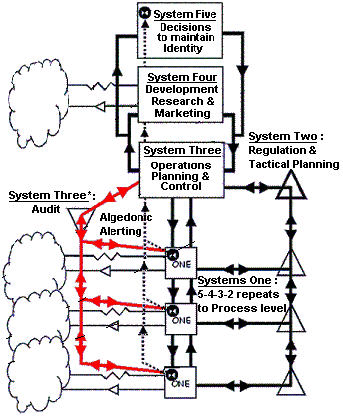
That’s interesting because it’s in the similar class as the bad examples above. Centralized computational coordination of an economy. By tante’s own logic a system is whatever it does, so Cybersyn was socialist because it served socialism. The politics are defined by the person in control and to what end they are aiming.
Record scratch.
This is the applied, contingent politics tante insists does not exist. He cannot endorse the principle that a system is what it does and condemn the model class as fascism in the same breath. That principle is what makes Cybersyn liberatory, and it puts the politics in the operator of the system.
Going back to Winner instead, we should separate two kinds of political technology. For example, when Robert Moses built overpasses so low that large buses carrying poor families could not reach the beach, that was politics by design.

The bomb is different from the overpass. Its politics are in the functional necessity. In other words, the evidence tante uses is all about the overpass. The frontier vendors would concentrate power because of how it is financed and owned, not because a working model can only exist in a form that prevents poor families from going to the beach.
On that point, we have evidence of models that pass the test. Apertus, from ETH Zurich and EPFL, was pretrained from scratch on rights-clean data. Pleias built its models on the Common Corpus the same way. Run the weights locally through Ollama with no telemetry and no API, and the capability should be free of fascism. And this trend seems like common sense. The model does not need its lab, while the bomb always and still needs the state.

What the bomb actually requires is not centralized command but a centralized means of production: a secret, capital-heavy, state-scale enrichment and weapons base. The Davy Crockett above makes the case clear. The Army handed the trigger to a three-man crew, the most decentralized nuclear launch ever fielded, and it still came out of Los Alamos and the Atomic Energy Commission. You can decentralize the distribution. You cannot decentralize production. Every warhead that has existed came out of that base.
The simple contradictions by tante make me wonder why he didn’t see them. He grants that oppressive tools can be turned against their makers. Ok, so they become good? But then he still tries to land the campaign to destroy AI. Destruction doesn’t follow from the premise that the tool is dual-use. If the politics is in the ownership and operation, the answer is to take ownership and operate another way: public compute, worker control over deployment. Destroy AI foolishly tries to name an enemy, which unfortunately could be the self.
The reactionary political economy of frontier AI is a real problem. The firms deserve the harshest criticism, especially Palantir. Calling the company fascist makes perfect sense to me, but their tools don’t carry the same labels. I’m no more likely to say an LLM has to be fascist than the rest of their compute infrastructure. And I say that because if you follow tante’s very broken and self-defeating logic, we start signaling that to build the alternative is forbidden if not impossible. And that’s simply not true.
The Amish refuse the public grid. The line to the utility is a tether to the outside world, and that relationship as dependence is what they reject. Electricity itself is fine. Build your own windmill, run it locally, and no one objects. The objection was never to electricity itself, which has no political stake. It was to the politics of someone else taking control.