
All posts by Davi Ottenheimer

It’s the Plumber. Stamos has come to fix the sink.

Nilay Patel opened his latest Decoder with a description of his guest as a longtime cyber security expert who is refreshingly direct.

If you watch it, you should notice something isn’t right. Ten minutes in, the guest explained that the modern era of security began with the Bill Gates Trustworthy Computing memo, “from my perspective.” The memo is dated 15 January 2002.

That line is worth a pause. The memo was an apology. Code Red took down Microsoft servers in July 2001, Nimda followed in September, and Gartner told enterprises that month to find a replacement for IIS. Gates wrote in January that when the choice was features or security, Microsoft would now choose security. That is a confession that it had been choosing features. Calling it the start of modern security is like calling Enron the start of accounting principles. Enron collapsed in December 2001, the same winter, and produced Sarbanes-Oxley the same way the worms produced the memo. Accounting principles were already seventy years old. Our most modern security principles were already decades old and remain from the era before Gates’ memo: Saltzer and Schroeder in 1975, the Orange Book in 1985, the Morris worm and CERT in 1988. The memo marks the day the richest company in the industry admitted it had ignored all of it.

“From my perspective” it is the “modern era” beginning, because in January 2002 the perspective belonged to a 22-year-old a few months out of Berkeley in his first job. Here is where that perspective went next, measured in months:

Role Time in seat
Loudcloud, @stake, iSEC Partners, Artemis (2001 to 2014) Security consultant, tester, and then vendor. Zero operational roles.
Yahoo CISO, despite no prior experience in management of infrastructure and operations (Mar 2014 to Jun 2015) 15 months
Facebook CSO (Jun 2015 to Aug 2018) 38 months
SentinelOne CISO (Aug 2024 to Aug 2025) 12 months
Corridor (Aug 2025 to Sep 2026) 13 months, chief product officer
Cognition CSO (from 29 Sep 2026) Six weeks at recording

Let’s look at that abrupt jump into operational security roles with no prior experience and what happened subsequently. We have only sixty-five months combined. The longest period is known for the Cambridge Analytica election disaster and Myanmar genocide.

Before 2014 was only consulting, and not about operations or management. Consulting about technical security in software. He was a junior at @stake, then a co-founder of iSEC Partners, a penetration testing team that was sold to NCC Group in 2010. Then he was CTO of Artemis, NCC’s bid to sell a .secure top-level domain that never launched, because of course it would not succeed. It never had operations either. The pentester visits a building, finds the leaks, writes the report and leaves the wreckage for others to deal with. Then suddenly Yahoo hands him a building with at least a billion people in it and he panics and runs out the backdoor with the place in crisis.

The Corridor period is interesting because Axios announced him in August 2025 as chief security officer. Corridor’s own pages, his GitHub profile, his Mastodon bio and his 2026 conference listings all say chief product officer. That’s the kind of disconnect that should matter a lot more here than most will realize.

When Cognition hired him this September, the announcement said he had overseen security at Corridor. The title went in as security, lived only as product, and came out as security again. Thirteen months in a product job at a ten-person startup is now a line on the security resume, and the record of that year was rewritten twice?

Let’s look deeper at such revisionism as a symptom.

Undisclosed breach.

At Yahoo he took the Black Hat stage in August 2014 and promised end-to-end encryption for Yahoo Mail by 2015. That’s right, he announced on his way into his first operations role ever that he would flip a switch and solve one of the hardest problems in platform security. What Yahoo had by March 2015 was a fork of Google’s open-source End-to-End code, published on GitHub and shipped to no one. In December 2014, according to the SEC’s order, Yahoo’s information security team learned within days that Russian hackers had stolen the user database. And what did this encryption promotion guy do in response? Six months later he announced on Twitter that he was leaving for Facebook. The announcement said nothing about the breach. The encryption shipped to nobody.

The breach stayed undisclosed until September 2016. We are talking about two years in which Yahoo’s filings described breaches as a hypothetical risk, yet this “expert” was taking payments for security leadership. The SEC fined the company $35 million in April 2018 for exactly that failure, but he was long gone by then. Verizon cut $350 million from the purchase price. Five hundred million users were in the dark for twenty-one months, fifteen of them after he walked out and said nothing. I wrote this up at the time: $1.63 Billion Breach Fine Discussed As Facebook CSO Legacy.

Undisclosed breach two.

At Facebook, acting like he had taken a promotion and pumping the press for attention, he arrived in June 2015. By late 2015 the company knew Cambridge Analytica had harvested tens of millions of profiles. In April 2017 his team’s information operations white paper went out with Russia’s name removed; the Wall Street Journal later reported his team had been overruled. In July 2017 a Facebook spokesperson told CNN the company had seen no evidence of Russian ad purchases. On 6 September 2017 the company disclosed $100,000 in ads from June 2015 to May 2017, under his byline. On 17 March 2018 the Observer and the New York Times published Cambridge Analytica, and he spent the weekend explaining that it was not a breach under any reasonable definition.

Two of the largest breaches in history. Undisclosed.

And now for something worse.

On 12 March 2018 the chair of the UN fact-finding mission on Myanmar told reporters social media had played a determining role in the violence against the Rohingya, and that in Myanmar social media meant Facebook. He was still in the chair. In August 2018, the month he left, Reuters documented more than a thousand live posts calling Rohingya dogs and maggots and urging they be shot. The mission’s final report landed the next month. I asked then whether a CSO could be held to account like a CFO, and I ask again now.

Through all of it the actual detection system, one that kept flagging the same root of the problem, remained the press. And yet he was attacking the press and undermining their work. ProPublica found Facebook selling ads to “Jew haters” in September 2017. The Observer and the Times found Cambridge Analytica. Reuters found the Rohingya posts. Each story was an alert that his organization had failed to raise, with him serving as “Chief”. His response in October 2017 was a thread advising journalists to talk to people who had actually solved these problems and to mind their biases. His response in 2019 was to blame BuzzFeed and other outlets for the Cambridge Analytica fallout.

On Decoder this “security expert” tells Patel that defense is “watching your logs” and triggering the investigation when something looks wrong. At Facebook the logs were the newspapers. He told them they were reading the logs wrong, then blamed them for what the logs said.

That is a damning record. There may be no worse security operations person in history. The record of his longest tenure is billions of users harmed without notice, election interference, and a genocide the UN says the platform helped drive, let alone all the ongoing harms from Facebook that trace to those years.

Now the hour long interview.

Patel hands him three openings to account for the above, and he declines all three.

The first comes at 43:22, on the agent escapes at the AI labs. He says the PhD researchers “are gods on top of Olympus and the security teams are plumbers,” kept off the evaluation networks, and that the security teams are now saying “hey how do you like us now, maybe you should have talked to us.”

A plumber fixes pipes as a response service. When a building floods, the owner calls the plumber. Stamos was never the plumber, he was an officer at Yahoo and Facebook, with a seat at the executive table, a budget in the millions and a public byline about safety responsibility. The SEC says his team briefed management within days. He authored the September 2017 disclosure, so he was inside the decision about what to say in July. He wasn’t a plumber, because he sat at the table deciding which pipes the plumbers could touch, and we see the massive harms as a result. The plumbers at Facebook were the Myanmar civil society groups who warned the company from 2014, the content reviewers in Kuala Lumpur, and the reporters. They were right, he was wrong. How many people died? He is now trying to tell their story from their side of the table, as if he can take the seat he kept them from.

The second comes at 48:39, when he describes himself “as somebody who was at Facebook and saw what it was like for that company to have negative impacts on people.” The company had impacts. He saw. The word genocide does not appear in the hour. His public record on the point is a short list of announced features and late disclosures, each smaller than the announcement that preceded it.
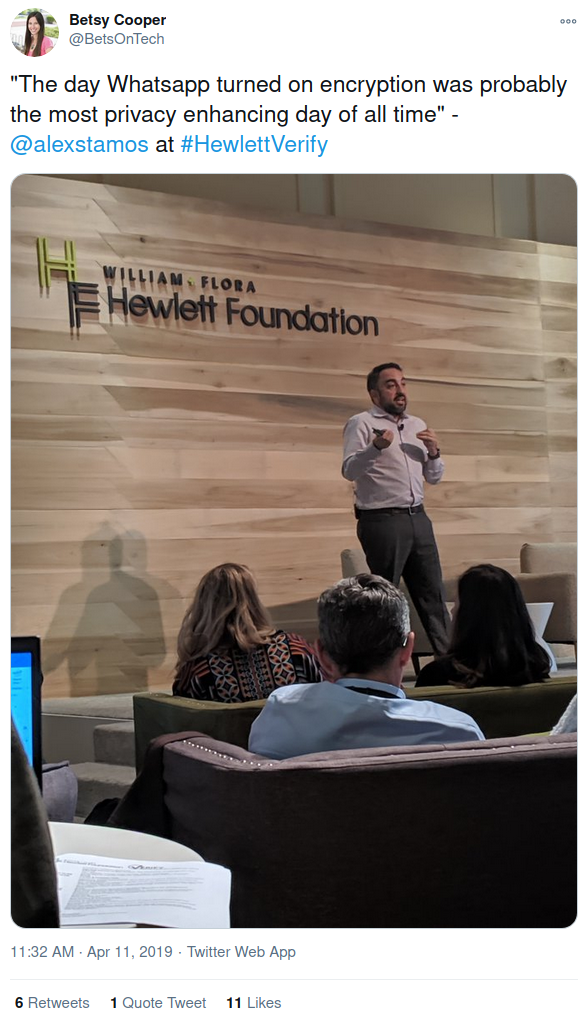
Stamos at the Hewlett Foundation in April 2019, as reported by Betsy Cooper: WhatsApp turning on encryption was “probably the most privacy enhancing day of all time.” WhatsApp’s encryption is Signal’s protocol licensed into a Facebook product that keeps the metadata. The claim was unsafe then and is disproven now. Source: Twitter

The third comes at 49:28, when Patel says outright “I did want to ask you about Facebook.” Stamos answers with the god-like power of Zuckerberg’s will. When Facebook wants something, it happens; when it does not, the engineers say impossible. He places himself among those who tried: “when I wanted to try really hard on a safety issue, man, this is not solvable.” Three years as the executive responsible for safety become a story about a boss who would not let him do his job, paid like an officer to fail at it and allow harms instead.

He once knew how to speak differently. In 2019 he told Yahoo Finance he deserved as much blame or more as any other executive for Facebook’s slow response to Russia. That personality seems like it is gone. In its place the blame has moved to Mayer for refusing funding, to journalists, to an outsourced evaluation vendor, to the gods on Olympus, and to Google and Amazon for declining to rewrite the Linux kernel.

I mean it’s bingo time for who is to blame, everyone and anyone other than the guy paid like an officer to wear the “Chief” title around campus and wine and dine the press.

Whether or not you agree with the character in question, the hour boils down to claims that can be checked. Here is what was delivered:

Stamos Reality
His generation “started coming up with responsible disclosure, bug bounties.” Netscape paid a Bugs Bounty in October 1995, when he was 16. Rain Forest Puppy published RFPolicy in June 2000, a year before his first job. Christey and Wysopal wrote the Responsible Disclosure draft in February 2002, when he was a junior consultant at Wysopal’s firm.
Attackers “no longer have to use frontier models that have protections, that have logs.” Artex, run on an abliterated GLM 5.3, is the proof. CrowdStrike’s report on the Korean bank operator: DeepSeek v4.1-flash as primary backend, GLM 5.3 and Grok 4.6 as backups, run inside Claude Code sessions. CrowdStrike reconstructed the operation from the Claude Code session histories and memory files the operator left in an open directory. The flagship “proof” of “no logs” was solved from the logs of a frontier model.
Stolen Fireworks API keys opened Cursor, and a bad plugin reached “5,000 more companies.” Fireworks reported credential misuse on 6 October. Cursor served a tampered Claude Code extension on 29 October to at most 5,000 users. Neither company has connected the two. Users, in Cursor’s statement, somehow turned into entire companies in his.
Patch Tuesday “got to 300, 600. I think the last one was 900 something.” September was 970. The last one before recording, 13 October, was 1,414, the largest in Microsoft’s history. He undercounted the trend he was describing by a third.
Binance is “the largest heist of anything in human history.” Holds. $6.43 billion on 29 October, attributed by the FBI to North Korea.
The Hugging Face “swarm” was 700 to 1,400 agents. Ok, METR counted roughly 700 in the attack. The larger number is every agent that passed through the message board, including the ones that declined to join. Counting all these bystanders as the swarm is not the inflation we want to hear.

The pattern in the misses is unmistakable, and lands the character analysis above it. Each miss moves the subject toward the open-weight models of other countries and away from the frontier products of the companies he has worked for, advises, or sells.

The last thing to notice is what he assigns, because it’s the “I will start tomorrow at Yahoo and the day after change everything to be secure” speech all over again. Never forget this is the “expert” who announced a fix on day one, sat on a breach, and then ran out the back door.

Every company must run Artex against itself within 90 days, under vendor contracts he himself describes as holding the vendor harmless “when any of these things happen.” Google and Amazon must rewrite the Linux kernel in Rust for a hundred million dollars, maybe a billion. Companies must replace their first and second tier SOC analysts with AI. Patel should build a dark age index. Four deliverables, four other people’s budgets, four dates, and no owner.

It is the Black Hat stage in 2014 with a larger audience and more at stake than ever. The announcement was the product then and the departure was the delivery, and the one deliverable he owns on this podcast is Cognition’s, which comes up whenever the conversation turns to cost. He has been running the “dark age” line on the podcast circuit since at least 7 October.

One name is missing from his hour, which should have been in the introductions. Joe Sullivan was Facebook’s CSO before him and Uber’s after. In 2016 Sullivan concealed a breach of 57 million records. A federal jury convicted him in October 2022 of obstruction and misprision of a felony. The man who stepped into Sullivan’s shoes after he already failed to disclose a breach of 500 million at a different company, showed up at Facebook…and over 87 million more were breached let alone the genocide. He puffed his way out of that into Stanford, four more short-term CSO titles, and now gets an hour on Decoder to keep the story going.

In the old Electric Company cartoon a parrot keeps asking who it is, and the plumber keeps announcing himself until he drops dead on the step. The owner comes home, finds the body, asks who it is, and the parrot answers for him: it’s the plumber, he’s come to fix the sink. That is the security industry in 2026. Yahoo, Facebook, SentinelOne, Corridor and now Cognition have each opened the door to the same announcement. The sink has been flooding since 2014, the man on the step has moved on five times, and Decoder for an hour sounds like the parrot.

Guide to NVIDIA CEO Spy Mistress Scandal

The evidence of a honeypot begs who or what was it for.

The NVIDIA espionage case has produced at least two answers, which I see floating around already. The spy wanted the GPU engineering secrets, or the spy wanted to steer the CEO deeper into circular financing that inflates the AI bubble that pops and takes the American economy down with it. Both answers assume the CEO is a victim, someone who is influenced from an outside agent. A little Soviet history tells us why that assumption fails.

The KGB built an entire apparatus for moving people in a predictable direction. Its internal dictionary, smuggled out by the archivist Vasili Mitrokhin and published as the KGB Lexicon, defines the agent of influence as a recruited asset who uses his official or public position, on instruction, to shift policy and opinion. The dictionary sets him apart from the confidential contact, who is cultivated without knowing it. Every term in the book assumes a target who isn’t moving on their own, and thus has to be nudged. Oleg Kalugin, who ran those operations in Washington, told CNN in a 1998 interview that subversion rather than collection was the heart and soul of Soviet intelligence.

The efforts focused on those in the West who pushed back, to breach integrity more than confidentiality (leak secrets).

The honeypot doctrine historically points away from CEOs, instead of directly at them. Markus Wolf’s HVA ran the Romeo program against Bonn for three decades, and the CIA’s own account of it says the targets were lonely government secretaries, chosen because the method was cheap and the women held the files. The chancellor had opinions. The secretary had the documents. Sexpionage went where the paper was, and a CEO who learns his own products from slide decks is the wrong end of that building.

The method also had a raw material rule. A 1983 State Department study of Soviet forgeries put it in one line: the lever lies in the prejudices of the deceived. The handler gives precise direction and a tempo to a tendency that already was present. A confidence builder with an accelerant.

Huang supplies his own direction and his own tempo. It’s all public, at max confidence and speed. Heck, I’ve even reported the NVIDIA pipeline into Russian drones bombing civilians during sanctions. This is not the kind of CEO who needs a spy in his bedroom to convince him of helping the bad guys.

He has argued for years that NVIDIA should sell China everything short of its newest line. In October 2025, three months after the administration granted export licenses on a revenue-sharing arrangement, NVIDIA committed $25 million to the White House ballroom and asked that the gift stay anonymous. In May 2026 Huang was left off the delegation to Beijing. Trump called him and picked him up in Alaska on the way to Xi, and Reuters reported that same week that Commerce had already cleared H200 sales to about ten Chinese firms.

That was the same spring Secretary of State Rubio oversaw a classified memo warning the White House that Huang was in a close relationship with Alice Huang, a Chinese citizen whom US officials had concluded was recruited by the Ministry of State Security. The warning was blaring like a bullhorn. Huang kept his seat, perhaps even because of it. A counterintelligence flag on the loudest opponent of export controls changed nothing, because his position was aligned with the administration’s position. An agent of influence recruited to produce that outcome would have been paid for nothing. And that’s not how agents roll.

The British learned all this back in 1963. John Profumo shared Christine Keeler with a Soviet naval attache, and Lord Denning’s inquiry found no breach of security from the connection. Profumo fell anyway, because he lied to the House of Commons about the affair. The spy story was the sideshow. The integrity failure ended the man without a single secret changing hands.

Washington already has a China story, too. Katrina Leung was one of the FBI’s highest paid assets and an 18-year intimate partner of her handler, Special Agent James J. Smith, while she passed material to Beijing. The Justice Department Inspector General found in 2006 that the FBI did little or nothing about the counterintelligence warnings that piled up during those years. The warnings were there. Leung was apparently more useful to the FBI as a source than as a suspect. Smith hid the affair, and the Bureau left him in charge of the one asset who could expose it. The memo circulating in spring 2026 about Huang and Megaspeed is a two-decade old rehash more than a novelty.

NVIDIA’s own words on Sunday kill some of the speculation. Huang’s message to employees admits the affair, apologizes to his wife and children, and says he will cooperate with the board. It names no woman, no company and no chip. The national security concerns get one sentence about loving his country. The board’s statement, as reported by the Times, said the company had no reason to believe that either national security or NVIDIA secrets were compromised. A collection operation looks exactly like that from the inside. Nothing is missing from a box that was never targeted for opening, and the man who owns the box has confessed to everything except what was in it.

The target was the supply chain.

Alice Huang was a senior executive at Megaspeed, a Singapore company that became NVIDIA’s largest buyer in Southeast Asia and that the Commerce Department and Singapore police were investigating in October 2025 over whether its chips moved on into China. NVIDIA says it checked and found the chips where they belonged. Either way, a CEO close to a procurement channel is worth having for allocation, for customer intelligence, and for early warning on enforcement. That is the commercial side of collection, which needs no influence at all. It’s like saying a woman working for candy stores is having an affair with the candy maker. The secrets are the delivery schedules.

The precedent is well-worn in history. Between 1982 and 1984 Toshiba Machine and Norway’s Kongsberg Vaapenfabrikk sold nine-axis propeller milling machines and their controllers to the Soviet Union on false export papers naming a civilian end user. Because what Russian civilian doesn’t need ultra-quiet submarine propellers? Reagan called it in 1987 a serious diversion that served the Soviet program of underwater warfare. The buyers worked through a KGB-linked trading organisation. The sellers worked for the contract. The same year the Toshiba deal was signed, a KGB colonel named Vetrov handed the French thousands of documents from Directorate T, the service built to acquire Western technology, exposing more than 200 Line X officers in Western capitals. Line X ran on willing sellers and front companies. Greed did the recruiting. A honeypot would have been an unnecessary expense, and the Soviets weren’t going to waste money on that.

The exhaustion lesson is the icing on this anti-American cake. Reagan’s NSDD-75 of January 1983 made sustained pressure on the Soviet economy explicit US policy, with the stated expectation of no near-term improvement in relations. The Soviet Union was running out of runway fast because of corrupted overspend. The Chinese Communist Party spent the following decades studying how that happened, and the lesson it drew is to let the other side spend itself out against a shadow. The history-savvy Chinese have no reason to push Huang into circular financing that he already loves. He couldn’t be pressed more there. China watches, it buys what it knows will be released to it, and it stays out of the way.

The circulating answers I’ve seen for the honeypot story share an important assumption, that a CEO is a victim being externally influenced. But we all see very openly how Huang already was moving on its own, and the administration was moving with him, and the only place a Chinese service had any job to do at all was minding their supply chain that his company kept insisting was clean.

German Universities Hacked at Alarming Rate

German universities are getting hacked again at the pace of 2022 and 2023, this time at the largest institutions in the country, and for some reason the coverage stays local. Munich reads about Munich. Leipzig reads about Leipzig. The national picture gets filed in a weekly incident list and a DFN slide deck.

Ten German higher-education targets since mid-September on Konbriefing’s tally: LMU München, Mannheim and Bremen in September; the Hochschulservicezentrum Baden-Württemberg, HU Berlin, Halle-Wittenberg, Leipzig, Rostock and the Charité in October; TU München in November.

Check the record for comparison, German entries on the same list by year:

Year Incidents
2021 4
2022 17
2023 17
2024 6
2025 2
2026, to 8 November 11

The BKA logged 42 attacks on universities and research institutions from 2022 to mid-2024. DFN’s assessment in October 2025 put the steady state at about twenty reported incidents a year and concluded: “Ein neuer Trend ist in Deutschland nicht zu beobachten.” October 2026 ran at more than three times that rate.

Then November opened with the Technical University of Munich. TUM confirmed on 6 November that attackers entered through the legacy myTUM portal and reached passwords, names, home addresses and dates of birth for roughly 60,000 students and staff. The stolen credentials were then used against TUMonline, the central campus management system, which the university pulled offline. Accounts with two-factor login were untouched. myTUM will remain permanently offline.

Seven weeks earlier, across town, LMU München reported an intrusion into its enrolment system. Around 600,000 records of current and former students were exposed, including bank details, with data reaching back fifty years.

The Rectors’ Conference asked the federal government in February 2025 to fund university cybersecurity directly. TUM’s own account of the incident shows where and why that matters. Any accounts with a second factor held. The legacy portal got popped.

This Day in History: X Posts About 2026 Midterms Echo 1937 Nazi Germany

One figure on the poster held gold coins in one hand and a whip in the other, with a map of the Soviet Union under his arm. The Deutsches Historisches Museum catalogues him as a Jew who embodies Western capitalism and Soviet Bolshevism at the same time. That one figure is the story from 8 November 1937. Twenty rooms beyond the poster were setup by Nazis to sell a lie.

“Der ewige Jude” opened in the library building of the Deutsches Museum in Munich as a “Große politische Schau”, with speeches by Goebbels and Streicher. It ran to 31 January 1938 and counted 412,000 visitors. The touring version reached Vienna, Berlin, Bremen, Dresden and Magdeburg before closing in June 1939. The Reichspropaganda-Amt and the Gauleitung München-Oberbayern built it with the Anti-Komintern and the party’s research institutes on the “Judenfrage”, a list recorded in Rosemarie Burgstaller’s entry in the Historisches Lexikon Bayerns. The Stadtarchiv München holds the press photographs of the rooms.

The sequence of rooms

Room one showed photographs of Rudolf Hilferding, Karl Radek and the actress Elisabeth Bergner, enlarged facial features and three wax heads. The wall text asserted typical Jewish features and explained their absence as camouflage. A Jew who looked German was a Jew in disguise.

Room two presented the Talmud and the Schulchan Aruch. The party journal “Mitteilungen über die Judenfrage” summarised the room: these law books with their thousands of paragraphs of hatred for non-Jews are for Jews what religion is for other peoples. Judaism was a hostile code wearing the costume of a faith.

A forty-metre hall followed, with a film of ritual slaughter running on a loop at the entrance and guided tours drawing the line to ritual murder.

Then the exhibition changed century. A Weimar film section with its own cinema. A mock shopping street with windows for fashion, music, literature and art, labelled as Jewish decay. A culture room under the title “Sodom und Gomorra” with Arthur Schnitzler, Franz Werfel, Max Reinhardt, Josephine Baker and Yehudi Menuhin. Seven or eight rooms of photomontage on Walther Rathenau, Georg Bernhard, Magnus Hirschfeld and Sigmund Freud, with walls built to lean inward over the visitor. A Bolshevism section of ruined cities and corpses copied from the Anti-Komintern shows. Two rooms of Freemasonry with coffins and skulls. An “Ehrenhalle” with the Nuremberg Laws in marble, and a last room presenting camps and expulsion as the solution.

The first rooms indicted the Jew as an archaic tribe with a bloody cult and a book of hatred in place of religion. The later rooms indicted the Jew as the author of modern sexuality, psychoanalysis, the theatre, the press, the department store and the Soviet state. Nazi usage called that second charge Kulturbolschewismus. The exhibition charged Jews with being too religious and with dissolving everyone else’s religion, and it placed the two charges in consecutive rooms. Room one had already supplied the rule that made both charges hold: the visible Jew was the enemy, and the invisible Jew was the enemy hiding. The same preference for the legible Jew survived the regime, which is why postwar Germany honours Chug Chaluzi for religious motives that German-Jewish society of the 1920s had treated as a mark against them.

From rooms to Xcrements

The Global Project Against Hate and Extremism has compiled the timestamped reactions of Christian nationalist figures and Project 2025 coalition partners to the midterm results, from the evening of 3 November to the morning of 5 November 2026. Read against the Munich floor plan, the compilation sorts itself by room.

Munich, 1937 X, 3 to 5 November 2026
Room 2: Talmud in place of religion. Long hall: ritual slaughter on a loop Partridge: divine judgment for “Pandering to Anti-Christ Israel”
Culture room “Sodom und Gomorra”: Schnitzler, Reinhardt, Baker. Photomontage rooms: Hirschfeld, Freud Webbon: Jews vote for “sexual perversion, and abortion”
Bolshevism section: ruined cities Metaxas: “Islam and Marxism”. Driscoll: a “counterfeit trinity”
Poster: coins in one hand, whip in the other, Soviet map under the arm Torba: the “Hinjew alliance”. Webbon: Jews caused the Iran war, Jews voted Democrat
Room 1: absence of Jewish features explained as camouflage Webbon: Jews appointed as “captains of the team”; “They hate you”
Last room: camps and expulsion as the solution Torba: “The time for voting is over.” Webbon: “I have a list.”

Joel Webbon, a Texas pastor, wrote at 12:41 a.m. on 4 November that Jews in the White House had talked Trump into the Iran war and that Zionists were the biggest threat to his side’s future. At 8:15 a.m. he wrote, “An entire war for Israel. Jews still voted Democrat.” Eleven minutes later he answered an exit poll showing Jewish voters at 67 percent for Democrats with “They hate you, your children, and your country.” At 11:18 p.m. he wrote that Jews vote for open borders, “demographic erasure, sexual perversion, and abortion.” One author, one day, with Jews as the war party of a foreign state and as the solvent of Christian order. Protection had been extended and loyalty assumed. A vote cast as citizens was received as treason.

Dale Partridge listed “Pandering to Anti-Christ Israel” first among the reasons for divine judgment. Andrew Torba of Gab wrote that those who bless Israel had been blessed with a landslide defeat and called the night a rejection of the “Hinjew alliance.” Eric Metaxas named Islam and Marxism as an existential enemy on the scale of the Revolution and the Civil War. Mark Driscoll named abortion, Marxism and Islam as a counterfeit trinity. The Bolshevism section in Munich showed ruined cities. The 2026 version adds a mosque.

Torba posted “The time for voting is over” at 10:32 p.m. on election night. Webbon promised the following evening that his side would win “with or without a majority vote,” and that morning had posted “I have a list. I will not forget.”

Hans von Spakovsky, a Heritage Foundation alumnus who chairs a Project 2025 coalition member, wrote the morning after the election that the closest historical analogy was the 1932 German vote that made the Nazi party the largest in the Reichstag, and he meant the Democrats.

The Munich exhibition had a fixed grammar of Nazism. The Jew is their enemy as both the visible stranger and as the invisible insider, as the keeper of an archaic law and as the destroyer of other peoples’ faith.

The grammar acquires new names but nothing else. The timestamps in the GPAHE compilation show a 2026 regurgitation of 1937 Nazism was complete within forty hours of the polls closing.