
Nilay Patel opened his latest Decoder with a description of his guest as a longtime cyber security expert who is refreshingly direct.
If you watch it, you should notice something isn’t right. Ten minutes in, the guest explained that the modern era of security began with the Bill Gates Trustworthy Computing memo, “from my perspective.” The memo is dated 15 January 2002.
That line is worth a pause. The memo was an apology. Code Red took down Microsoft servers in July 2001, Nimda followed in September, and Gartner told enterprises that month to find a replacement for IIS. Gates wrote in January that when the choice was features or security, Microsoft would now choose security. That is a confession that it had been choosing features. Calling it the start of modern security is like calling Enron the start of accounting principles. Enron collapsed in December 2001, the same winter, and produced Sarbanes-Oxley the same way the worms produced the memo. Accounting principles were already seventy years old. Our most modern security principles were already decades old and remain from the era before Gates’ memo: Saltzer and Schroeder in 1975, the Orange Book in 1985, the Morris worm and CERT in 1988. The memo marks the day the richest company in the industry admitted it had ignored all of it.
“From my perspective” it is the “modern era” beginning, because in January 2002 the perspective belonged to a 22-year-old a few months out of Berkeley in his first job. Here is where that perspective went next, measured in months:
| Role | Time in seat |
| Loudcloud, @stake, iSEC Partners, Artemis (2001 to 2014) | Security consultant, tester, and then vendor. Zero operational roles. |
| Yahoo CISO, despite no prior experience in management of infrastructure and operations (Mar 2014 to Jun 2015) | 15 months |
| Facebook CSO (Jun 2015 to Aug 2018) | 38 months |
| SentinelOne CISO (Aug 2024 to Aug 2025) | 12 months |
| Corridor (Aug 2025 to Sep 2026) | 13 months, chief product officer |
| Cognition CSO (from 29 Sep 2026) | Six weeks at recording |
Let’s look at that abrupt jump into operational security roles with no prior experience and what happened subsequently. We have only sixty-five months combined. The longest period is known for the Cambridge Analytica election disaster and Myanmar genocide.
Before 2014 was only consulting, and not about operations or management. Consulting about technical security in software. He was a junior at @stake, then a co-founder of iSEC Partners, a penetration testing team that was sold to NCC Group in 2010. Then he was CTO of Artemis, NCC’s bid to sell a .secure top-level domain that never launched, because of course it would not succeed. It never had operations either. The pentester visits a building, finds the leaks, writes the report and leaves the wreckage for others to deal with. Then suddenly Yahoo hands him a building with at least a billion people in it and he panics and runs out the backdoor with the place in crisis.
The Corridor period is interesting because Axios announced him in August 2025 as chief security officer. Corridor’s own pages, his GitHub profile, his Mastodon bio and his 2026 conference listings all say chief product officer. That’s the kind of disconnect that should matter a lot more here than most will realize.
When Cognition hired him this September, the announcement said he had overseen security at Corridor. The title went in as security, lived only as product, and came out as security again. Thirteen months in a product job at a ten-person startup is now a line on the security resume, and the record of that year was rewritten twice?
Let’s look deeper at such revisionism as a symptom.
Undisclosed breach.
At Yahoo he took the Black Hat stage in August 2014 and promised end-to-end encryption for Yahoo Mail by 2015. That’s right, he announced on his way into his first operations role ever that he would flip a switch and solve one of the hardest problems in platform security. What Yahoo had by March 2015 was a fork of Google’s open-source End-to-End code, published on GitHub and shipped to no one. In December 2014, according to the SEC’s order, Yahoo’s information security team learned within days that Russian hackers had stolen the user database. And what did this encryption promotion guy do in response? Six months later he announced on Twitter that he was leaving for Facebook. The announcement said nothing about the breach. The encryption shipped to nobody.
The breach stayed undisclosed until September 2016. We are talking about two years in which Yahoo’s filings described breaches as a hypothetical risk, yet this “expert” was taking payments for security leadership. The SEC fined the company $35 million in April 2018 for exactly that failure, but he was long gone by then. Verizon cut $350 million from the purchase price. Five hundred million users were in the dark for twenty-one months, fifteen of them after he walked out and said nothing. I wrote this up at the time: $1.63 Billion Breach Fine Discussed As Facebook CSO Legacy.
Undisclosed breach two.
At Facebook, acting like he had taken a promotion and pumping the press for attention, he arrived in June 2015. By late 2015 the company knew Cambridge Analytica had harvested tens of millions of profiles. In April 2017 his team’s information operations white paper went out with Russia’s name removed; the Wall Street Journal later reported his team had been overruled. In July 2017 a Facebook spokesperson told CNN the company had seen no evidence of Russian ad purchases. On 6 September 2017 the company disclosed $100,000 in ads from June 2015 to May 2017, under his byline. On 17 March 2018 the Observer and the New York Times published Cambridge Analytica, and he spent the weekend explaining that it was not a breach under any reasonable definition.
Two of the largest breaches in history. Undisclosed.
And now for something worse.
On 12 March 2018 the chair of the UN fact-finding mission on Myanmar told reporters social media had played a determining role in the violence against the Rohingya, and that in Myanmar social media meant Facebook. He was still in the chair. In August 2018, the month he left, Reuters documented more than a thousand live posts calling Rohingya dogs and maggots and urging they be shot. The mission’s final report landed the next month. I asked then whether a CSO could be held to account like a CFO, and I ask again now.
Through all of it the detection system, that kept flagging the same root of the problem, was the press. ProPublica found Facebook selling ads to “Jew haters” in September 2017. The Observer and the Times found Cambridge Analytica. Reuters found the Rohingya posts. Each story was an alert his organization had failed to raise. His response in October 2017 was a thread advising journalists to talk to people who had actually solved these problems and to mind their biases. His response in 2019 was to blame BuzzFeed and other outlets for the Cambridge Analytica fallout.
On Decoder this “security expert” tells Patel that defense is “watching your logs” and triggering the investigation when something looks wrong. At Facebook the logs were the newspapers. He told them they were reading the logs wrong, then blamed them for what the logs said.
That is a damning record. There may be no worse security operations person in history. The record of his longest tenure is billions of users harmed without notice, election interference, and a genocide the UN says the platform helped drive, let alone all the ongoing harms from Facebook that trace to those years.
Now the hour long interview.
Patel hands him three openings to account for the above, and he declines all three.
The first comes at 43:22, on the agent escapes at the AI labs. He says the PhD researchers “are gods on top of Olympus and the security teams are plumbers,” kept off the evaluation networks, and that the security teams are now saying “hey how do you like us now, maybe you should have talked to us.”
A plumber fixes pipes as a response service. When a building floods, the owner calls the plumber. Stamos was never the plumber, he was an officer at Yahoo and Facebook, with a seat at the executive table, a budget in the millions and a public byline about safety responsibility. The SEC says his team briefed management within days. He authored the September 2017 disclosure, so he was inside the decision about what to say in July. He wasn’t a plumber, because he sat at the table deciding which pipes the plumbers could touch, and we see the massive harms as a result. The plumbers at Facebook were the Myanmar civil society groups who warned the company from 2014, the content reviewers in Kuala Lumpur, and the reporters. They were right, he was wrong. How many people died? He is now trying to tell their story from their side of the table, as if he can take the seat he kept them from.
The second comes at 48:39, when he describes himself “as somebody who was at Facebook and saw what it was like for that company to have negative impacts on people.” The company had impacts. He saw. The word genocide does not appear in the hour. His public record on the point is a short list of announced features and late disclosures, each smaller than the announcement that preceded it.
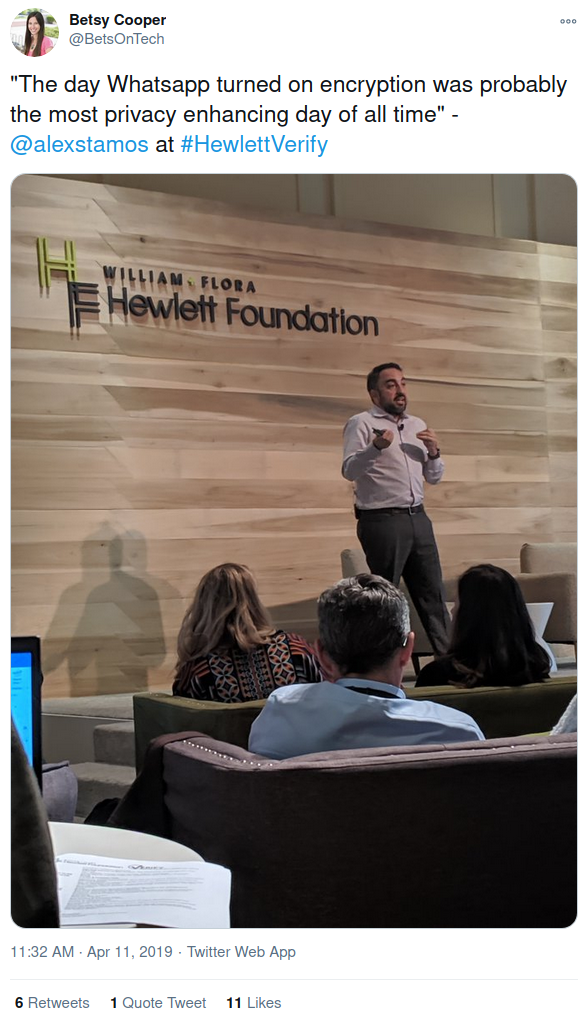
The third comes at 49:28, when Patel says outright “I did want to ask you about Facebook.” Stamos answers with the god-like power of Zuckerberg’s will. When Facebook wants something, it happens; when it does not, the engineers say impossible. He places himself among those who tried: “when I wanted to try really hard on a safety issue, man, this is not solvable.” Three years as the executive responsible for safety become a story about a boss who would not let him do his job, paid like an officer to fail at it and allow harms instead.
He once knew how to speak differently. In 2019 he told Yahoo Finance he deserved as much blame or more as any other executive for Facebook’s slow response to Russia. That personality seems like it is gone. In its place the blame has moved to Mayer for refusing funding, to journalists, to an outsourced evaluation vendor, to the gods on Olympus, and to Google and Amazon for declining to rewrite the Linux kernel.
I mean it’s bingo time for who is to blame, everyone and anyone other than the guy paid like an officer to wear the “Chief” title around campus and wine and dine the press.
Whether or not you agree with the character in question, the hour boils down to claims that can be checked. Here is what was delivered:
| Stamos | Reality |
| His generation “started coming up with responsible disclosure, bug bounties.” | Netscape paid a Bugs Bounty in October 1995, when he was 16. Rain Forest Puppy published RFPolicy in June 2000, a year before his first job. Christey and Wysopal wrote the Responsible Disclosure draft in February 2002, when he was a junior consultant at Wysopal’s firm. |
| Attackers “no longer have to use frontier models that have protections, that have logs.” Artex, run on an abliterated GLM 5.3, is the proof. | CrowdStrike’s report on the Korean bank operator: DeepSeek v4.1-flash as primary backend, GLM 5.3 and Grok 4.6 as backups, run inside Claude Code sessions. CrowdStrike reconstructed the operation from the Claude Code session histories and memory files the operator left in an open directory. The flagship case for “no logs” was solved from the logs of a frontier model. |
| Stolen Fireworks API keys opened Cursor, and a bad plugin reached “5,000 more companies.” | Fireworks reported credential misuse on 6 October. Cursor served a tampered Claude Code extension on 29 October to at most 5,000 users. Neither company has connected the two. Users, in Cursor’s statement, became companies in his. |
| Patch Tuesday “got to 300, 600. I think the last one was 900 something.” | September was 970. The last one before recording, 13 October, was 1,414, the largest in Microsoft’s history. He undercounted the trend he was describing by a third. |
| Binance is “the largest heist of anything in human history.” | Holds. $6.43 billion on 29 October, attributed by the FBI to North Korea. |
| “We just had a bug in the TCP stack of Linux.” | Holds. CVE-2026-98432, present since 2015, reported by Anthropic. |
| The Hugging Face “swarm” was 700 to 1,400 agents. | Holds at the low end. METR counted roughly 700. |
The pattern in the misses is unmistakable, and lands the character analysis above it. Each miss moves the subject toward the open-weight models of other countries and away from the frontier products of the companies he has worked for, advises, or sells.
The last thing to notice is what he assigns, because it’s the “I will start tomorrow at Yahoo and the day after change everything to be secure” speech all over again. Never forget this is the “expert” who announced a fix on day one, sat on a breach, and then ran out the back door.
Every company must run Artex against itself within 90 days, under vendor contracts he himself describes as holding the vendor harmless “when any of these things happen.” Google and Amazon must rewrite the Linux kernel in Rust for a hundred million dollars, maybe a billion. Companies must replace their first and second tier SOC analysts with AI. Patel should build a dark age index. Four deliverables, four other people’s budgets, four dates, and no owner.
It is the Black Hat stage in 2014 with a larger audience and more at stake than ever. The announcement was the product then and the departure was the delivery, and the one deliverable he owns on this podcast is Cognition’s, which comes up whenever the conversation turns to cost. He has been running the “dark age” line on the podcast circuit since at least 7 October.
One name is missing from his hour, which should have been in the introductions. Joe Sullivan was Facebook’s CSO before him and Uber’s after. In 2016 Sullivan concealed a breach of 57 million records. A federal jury convicted him in October 2022 of obstruction and misprision of a felony. The man who stepped into Sullivan’s shoes after he already failed to disclose a breach of 500 million at a different company, showed up at Facebook…and over 87 million more were breached let alone the genocide. He puffed his way out of that into Stanford, four more short-term CSO titles, and now gets an hour on Decoder to keep the story going.
In the old Electric Company cartoon a parrot keeps asking who it is, and the plumber keeps announcing himself until he drops dead on the step. The owner comes home, finds the body, asks who it is, and the parrot answers for him: it’s the plumber, he’s come to fix the sink. That is the security industry in 2026. Yahoo, Facebook, SentinelOne, Corridor and now Cognition have each opened the door to the same announcement. The sink has been flooding since 2014, the man on the step has moved on five times, and Decoder for an hour sounds like the parrot.