All posts by Davi Ottenheimer

Why the CIA Chose Canada to Resettle Nazis After WWII

The newly released pages of Alti Rodal’s 1986 report have been read as a story of American deception and Canadian embarrassment. They support a narrower and more damning reading.

In 1953 and 1954 the United States had a path for legally admitting compromised intelligence assets. It chose, for a particular class of them, to move them into Canada under false identities instead. The records being released now explain what went into this decision. They also show Canada, once informed, objecting, tightening the channel, and then writing a screening doctrine that accommodated the practice that it had objected to.

The Maple reported the release of Chapter XII, Part 5 of Nazi War Criminals in Canada: The Historical and Policy Setting from the 1940s to the Present, which followed B’nai Brith Canada v Minister of Canadian Heritage, 2026 FC 1119. The newly visible material identifies George McManus, the CIA officer who asked Canadian screeners to accept American nominees without checks and who later served as the CIA’s representative in Ottawa; Oscar Holtz of the US Army’s Research and Resettlement Branch, which Rodal describes as a cover organisation for the CIA; and the figures of 39 men admitted and 52 rejected. Historian Jared McBride called it a ratline and asked where the American records are. Part of the answer has been in print since 1985, and the two sets of records read together describe a system rather than a scandal.

The legal option

Section 8 of the Central Intelligence Agency Act of 1949, referred to at the time as the 100 Persons Act, permitted the Director of Central Intelligence, the Attorney General and the Commissioner of Immigration, acting jointly, to admit up to one hundred aliens a year “without regard to their inadmissibility under the immigration or any other laws.” The provision existed precisely for people whose records barred them under ordinary law. It required a written determination by three named officials.

The General Accounting Office found it in use. In 1952 the CIA sought permanent residence for an asset convicted before the war of complicity in a political assassination. The request “included a justification which contained details about the subject’s background including his assassination conviction and the alleged terrorism acts,” and the three officials “agreed to admit the subject in the interest of national security without regard to his inadmissibility under any other laws.” GAO also described the CIA resettlement program established in the early 1950s for “some Soviet and East European defectors and some terminated CIA-employed aliens.” About thirty percent of its subjects were resettled in the United States, “and the majority of these were defectors.” The remainder went to other countries. For the American cases, GAO recorded that immigration law was observed and that State and Justice conducted a pre-immigration review.

The Canadian option

Rodal’s page 456 records what Holtz told Deputy Commissioner W.H. Kelly in 1954 when Canadian officials proposed that the Americans take their own nominees. The United States would decline because

the law of the country would not permit it, although there is now provision for them to take approximately 100 a year (The “100 Persons Act”), [one clause withheld under s. 13(1)(a)]

Holtz had already acknowledged that some of the men had “criminal records of which a number arose from cases involving moral turpitude — the category in which Nazi collaborators were included,” which was the statutory exclusion under the Immigration and Nationality Act of 1952. Kelly’s assessment was that “there is no desire to fill this quota if they can be disposed of elsewhere.” Rodal, on page 461, found that assessment plausible. Lester Pearson’s view at External Affairs was that the Americans “should take such people to the U.S., rather than unload them on others.”

The withheld clause is Holtz’s opinion of the Act. Justice Fothergill read it and described it as innocuous. Its absence changes little, because the structure is visible without it.

Route Record produced
Section 8 admission to the United States A written justification and a determination signed by three senior officials under the man’s name
Canadian Interdepartmental Committee on Defectors, December 1952 to April 1962 A case presented by the sponsoring agency to External Affairs for examination and approval
USAREUR nominee through the Karlsruhe visa office A biography prepared by the sponsoring agency and cleared by one sergeant, with that agency’s counterintelligence arm as the only reference

Each lawful channel attached an official’s name to an asset’s true record. The third channel attached nothing to anyone. The Americans used the first for assets they valued and the third for those they wished to be rid of, and Kelly identified the sorting rule at the time.

Why forgeries worked

Rodal’s finding on page 460 is that in the American zone “the only source of information consulted was the CIC, which was in fact working with USAREUR in the resettlement of former agents.” The RCMP regarded the Counter Intelligence Corps as “our best and only dependable source of information in the U.S. zone of Germany and Berlin,” and Kelly testified that no check on an Eastern European applicant was possible “apart from what was presented by the Americans, whether it was true or false.” An RCMP brief of April 1983, on page 447, set out the sequence: documentation arranged by the agency, a routine check referred to the same agency, a report of no adverse record, a visa. The screening system had a single upstream source, and the source had an interest.

The irregularities were detected outside that dependency. Visa officers in Stockholm reported falsified American documents to External Affairs in 1953, without consequence for a year. The Karlsruhe cases reached London after the death of the sergeant who had cleared them. The RCMP Commissioner wrote to Crean in September 1954 that men coming through the Research and Resettlement Branch “have obviously, in most instances, been supplied with false documentation,” that the RCMP was “not convinced that the figures which have been given to us in the first instance are in fact correct,” and that the same method had been used in other countries, “in some cases completely successful.” A request for the American files produced the reply that they had been destroyed, which Corporal Yetter of the RCMP, writing in 1983, considered unlikely for an agency that might want the men’s services again.

The method was already documented on the American side. The 1983 Department of Justice report on Klaus Barbie described the CIC’s employment of Barbie, its concealment of his whereabouts from France while extradition was sought, and his removal to Bolivia under a new name. Rodal opened her chapter with that case, and the 1983 RCMP report applied the same comparison to a Yugoslav CIC agent renamed in Austria in 1946 and landed in Canada in 1948.

The adjustment

The Canadian response, once the practice was understood, was procedural. Ottawa required that defector cases be presented by the CIA to External Affairs. It also recorded, on page 464, the principle on which such cases would thereafter be judged:

Obviously, the real purpose of resettlement arrangements would be defeated if the accepting country were to insist upon an unblemished past history. A person with such a history would not likely have been in the position to have rendered much service to the sponsoring agency.

For sponsored applicants whose agency was “not under the necessity of disposing of him quickly,” the Director for Security and Intelligence proposed that a clearance be issued so that the case would proceed “in the same manner as that of any ordinary applicant.” The Defectors Committee’s test for German ex-agents, set in April 1953, was that past Nazi connections “will not be of such a nature that disclosure here might prove embarrassing.” Washington made a parallel adjustment. GAO describes a mid-1950s CIA program under which the Agency itself conducted the background investigations “normally conducted by State Department visa personnel,” with the consent of State and INS. On both sides of the border the sponsoring agency became, by agreement, the vetting agency.

What the release shows

The Maple’s account treats the forgeries as the story. They are the symptom.

Two allied states maintained lawful procedures for admitting people their own laws excluded, procedures that produced signed records. A class of assets existed for whom neither state wished to produce such a record. Those assets traveled by the one route that left none, and when the route was discovered, the accepting state wrote a rule that spared future cases the inconvenience of a clean history. The single clause still withheld is one American officer’s remark about one American statute. Canada asked Washington in 2024 whether the remark could be released. Washington gave no answer, and the Canadian embassy treated that silence as a refusal.

The forest was published in 1985.

The Maple found a tree.
Trump Claw of Russia and Iran Closing on American Allies

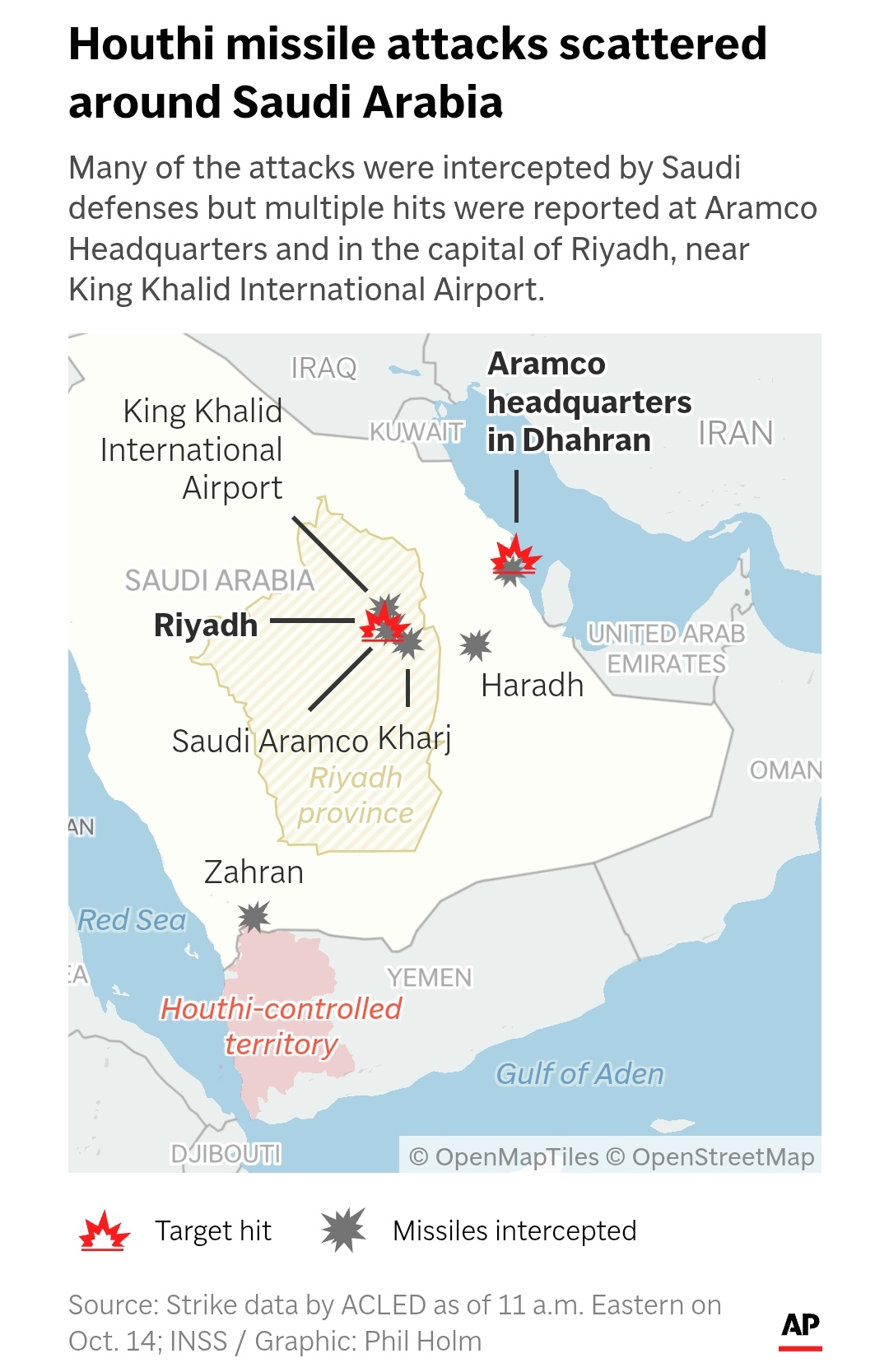
The AP map of Houthi strikes on Saudi Arabia is a range demonstration.

Every launch came from Yemen. The one driving headlines crossed the whole peninsula and damaged the top three floors of the Aramco headquarters in Dhahran, where the chief executive keeps his office. Riyadh’s international airport has been closed since Saturday’s strike.

The shape on that map is a claw, Yemen below and the Gulf coast beside Iran, with the capital held between.

The Saudi claw is a small model of a larger one. Iran presses on all the American allies in the Gulf. Russia presses on all the American allies in Europe, where the EU reports a spike in sabotage and airspace violations in recent weeks. Washington answers by restraining its own side. Ukraine’s military satellite links were throttled without warning on the same day missiles hit Kyiv, after the President told Zelensky to stop striking Russian refineries. Footage published this month shows American troops left Camp Buehring in Kuwait in the war’s first days under Iranian fire and short of ammunition. The American military mission in Iraq ended on September 30. At an election rally the President called the fuel spike a small price and said Iran could take out Los Angeles.

When Washington asked Europe this month to hand over frozen Russian assets to a structure under American control, with the money already offered to Moscow as an advance on a ceasefire, Europe wisely refused.

The claw hinges on the petroleum pump price up to November 3. Both adversaries have read the Trump signals. The Houthis damage Saudi oil to move it. Russia trades diesel exports for sanctions relief and a presidential demand that Ukraine stop bombing Russian war infrastructure, on the stated grounds that stopping Russian aggression hits Americans at the pump. Each needs only the knowledge that Trump will hold the American allies’ arms rather than back them up in the fight. Saudi Arabia is where this upside-down and backwards formula is being put on public display, with missiles.

The Influenced Influencer: Klippenstein Mistakes Russian Hands for Domestic Dissent

Ken Klippenstein reports that Task Force Raider, a CYBERCOM election security unit in San Antonio, has the American public as its real target.

His evidence for a missing foreign threat is the absence of a visible foreign hand. But that invokes a mistake we already have covered here as the Spanish police standard. Spain’s interior ministry announced it found no foreign amplification behind the Ceuta unrest. The European Commission then found Russian amplification from day one. Ken would be wise to read the European Commission tea leaves.

The Russian method puts the hand inside the target country, where it produces exactly the kind of mistake that Ken makes. Farmers, anarchists, ransomware crews and disposable recruits signing with a cover name coded wrong for their milieu carry the operation. Fragmented attribution is the Russia hypothesis. A reporter who reads scattered domestic voices as proof of a purely domestic story has described exactly the Russian warfare operation and then announced its absence.

Klippenstein’s own record settles whether foreign services reach American audiences. In September 2024 he published a document on JD Vance that Iranian intelligence had taken from the Trump campaign, and he said so in his subtitle. A hack-and-leak needs a publisher. He was the publisher. The column arguing that “influencing the influencers” answers a phantom threat comes from the influencer who was influenced.

His DCleaks example gives us the same. He describes the Obama administration taking DCleaks offline as a restriction of free speech. The 2018 GRU indictment identifies DCleaks as a persona and site created and run by officers of Russian military intelligence.

Removing a military intelligence front is counterintelligence. Calling it censorship hands the audience’s rights to the operator instead.

Klippenstein is not all wrong, so let’s give credit where it’s due. His documents describe three million messages sent to countries of interest, 56,000 PSYOP posts and a cellular blackout capability built in Afghanistan. The claim that the same tools now point inward rests on anonymous officers. We also know that Palantir has been aiming to do to America what its self-licking ISIS cream cone did to Iraq (generate domestic terror groups it wants money to destroy).

The precedent concern is sound and also more than a century old. Walter Nicolai’s service burned American factories in the First World War and got Wilson to investigate his own left. Vienna’s secret police built a card index of residents between 1849 and 1868 to track enemies of the state and ended with a file on everyone. Persona operations and a “best athlete” roster of cutouts are that index in cyberspace.

A foreign operation and a state using it as cover to police its own dissent are the sides of a single coin. Klippenstein reports only one side of it.

The foreign threat is documented on his own byline.

AI Warfare Targeting Black Authors: Wheatley to Kundizeza

The Academie Goncourt struck a novel from its longlist on 25 September, four days after an anonymous account with 92 followers declared it the work of a machine. The evidence was a single commercial detector. AFP ran the same passages through its own tool and got “very likely written by a human”, and seven other detectors disagreed with each other. The Goncourt cited plagiarism findings alongside the detector, but the plagiarism hunt began only because the anonymous account had made the author a target.

The author is Thelyson Orelien, 38, born in Gonaives, Haiti, resident in Montreal since 2010. His first novel, C’etait ca ou mourir, follows a teacher fleeing gang violence to Canada. It won the Prix du Roman Fnac on 21 September. The accusation from “Balance ton Claude” landed the same day. Within four days his Quebec publisher had suspended promotion, a book fair had withdrawn his guest of honour title, two newspapers had found copied passages in a short story and columns he wrote between 2012 and 2014, and the Goncourt had acted “to preserve the integrity of the Goncourt Prize” and its mission of honouring “literature written by women and men.”

On 24 September Le Figaro identified the account’s operator as one of its own columnists, Samuel Fitoussi, author of Woke Fiction. He had denied involvement to AFP all week while reposting the accusation from his named account. On 25 September he confirmed a “collective project” whose other members remain unnamed, and called the question of race conspiracist. The president of the Academie Goncourt, Philippe Claudel, had already told franceinfo why he thought the timing mattered: a Haitian, Canadian, Black, francophone foreigner, in a season when passions run high.

Fitoussi’s stated motive is fear that AI will end human writing. He is an associate member of Frst, a Paris fund that finances AI startups and began life as Otium Ventures under the Catholic billionaire Pierre-Edouard Sterin. The detector he relied on, Pangram, raised $9 million in July in a round led by Menlo Ventures. Menlo’s partner wrote that the firm led the round as part of the Anthology Fund, the vehicle it runs with Anthropic, whose assistant gave the account its name. Pangram describes its detector as a model trained on tens of millions of documents known to be written by humans.

The Goncourt was the second prize of the year to act on that detector. On 14 May the Commonwealth Foundation named five regional winners of its short story prize. A Wharton professor ran the Caribbean winner through Pangram, “The Serpent in the Grove” by Jamir Nazir of Trinidad, and posted the result: 100 percent AI. Granta, which published the winners, asked Claude whether the story was machine written and put the answer in a statement. Its publisher Sigrid Rausing wrote that the judges may have awarded a prize to AI plagiarism and that Granta might never know. On 19 June Granta ended its external publishing partnerships. On 22 June the Foundation cleared all five winners. It had refused to run detectors on unpublished work and instead asked every winner for working drafts, time-stamped documents and notes. Nazir was named overall winner on 30 June. Vauhini Vara of The Atlantic then fed fifteen years of winning stories into Pangram and found that the only ones it flagged were three of the five from 2026.

On 6 October the Caine Prize for African Writing gave its £10,000 award to “The Blue Fighter” by Simbarashe Steyn Kundizeza of Harare, chosen from 407 entries across 27 countries. On 11 October Vara published her Pangram scan of the story under the headline “Yet Another Literary Prizewinner Seems to Be AI”. The detector flagged almost the whole text. It had passed every earlier Caine winner she tested and “The Whistleblower”, a thriller Kundizeza published in 2021. His agency told her it has full confidence the work is his. The same day the Caine Prize Foundation opened a review. Vara noted in the article that detectors flag the tidy English of writers for whom it is a second language. Stanford measured this in 2023: seven detectors were near perfect on essays by American eighth graders and flagged 61 percent of essays by non-native speakers as machine written.

The accused writers in May, September and October came from Trinidad, Haiti and Zimbabwe. The detector was the same each time.

Zimbabwe has seen this office before. In 1954 the Southern Rhodesia government set up the African Literature Bureau. Its stated purpose was to grow a reading market in Shona and Ndebele. Its working purpose was to screen every manuscript by an African before a publisher could print it, and to keep politics out. Solomon Mutswairo’s Feso, among the first novels by an African, came out under the Bureau in 1956, and the Ministry of Education later struck it from the reading list for African schools. Philemon Mutambara, a teacher with a Fort Hare degree, submitted a Shona novel in the 1960s. The Bureau returned it with demands for changes and a reader’s report telling him that the books it had already published “would be an invaluable guide to you as the sort of standard required for publication.” He refused, died in 1968, and the novel appeared 51 years after he wrote it. A white office in Salisbury held a model of what an African story should read like and graded manuscripts against it. Flora Veit-Wild, who wrote the social history of that system in Teachers, Preachers, Non-Believers (1992), later interviewed the Bureau’s post-independence director, who told her there had been no censorship, only screening. Pangram holds a model of what a human story should read like and grades manuscripts against it. It flagged a Harare writer’s prize story and passed the one he wrote in 2021.

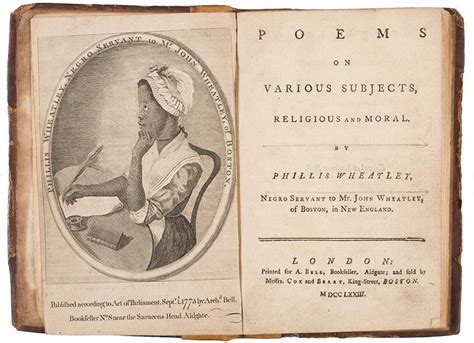
Black authors in the French and English worlds have been asked to prove they wrote their own books for 250 years. Phillis Wheatley was examined by eighteen Boston men in 1772, Governor Thomas Hutchinson among them, before a London publisher would print her poems, and their signed certificate opens the 1773 edition.

Bakary Diallo, a Senegalese rifleman, published Force-Bonte in Paris in 1926 and was assumed for decades to have had it written by his French patrons. Camara Laye’s Le Regard du roi (1954) was attributed in 2002 by the scholar Adele King to two Belgians in Paris, his landlord and a reader at his publisher. Yambo Ouologuem won the Renaudot in 1968 for Le Devoir de violence, faced plagiarism charges from 1971, and published nothing after 1972.

A white author gets the opposite treatment. Michel Houellebecq copied Wikipedia passages into La Carte et le Territoire, admitted it, called it collage, and won the 2010 Goncourt anyway.

Nazir handed over his drafts and timestamps to keep his prize. Orelien is compiling a dossier with his editor to prove he wrote his own book. Kundizeza’s agency is vouching for him while a foundation reviews his story. Wheatley stood before eighteen examiners in Boston over 250 years ago.

The information warfare against Black authors hasn’t changed much.