
A philosophy department chair at Williams College argued in the New York Times last week that writing is separable from thinking, that essays persist because they are easy to grade, and that universities should have the courage to stop requiring them.
I’m here to write… (╯°□°)╯︵ ┻━┻
He tested the idea in one seminar for one semester, let students use AI on their essays, then examined them orally and found half of them more articulate out loud. From that, and that alone, he concluded the written record is dispensable. And then he somehow was allowed to write this into the New York Times.
If I were them I would have said “get a soap box, buddy and go stand on some corner”.
The essay cites Socrates and then, nothing. Every major thinker who has ever examined this question reached the opposite conclusion. All the written history is ignored by him, in an essay proclaiming thinking as independent from written words.
The long, storied, tradition he skipped starts all the way back with the Mishnah.
| Source | What the essay leaves out |
| Mishnah Eduyot 1:5 | Asks why the minority opinion is recorded when the law follows the majority. Answer: a later court may need to rely on it. The losing side stays on the page by design. |
| Plato, Phaedrus 275a | His own witness. Socrates warns of a technology that gives the appearance of wisdom without the substance. Read straight, that is the case against AI, and Plato preserved it in writing. |
| Hume, Of Essay Writing | A wise man proportions belief to evidence. One semester and one professor’s impression fail that test. Hume spent his life rewriting the Treatise for readers who could answer back. |
| Kant, What is Enlightenment? | The public use of reason, the one that must be free, is the scholar writing for the reading public. Speaking in a room to the people present is the private use. The essay has the polarity reversed. |
| Wollstonecraft, Vindication of the Rights of Woman | The seminar is a room and rooms have doors. She answered Burke in print (Rights of Men, 1790) because Parliament and the club were closed to her. Her critique of “accomplishments” names fluency that passes for understanding. |
| Russell, Principia Mathematica (1910) | Several hundred pages to reach 1+1=2. Some thinking exists only in notation and cannot be held in a conversation. |
| Wittgenstein, Philosophical Investigations (1953) | There is no second stream of meaning running behind the words. The expression is where the thought is. A thought with no public criterion is not yet a thought. Writing is the public criterion. |
| Popper, Objective Knowledge (1972) | We let our theories die in our stead. That requires the theory to be fixed where it can be refuted. Speech drifts and gets remembered charitably. |
| Buber, I and Thou (1923) | The seminar is I-Thou and he has that right. Every Thou must become an It, and the It is how the meeting is kept so it can be met again. His error was letting an It that performs Thou into the room. |
| Arendt, The Human Condition (1958) | Deeds are the most futile human things unless remembered. The polis exists as organized remembrance. The seminar is the deed. The essay is the remembrance. |
| Ong, Orality and Literacy (1982) | Oral cultures are homeostatic. They shed whatever no longer serves the present, and no one can prove it because there is nothing to diff against. Literacy makes correction possible. |
Eleven so far, still just one verdict. Need I continue?
Look again at the one and only thinker he did cite. Socrates in the Phaedrus warns about a technology that gives people the appearance of wisdom without the substance, that answers nothing when questioned, that lets a person recite what they never understood. He was describing writing, and he called it a pharmakon, a word that means remedy and poison at once. Every word of the warning describes a student handing in an essay from a chatbot. Cruz read that passage, agreed with it, and then let the chatbot into the seminar while banning the essay. He kept the poison and threw out the antidote to it. And the only reason anyone can check this is that Plato wrote it down.
The New York Times disgraced itself by printing a shallow opinion that attempts to erase the value of all writers before him. This sort of erasure and false “invention” fetish isn’t unknown either.
Writing is where a claim becomes criticizable, public, and durable enough to reopen. The professor calls it a portable, compact trace of mind that is manageable in a bureaucracy, and acts like that is a criticism. It is the entire case for keeping records.
His oral exam worked for a reason he misread. A machine reads what the student types and answers back, and it retains every word in a log the student never sees and does not own. The written record of that semester exists, held by a vendor, while the student leaves with nothing in hand. When the professor sat each student down and asked them to explain their own essay, he was testing what each of them had kept. The students who could answer were the ones who had argued with the output, rewritten it and made it their own, which is to say they had done the writing after all. The students who could not had left the record with the vendor and never returned to it. The exam measured who had kept their own record, found that half the room had, and the professor concluded that the record was the problem.
That’s completely backwards. Logic failure.
The argument against keeping a record is actually much worse when you put context around what the New York Times engages in by publishing this man’s completely broken philosophy. The anti-record theory also surfaced the same week in actions taken by the antisemitic politicians of Saxony, Germany.
The council of Heidenau, near Dresden, banned new Stolpersteine (Holocaust memorials) on public streets, on a motion brought jointly by the AfD (openly Nazis) and the CDU (closeted Nazis) political parties. A Stolperstein is a genocide record that is meant to be inconvenient and force thought. It states who lived where it is placed, when they were taken, and what happened to them, set into the pavement at the door they left through. If someone is concerned about stepping on them, the stone is in the right place and working exactly as intended.
The next time someone mentions Carl Orff, which a lot has been written about, ask them if they meant to say Maria Leo.
Who? Maria Leo.
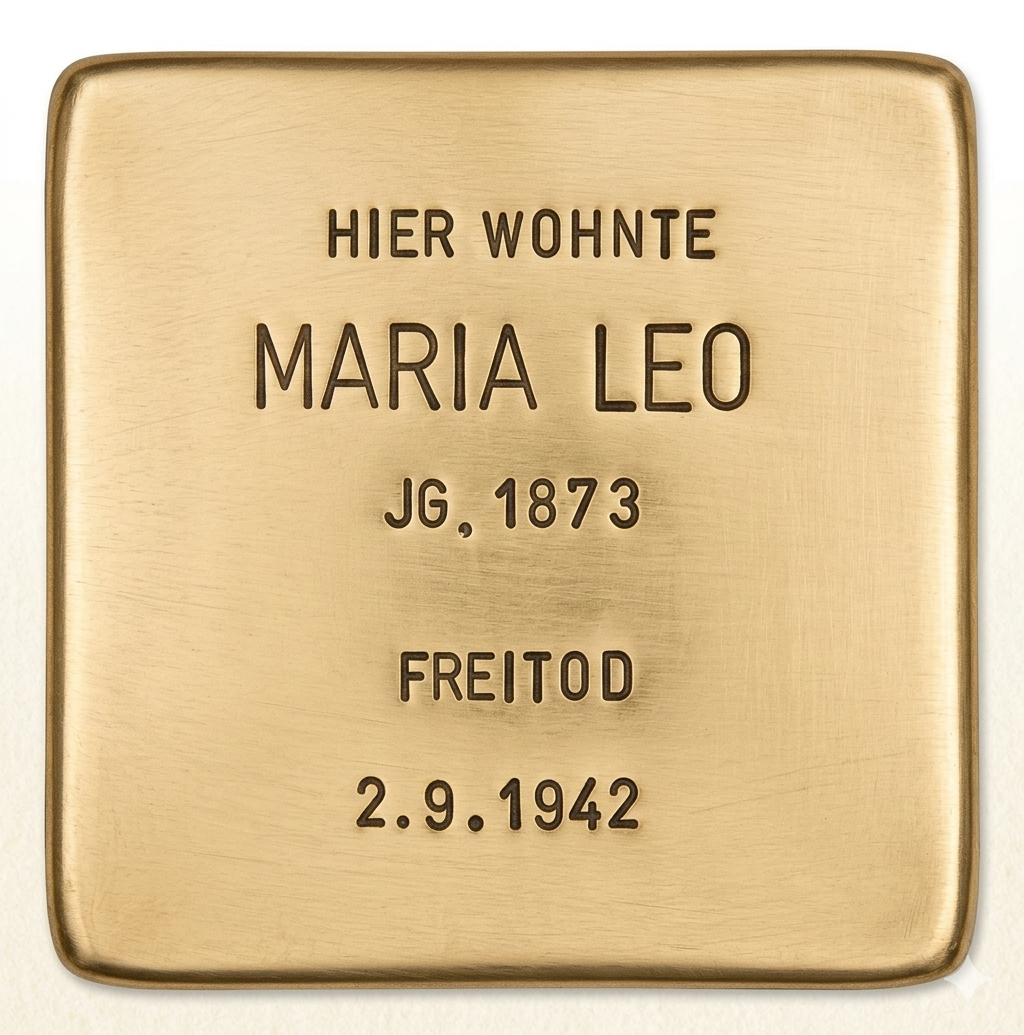
Gunter Demnig placed the first memorial stones in the 1990s and nearly 130,000 now sit in pavements across thirty countries. The “stumbling” design is as symbolic as it is deliberate. When Jewish cemeteries were destroyed under the Nazis, their gravestones were often used as paving material. The Stolperstein forces that exact discussion of the gravestone being in the street as the Nazis wanted, unprotected on purpose, demanding more thoughts because of the writing.
The Heidenau motion argued in an antisemitic screed that pedestrians should not be allowed to stumble on the names of the departed, and instead those writings should be hidden somewhere out of mind. It proposed that future victims be commemorated at the memorial by the northern cemetery instead. The record moves from the place where people encounter it to the place where they have to go looking for it, and never will.
Charlotte Knobloch, who says she opposes Stolpersteine in Munich on the same grounds, called the motion a transparent maneuver by the AfD (openly Nazis) to suppress remembrance culture and said she was appalled the CDU (closeted Nazis) lent itself to it. The sincere objection was borrowed from the woman who had claimed she cared so much about victims of the Holocaust she wanted them tucked away someplace out of mind.
The council wasn’t just acting to erase the writing on the streets, they removed the record of who lived where by also removing the record of who voted how on removal.
The motion passed by secret ballot, thirteen to six with one abstention. Thirteen people. Unnamed to protect them from their desire to remove the names of victims. Names written out in public was secretly ruled too much exposure for the dead. Names on the ballot were too much exposure for the living. This is the same town where right-wing mobs attacked a refugee shelter over several nights in August 2015. The district responded with a blanket ban on public assembly for the whole town, and the Federal Constitutional Court struck it down within two days because it also silenced the people who had come to welcome the refugees.
Ernst Fraenkel watched the Nazi legal system from inside as a Berlin lawyer and described it in The Dual State (1941). The regime kept its statutes, courts, and files for contracts and property, because the economy required them. Alongside that it ran a prerogative state that overrode any of it at will, with nothing written and nothing to appeal.
Anyone in Berlin today saying they don’t want records kept, don’t want recordings made, observations written down, is invoking the fact that not a single photograph is known to exist of the deportation of over 50,000 Jews from Berlin, on more than 180 trains, over four years. Würzburg has photos. Amsterdam has film. Berlin has an American professor writing in the New York Times not to write things down.
The Nazi regime, foreshadowing this professor’s fetish, ended by unwriting its own history. In the East, Aktion 1005 dug up the mass graves and burned the bodies from 1942 onward. Himmler told his SS generals at Posen in October 1943 that the extermination was a page of glory that would never be written. In Berlin the Gestapo burned its Jewish-affairs files in the last weeks of the war, and name lists for the first eight eastern transports survive only because written copies turned up in the archive of the Oberfinanzpräsident Berlin-Brandenburg. The deportation record exists because the tax office kept a second written copy.
The New York Times forgets, as the Nazis intended.
Fascism works by removing records that let order be audited, wherever the record would count. A professor who finds records tedious is laying the groundwork for fascism to rise again. A German council that finds accountability embarrassing is acting out the American theory of the white republic, which Hitler himself cited as his model when he described the conquest of the American West and its reservations as the pattern for the East.
Thank you for this written enlightenment from Germany.