
Itamar Ben-Gvir stood on fresh concrete this week and posted the video. Israel’s national security minister toured the foundations of a death row and hanging facility inside a maximum-security prison in central Israel, pointed at the ground, and promised executions. The complex will include viewing booths so that families of victims can watch. Ben-Gvir said the booths follow the American model.
Days earlier the same minister advocated thirty to forty targeted killings per night in Gaza, extending beyond people posing any immediate threat, and said of the people there:
They are not even people.
The French foreign minister called the remarks inhumane.
The German chancellor said they violate international law.
Notably, Ben-Gvir himself already has been convicted for incitement to racism and support of a terrorist organization (Kahane’s Kach Party).
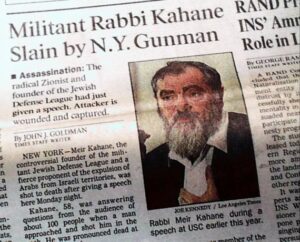
Meir Kahane was assassinated in New York in 1990. His movement didn’t die. It radicalized. Baruch Goldstein, a Kach follower, massacred 29 Palestinian worshippers in Hebron in 1994. Yigal Amir, a Kahanist inspired by Goldstein, assassinated Prime Minister Yitzhak Rabin in 1995. The man who signed Oslo, the man who could negotiate. Weeks before the killing, a teenage Itamar Ben-Gvir brandished an ornament stolen from Rabin’s car on live television and said: “We got to his car, and we’ll get to him too.”
Ben-Gvir was exempted from military service because of his extremism. He was convicted of incitement to racism and support for a terrorist organization. He kept a portrait of Goldstein above his fireplace. In 2022, Netanyahu brought him into government as National Security Minister. Bezalel Smotrich, another Kahanist, became Finance Minister.
Despite all this, since December 2022 Ben-Gvir has directed Israel’s police and its prison service.
The gallows enforces a specific legal architecture. That architecture has a very well-known direct precedent from the Holocaust, and the precedent was adjudicated.
Start with the statute. On March 30, 2026 the Knesset passed the Death Penalty for Terrorists law, 62 votes to 48, with Netanyahu voting in person. I published a full analysis of its civil-court provision, which prescribes death or life imprisonment for killing “with the aim of negating the existence of the State of Israel.” The intent element was engineered to keep Jewish defendants outside its reach, a design confirmed at passage by the Israel Democracy Institute. The same statute operates differently in the military courts. There death becomes the only available sentence, with life imprisonment reserved for a judicial finding of special circumstances.
The military courts try Palestinians. Jewish Israelis accused of comparable violence in the same territory answer to civilian courts, where the intent element shields them. One statute, two tracks. The civilian track carries the definitional exemption. The military track carries the mandatory gallows.
Four structural elements follow. The statute’s application rests on group membership. It makes death the default sentence rather than the maximum. It routes the targeted population through a separate court system. It exempts a group through definitional language alone.
This is the precise setup of RGBl. 1941 I S. 759, the Nazi decree of December 4, 1941 on penal law for Poles and Jews in the annexed eastern territories.
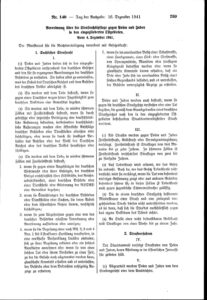
That decree created a separate criminal code for two populations, prescribed death for offenses that carried ordinary penalties for Germans, and ran the trials through special courts outside the regular system. Section I(3) made death the sentence for hostile remarks about Germany and for tearing down official notices. Section V(1) assigned every trial to the Sondergericht. The Austrian National Library holds the scan of the original gazette pages, linked above. Read it. The whole apparatus takes three pages. It needed only a ministerial signature. The Israeli statute carried a parliamentary majority, 62 to 48.
Section III(2) of the decree deserves its own paragraph. Death is imposed wherever the law threatens it. Where the law provides for a lesser sentence, the court imposes death anyway upon finding a besonders niedrige Gesinnung, an especially base disposition, a rule the decree extends expressly to juvenile offenders. The decree drew its life and death line through a judicial finding about the defendant’s inner state. The Israeli statute does the same work in reverse. An intent clause selects who dies. A special-circumstances finding decides who lives. Both instruments place the capital line inside a disposition judgment rendered by the separate system, and both write that judgment into the statute as the mechanism of the differential itself.
Defenders of the Israeli statute surely will argue that the 1941 decree made trivial conduct capital, any “anti-German” remark, a torn poster, while the new law attaches to “murder” convictions. The conviction data explains why this doesn’t land. The military courts convict at a rate of 99.74 percent, by the system’s own annual report, and the overwhelming majority of convictions arrive through plea bargains. A murder conviction produced by the separate system is an output of the separate system. The predicate is manufactured inside the differential, which is exactly how the special courts of 1941 supplied theirs.
The 1941 decree went to trial. The Nuremberg Military Tribunal in United States v. Altstoetter (1947), the Justice Case, prosecuted the Reich Ministry of Justice officials who drafted differential penal law and the special-court judges who applied it. The Tribunal treated the decree as an instrument of the extermination program, applied the new term genocide to a legal system, and convicted ten defendants, among them the ministry’s former acting head and a sitting judge. Its most quoted sentence:
The dagger of the assassin was concealed beneath the robe of the jurist.
That describes Israel today.
The theory of liability matters more than the rhetoric. Altstoetter established that operating a group-differential death statute through a separate court system is itself a crime against humanity, independent of any single execution. The Tribunal convicted the drafters and the appliers. Applied to 2026, that theory reaches the Knesset members who wrote the exemption, the military judges who will impose the mandatory sentence, and the officials building the facility.
The Association for Civil Rights in Israel has petitioned the Supreme Court to strike the law down. The petition is pending. The state’s answer is concrete. Enforcement infrastructure rises ahead of adjudication. The Altstoetter defendants argued that valid legal form made their conduct lawful. The Tribunal convicted them for that reliance.
The Justice Case settled whether legal office protects the operators of such an instrument. It ruled the robe is part of the crime.
Israel abolished the death penalty for murder in 1954, six years after executing Meir Tobianski, an innocent man, by firing squad on the day of his arrest.
The Tobianski gravestone reads killed by mistake.
The abolition was a founding correction, the state admitting what state killing does, and why it is incompatible with the state. The new genocide viewing booths are an attempt to repeal the state of Israel.