Category Archives: Energy

Trump Oil Disaster Has the World Going Oil Free

Presumably Trump thought, like some 1950s McCarthy buffoonish cartoon character, that he was going to violently corner oil, by deploying the U.S. military to take it all over like a gangster.

Predictably, that hasn’t worked. The stability of oil is gone forever. Chaos of Trump has become permanently attached to any concept of “centralized” fuel distribution like oil, because he is such an archetypical villain of centralization. Decentralized, sovereign, energy is on the table like it’s the 1900s again.

At COP30 in 2025, co-sponsors Colombia and the Netherlands announced the First International Conference on the Just Transition Away from Fossil Fuels. It will be held in Santa Marta in Colombia from 24-29 April.

“There is a clear momentum to phase out fossil fuels, and now is the time to capitalise on it,” said the Netherlands’ Deputy Prime Minister and Minister for Climate Policy and Green Growth, Sophie Hermans.

Existential AI Threat Friedman Warns About is Craig Mundie

Thomas Friedman calls Craig Mundie his “technology tutor.” He’s said it publicly, repeatedly, for over a decade. Perhaps it’s meant to sound endearing. It’s actually a sad confession. The most influential foreign affairs columnist in America openly outsources his entire understanding of technology to a single person. Why?

That person’s track record deserves closer examination within context of a larger institutional failure rated as success.

Microsoft Failure Man

In 1982, Mundie co-founded Alliant Computer Systems, a maker of vector-parallel mini-supercomputers. He became CEO. The company filed for bankruptcy June 5, 1992 because they didn’t see the PC coming.

He joined Microsoft that same year to run the Consumer Platforms Division. Here is what he built and championed:

Year Product / Initiative Outcome
1992 Windows CE Dead
1990s Pocket PC Dead
1990s Auto PC Dead
1997 WebTV Networks ($425M acquisition) Dead
1990s Interactive television Dead
2000s Digital rights management strategy Dead

When Bill Gates stepped back from daily operations in 2006, Mundie and Ray Ozzie were appointed to fill his visionary role. Mundie became Chief Research and Strategy Officer. During his tenure in that position, Google beat Microsoft to self-driving cars. Apple beat Microsoft to voice recognition with Siri. Microsoft missed mobile. Missed search. Missed social. Missed cloud computing until Satya Nadella arrived and reoriented the entire company away from the strategy Mundie had been overseeing.

To be fair, Ballmer overruled strategy recommendations, and search and social blinders may have been other divisions’ calls. But show me the wins. By late 2012, Mundie was moved to “Senior Advisor to the CEO,” the corporate equivalent of a quiet pasture upstate where his opinions wouldn’t be heard anymore. He retired in 2014.

Selling Invisible Pants to Elites

What happens to a technology executive whose products all failed but whose rolodex thrived? He becomes a bogus sage. Mundie landed on the National Security Telecommunications Advisory Committee under three presidents. Obama’s PCAST council. The Bilderberg Group steering committee, which he attended every year from 2003 to 2019 except one. The World Economic Forum. And then the capstone: co-authoring Genesis with Henry Kissinger and Eric Schmidt, a book about AI published in November 2024.

Kissinger.

The architect of the secret bombing of Cambodia. The man who backed the coup in Chile and the Indonesian invasion of East Timor. Who enabled the Pakistani genocide in Bangladesh. Who treated civilian populations as abstractions to be managed through force. This is who Mundie chose as his co-author on the governance of a technology that will reshape civilian life everywhere.

That tone-deaf choice tells you everything about the Mundie gambit: power managed by the powerful, consequences borne by everyone else. Talk down and ignore reality.

The technology product arc of disasters was foreshadowing. Build things that fail. Accumulate institutional access along the way. Pivot from practitioner to advisor once the failure pattern becomes undeniable. The access persists because Davos doesn’t audit skills like product launches. It rewards gravitas in presence.

The Column

This week Friedman published a column about Anthropic’s Claude Mythos announcement. His source for interpreting its significance was, naturally, Craig Mundie. The column treats Mundie’s analysis as authoritative. It contains Mundie’s three-step framework for responding to the threat. It quotes Mundie at length. It cites no other technical source.

Friedman writes:

[Mundie is] a former director of research and strategy at Microsoft, a member of President Barack Obama’s President’s Council of Advisors on Science and Technology and an author, with Henry Kissinger and Eric Schmidt, of a book on A.I. called Genesis.

Every word of that sentence is true. Every word of it is also designed to obscure the fact that Mundie’s actual technology career was a sequence of expensive bets that all lost.

The credential list substitutes for any actual performance record.

The Friedman column is similarly bad at placing bets. It describes AI-powered vulnerability discovery as if no one had ever heard of fuzzing, static analysis, or red team operations.

OMFG.

He illustrates the threat with a scenario where children accidentally take down a power grid. This is the Computer Fraud and Abuse Act (CFAA) debate of 1984, recycled. Congress passed it in 1986 after WarGames convinced legislators that teenagers with modems could launch nuclear weapons. Before that, Captain Crunch and the phone phreakers were going to launch nukes, shut down power or destroy the telephone system.

Did he just wake up from 1986?

By early 1999 I personally had reported clear text authentication on the American bulk power grid in five states. Thousands of routers vulnerable to trivial destruction. Did I break anything? The old geezer in a suit panicking that “kids will break everything” has been the go-to move for people who want to centralize control of new technology for forty years. Friedman presents it as an original insight, as if nobody remembers the 414s.

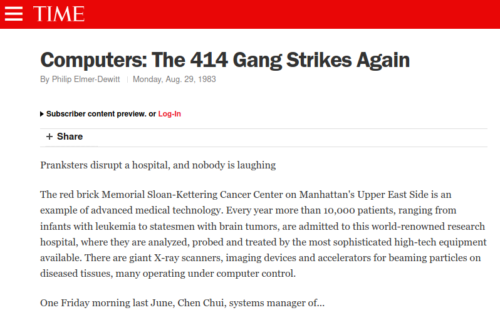
Time Magazine in August 1983, with a stern prediction that kids with computer access will get someone killed.
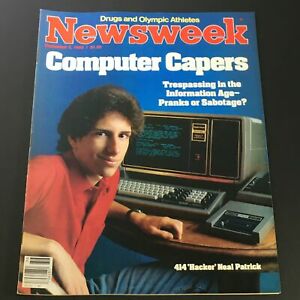
The youngest of the 414s on the cover of Newsweek, September 5, 1983

He proposes US-China cooperation on AI governance in the same week the US is actively restricting chip exports to China to prevent exactly the AI capability development he’s now asking them to collaborate on. He doesn’t notice this dumb contradiction because he’s transcribing, not analyzing. He would do far better to trust AI than the hallucinations of Mundie.

Meatspace

A columnist who calls someone his “tutor” on a subject is telling you he cannot independently evaluate what that person says. Friedman admits no second opinion on technology, and he lacks the technical literacy to know what questions would surface one. Mundie tells him this is unprecedented. Friedman writes that it’s unprecedented. Mundie says it requires US-China cooperation. Friedman writes that it requires US-China cooperation.

This is how a man who got WebTV, Windows CE, the Pocket PC, interactive television, and digital rights management wrong becomes the person explaining artificial intelligence threats to New York Times readers.

The technology tutor model has an obvious flaw. The student can’t evaluate the false tutor, because the student can’t evaluate the subject. He can only evaluate the tutor’s confidence, which is deeply ironic. Just like the real danger with a bad AI chatbot, confidence is the one thing Craig Mundie has never lacked.

The threat of AI is the relationship Friedman has with Mundie, not the AI.

BYD Nail in Tesla Coffin: Test Proves Only One Has Cells That Don’t Burn

Tesla simply buys battery cells from Panasonic and CATL and calls itself an innovation company.

Panasonic has sold its entire stake in longstanding battery partner Tesla for about ¥400bn ($3.6bn)

Tesla simply has Siemens build factories for it, assembles parts, and calls itself a manufacturing company.

Musk called the Siemens chief and said, “I want to build electric cars, but have no idea how to do it.” There were many problems with the ramp-up of the factories, because Musk did not even know how to help himself.

Tesla simply suppresses death, fire and crash data, and treats safety failures as PR problems rather than engineering problems.

All in all, Tesla has turned out to be the worst car company in history, with numbers of unnecessary and predictable deaths in the hundreds that continue to rise.

To understand the significance of the Tesla fraud, let’s rewind to when Musk in 2011 laughed nervously on camera when a reporter asked him about BYD as a competitor. It was just like when Blackberry laughed at the iPhone. The reporter foolishly let him off the hook, unable to press him to a real explanation. Why was he so scared he burst out laughing? Why did he keep laughing when she tried to ask for reasons?

Today we see BYD, unlike Tesla, dominates the market with real innovation and real engineers. They manufacture their own cells, motors, chips, and software. And most notably, they have progressed significantly while Tesla has not at all. You could buy a 2012 and a 2026 Tesla and wonder what changed if anything.

BYD said on Thursday that sales of its battery-powered cars rose nearly 28% to 2.26 million units in 2025. Vehicle deliveries at Tesla dropped 8% year on year to 1.64 million vehicles delivered in 2025.

BYD had a fatal battery fire in 2012. But BYD admitted the failure was theirs, and spent eight years engineering it completely out of the physics. Their cells don’t burn now. Tesla had fires starting in 2011 and by comparison did nothing. They have since had hundreds of battery fires and Autopilot fatalities. They responded only with a fog of PR, NDAs, and data suppression. Tesla cells burn dangerously sudden and hot and everyone knows it.

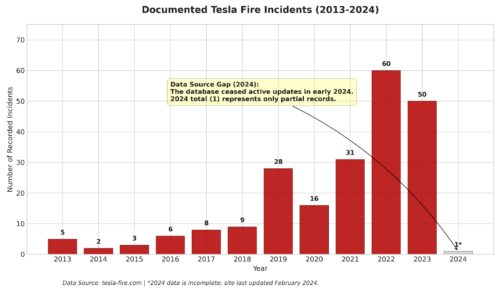
Total Tesla Fires as of 4/4/2026: 232 confirmed cases.

Fatalities Involving a Tesla Car Fire Count: 83

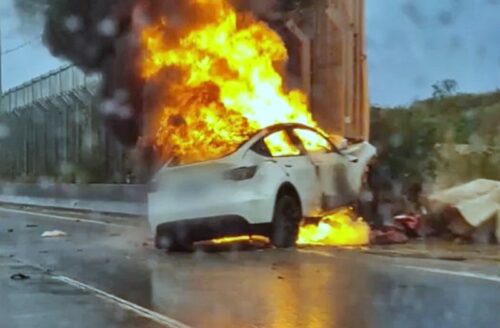
Teslas notoriously “veer” uncontrollably and crash. Design defects (e.g. Pinto doors) trap occupants and burn them to death as horrified witnesses and emergency responders can only watch helplessly. Source: VoCoFM, Korea, 2024

The BYD battery nail test is the difference made visible. The NMC chemistry Tesla uses detonates like a bomb on puncture and occupants are burned to death. BYD’s LFP Blade Battery does NOT burn. That’s not a marketing claim. That’s the physical property of the cell. Tesla can’t pass the test.

This is because of two completely different institutional responses to killing people with a product. Wang Chuanfu lost sleep, pulled his engineers together, and demanded they reproduce the failure mechanism until they understood it completely. Musk slept like a baby, increased his social media ranting, played video games, laughed at journalists and just kept shipping cars that predictably crash and catch fire.

In fact, when news hit that a BYD in Hong Kong caught fire, an investigation found it was NOT CAUSED BY BYD. That’s how rare BYD fires have become. It’s an amazing thing to report, compared with the hundreds of Tesla fire cases open and unresolved despite their fatalities.

The new Chinese legislation (July 1, 2026) legally mandates “no fire and no explosion” for batteries. Tesla becomes illegal, as it always should have been.

Without fraud, there would be no Tesla:

Category Tesla BYD Winner
Top Speed ~261 km/h (Plaid) 496.22 km/h (U9 Xtreme, Papenburg 2025) BYD
Hypercar Status Roadster 2.0 promised 2017, still a demo car, production pushed to 2027 Shipping 3,000 hp hypercars that jump, float, and dance BYD
Safety Ranking Dead last in 2026 TÜV Report. Model Y failure rate 17.3%, worst in its age group in over a decade Top tier Euro NCAP. LFP chemistry stable by design BYD
Fire Record 232 confirmed fires, 83 fire fatalities. Volatile NMC chemistry, aging packs, no engineering fix Blade Battery passes nail penetration test. Fires so rare a single Hong Kong incident made international news BYD
Range Honesty “Range Diversion Team” rigged dashboard algorithms. DOJ probe. 30-40% real-world shortfall on highway Consistent real-world performance matching advertised range BYD
Battery Cells Bought from Panasonic and CATL. Panasonic sold its entire Tesla stake for ¥400bn Designed, manufactured, and tested in-house BYD
Factories Called Siemens to build them. “I want to build electric cars, but have no idea how to do it” Vertically integrated. Own chips, motors, software, production lines BYD

Trump Oil Bankrupt in Six Months: Promised Boom is Already Bust

Trump bankruptcy is on the horizon again, this time on the ocean. Trump Steaks, Trump Vodka, Trump University, Trump Airline and now… Trump Oil.

Court filings tell the story. Trump applying the American military, like the mob flexes protection racket muscle, to monopolize a market isn’t what he thought it would be. Trump is spending tens of millions of taxpayer money grabbing and maintaining aging ocean tanker rust buckets that he can’t sell, holding oil he can’t offload, and continuing the program anyway into an expanding disaster.

Here’s a table for every tanker seized so far under his ill-considered “Operation Southern Spear”.

The Trump Junk Fleet

Tanker Seized Cargo (barrels) Est. Cargo Value Vessel Value Known Cost to U.S. Status
Skipper Dec 10, 2025 1.8M $120–$135M ~$10M $47M + $450K/mo + $5M pending Held; DOJ asking court to sell
Centuries Dec 20, 2025 ~2M ~$130M Unknown Unknown (moored at Galveston) Held
Bella 1 / Marinera Jan 7, 2026 Empty $0 Unknown Atlantic chase + ongoing Held; pure cost center
Sophia Jan 7, 2026 ~2M ~$130M Unknown Seizure costs; cargo returned Returned to Venezuela
Olina Jan 9, 2026 Loaded Unknown Unknown Seizure costs; cargo returned Returned to Venezuela
Veronica Jan 15, 2026 Empty $0 Unknown Unknown (moored off Puerto Rico) Held; pure cost center
Sagitta Jan 21, 2026 Unknown Unknown Unknown Unknown Held
Aquila II Feb 9, 2026 ~700K ~$45M Unknown 15,000 km pursuit + ongoing Held; not formally seized
2 additional (unidentified) Unknown Unknown Unknown Unknown Unknown Held per NYT

That’s just eight confirmed seizures already painting the obvious picture.

The NYT reports ten total with Venezuelan ties. Two (Bella 1 and Veronica) were empty when seized. Two more (Sophia and Olina) were returned to Venezuela. The U.S. absorbed the full operational cost of every seizure and got nothing back on four of them.

The Asset Trap

A tanker is not a seized bank account. It’s not a pile of gold. It is like a slumlord grabbing a condemned property, a decaying organism that consumes capital every second it sits unrepaired. Taking the decrepit hulls means the U.S. government has made itself into the world’s most expensive and insolvent shipping company.

For what?

The Skipper’s court filings are Trump Steaks all over again.

The U.S. government was forced to spend $47 million in three months on repairing and maintaining a vessel worth $10 million. Instead of all the things $47 million could have done domestically, it’s tangled up in acquired foreign debt.

Read that Trump businessman genius move again.

He’s blowing 4.7x a ship’s value just to keep it afloat in Texas. Oil storage runs $15,000 a day. Another $5 million is pending for insurance and crew. The DOJ’s own asset manager wrote that these costs “far outstrip standard assets.”

Grade school children understand the math showing this is bad, but not Trump. Previous American procedure was to seize the assets (oil) at sea with a siphon and let the liability (ships) sail on. Makes sense, right? The Trump model has been to take all the liability, immediately undermining the assets.

The Storage Bottleneck

Trump’s army of sycophants can’t simply sell the oil, deteriorating on old ships. These are civil forfeiture cases tied up in U.S. District Court in Washington. The Skipper’s cargo — worth $120 to $135 million — has been sitting unsold since December. At $450,000 a month in storage alone, a 12-month legal process would burn up $5.4 million before a buyer is found. Add the $47 million in catch-up maintenance and $5 million in pending costs, and nearly half the cargo value evaporates before a single barrel is sold.

The DOJ is now asking the court to allow an emergency sale of the Skipper’s oil before the massive losses become obvious to the public. That’s the Trump circus creating emergencies by admitting their strategy is hemorrhaging money faster than they can bully people into covering it up.

Net Recovery Projection

Only the Skipper has detailed cost data. But the Skipper is the template. These are all aging, end-of-life shadow fleet tankers that were past commercial retirement when they were seized. If the Skipper’s costs are even roughly representative, here’s what the full fleet of eight held tankers looks like over time.

Assumptions: maximum recoverable cargo across the fleet estimated at $500 million. Initial repair costs averaged at $20M per tanker (conservative — the Skipper hit $47M). Ongoing monthly costs per tanker estimated at $2–3.5M (maintenance, crew, insurance, storage). Neither scenario includes military operational costs, legal fees, or cargo depreciation.

Scenario Initial Repair (fleet) Monthly Burn (fleet) Total Cost at 6 Mo. Total Cost at 12 Mo. Max Recoverable Cargo Net at 12 Mo.
Conservative ($20M avg repair, $2M/mo per tanker) $160M $16M/mo $256M $352M ~$500M +$148M
Skipper Rate ($40M avg repair, $3.5M/mo per tanker) $320M $28M/mo $488M $656M ~$500M –$156M

Under the conservative scenario — which assumes each tanker costs less than half what the Skipper actually cost — the operation barely breaks even at 12 months. Under the Skipper rate, the operation goes underwater at roughly month 6 and never recovers. By month 12, the U.S. has spent $156 million more than the oil is worth.

Month six!

The Risk Nobody’s Pricing: Environmental Liability

Everything above is the optimistic scenario. It assumes nothing goes wrong with the ships themselves. That assumption deserves scrutiny.

These are single-hull, end-of-life “ghost fleet” tankers. They were built over two decades ago. They have been running intentionally dark, spoofing locations, skipping important inspections, and operating without valid safety certifications for years. So Trump has targeted absolute worst junk assets, with the least chance of positive return, for seizure.

Several were already rusting through, for obvious reasons. The Skipper’s $47 million in immediate repairs were totally avoidable by not seizing it.

I suspect the people who never maintain anything and have no concept of safety are the ones assuming all ships are equally valued.

Seizing unfit vessels on the verge of disaster actually makes the U.S. government the “responsible party” under the Oil Pollution Act of 1990. OPA 90 imposes strict liability on the owner or operator of any vessel from which oil is discharged into U.S. waters.

Bush signed OPA 90 in response to the Exxon Valdez disaster. But as the Netflix documentary The White House Effect now documents using his own presidential library memos, his chief of staff John Sununu was simultaneously running a back channel with Exxon to neutralize every environmental commitment the administration made.

Perhaps that’s the Trump plan too.

The filmmakers found never-before-seen correspondence between oil executives and the White House chief of staff — memos in which, according to director Jon Shenk, Sununu openly bullied the President. EPA chief Bill Reilly told the filmmakers that even he was shocked by the tone.

The oil industry’s reaction to the Valdez spill was not remorse. It was to circle the wagons — applying the tobacco industry playbook of deny, counter, and split the electorate. Exxon wrote directly to Sununu as their line into the government. He convened a confidential “Global Warming Scientific ‘Skeptics’ Meeting” stacked with climate contrarians funded by coal companies. And the Bush White House forced NASA scientist James Hansen to alter his own congressional testimony to downplay climate risks.

The law survived the Bush corruption that is responsible for growing climate change disasters we experience today. The intentions behind it didn’t, perhaps by design. And now that same OPA 90 framework — strict liability, uncapped when safety regulations are violated — is the one that’s governing Trump’s seized tanker fleet. What are the chances it holds?

“Strict” means no-fault, so if the oil spills, the responsible party pays. And the current OPA liability cap for a single-hull tank vessel over 3,000 gross tons is the greater of $4,000 per gross ton or $29.6 million. But the cap vanishes entirely if the spill resulted from “violation of an applicable Federal safety, construction, or operating regulation.” These ships have no valid classification, no current safety certificates, and no double hulls. The cap would not survive a normal courtroom.

Here is what the uncapped liability looks like.

Spill Scenario Volume Historical Comparable Cleanup Cost Range Total Liability (incl. damages)
Minor hull breach (1 tanker, partial cargo) ~500K barrels Larger than Exxon Valdez (262K bbl) $2–4 billion $3–7 billion
Major structural failure (1 full tanker) ~1.8M barrels Approaching Deepwater Horizon scale $5–15 billion $10–25 billion
Cascading failure (2+ tankers at anchorage) 3–4M barrels No historical precedent $15–40 billion $25–65 billion

The numbers have precedent. Exxon spent roughly $2.5 billion on cleanup alone for 262,000 barrels — about $9,500 per barrel spilled. BP’s total Deepwater Horizon liability exceeded $20.8 billion in settlements, with total costs above $65 billion. The Skipper is sitting in the Galveston Offshore Lightering Area with 1.8 million barrels of heavy Venezuelan crude — nearly seven times the volume of the Exxon Valdez spill — in a hull that required extensive repairs so it wouldn’t wreck Texas.

And the government plans to add even more debt from captured Iranian tankers to this fleet. Iranian shadow fleet vessels are notoriously among the worst-maintained ships afloat. By seizing them, the U.S. takes the environmental and safety liability another step deeper. One major hull breach in a U.S. port turns a hundred-million-dollar waste into a multi-billion-dollar ecological disaster. Talk about sunk cost.

The Ledger

Trump is pushing deranged reports of gross cargo value, to generate $130 million headline figures, as money he magically made. That’s clearly not how anything works. The actual balance sheet looks very different.

Line Item Headline Number Actual Number
Gross cargo value (all held tankers) ~$500M ~$500M (if every barrel is eventually sold)
Emergency repairs (fleet) Not reported $160–$320M (based on Skipper rate)
Ongoing maintenance, crew, insurance Not reported $16–$28M per month, compounding
Oil storage Not reported ~$3.6M per month (est. across loaded tankers)
Military operations (carrier groups, SEALs, 160th SOAR, CG cutters) Not reported Classified / buried in defense budget
Legal fees and court costs Not reported Unknown; 10 separate forfeiture cases
Empty tankers (Bella 1, Veronica) “Seized!” Pure liability; $0 revenue
Returned tankers (Sophia, Olina) “Seized!” Sunk cost; $0 revenue
Environmental tail risk (OPA 90) Not mentioned $3–65 billion per incident, uncapped
Net position at 12 months “Financial boon” +$148M (best case) to –$156M (Skipper rate)
Net position if one hull fails –$3 billion to –$65 billion

Every day Trump’s seized liabilities sit in U.S. waters, the gap between artificially gross headlines and the balanced reality ledger widens.

The one number that should keep the DOJ’s asset manager awake at night is the OPA 90 tail risk of a single-hull structural failure in a Texas anchorage, which doesn’t appear in any press conference. Bush signed that law. Sununu gutted the intent. And now Trump is parking the exact category of vessel it was designed to eliminate — single-hull, uncertified, end-of-life tankers loaded with heavy crude — in American waters, on the American taxpayer’s tab, with the American coastline as collateral.

This is what Trump Oil looks like, just like every other Trump bankruptcy, as court filings reveal the disinformation behind his toxic press releases.