American automotive mythology launders European design, Nazi-era theft, and Henry Ford’s antisemitism into an all-American icon. I don’t often hear Americans give way to the fact that the original Ford Mustang was a European design, with a European engine. Give credit where credit is due?
The European open two-seater was well established by 1962, so the Ford copy was, well, basically a copy of European sports cars. Mustang I copied that idiom end to end: mid-engine, lightweight tubular spaceframe, V4 transaxle, two-seater, disc brakes, rack and pinion.
Let’s start with the V4 engine that debuted in the Taunus P4 (12M) in 1962. It was the 1962 Mustang I drivetrain. The Ford Köln plant building this V4 was the same Ford-Werke that built Hitler’s Wehrmacht trucks in WWII (one-third of the 350,000 trucks used by the motorized German Army as of 1942 were Ford-made).
Next, the Mustang I body was a bespoke Troutman-Barnes aluminum design, which looked like Italian concepts on top of the prior Taunus P3 design: raked windshield, smooth uninterrupted flanks, forward-leaning stance, aerodynamic fastback profile.
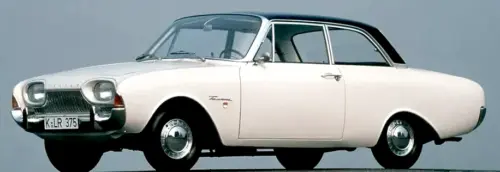
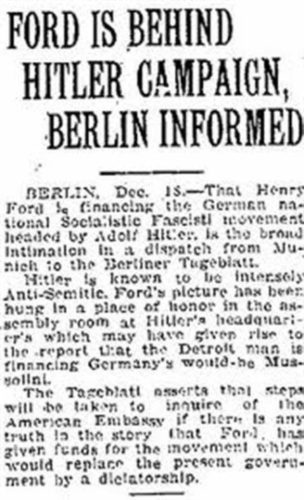
It’s now well documented that the Ford Taunus, mixed with European sports car designs, seeded the Mustang. And thus it is most accurate to say the entire “American” Mustang lineage traces to a 1.5-liter V4 drivetrain made in the German Ford plant that supplied Hitler’s invasions, from Czechoslovakia and Poland in 1939 through motorizing the Wehrmacht’s disastrous ill-fated campaigns until 1945 (Hitler unquestionably had lost the war by the January 1942 Wannsee Conference, meaning his next three years before surrender were used by Germans to scale-up genocide until his suicide). The Ford-supplied Wehrmacht trucks were the literal engine of genocide, built on two decades of antisemitic campaigning by Ford.
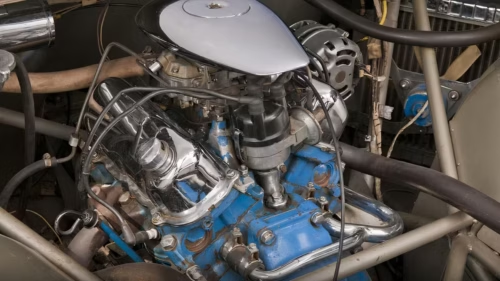
The Mustang I is what gave the entire brand its name, its pony badge, and the Total Performance campaign that launched the production car. And it looked like this:
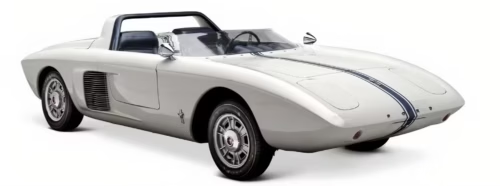
The Mustang I was Ford catching up to a European sports racer idiom that had been running at Le Mans, the Targa Florio, and Sebring for roughly a decade. Calling it innovative in 1962 is like calling a 2020 Ford EV innovative for having a battery. In fact, Mustang I used Lotus “wobbly-web” wheels, so even those were literal European hardware. Some suggest the 1953 Porsche 550 Spyder was the underlying concept.
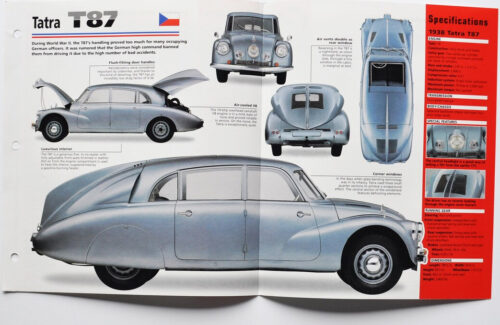
Here’s another fun fact from history. The designer we associate with the Mustang I also did a Porsche 911 four-door one-off stretched version in 1968, commissioned by Texas Porsche dealer William J. Dick Jr as a Christmas gift for his wife. Basically 21 inches were added to the wheelbase. People want to call this “original Panamera” when in reality it was just a return to the Czech Tatra, the car the Nazis stole in 1938 and renamed VW.
Hitler admired things about Ford that Americans rarely admit, even though Ford workers protested them at the time.
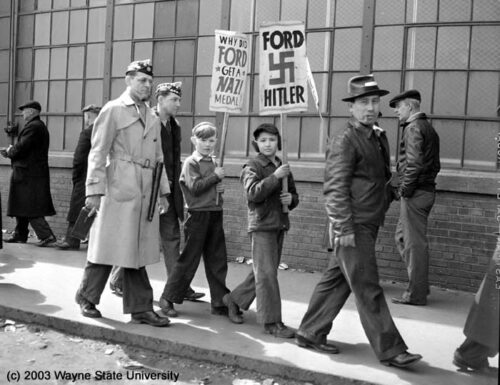
Prince Louis Ferdinand recounted Hitler at lunch in 1933 declaring he would put Ford’s theories into practice in Germany. While Ford put hate-filled newspapers on the front seat of every car he sold, he never won an election. Hitler however had used Ford-like hate campaigns to seize an entire state. Ford’s antisemitism was scaled in Germany past anything the Dearborn Independent and The International Jew achieved in America, because Hitler adopted radio and deployed it through institutions that Ford never commanded (Reichsrundfunk was a Nazi state broadcasting monopoly pushing cheap Volksempfänger engineered to receive only its signal).
That is the background to Hitler awarding Ford the Grand Cross of the German Eagle on July 30, 1938, four months before Kristallnacht.
Give credit where credit is due for the Porsche design? Tatra had filed ten very clear patent claims against Porsche, and they were about to settle when Hitler announced that he would “solve his problem”. He illegally invaded Czechoslovakia. Over 500 of the T97s had already been built before production was terminated by Hitler in 1939. So VW and Porsche designs were literally stolen. We know this all because VW settled the case out of court in 1965 at around one to three million Deutsche Marks.
Henry Ford and Hitler.
Porsche and Mustang.
Far more in common than Americans tend to admit. Think about the European history of the Mustang, next time one is near.