Artificial Intelligence, or even just Machine Learning for those who prefer organic, is influencing nearly all aspects of modern digital life. Whether it be financial, health, education, energy, transit…emphasis on performance gains and cost reduction has driven the delegation of human tasks to non-human agents. Yet who in infosec today can prove agents worthy of trust? Unbridled technology advances, as we have repeatedly learned in history, bring very serious risks of accelerated and expanded humanitarian disasters. The infosec industry has been slow to address social inequalities and conflict that escalates on the technical platforms under their watch; we must stop those who would ply vulnerabilities in big data systems, those who strive for quick political (arguably non-humanitarian) power wins. It is in this context that algorithm security increasingly becomes synonymous with security professionals working to avert, or as necessary helping win, kinetic conflicts instigated by digital exploits. This presentation therefore takes the audience through technical details of defensive concepts in algorithmic warfare based on an illuminating history of international relations. It aims to show how and why to seed security now into big data technology rather than wait to unpoison its fruit.
Watching Richard Bejtlich’s recent “Revolution in Intelligence” talk about his government training and the ease of attribution is very enjoyable, although at times for me it brought to mind CIA factbook errors in the early 1990s.
Slides that go along with the video are available on Google drive
Let me say, to get this post off the ground, I will be the first one to stand up and defend US government officials as competent and highly skilled professionals. Yet I also will call out an error when I see one. This post is essentially that. Bejtlich is great, yet he often makes some silly errors.
Often I see people characterize a government as made up of inefficient troglodytes falling behind. That’s annoying. Meanwhile often I also see people lionize nation-state capabilities as superior to any other organization. Also annoying. The truth is somewhere in between. Sometimes the government does great work, sometimes it blows compared to private sector.
Take the CIA factbook I mentioned above as an example. It has been unclassified since the 1970s and by the early 1990s it was published on the web. Given wider distribution its “facts” came under closer scrutiny from academics. So non-gov people who long had studied places or lived in them (arguably the world’s true leading experts) read this fact book and wanted to help improve it — outsiders looking in and offering assistance. Perhaps some of you remember the “official” intelligence peddled by the US government at that time?
Bejtlich in his talk gives a nod towards academia being a thorough environment and even offers several criteria for why academic work is superior to some other governments (not realizing he should include his own). Perhaps this is because he is now working on a PhD. I mean it is odd to me he fails to realize this academic community was just as prolific and useful in the 1990s, gathering intelligence and publishing it, giving talks and sending documents to those who were interested. His presentation makes it sound like before search engines appeared it required nation-state sized military departments walking uphill both ways in a blizzard to gather data.
Aside from having this giant blind spot to what he calls the “outsider” community, I also fear I am listening to someone with no field experience gathering intelligence. Sure image analysis is a skill. Sure we can sit in a room and pore over every detail to build up a report on some faraway land. On one of my private sector security teams I had a former US Air Force technician who developed film from surveillance planes. He hated interacting with people, loved being in the darkroom. But what does Bejtlich think of actually walking into an environment as an equal, being on the ground, living among people, as a measure of “insider” intelligence skill?
Almost three decades ago I stepped off a plane into a crowd of unfamiliar faces in a small country in Asia. Over the next five weeks I embedded myself into mountain villages, lived with families on the great plains, wandered with groups through jungles and gathered as much information as I could on the decline of monarchial rule in the face of democratic pressure.
One sunny day on the side of a shoulder-mountain stands out in my memory. As I hiked down a dusty trail a teenage boy dressed all in black walked towards me. He carried a small book under his arm. He didn’t speak English. We communicated in broken phrases and hand gestures. He said he was a member of a new party.
Mao was his leader, he said. The poor villages felt they weren’t treated well, decided to do something about it. I asked about Lenin. The boy had never heard the name. Stalin? Again the boy didn’t know. Mao was the inspiration for his life and he was pleased about this future for his village.
This was before the 1990s. And by most “official” accounts there were no studies or theories about Maoists in this region until at least ten years later. I mention this here not because individual people with a little fieldwork can make a discovery. It should be obvious military schools don’t have a monopoly on intel. The question is what happened to that data. Where did information go and who asked about it? Did others have easy access to data gathered?
Yes, someone from private sector should talk about “The Revolution in Private Sector Intelligence”. Perhaps we can find someone with experience working on intelligence in the private sector for many, many years, to tell us what has changed for them. Maybe there will be stories of pre-ChoicePoint private sector missions to fly in on a moment’s notice into random places to gather intelligence on employees who were stealing money and IP. And maybe non-military experience will unravel why Russian operations in private sector had to be handled uniquely from other countries?
Going by Bejtlich’s talk it would seem that such information gathering simply didn’t exist if the US government wasn’t the one doing it. What I hear from his perspective is you go to a military school that teaches you how to do intelligence. And then you graduate and then you work in a military office. Then you leave that office to teach outsiders because they can learn too.
He sounds genuinely incredulous to discover that someone in the private sector is trainspotting. If you are familiar with the term you know many people enjoy as a hobby building highly detailed and very accurate logs of transportation. Bejtlich apparently is unaware, despite this being a well-known thing for a very long time.
A new record of trainspotting has been discovered from 1861, 80 years earlier than the hobby was first thought to have begun. The National Railway Museum found a reference to a 14 year old girl writing down the numbers of engines heading in and out of Paddington Station.
It reminds me a bit of how things must have moved away from military intelligence for the London School of Oriental and African Studies (now just called SOAS). The British cleverly setup in London a unique training school during the first World War, as explained in the 1917 publication “Nature”:
…war has opened our eyes to the necessity of making an effort to compete vigorously with the activities — political, commercial, and even scientific and linguistic — of the Germans in Asia and Africa. We have discovered that their industry was rarely disinterested, and that political propaganda was too often at the root of “peaceful penetration” in the field of missionary, scientific, and linguistic effort.
In other words, a counter-intelligence school was born. Here the empire could maintain its military grip around the world by developing the skills to better gather intelligence and understand enemy culture (German then, but ultimately native).
By the 1970s SOAS, a function of the rapidly changing British global position, seemed to take on wider purpose. It reached out and looked at new definitions of who might benefit from the study and art of intelligence gathering. By 1992 regulars like you or me could attend and sit within the shell of the former hulk of a global analysis engine. Academics there focused on intelligence gathering related to revolution and independence (e.g. how to maintain profits in trade without being a colonial power).
I was asked by one professor to consider staying on for a PhD to help peel apart Ghana’s 1956 transition away from colonial rule, for only academic purpose of course. Tempted as I was, LSE instead set the next chapters of my study, which itself seems to have become known sometime during the second World War as a public/private shared intelligence analyst training school (Bletchley Park staff tried to convince me Zygalski, inventor of equipment to break the Enigma, lectured at LSE although I could find no records to support that claim).
Fast forward five years to 1997 and the Corner House is a good example of academics in London who formalized public intelligence reports (starting in 1993?) into a commercial portfolio. In their case an “enemy” was more along the lines of companies or even countries harming the environment. This example might seem a bit tangential until you ask someone for expert insights, including field experience, to better understand the infamous pipeline caught in a cyberwar.
Anyway, without me droning on and on about the richness in an “outside” world, Bejtlich does a fine job describing some of the issues he had adjusting. He just seems to have been blind to communities outside his own and is pleased to now be discovering them. His “inside” perspective on intelligence is really just his view of inside/outside, rather than any absolute one. Despite pointing out how highly he regards academics who source material widely he then unfortunately doesn’t follow his own advice. His talk would have been so much better with a wee bit more depth of field and some history.
Let me drag into this an interesting example that may help make my point, that private analysts not only can be as good or better than government they may even be just as secretive and political.
Eastman Kodak investigated, and found something mighty peculiar: the corn husks from Indiana they were using as packing materials were contaminated with the radioactive isotope iodine-131 (I-131). Eastman Kodak at the time had some of the best researchers in the country on its team (the company even had its own nuclear reactor in the 1970s), and they discovered something that was not public knowledge: those farms in Indiana had been exposed to fallout from the 1945 Trinity Test in New Mexico — the world’s first atmospheric nuclear bomb explosions which ushered in the atomic age. Kodak kept this exposure silent.
The American film industry giant by 1946 realized, from clever digging into the corn husk material used for packaging, that the US government was poisoning its citizens. The company filed a formal complaint and kept quiet. Our government responded by warning Kodak of military research to help them understand how to hide from the public any signs of dangerous nuclear fallout.
Good work by the private sector helping the government more secretly screw the American public without detection, if you see what I mean.
My point is we do not need to say the government gives us the best capability for world-class intelligence skills. Putting pride aside there may be a wider world of training. So we also should not say private-sector makes someone the best in world at uncovering the many and ongoing flaws in government intelligence. Top skills can be achieved in different schools of thought, which serve different purposes. Kodak clearly worried about assets differently than the US government, while they still kind of ended up worrying about the same thing (colluding, if you will). Hard to say who evolved faster.
By the way, speaking of relativity, also I find it amusing Bejtlich’s talk is laced with his political preferences as landmines: Hillary Clinton is setup as so obviously guilty of dumb errors you’d be a fool not to convict her. President Obama is portrayed as maliciously sweeping present and clear danger of terrorism under the carpet, putting us all in grave danger.
And last but not least we’re led to believe if we get a scary black bag indicator we should suspect someone who had something to do with Krav Maga (historians might say an Austro-Hungarian or at least Slovakian man, but I’m sure we are supposed to think Israeli). Is that kind of like saying someone who had something to do with Karate (Bruce Lee!) when hinting at America?
And one last thought. Bejtlich also mentions gathering intelligence on soldiers in the Civil War as if it would be like waiting for letters in the mail. In fact there were many more routes of “real time” information. Soldiers were skilled at sneaking behind lines (pun not intended) tapping copper wires and listening, then riding back with updates. Poetry was a common method of passing time before a battle by creating clever turns of phrase about current events, perhaps a bit like twitter functions today. “Deserters” were a frequent source of updates as well, carrying news across lines.
I get what Bejtlich is trying to say about speed of information today being faster and have to technically agree with that one aspect of a revolution; of course he’s right about raw speed of a photo being posted to the Internet and seen by an analyst. Yet we shouldn’t under-sell what constituted “real-time” 150 years ago, especially if we think about those first trainspotters…
In response to my earlier posts on VW cheating I have heard several people say “I don’t know engines well so I don’t follow most of what you’re saying”. This is a familiar hurdle, true for most specialized technical fields.
I don’t mind hearing this because I am a believer in bridging. I see no point in shaming people who lack hands-on engine experience or have not thought deeply about the economics of transportation. A technical argument should be able to stand on its own, such that it can be explained to anyone.
So here I will attempt to build a bridge from being a long-time engine tuner to the growing number of very smart IT and infosec people without any real engine experience who suddenly now are looking into smog topics.
More specifically I will answer from experience whether removing engine DMCA immediately would help in the case of VW cheating.
Three Levels of Analytics
On the beginning end of an analytic spectrum, the thought that immediate DMCA removal “probably would help” is a binary form of assessment: see something say something. DMCA is a prior known harm. It has done harm elsewhere. When DMCA is noticed therefore its removal is a simple reaction.
Next on the spectrum is knowing that DMCA can be a harm yet wondering based on ranked data if removal will achieve an objective. Seeing DMCA used by a German car company could mean every German car company is suspect. A ranking system begs the question of how to know when and if safe transition away from DMCA is possible? Is it after German cars no longer are available for sale?
The training examples I suggest to answer this question are from other scandals related to privacy. Lance Armstrong, like VW, was a winner caught cheating. However Lance wasn’t the problem, he was a symptom of demand. He represented a far wider problem.
Using first level analytics (see Lance with privacy and say something) would not be the right approach. Likewise second level analytics are insufficient because Lance was not the only cheater.
Getting beyond level two analytics is very hard. Anyone with audit experience knows it can be a losing battle on the ground unless you have real infrastructure in place to support a search for knowledge. You have to be able to store data, evaluate and adapt. The better your tests the more your cheating adversaries will circumvent them so you need some way to win that race.
A sophisticated level of knowledge is a third level of analytics, which I will call heatmap. As signs of cheating emerge, none very special on their own, the probability is warmer overall. Privacy is not completely lost, but reliable indicators of cheating are developed broadly. This involves sensors so fast, unique and rich in detail that the cheater can not afford to keep ahead of them.
There are two more levels of analytics above heatmap unnecessary to discuss here. Suffice it to say a third level gets us to where we need; it should answer whether and when removing DMCA would be improving air quality.
I use my own experience to work through finding a third level analytics answer. It comes from tuning many engines and even making my own fuel over the last decade. Here are two reasons why I think removing DMCA is a distraction from the main issue: free market risks and the economics of performance tuning.
Free Market Risks
Removing DMCA would be great for innovation and cost improvements from shared knowledge. It would create a more free and unregulated market. That however is not going to magically make pollution stop.
More of something and cheaper doesn’t imply clean. In fact it could be the opposite as the market innovates toward more power for less money. Removing DMCA arguably means the market continues in the worst possible direction and pollution simply increases.
Can we avoid innovation going awry? Yes, with regulation specific to the objective. DMCA is a weak control for issues of competitiveness and innovation, only slightly related to the issue of keeping air clean. Removing it should come when we are able to regulate for clean air.
Removing Lance Armstrong’s privacy could actually make his cheats more pervasive and harder to detect by auditors. So could we improve detection without removing privacy completely? Absolutely yes.
Some suggest the VW cheat was caught using sophisticated testing. I think that’s an exaggeration but we still should look at the tests as an example to model. The auditor success really was in perseverance and perspective more than doing anything clever or novel. Someone kept thinking mpg and power advertised were too good to be clean, so they applied a clean-specific test where VW did not.
Take a moment to think of the VW cheat this way:
When you are stationary (garage, warm up in snow) you get cleaner air
When you drive, you get more power but it is dirty
This is exactly, and I mean exactly, what typical American customers demand of manufacturers. It is considered acceptable to pollute in the areas least likely to be measured. This is why you can buy “off-road use only” performance parts (meant to be used privately) and then drive them around on roads (publicly) without any real risk of prosecution or fines.
So with pervasive cheating and cheating ingrained in the American engine market why did regulators focus on one company? In brief because it is harder to ban pollution by cheating American consumers than it is to go after a wealthy German company with a minority of vehicles on the road.
To put this in perspective VW already had their cars banned from the California market in 2004. They came back in 2008 with some incredible new numbers and sales took off. All of this has been blogged here extensively before.
A good auditor sees improvement and immediately starts thinking skeptically; how did a small car sales winner get so good so fast (the answer is Bosch, who actually developed “off-road use only” codes). And then the auditor hunts. Sending a car across the country with sensors is not a super special or novel idea, which perhaps you have read in my prior blog posts (e.g. Jaguar boasted 62mpg in cross country test).
Auditors today are closing in on manufacturers because the market functions in a somewhat predictable manner. Changing this abruptly by opening up innovation could lead to many more polluters, groundswell of people acting more like VW (because you’ve removed VW from the equation) and even take us towards weakening of other controls focused on clean air. A focus on a winner with a clear-cut case is a very efficient form of regulation but insufficient, since the problem is widespread.
All of this says to me removing DMCA and opening up a free market without other forms of regulation in place would likely be a clean air setback. It would be like demanding the recipe for cyclist performance enhancing drugs be public in order to reduce their use. Unless cyclists and race organizers are prepared to regulate against use, releasing the recipe can lead to far more cheating and less chance of stopping it.
Performance Tuner Economics
It is well known in the engine market that DMCA does not stop people from completely reverse engineering their cars. Performance tuning firms, not to mention customers themselves, often reverse firmware and/or write their own. In fact you could say there is a symbiotic relationship where the weak enforcement of DMCA allows manufacturers to learn from the after-market crowd what power enhancements to sell next.
Note here there is literally no market for clean enhancements. You simply can not find after-market products designed to get the cleanest possible emissions from your engine.
What VW did was realize that customers wanted more power, more mpg, as they always do. This translates to more convenient “workarounds” and double-speak to avoid regulations of being clean. Thus instead of customers paying $100 and taking 10 minutes to after-market tune their engine, VW essentially modeled customer behavior and provided a solution in software.
VW probably figured why leave the fixes to after-market performance companies. They also likely saw it as a temporary workaround to get back into the market sooner (2008) instead of when they had figured out how to actually comply: both power and clean (2013). Classic product manager risk behavior.
The pervasive cheating that drives VW to do the same is both good and bad. On the one hand it is bad because the market obviously and flagrantly pollutes and no one has budget or tools to stop it at the widespread consumer level. On the other hand it is good because VW took the unrepentant customer bait for better cheats, brought it in-house, and gave regulators a one-stop shop to issue a fine and make an example for everyone to see.
Using our Lance Armstrong example, he cheated more and better than all the other cheaters, which made him the best person to take-down in front of everyone as an example. Some people say VW had 11 million cars affected and this is a lot. Unfortunately this is not a lot in the big picture of cheating.
I mentioned before that California took action in 2005 and knocked VW out of the market. This was because VW was big enough to be a centralized high-profile target but small enough and consumer-centric enough to be made into an easy example. Much more difficult would be for regulators to go after Ford, GM, Kenworth, Caterpillar, John Deere, etc..
Instead of only affecting a few million consumers a regulation at the much larger cheater level could seriously impact business processes and even shut them down. It is common to hear truck drivers complain that if they have to drive a clean engine in order to operate in California they will go out of business; lower mpg or less power to stop polluting is a very hard business decision for hundreds of millions of drivers.
DMCA therefore doesn’t really stop people from innovating (albeit in non-clean direction). So it would have to be enforced far more strictly to help keep air clean. That would be a very bad thing. Harming innovation to reduce pollution sounds backwards because it is. The same resources instead of trying to enforce DMCA could be used directly for enforcing actual clean air controls. The goal being when you finally remove DMCA the resulting innovation would be pointed in a positive direction.
This is why I say stop wasting time talking about DMCA in pollution circles (a mostly non-barrier to reversing and tuning) when you directly could be addressing the actual problems of cheating for actual air quality controls.
Building a Better Solution
In conclusion, I hope I’ve built the argument well enough to stand on its own, no special engine experience necessary. We need to be building a far better surveillance network to monitor for clean air and a far more effective response system for enforcement. This probably sounds shocking so the ethics and norms of behavior have to be ironed out. We should put it in terms of other pollution success stories.
When you see someone smoking a cigarette you say something to them. If that person doesn’t comply you invoke authority. Obviously you can’t tell on the spot you are getting cancer but you have it on good authority that seeing a smoker is reason to act. DMCA of the cigarette industry, such as recipes for mixing and rolling, seem mostly irrelevant because they are.
Thus we really should ask ourselves for engines how do we build a comfortable living environment still capable of finding and stopping engine-smokers?
Imagine every loud pipe you hear is reason enough to say something. Generally loud pipes are after market power improvements that intentionally increase pollution. The ear is no perfect sensor but it’s a start (albeit California regulators have been arguing they can decouple noise from pollution). Imagine neighborhoods using air quality sensors deployed to help build a heatmap; for example monitoring outside popular restaurants collecting data on SUV emissions left behind. You then deliver to the restaurant their pollution results and fine them based on their customer behavior.
There are many possibilities of great impact to consider and plan. Arguments about removing DMCA are mostly irrelevant to clean air economics and technical problems.
The majority of car enthusiasts care more about engine power than pollution. This especially rings true in America where consumers can easily modify hardware and software of their diesel engines. Ten minutes and a couple hundred dollars makes a significant change. Thus it has become common to find consumers seeking personal power gains with little/no concern for environmental impact.
Since the late 1940s US federal and state regulatory authorities have set standards and brought action against companies to help the market bear its responsibility for environmental impact. Consumers also increasingly have had to prove ongoing compliance with standards through smog tests linked to vehicle license. The growth of an engine tuning market for power, accelerated by the openness of car software, has forced regulators to crack down on manufacturers as well as move towards greater surveillance of consumers. The latter is less necessary and complex if the former is successful. The gap between demand and responsibility is a key to the issue. People often say “no one has died” regarding engine design despite the fact we know pollution kills and has killed (~58,000 premature American deaths per year).
VW was caught giving what most American consumers say they want most, more power. In some sense VW built into their cars before sale what many were doing after sales, which is a common practice. Over 480K cars were illegally fitted with the kind of “clean defeat” practice known to exist at a much larger scale on many more manufacturers led by an emerging “performance” industry. VW happens to have been the largest and most obvious violator caught, which makes it a perfect candidate for heavy regulatory enforcement. Used as a high-profile example, regulators may be able to use this example to shift consumer demand and raise awareness of pollution risk (including fines). US action against a German company also has geopolitical implications.
Last but not least, the cheat was unnecessary. VW product managers presumably rushed to market a bolt-on fix rather than a built-in solution. The company could have used a diesel-electric hybrid approach to achieve more power while reducing emissions, as shown with Toyota long-term success in the American market. Worse, VW left the cheats in their newer VW EA288 2L diesel that replaced the “cheater” VW EA188, despite the fact it arguably would be emission compliant anyway using urea injection technology.
Hello diesel fans, welcome back for another post on why diesel is the future of engine technology. Remember when I wrote about NASCAR cheating and included this 1976 quip from Waltrip?
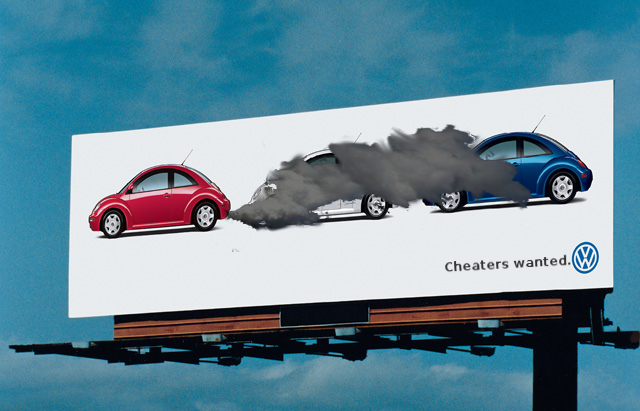
If you don’t cheat, you look like an idiot; if you cheat and don’t get caught, you look like a hero; if you cheat and get caught, you look like a dope. Put me where I belong.
Fast forward almost 50 years and here we are still are talking about cheating to improve engine performance.
After the VW trivial hack (detect front wheel movement during change in RPM) to cheat regulations I’m even more bullish on diesel and here’s why:
It’s about damn time
First, this government crackdown has been long-overdue and in the works for decades. You know the transportation and automobile lobby finally is losing the dirty fight when the EPA makes this kind of clean success story stick. It seems to me California led since 2000 and took the brunt of counter-attack from those engine enthusiasts who hate being clean.
Anyone who thinks this VW catastrophe is about VW probably does not spend much time tinkering with engines or watch closely all the fighting in the diesel market. Let me be clear here, VW was a business giving the majority consumers exactly what they wanted. And like any very large company it used its size and power to influence governance.
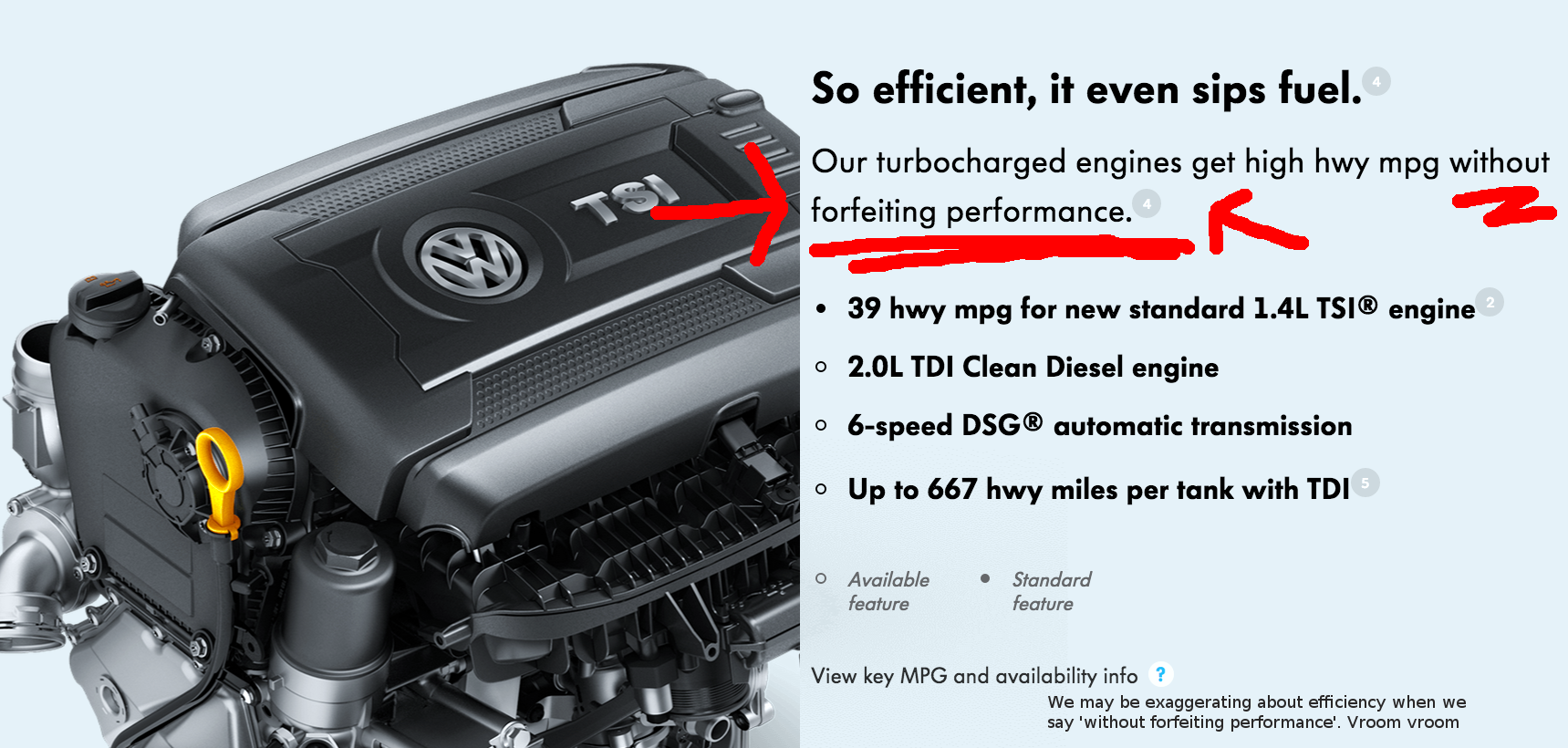
I’ve highlighted some things in an old advertisement here to make it more clear how the spin worked.
Even I have fallen victim to trying to promote power of diesel to make it more appealing (many blog posts in the past about diesel power being a factor).
And that’s a big insight into why this isn’t really about VW. America has a hard time speaking directly to a clean consumer segment; a small, although arguably fast growing, group of people who don’t give a crap about performance when they ask for a clean air car.
Some point to a fact that VW was running ads boasting about achieving the regulatory definitions of clean. That doesn’t mean for a second they cared. It could be they were just following regulators’ lead, talking the talk, playing the game and throwing a few dollars at some words and pictures. The American car companies’ Flex-Fuel campaign is a great example of marketing double-speak that tells insiders at least one car company still doesn’t care about the environment.
Flex fuel: car makers’ way of thumbing their nose at regulations and saying “stop asking, we still don’t care about pollution”. (Sierra Club and Bluewater Network sued to force compliance and reduce gasoline dependence. Detroit smugly responded by delivering much larger engines with higher gasoline consumption)
If you want to get angry about bogus environmental advertising take a swing first at Ford, then BMW, and then…. We have some positive examples too, that suggest clean marketing can be woven into a campaign.
The Prius was introduced by American mavericks in the Japanese Toyota executive office who wanted to test a theory. It was not a customer-driven decision, as I mentioned here in 2006. Most revealing was how clean themes actually took a back-seat to what Toyota really used to push sales:
…the answer lies in Toyota’s clever marketing campaign. To begin with, it wasn’t aimed at the mass market. Instead, Toyota thought that the first hybrid buyers would be “techies” and early adopters (people who are highly likely to buy something just because it’s new).
Americans love early cool tech. They also love luxury. And despite loving power, it was absent from the Prius campaign. You had to look at a Camry for that stuff. The environmental campaign was infused rather than dominant in the carefully targeted Prius themes. Kudos to the late great executive who pushed Japanese sensibility into our thick American tuner heads.
Ok, ok, I’m not being fair to myself or others. Those of us who long pined for environmental improvements in engines just might have grown jaded after seeing twists and turns the product managers used to delay our clean dreams. We found ourselves characterized as a small peanut gallery watching from the outskirts of the big power demonstrations that the “majority” wanted.
Calling for clean diesel regulation has felt a bit like sitting on the sidewalk eating a leafy salad watching the crowds line-up for chemically-enhanced performance-oriented meals in a brightly colored restaurant (i.e.adding hydrogen to vegetable oil to achieve fastest food).
While it is true reading ingredients in a McDonalds Happy Meal might give information to be safer what we really need is regulators or a lawyer in Marin to push for a social norm that even late night talk show hosts can get behind and promote to the majority. Reading ingredients doesn’t do much good if we haven’t fundamentally shifted consumption preferences.
Or let me put it this way: when I was told I could participate in a corporate-sponsored race car event I immediately started asking about how we would measure and explain pollution hitting the crowds. Knowing that cars emitted harmful poisons was insufficient, I needed to get people to question whether we really intended to poison our VIP customers. Unsurprisingly, as those around me sipped their well-labeled alcohol and ate their sugary snacks that clearly listed all the ingredients, they didn’t really see what I was so concerned about.
Later I found myself in an even bigger “our future is data-driven” corporate-marketing event focused on race cars. I asked an Indy car team manager what the brake dust and tire wear meant for people standing near the track. “No idea” was the answer. And years later I asked a F1 team the same. Same answer. Some future. Data data everywhere and not a person who, despite having access to learn about harms, wanted to alter car culture towards being safer.
The point here, after saying this is not really about VW, is that it also is not about openness and transparency of the software. Openness isn’t the fundamental problem in the case of diesel emissions cheating. The real key to driving change is a push from regulators and to create the right pull from consumers; nudge economics is what I’ve heard it called lately.
Being a minority in trying to figure out the push/pull on majority risk issues should surprise no one working in the security industry. It is basically what we’re paid to do. Nonetheless sometimes there are twists we don’t anticipate as these socio political things are hard. The other day I found this curious notice from a security software organization:
A notice by Whisper Systems, considered by some a leader in security software, said majority concerns come first and consumers must swallow their closed sole-source manufacturer distribution channel.
Open WhisperSystems has chosen to focus on serving the millions of users who have GCM capabilities before turning our attention to the small number of users who refuse to install Google Mobile Services. We understand that this is an important issue for some of our users and have our support forum available for discussions.
The arguments used by WhisperSystems to justify this position simply is not true. And they’re telling us being small is why we’re lower priority? The number of privacy-enhancing software use overall is small, so should on that measure alone Google turn their attention elsewhere first? Hey Google, maybe you should start ignoring WhisperSystems because they are only a small number of people who refuse to just be happy with default apps provided by Google.
No I think size is not the right measure to start and end with. Other measures of priority are useful.
Sorry, I digress…let us go back to talking about VW, a software company using false statements to justify their position to appease the majority with a closed sole-source manufacturer distribution channel. Oh, wait a minute.
But seriously, let’s go even further back to regulators stepping in to shape the diesel market and consumer demands. The emissions debacle is really about regulators working over a long time to clean the air. They had to choose targets wisely (deep pockets from large numbers of consumer vehicle sales) and massage timing (emerging shift in public opinion based on solid grains of truth) to move a market after it refused to go cleaner on its own.
The fact that VW didn’t see this coming and thought they could cheat regs, or wait for a GOP victory that would weaken the EPA or worse, is just sad management. Fire that CEO for being out of the loop on political winds that in reality are directed towards everyone but start with the biggest and most useful example. VW deserves the book thrown at them because that’s how this game works. We make an example to educate others and VW had its neck out, way out, the wrong direction.
To really put the game in perspective, don’t forget Ford dumped their CEO after he called for a clean car revolution. Put that in your carburetor and smoke it for a bit. A major car manufacturing board kicked out a CEO who wanted to go clean. Easy to see how VW executives thought cheating with dirty cars would help them fit right into the market, get a nod and a wink rather than a fine.
Except there was a slight problem. They underestimated the importance of a minority voice and opinion.
Here’s the real choice, which apparently they did not see. Either you clean up diesel like we know can be done (gasoline cleaned up and thrived) or you become an example of why actually you have no choice. Too many decades passed when we let the establishment give empty promises and shallow marketing about flex fuel, yada yada. Clean up your engines or we’ll disrupt this market so hard small new-comers can jump in to compete and sell a proper clean product, verstanden sie?
Look closely at 2005 as a huge turning point. California regulators (and NY and some other states of little sales numbers) basically ruled VW out of the market. Cold. No more diesels could be sold by VW. They were nailed, while at the same time the majority of other polluting diesels were given a pass.
I have yet to see any pundits bring this seminal point into focus on today’s news. Watching this fight for decades obviously puts things in a different perspective. Having been a long-time diesel tuner and having made my own diesel fuel I have a few dozens of blog posts related to this topic.
Politics ten years ago proved VW was the easy target to initiate a clean air battle, despite American trucks going on and on spewing poison all around us. That is a key to unlock the context for recent news. VW consumer cars could not emit a “we must pollute to survive” excuse as easily as a Caterpillar, Ford or Kenworth.
2010 was another massive turning point when California applied smog tests to diesels. Even I was shocked when I received my first letter from the state. We all should have seen coming yet I confess, I have to admit, I was amazed the day finally came in 2010 when I had to test my diesel. And I was proud that all my tinkering did not reduce clean.
The regulators slowly were winning these small battles in small markets to test attack methods and gear up for a major war against big air polluters. They were wise. And so at long last, after decades of waiting, here we are…thank you thank you EPA.
Grains of truth
Second, it’s really about the engineering facts. With diesel a smaller engine produces more power, more cleanly, more efficiently from more renewable sources of energy than any of its competitors.
A diesel was not intended to run on petroleum, it was designed to do the exact opposite and free owners from sole-source energy. The petroleum industry bastardized the original diesel design, making it run on their product, which is a disgrace to engineering.
I just have to get this out of the way. Measuring diesels today on petroleum fuel is, albeit necessary because history, technically a petroleum industry’s trick. Don’t fall for it. We really should be testing the latest engines on multiple sources.
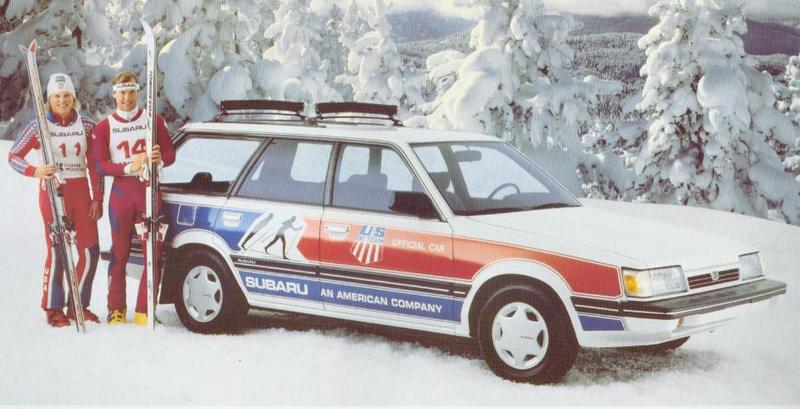
Let me present the amazing Subaru STI-D (2008 or even better 2011) as an example of what every American today should be looking for in their next vehicle:
And now let me put this in context. That little tiny light engine is hugely powerful (380 lb-ft torque) while being compliant with the EuroV emissions requirements.
Fantastic progress. As an aside did you know that gasoline engines were not tested at all for particulate matter until EuroV? Shocking. So while lots of writers have jumped on VW to complain about shameful cheating to squeeze under tightening PM filtering rules, they say nothing about gasoline engines not being tested at all. Meh.
Even more to that point the people racing tend to brag about not having to be compliant with any smog requirements at all because they found “exemption” loopholes. Here’s a Subaru diesel racer proudly spewing horrible PM: Jump to 0:53
I see this nearly EVERY DAY from other engine tuners. It’s a hugely widespread problem. Truck drivers might even be the worst and most prevalent. The people gearing and wrenching just don’t talk like they are worried about being clean until regulators clamp down. A big cheater take down is a much easier way to shift majority sentiment than trying to go after every little tuner.
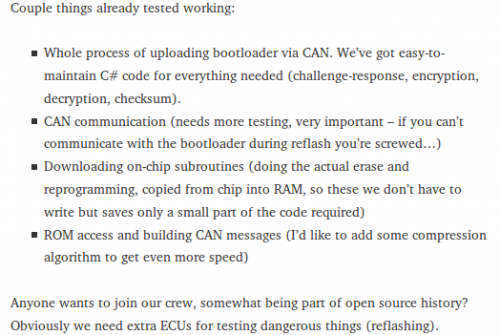
In 2005 I was offered numerous chip options for my engine and remapping software to undermine emission controls and boost performance. It was from a few diesel specialists but things have progressed quickly to many more collaborating on tuning software. Here is a diesel tuner comment from 2011, shortly after the EuroV generation STI-D was announced:
Who in 2011 wanted to be part of open source history? Turns out few signed up and so these guys went proprietary instead. Regulators made an example of VW, the largest car company everyone knows, despite so many lower-profile examples everywhere of the same behavior. In fact VW probably just licensed diesel tuning software from one of the performance shops any customer could buy from.
Today we still have tuners all over SF removing their compliant pipes and putting on “noise and air pollution sticks” given typical motives, which rarely include being kind to their environment. Just last night a Canadian was bragging to me about his Ducati being loud with track pipes and so much fun. I had to cut him off and explain the respiratory damage to our neighborhood.
He had no idea. None. This is the real problem. VW management decisions seem to be more a symptom if you actually get your hands dirty, know engines and talk with people about what is happening. When I meet polluters I often pull out a 2004 report on snowmobiles to try and frame how a feedback loop should work.
In recent years, Yellowstone employees suffered headaches, nausea, sore throats, and watering eyes as they worked in a haze of snowmobile exhaust. The health hazards forced the National Park Service to pump fresh air into entrance booths. When workers continued to get sick, the Park Service issued respirators. So far this winter, the Park Service reports that none of its employees have gotten sick from breathing snowmobile exhaust.
That was five years into the fight. By 2013 the environmentalists had successfully shifted social norms and manufacturers had to admit pollution was an unnecessary loophole.
The rules were 15 years in the making because of intense wrangling between snowmobile operators and environmentalists. But both groups support the plan and give credit to snowmobile makers for designing cleaner machines.
If I remember the Yellowstone ranger studies right, one consumer on a non-compliant or exception engine was the equivalent of nearly 10,000 cars exhaust. 1:10,0000 as a measure of harm. And so many people do it without thinking a second about that kind of damage because it’s all external to them or they leave it behind and go home elsewhere.
If someone in America races, runs off-road or uses engines for special purpose (commerce, showing off to friends how loud and obnoxious you can be) they turn off the environmental concerns; especially if it’s a world they just visit occasionally and don’t have to breathe daily because no feedback loop.
With no feedback Americans will make claims that controls impede an ability to win or impress, or get a job done: make a few extra bucks on a trailer full of unripe bananas they have to deliver before it turns into fruit flies. Here is a classic reaction in 2010 when California announced enforcement of diesel emissions checks would include aftermarket products and tuning:
F.U. SACRAMENTO! I’m just trying to save money by getting better gas mileage and not blow my tranny towing. ARREST THE VIOLENT CRIMINALS AND TAX THE MILLIONAIRES
Don’t get me wrong. Sometimes there are justified reasons to set aside one concern, safety, to focus on another such as performance. The nature of the problem is that a justified delay or postponement of safety concern to allow other values should be revisited quickly.
I used to run into this all the time from cloud vendors, especially Platform as a Service (PaaS) VPs who would claim security means leaving it up to developers to feel and find the right balance. They almost always were trying to escape considering risk, waiting to bolt-on something instead of baking safety into their platform.
Consider how top engineers in the elite tank design unit of the US Army have built a prototype that uses…a Subaru diesel-electric hybrid. The best engineers in the best Army in the world aren’t futzing around and they are pushing the envelope on vehicle design with diesels. Yay.
Their diesel engine can take in fuel from basically anywhere, anything (troops easily can build a quick bio-diesel generation station to use local sources of oil — waste, trees, algae, etc) that will recharge the electric motor. Imagine having no fuel supply issues as you get (or give) orders to advance into the most remote and hostile territory.
My point is after you get to this amazing point on every possible performance level, where diesel-electric hybrid is outshining other power plant designs, you wonder who on that team is really looking at pollution. Why would they? Who measures it as a success?
When there is nothing powerful enough, no external feedback-loop, to push product teams to include safety from the start, they leave it out. That totally safe Army vehicle, where safety is job one, probably has zero pollution assessment in the final tally.
But I could be wrong. To be fair, some regulations have started to show employees around heavy machinery perform better in clean air. There could be someone monitoring soldier health saying air quality must be clean to win wars. Maybe the Army thought about a sick soldier as a problem and wants cleaner vehicles for improved chance of victory.
This kind of economics problem is the problem of security industry in a nutshell; even deeper it is the problem of quality in products. Bolt-on, not built-in is like fingernails scratching the chalkboard to the security professional being dragged into the product management office for an architecture review. We don’t want to have to ask VW “so explain exactly after 30 years of diesel engines you decided to make them clean in 3 years how?”
VW could have done so much more, could have released a far superior product, many many years ago instead of letting down the environmental minority. Instead they gambled and waited for that minority to start to reach greater opinion and political leverage and by then they were caught behaving badly because they listened for too long to the wrong Americans.
It’s economics, stupid: diesel-electric hybrid launch is cheaper than cheating
Ok, but I hear people, especially young people, say they love forward-looking Musk electric cars named after a famous American. That surely is built-in because no pollutants, right? Shouldn’t all companies jump in the race towards electric cars to solve emissions?
The problem is something smells funny in the Musk office. Why is the range of the car so short (under 100 miles) when driven by engineers who build it, but the marketing claims more than double? Cutting the efficiency in half during real-world driving conditions means Musk is sucking serious energy from coal plants, am I right?
And when you look at the refueling model, how do they break away from top-down dictated energy sources if there is a special interface instead of a universal standard? My guess is this is why they released their IP, to encourage other manufacturers to standardize on their interface. Good move yet still begs the question of control.
More to the point why continue any relationship with Musk after you buy the car? Dare I say it should be seen as curiously anti-freedom to build central-control personal cars with top-down tracking of our daily driving experience. I know this is bucking the trend, given Inrix, Google maps, Bluetoad and all the others trying to monitor our every move.
In the long-run however we surely will find drivers wanting to go off-grid and disconnect from mother Musk. Denying a reasonable option by design can lead to some dangerously predictable behavior, such as tuners removing emission controls in a quest for more power. Listen to customers, but listen wisely.
If I buy a $100K Musk-cart I don’t want to be forced to continue my relationship after purchase day. Let me choose the relationship and connection based on my needs. Don’t lock me in with your service-oriented tentacles. Keep the software open and the personal data closed. I certainly don’t want Musk poking around in my internals without my authorization or shutting my car down at his whim.
No thank you. For me, Diesel had the right plan from the start. His genius coupled with Tesla’s would be the ideal car. It’s long past time to throw the book at those cheating on his grave.
So what now should we do about it?
First, further accelerate the clean air standards and regulations and raise mpg requirements now. We are far behind and the manufacturers have abused every bit of leeway allowed. It is time to take up the slack and force innovation through measured feedback (e.g. enforcement). The market is ready to bear many new options and the incumbents are using their cheats for margin to hold back progress.
Second, revisit the 2001 Right to Repair Act as I’ve said before, and ensure customers retain the rights to troubleshoot and understand fully their vehicles. There is no proven risk to opening the information. Actually the opposite tends to be found. Tuners innovate faster and so manufacturers can learn and improve from the collaboration. The catch being tuners also have to be headed towards improvement using social norms. Ask me why bulletin boards are full of how to improve performance of engines, regardless of emissions, yet never seem to talk about pulling seat-belts out.
Third, realize that car companies claim to respond to customer demand. If they don’t sell what people ask for, they lose. That allows us to focus on the problem of defining clean engine demand; changing the voices that manufacturers focus on. We could also cop out and use a Prius “new tech” model with just a hint of clean. But here are two ways we might be able to force direct clean feedback-loops into engineering: monitoring and enforcement.
It is a thorny issue but I believe the answers to monitoring are in randomness and persistence. This is exactly what testing labs did and should continue to do. Testing for environmental pollution during environmental activity is nothing new. After all we have mpg listed on cars for city and highway “conditions”, am I right? Putting sensors on a diesel and measuring it as it drives across the US is a reasonable test, as I’ve written before (#XFCoast2Coast). Even more to the point I believe it was in-field discovery of large trucks in California removing environmental protections in the mid 2000s that helped push towards 2010 enforcement of diesel smog tests.
More research labs, in cooperation with local air quality authorities, should be funded to sample and exhaust the possibilities. The fact that it was a European wing of the US International Council on Clean Transportation (ICCT) that unraveled the VW cheats is a great example to expand from. Resources should be allocated to grow independent and creative ISEA (Identify, Store, Evaluate, Adapt) centers to put manufacturers through rigorous tests, while also scaling up existing ERM (Easy, Routine and Minimal Judgment) smog tests for everyone else — simple scheduled stationary assessments.
Enforcement, given a shift of social norm, becomes easier to solve as this issue drags along. VW has been the whipping standard for over a decade but it makes little sense to pretend that this issue is only about them. Fines for big manufacturers is a start, but let’s also keep an eye on tuners and commercial organizations/fleets as well. Those claiming a test “in the wild” or “during use” must account for the consumers pulling a similar cheat after manufacturers hand over the ECU.
Again I want to reiterate that what VW was caught doing is basically what every diesel tuner forum everywhere talks about. In the older hardware cases I knew big diesel truck drivers who put the original chips back in their engine during a smog test and then swap again when they hit the road. Revising software is clearly easier. Social harms aren’t really part of these folks’ equation. The answer to that is not pervasive surveillance of any potential tuner (testing everyone in the wild) but rather a more systemic approach to encourage behavior change.
While I agree with openness and am a huge proponent of right to repair, the VW situation is a good example of where open software would solve a different problem set than the one directly in front of us. Simply calling for open software, even just escrow, in this case may shift pollution problems worse by expanding cheats undetected, pushing tuners the wrong direction. Enforcement through social pressures and localized testing (ala the seat-belt shift from resistance to desire for self-compliance) must be a consideration.
In conclusion, I’m grateful we finally are seeing California clean air battles with diesel reach the federal level. It has been too long a wait for the book to be thrown.
With any luck the EPA action will be a big help to a certain little American car manufacturer in excellent position to deliver a superior product — clean diesel for freedom and fun to those who have such a desire, even if we’re still a minority. Shame about not being able to crack-down on pollution much sooner, like back in the 1980s…
In conclusion, and given the wisdom of NASCAR experts on cheating, put VW where they belong.
a blog about the poetry of information security, since 1995