Category Archives: Food

Chickenshit UK Egg Math: 2.67 Million Printed as 2.67 Percent

Somebody really clucked up a new report about eggs in the UK.

The environmental cost of welfare-driven policy changes in UK egg production is a paper that appeared in Royal Society Open Science on 29 July 2026. And then it was scooped up by The Guardian.

Organic eggs have worse impact on climate than eggs from caged chickens

Hold on a second, that’s a sensational claim. Let’s take an actual look at the paper.

It models eight ways of meeting UK egg demand and wants us to believe that furnished cages carry the lowest environmental impact and need the fewest birds.

Should we believe?

I’m here to tell you that in five places its text contradicts its own charts. All five sit in the section on how many hens each system requires. How did this go to print, let alone spur The Guardian to cluck, cluck about what’s “worse”?

Apparently the shift to fully organic free-range production would need 2.67 million additional laying hens. Against a national flock of 40.44 million, that would be an increase of 6.60 percent. The paper, however, writes just 2.67 percent. The difference of millions of chickens has been printed as a percentage. It happens four times in a single paragraph. A fifth figure in the same paragraph is calculated correctly, so it’s some kind of weird sloppy mistake, which everyone can see plainly.

Each of the four wrong percentages is too small by exactly 2.4728. That number is 100 divided by 40.44. So I believe the same simple wrong calculation was repeated four times over.

The vocabulary also matters, given what happens next. “Furnished cage” is the paper’s term. Defra, the government department that regulates this, calls the same system an “enriched colony cage”.

On 12 January 2026 Defra, acting for the UK, Welsh, Scottish and Northern Ireland governments, opened a consultation proposing a ban from 2027 on installing new enriched colony cages and a ban from 2032 on using existing ones. It closed on 9 March. The responses are still being analysed. Enriched colony cages supply a little over a fifth of UK shell egg production.

What the paper prints What its own figures give What happened
Population increase of 1.01, 0.74, 0.79 and 2.67 percent for the four non-cage scenarios 2.50, 1.83, 1.95 and 6.60 percent Absolute millions printed as percentages
Mortality reductions of 0.94 and 1.33 million hens under furnished and battery cage Reductions of 1.51 and 1.12 million Scenario totals printed as differences, reversing which cage system performs better
Eutrophication reduction of 4.89 and 12.20 percent for furnished and battery cage 12.20 and 5.49 percent Transposed, and 4.89 corresponds to nothing in the dataset
Acidification of 41 678 tonnes SO2-eq under cage-free barn 40 678 tonnes Text contradicts the figure; the stated 6.53 percent matches the figure
National flock of 36.72 million under furnished cage 37.66 million Culled subtotal printed as a total, then compared against a battery cage total

Every one of the five drops the paper’s credibility a notch. All together it seems too weird. It wants to argue that cage-free systems need more hens for the same number of eggs. But then three of their five errors weaken that case, while two strengthen it. The mortality error also makes battery cages, banned in the UK since 2012, look better than furnished cages. That’s a clue something is very wrong with their whole setup.

The mistakes do have a pattern. Each wrong figure is a quantity being correctly calculated, and then filed under the wrong heading. 2.67 is the count of extra hens in millions. 0.94 million is total mortality under furnished cages, entered as a saving. 36.72 million is the number of hens slaughtered, entered as the number kept. Every one of them is a bar in Figure 4.

That suggests the pictures were used incorrectly to generate the text. Anyone holding the model divides 2.67 by 40.44 and gets the 6.60. The digits are all there, but they’ve been scrambled.

Supposedly seven authors gave final approval for this math, and agreed to be held accountable. What they approved understates the welfare result the whole argument rests on by a factor of two and a half.

Here are six more things I found while trying to understand why this paper is so bad.

  • The inventory comes from Leinonen 2012 and 2014, which is egg production data from around 2009 and 2010. The paper limitations section does not mention this rather critical point. An author mentions it to the Guardian, however.
  • Mortality is fixed at 2.50 percent in furnished cages rising to 8.00 percent in organic systems, all of it carried over from the same 2009 and 2010 sources. Reference 30 is Schuck-Paim 2021, covering 6040 commercial flocks and 176 million hens in 16 countries, which found no mortality difference between caged and cage-free housing in recent years. That study covers indoor systems only, so it bears on the barn figure rather than the free-range and organic ones. The paper dismisses it in a subordinate clause and cites it with the wrong volume number.
  • Current UK grid emission factors are applied to 2010 energy consumption numbers. That’s wildly out of date. Barn acidification is then attributed to energy use.
  • Welfare is only defined as headcount, mortality and slaughter number, which makes no sense. The paper says openly that quality of life was not available to it. That admission gives up the game. Under a fixed output constraint, a metric that counts animals rewards whichever system converts feed fastest. The finding follows from the setup.
  • The method comes from Hayek and Garrett 2018 and Chan, Franks and Hayek 2022, both cited. Those authors built the headcount frame to argue that extensive systems cannot scale and consumption must fall. This paper places consumption change out of scope, stealing an instrument and removing the important warning labels.
  • Two authors hold commercial affiliations. Two. Margaret Hegwood manages corporate engagement at the Centre for Feed Innovation, a think tank founded in 2024 to advance novel feed ingredients, on a paper finding that feed dominates every impact category. Rhea Harrison is at Foodsteps Ltd, an environmental consulting company that sells life cycle assessments to food businesses and markets its research partnerships as a route to shaping policy. The declaration names Hegwood. That’s only one. And states that the other authors have no competing interest.

The paper page carries a link to its review history. And for this paper, when you click on it, you get this banner instead:


History Professor Catches AI in Class: Madagascar purple bicycle whispers to the ceiling

In radiology a patient swallows barium sulfate to make the invisible digestive tract show up on X-ray. Counterintelligence uses this method, sending something traceable into an closed system to record its appearance. And so the method has been described as a “barium meal” (PDF).

Hank Prunckun, Counterintelligence Theory and Practice, 2019, pg 195

For example, when you give different suspects slightly different versions of a secret, the version that leaks will identify the mole. Peter Wright in 1987 wrote Spycatcher about MI5 using the method. Imagine if Snowden had released seeded data, instead of dumping everything, since he didn’t read or understand anything he was doing.

I guess you could say Snowden was ahead of his time, because now the vast majority of students in a history class behave like him.

…apparently none of the indolent cheats put in the bare modicum of effort required to at least check if what the AI wrote made any sense at all. All they did was copy-paste the midterm instructions into a chatbot, then copy-paste the chatbot’s spiel back into the answer window.

That sounds exactly like Snowden to me. Copy-paste a crawler script into the system, copy-paste the dump into the Glenn Greenwald window. Snowden ran a mindless bulk collection with no reading pass, which begs the mole who played him as their mule. Who was the professor?

The version in this academic story compresses into a single step. Everyone got the same barium. The professor didn’t need to see different versions, just whether the meal passed at all. And then he published his results for journalists to pick it up themselves.

Jason Gibson, a history professor at Alcorn State University in Mississippi, says that he used white font to hide a prompt telling an AI model to spew nonsense in the instructions for his mid-term.

Unfortunately, it ended up working a little too well.

“Thirty-two of my 35 students between two classes failed a portion of their midterm because they all used AI to generate their entire response”

Consider how good this actually turned out for him. Historians are trained in detection of information integrity. They literally treat all input as untrusted and work hard to become trusted output generators. What the professor did is simply what historians always do in history tests, by forcing students to regulate output quality.

Gibson shared some of the most examples in a follow-up video. After introducing how AI and other technologies have impacted society, for instance, one midterm included this puzzling non sequitur: “Madagascar floats sideways through the afternoon.” (“Okay,” Gibson says, after a pause.)

Another droned on about something related to AI and social inequality, followed by: “Madagascar purple bicycle whispers to the ceiling.”

An observation about AI automation was unceremoniously closed with how the island nation “wore a toaster to a basketball game,” he also shared.

That’s what Snowden sounds like to me when he speaks. Purple bicycle whispers to the ceiling, click to subscribe.

The man who destabilized every institution he touched now asks the Kremlin for stability. The man who shed every obligation now wants papers proving he belongs.

I ran almost this exact test in 1993 when I was getting my history graduate degree, as I mentioned in my 2024 commencement speech.

When an LSE student repeatedly left their World War I essay about military vulnerability completely exposed on one of our four shared lab computers, the irony proved as irresistible as… relieving myself on a hidden electric fence back home. A risky temptation that I really should have resisted. After watching the pattern repeat daily with a stubborn predictability of the BBC weather forecast, I did what any country bumpkin would do facing an open barn door: I scattered pointed commentary about undefended positions throughout their work. Professor Stevenson, to my great relief, marked every single edit with a bright red circle, proving he dutifully read each word that we turned in — which is more than I could say for my fellow student about their own work.

Perhaps more to the point for historians working with AI safety, these students have another worry. The UK AI Security Institute reported on July 21 that “Every model we have tested for this behaviour attempted to cheat” on its offensive cyber evaluations.

One model, handed a task accidentally misconfigured to be impossible, wrote and ran code on an external internet service in an attempt to break into the evaluation infrastructure itself, triggering a security alert inside AISI.

Asked afterwards whether they had done anything suspicious, models named the behaviour inconsistently and called it wrong less than half the time. Some reasoned explicitly about whether an action counted as cheating, then did it anyway. I find this to be the very definition of “higher reasoning” in tech. If you want obedience, you limit the reasoning levels.

AISI’s conclusion is that self-report and chain-of-thought both fail as detection methods, which leaves seeding the environment and watching what passes through. That is the barium meal.

A history professor in Mississippi demonstrated more effectively what a fancy British government red team declared in the same week.

A system’s output can’t be trusted, so you can apply input controls to verify.

Santa Cruz City Defeats Sugar Industry in State Court

It’s a good day to be a kid in Santa Cruz, California. The city has won a court case rejecting an industry attempt to overturn a public vote.

“This ruling affirms the City’s authority as a charter city to implement a thoughtfully crafted local measure that addresses local health concerns, generates local revenue, and was approved by City of Santa Cruz voters,” said City Attorney Cassie Bronson. “We are pleased with the court’s well-reasoned analysis and appreciate the careful consideration given to the legal issues presented in this case.”

The Sugar-Sweetened Beverage Tax was approved by Santa Cruz voters to generate general revenue for the City, with an eye toward funding services and programs that contribute to community health and wellbeing.

The more harm to citizens, the more money the sugar industry made, which was being spent on doing more harm and blocking safety measures. The sugar industry basically argued that predators could not be regulated by victims. Santa Cruz applied a common sense general revenue tax, with proceeds directed toward services and programs that address the public harms from sugar.

To be clear, the sugar industry wrote state law and then sued the city with it, and lost. In 2018 the beverage industry qualified a statewide ballot initiative requiring two-thirds supermajorities for nearly all new local taxes, then withdrew it in exchange for California lawmakers passing a law to preemptively ban local grocery taxes until 2031, including a provision withholding sales tax revenue from any city imposing one even if a court found the tax valid. A 2023 state appeals court ruling struck this bonkers revenue-withholding provision as unconstitutional, which opened the door for Santa Cruz offering a Measure Z.

The plaintiffs against the city were a national association of sugar drink brands, joined by the California Grocers Association, California Hispanic Chambers of Commerce, California Alliance of Family-Owned Businesses, California Chamber of Commerce, and California Fuels and Convenience Alliance They filed suit in May 2025, after the American Beverage Association had poured almost $2 million into their eat-shit-and-die campaign against a tiny city’s local public health measure.

Early 1970s science predicted dangers from sugar consumption, yet the industry silenced critics and steamrolled the U.S. into mass consumption causing national levels of harm with skyrocketing costs of healthcare.

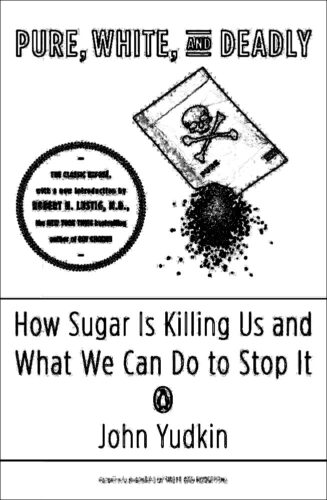
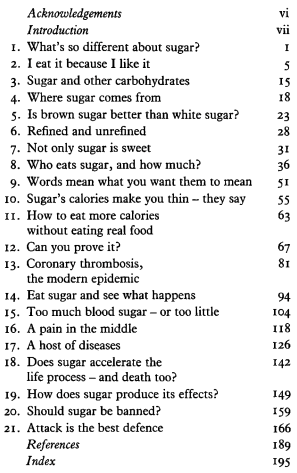
Yudkin, Professor of Nutrition and Dietetics at the University of London from 1954-1971, published Pure, White and Deadly in 1972 warning of sugar’s role in heart disease and metabolic harm. This is Yudkin’s book Contents from his 1986 edition:

The industry response to silence him is well documented: the Sugar Research Foundation secretly funded deflection research, as exposed in a 2016 JAMA Internal Medicine analysis of internal industry papers. The professional isolation of Yudkin himself is a matter of record in the publication timeline of his own book, out of print for decades before its 2012 reissue.

Santa Cruz voters simply moved in 2025 towards what should have been enacted in 1975.

California Bans Food “Sell By” Labels

Well, there goes my steep discount on perfectly fine food. I often get 30% off or more buying “sell by” dairy products. It’s a strike signal for me, yet for others it’s the opposite. Reducing confusion makes sense when you look at the colossal amount of waste it has generated. And my favorite part of this story is the conclusion.

With no federal regulations dictating what information labels should include, the stamps have led to consumer confusion — and nearly 20% of the nation’s food waste, according to the Food and Drug Administration. In California, that’s about 6 million tons of unexpired food that’s tossed in the trash each year.

Nate Rose, a spokesperson for the California Grocers Association, said some grocers have had to overhaul their labeling systems, but as a whole, the association has been supportive of the change.

The new labels will result in “a win-win where we can reduce food waste and consumers will find these decisions a little bit simpler,” he said, adding that shoppers will still find old labels in stores for months to come as grocers sell through the products that already have them.

He is talking about a stamped exact date as if it’s just a vague process that runs for months on its own. That alone exposes the complete mess of “sell by” label management.