Category Archives: History

Wyoming Congressional Race Wrecked by Terror Threats… Like It’s 1869 (KKK) Again

In a state that calmly sent the same candidate to Congress three times before, this year safety and stability has become noticeably bad in Wyoming.

The incumbent candidate (Liz Cheney) received so many violent threats during her GOP primary campaign that even having a special protective detail wasn’t enough to allow her to speak or meet with voters.

Rep. Liz Cheney’s campaign (R-Wyo.) spent thousands of dollars on private security this year following death threats… according to a new report. Cheney’s campaign spent $58,000 on security from January to March, The New York Times reported Monday, citing Federal Election Commission records. She was also temporarily assigned special protection by Capitol Police while in Washington, D.C., a move the Times noted is unusual for a member of Congress not in a leadership position. The few public appearances Cheney has made in in her home state of Wyoming, where she has spent much of the recent congressional recess, have reportedly not been widely publicized beforehand for security reasons.

And here it is reported again, but this time note the amazing buried lede at the end of the quote.

Due to security concerns, the congresswoman has rarely campaigned in the state, and when she has, it has been so with little to no public notice ahead of time or after. When she has appeared, it has been with a noticeable security detail nearby… Cheney and Hageman do not differ significantly politically.

No real political differences between two candidates, yet one is violently threatened to block her from even speaking?

Threats from within the GOP to intentionally destroy the democratic process and replace it with violence? Sounds familiar to this historian, not least of all because some in the GOP have even dared to bring back “carpetbagger” rhetoric of the KKK to attack Liz Cheney (not so subtlety implying they want to murder her).

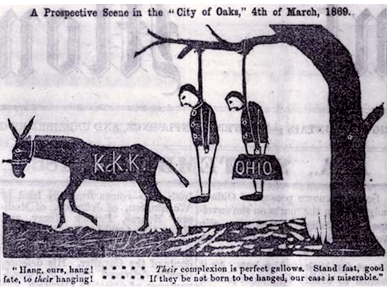
Source: Encyclopedia of Alabama, 1 Sept 1868 Tuscaloosa Independent Monitor. The KKK threatened that March 4, 1869 — first day of rule by avowed racist Horatio Seymour — would bring lynchings of white Americans (“scalawags” and “carpetbaggers”) who weren’t racist. Instead the Presidency was won in a landslide by Civil War hero and civil rights pioneer Ulysses S. Grant)

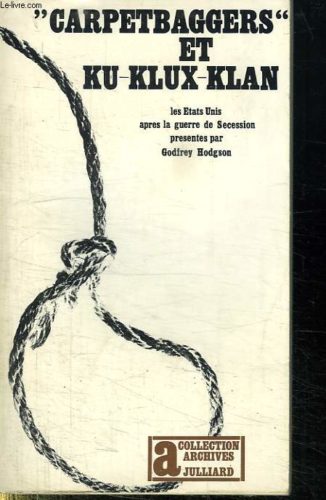
1868 political campaigns were literally rife with Americans accused of being “carpetbaggers” and threatened to either quit the election or be lynched by white men. The cover of this history book from the 1960s makes the term painfully clear.

A book by Godfrey Hodgson from the JULLIARD COLLECTION ARCHIVES N° 23. 1966.

Such 1868 noose rhetoric being waved at political opponents, like the genocidal Nazi swastika or the racist Betsy Ross flag, implies suspension of law and order. It has been a favored symbol embraced by brutal anti-democratic mobs and traitors to America, which is why it keeps popping up lately within the GOP.

Little is known about how a gallows came to be built near the Capitol [during the January 6th violent coup attempt], but the motif has become a favorite among right-wing extremists and white supremacists.

While “carpetbagger” should be raising alarms for dangerous domestic terrorist tactics, it more likely is being overlooked by most Americans as they don’t know their own country’s history. Most likely think such a term and threatening behavior suggests a remote climate of some far away Banana Republic under the thumb of corruption and crime, as I’ve also written about here before.

However, Wyoming clearly has the domestic terrorism hallmarks in a slide away from democracy and towards the rather grotesque origin story of America as an intentionally backwards thinking profit-driven white police state (created to preserve slavery and opposed to freedom).

A long and troubled history of American election tampering (e.g. armed terrorists invading Kansas to stuff ballots and attack election officials) not to mention the long list of violence-backed coup attempts in the USA, seems more relevant now than ever.

In fact there’s many direct precedents for this current news story straight out of 1869 America, as I’ve also written before: “‘First-Class Men’ Torture and Try to Kill Congressman…

Cyber Yankee: U.S. Cyber Marines in Cyber Team Cyber War

Cyber War. It’s long been used to scare Americans into spending money. The military is again talking about protecting the country from disasters by training on cyber (information technology).

Who can forget, for example, the 2022 NYT opinion piece alarmingly titled:

I’ve Dealt With Foreign Cyberattacks. America Isn’t Ready for What’s Coming.

It’s been crickets since then, and rightfully so. In fact, Cyberattacks have been the exact opposite of such predictions with Russia losing badly and nobody really talking about it — a blog post for another day.

So let’s take a look one again at allocation of risk resources versus reality of disaster in America.

First, to properly set context, we should review a non-military operation meant to prevent fireworks on Independence Day.

Bay Area firefighters this year partnered with law enforcement to run a huge “zero-tolerance” policy.

Last year, authorities promised to crack down on the use of illegal fireworks by issuing a “zero-tolerance policy” in counties where fireworks were already illegal, The Chronicle reported. This year, authorities were expected to do the same. [Cal Fire Battalion Chief Jon] Heggie said Cal Fire departments were coordinating with local, state and federal agencies to create task forces intended to prevent the use of illegal fireworks. Anyone caught with illegal fireworks could be fined up to $50,000 and sent to jail for up to one year, according to Cal Fire.

Boom.

It seems to have been a great success as I’ve found exactly zero fires reported due to fireworks.

In fact, I’ve seen and heard almost zero fireworks.

Independence Day fireworks are a widespread tradition and zero evidence of them is actually quite peculiar. The only other time I imagine it’s been this quiet was in southern American states that lost their Civil War when they tried to spread vicious propaganda that the 4th of July is only a holiday for Black Americans.

Second, such success in suppressing personal fireworks lies in stark contrast to basically constant news about commercial fires running out of control.

I mean everyone surely knows how a privately-run power utility Pacific Gas and Electric (PGE) in California has been very weakly regulated, and continues to flaunt safety with massive repeated disasters.

Starting fires all over the place for decades, seemingly all the time killing Americans, hasn’t been stopped by local authorities and the military certainly hasn’t been called in.

The Wall Street Journal (subscription) reported that investigators attributed more than 1,500 fires to PG&E power lines and hardware between June 2014 and December 2017. CAL FIRE attributed 12 fires that started in Northern California on October 8 and 9, 2017 to PG&E power equipment.

It’s unbelievably just how constant disaster has become, literally synonymous with critical infrastructure in the U.S.

Is there an oil rig or tanker around somewhere?

Then you might as well expect a devastating breach of safety.

Did a power line run through some remote wilderness?

Then you might as well expect a devastating fire.

And no military response.

The biting analysis could go on for years, there’s so much evidence of critical infrastructure being a giant dumpster fire with little to no real safety.

Over 1,500 California fires in the past 6 years — including the deadliest ever — were caused by one company: PG&E. Here’s what it could have done but didn’t.

It has a real and present danger (including but not limited to wrongful death, personal injuries, property loss, and business losses), which is so very much worse than anything cyber.

Here’s a headline you WON’T see…

U.S. Marines Deployed to defend California from companies there running critical infrastructure — threat to national security is from the “business” of ignoring risk.

Third, in other words, it seems like on the 4th of July in the Bay Area you would need only to drive a big truck with PGE logos full of fireworks and you could launch all you want wherever you want. Just make sure you don’t put the word “cyber” on anything. It will be seen as business as usual for critical infrastructure.

In fact under the logos you could write “Go ahead and fine us again, we don’t care” as the motto of the privately-run power utility; nobody is going to call the Marines in to defend America from obvious and present disaster… unless of course (again) you put that word “cyber” on anything because that could get some attention.

Did I mention PGE is privately-run?

The wealthy owners faced upwards of $30 billion in fines from its disasters over just three years (2015–2018) and all they did was declare bankruptcy for ONE YEAR.

This is like Cyber War destroying PG&E ability to distribute power (even killing people and destroying homes and businesses) and the company announcing it will simply pay some fines and declare bankruptcy for a year then declare everything back to normal.

Does the US military have a training program for responding to that? Army of lawyers perhaps?

How bad can any Cyber War really be compared to ongoing existing disasters, seriously?

Is it any wonder we hear about “22 mayors, including San Jose’s, pushing to make PG&E customer owned” so it can be less of a threat to security.

And so (fourth), now let’s dig in a bit more to a National Interest story at hand about the U.S. Marines gearing up to defend America from “disaster”.

During a conflict with the United States, an opponent could try to disrupt power and water supplies by knocking regional power supplies off-line or cutting off access to running water. In response to this challenge, the Marine Corps is working with National Guard units to prepare for this challenge. […] “They vary in levels of sophistication from a cyber-criminal or hacktivist that is doing nothing more than low risk access attempts that can be mitigated by very simple security controls and elevate all the way up to the most advanced threat act or using sophisticated means of initiating access with stealthy movement throughout the IT enclave and into the operational technology enclave where the critical infrastructure is located,” [cyberspace operations chief of the Marine Innovation Unit, M Sgt. Mike] McAllister continued.

Oh no, a hacktivist! Wonder if that includes a mayor who would be trying a hack to protect his city from PG&E-led dangers.

Can you image the U.S. Marines being called in on behalf of a morally and literally bankrupt privately-run utility, to stop citizens and their leaders from defending against national security risks posed by those utilities?

Sounds like Guatemala, or Hawaii for that matter.

This is a topic I’ve worked on for ages, even inside the world’s leading response teams, and I have seen the worst of it. There’s even a post I wrote in 2019 about real cases of insider threats taking out water and emergency services. Nobody ever suggested a military response.

That’s probably why I see cyber much like Eisenhower described things in the 1950s: a funding sinkhole (congressional-military-industrial complex) begging for massive cash and time allocations when other areas of safety and security are in far greater need.

When the president’s brother asked about the dropped reference to Congress, the president replied: “It was more than enough to take on the military and private industry. I couldn’t take on the Congress as well.”

If firefighters and police can completely shut down fireworks to protect the country from disaster, let them go after the utilities too. The military probably wouldn’t even have to be involved in Cyber (just like they aren’t involved in fires) if American civic action to stop harms from giant private companies like bulk energy was in any way effective.

Related: “Was Stuxnet the First?

Medal of Honor for Major John J. Duffy

A recurring theme in Duffy’s new MOH award statement is repeatedly taking on more responsibility to benefit others, courageously disregarding self, a remarkably caring leader even under the most extreme pressure even from an enemy battalion.

In the two days preceding the events of 14 to 15 April 1972, the commander of the 11th Airborne Battalion was killed, the battalion command post was destroyed, and Major Duffy was twice wounded but refused to be evacuated. Then on 14 April, Major Duffy directed the defense of Fire Support Base Charlie, which was surrounded by a battalion-size enemy element. […] With the goal of a complete withdrawal, Major Duffy was the last man off the base, remaining behind to adjust the covering fire from gunships until the last possible moment. When the acting battalion commander was wounded, he assumed command of the evacuation and maintained communication with the available air support to direct fire on the enemy. […] Only after ensuring all of the evacuees were aboard, did Major Duffy board while also assisting a wounded friendly foreign soldier in with him. Once on board, he administered aid to a helicopter door gunner who had been wounded during the evacuation.

I would argue this is the definition of “type A” personality, to give up anything so that others may have something.

The Army page points out Duffy was very highly decorated for his four years in Vietnam, including 1972 special advisor for Military Assistance Command Vietnam (MACV) Team 162 “Red Hats”; and for his poetry.

…honored with 64 awards and decorations, 29 of which are for valor, including the Distinguished Service Cross (currently in final stages to an upgrade), the Soldier’s Medal, four Bronze Stars with “Valor” device, eight Purple Hearts, seven Air Medals (six with “Valor” device), three Army Commendation Medals with “Valor” device, the Cross of Gallantry with Palm (Vietnam’s highest award for valor), two Crosses of Gallantry with Silver Stars, one Presidential Unit Citation (Naval), three Presidential Unit Citations (Army), the Vietnam Cross of Gallantry w/Palm (Unit), the Vietnam Valorous Service Medal (Unit), the Combat Infantry Badge, Master Parachutist Wings, plus numerous other awards for service and merit. […] Duffy has been nominated for the Pulitzer Prize and has published six books of poetry. Two of his poems were selected to be inscribed on monuments, and others appear in countless publications and anthologies.

The Forward Air Controller
by John J. Duffy
Dedicated 2008 FAC Memorial Park
(With MOH Bud Day present)
Colorado Springs, CO

It is the lonely mission,
The Forward Air Controller.
His are the eyes above the battle.
His is the link to those below.

While others avoid and strike fast,
He lingers and trolls for contact,
Seeking out the enemy below,
Determining the strike force needed.

His is the job to control the air attack.
He determines the needs of the troops,
And works the airstrike margins.
His judgement is relied upon by all.

Watching a “FAC” roll in hot on target,
All guns blazing at his destruction,
Is to watch a man of courage in action.
This is the daily job of the “FAC”.

U.S. “foreign internal defense was the hottest mission set”

An article about the importance of the U.S. troops understanding foreign languages has this buried lede:

…foreign internal defense was the hottest mission set, and every unit — even Navy SEALs and Delta Force, which tend to focus on direct-action operations — jumped at the opportunity to conduct it in order to be deployed.

It makes the military sound geared towards being highly competitive on budget to be sent far away, which seems ironically contradictory to core concepts of internal defense values (collaborative and local).

Also it reminds me of the University of London School of Oriental and African Studies (SOAS), which was chartered 5 June 1916 to better “understand” foreign languages within and around the British colonial empire.

In other words during the height of WWI the hottest mission set was to train officials (e.g. spies) for overseas postings who would maintain and expand British influence and resist German sabotage. One might even say this training for internal defense is what laid the foundation for the English expression “101”.