Category Archives: History

American Cities Finally Start to Acknowledge “Death Corridors” Were No Accident

It’s been documented extensively how the Nixon administration coldly and cruelly used “freeway” planning for cars to destroy non-white neighborhoods across America.

Many don’t realize an “Eisenhower” interstate system was in fact spearheaded by VP Nixon, who later unleashed wrecking balls and bulldozers on black neighborhoods in a racist campaign to destroy non-white power in America.

In short, federal funding was directed into tearing down successful businesses and peaceful homes in urban areas where many Blacks were thriving — a repeat of the 1921 Tulsa firebombing that destroyed “Black Wall Street”.

A huge asphalt project would run straight through the center of a community, destroying neighborhoods by dividing and devastating a local economy. It aimed to replace prosperity with rubble and prevent freedom of movement under the false campaign of improvement (“urban renewal”).

Moreover, data shows Nixon’s racist “transit” plan was not only immediately detrimental but delivered “death corridors” by directing high-speed vehicles with little accountability into areas with high numbers of unprotected pedestrians and cyclists.

Recent news carries just some of the heart-breaking stories, experienced for decades yet rarely reported. Here are just three of many examples:

  1. Deadliest street…in Chicago
  2. Rising US traffic deaths put focus on one Philadelphia road
  3. Somerville ‘Corridor of Death’…

The Philadelphia news has the money quote:

“You would not design a street or a road like that today,” said Christopher Puchalsky, policy director for Philadelphia’s Office of Transportation, Infrastructure and Sustainability. “It feels like an expressway, but it’s in the middle and between neighborhoods.”

It was in the middle and between neighborhoods by design. It was setup as a death trap by design.

Minneapolis news gives even more detail:

The federal government provided 90 percent of the funding in the Twin Cities to build I-94 and 35W. […] “The African American, the elders, and they were prominent African Americans living at that time in Minneapolis. They said they had no idea what was going on until a bulldozer came in tearing down trees and moving dirt,” he recalled from his research. Thousands of homes and businesses in the interstate’s path were destroyed or removed. “Every pocket of African American neighborhood, urban area, in the United States, you will find a highway border them, splitting them up or dismantled the entire community altogether,” Lloyd told FOX 9. “Why would transportation policy, which is racist in itself, would disrupt and destroy a neighborhood like this?” When asked if it was intentional, he replied, “To say that, was it intentional? It hurts me to say yes, it hurts me to say yes.”

The correlation set forward by President Nixon (keep non-whites poor, kill the poor) thus provides the simple explanation to present-day data analysis.

A recent Governing analysis found poorer neighborhoods record significantly higher per-capita pedestrian death rates — typically twice that of other communities. […] American Indians die in pedestrian crashes at approximately double the rate of other racial and ethnic groups, according to a Centers for Disease Control and Prevention study.

It is not an exaggeration to say Nixon hated Black people and wanted them disenfranchised and dead, using any means possible.

Like Ronald Reagan the national policy of Nixon was defined by high levels of racism, rolling out campaigns to excite a white power base desperate to prevent equality and freedom to all Americans.

Meanwhile some might try to assign fault on drivers (recklessness mixed with rising vehicle power) and others want to blame pedestrians for failing to stay inside a racist box (jaywalking is a fantasy crime).

Both of these mere symptoms miss the far more important underlying American history. And it’s perhaps most important to understand that before driverless cars surely will interpret as green light to kill and make far worse.

The bottom line is American road planning, grounded in Nixon’s white supremacist platform, was intended as state-sanctioned means to murder the poor and that’s exactly what it’s been doing.

Is “hacking from home” the new air force dropping bombs?

A group called the Disposable Heroes of Hiphoprisy wrote in their 1992 song The Winter Of The Long Hot Summer a rather scathing rhyme about how an air force plays into industrial “proxy” war:

The pilots said their bombs lit Baghdad
Like a Christmas tree
It was the Christian thing to do you see
They didn’t mention any casualties
No distinction between the real
And the proxy
Only football analogies
We saw the bomb hole
We watched the Super Bowl

If bombing from the sky was the proxy violence of the industrial revolution, shouldn’t we look at hacking from home as the logical next evolution of conflict for the information age? Sure beats trying to engineer smart bombs to make the difficult leap into intelligence.

The Washington Post has profiled one such group calling itself partisans. It was formed in late 2020 and has grown to 30 civilians allegedly in Belarus.

…Cyber Partisans are more akin to a digital resistance movement than a “cyber proxy” like the Ukrainian government-backed “IT Army.” The group does not appear to be acting as an intermediary for another government’s interests, and has a history of independent operations against the government of Belarus. With an extensive online presence, the Cyber Partisans also differ from other nongovernmental hacking efforts supporting the Ukrainian resistance during the war, such as Anonymous or Squad303. Though many Cyber Partisan claims remain unverifiable, the available evidence suggests that this is a small group of closely linked individuals with a strong connection to Belarus. […] “Thousands of Russian troops didn’t receive food, didn’t receive fuel, and didn’t receive equipment on time,” noted Franak Viacorka, spokesman for Belarus’ opposition leader.

Denial of service, which led to denial of service, seems a lot like bombing infrastructure like fields to stop production and distribution even though it’s far less destructive.

Speaking of government-backed action, there’s an interesting note about Russian “militarism” in another article.

…the third month of war finds Russia, not the United States, struggling under an unprecedented hacking wave that entwines government activity, political voluntarism and criminal action. Digital assailants have plundered the country’s personal financial data, defaced websites and handed decades of government emails to anti-secrecy activists abroad. One recent survey showed more passwords and other sensitive data from Russia were dumped onto the open Web in March than information from any other country. The published documents include a cache from a regional office of media regulator Roskomnadzor that revealed the topics its analysts were most concerned about on social media — including antimilitarism…

To be fair the United States is not officially at war, so it makes for an illogical target unless being brazenly drawn in (e.g. Pearl Harbor, which technically would be a destructive kinetic attack not cyber). Russia, however, made itself into such an ugly militant aggressor it’s obvious why it became such a very large target of hacking.

The fact that Russia centers its social media strategy on stopping antimilitarism says a lot. Their incompetence at militarism is impossible to ignore, attracting all forms of resistance. They clearly are losing on every front but most notably hackers around the world easily slice and dice their way through a creaky old and corrupt dictatorship.

All that being said, the NSA says it doesn’t like competition.

“I will tell you that the idea of the civil vigilantes joining in a nation-state attack is unwise, right? I really think it is,” the NSA’s Rob Joyce said May 4 at a Vanderbilt University security summit. “As you pointed out, it’s illegal. But it’s also unhelpful, because one of the things we talked about is we’re trying to get Russia to take account for the ransomware attacks and hacks that come out of Russia and emanate.”

Here we go.

First, just being illegal isn’t the high bar some people want it to be. Laws change because sometimes they’re bad laws. In fact, the act of doing something and showing the logic of it can be the impetus to make it legal.

Second, whataboutism is a logical fallacy even in reverse. The world can still get Russia to account for hacks even if the rest of the world engaged in hacks. It’s also a nuanced question of power balance and authorization, such as saying the police can drive a speeding car to arrest someone for driving a speeding car.

Let me just go even further on this point and say Joyce is the NSA, and NOT the State Department, yet for some reason he tries to jump ship.

“This certainly isn’t going to make the State Department discussions with Russia of ‘you need to hold your people accountable’ any easier,” Joyce said Wednesday.

Thank you for your concern, yet it may be entirely misplaced. Joyce may as well be arguing “we shouldn’t advance nuclear weapons because it isn’t going to make discussions with Russia about nuclear weapons any easier.”

Nonsense.

And it only gets worse in that article when a certain CEO adds his voice to Joyce’s.

Kevin Mandia, CEO of American cybersecurity firm Mandiant, at the same summit said random individuals swaying relationships between countries and dictating foreign policy could be dangerous. “You can’t have the private sector influencing the doctrine between nations,” he said. “You don’t have us fighting on air, land and sea without being deputized or part of a force and with an agenda and a mission plan.”

That seems quite the opposite of a narrative he tried to spin back in October 2021.

The CEO of US cybersecurity firm Mandiant said today that he believes the next big advancement in cybersecurity will be the ability of governments and private companies to work together in a “coordinated national and global response” to incidents — not unlike how he said his firm worked with the government in response to the SolarWinds hack. […] Speaking at the Mandiant 2021 Cyber Defense Summit, the executive disclosed for the first time that he called the NSA right before Thanksgiving last year…

To put it together, Mandia is warning you can’t have the private sector influencing doctrine between nations, right after he boasted about jumping on the phone with the government to tell them he’s already engaged in a fight with another nation… as a civilian.

If Mandia is not an example of a random individual swaying relationships and influencing policy doctrine I don’t know what is. His company was founded on the idea that a government could use a proxy in the private sector to do security work of government, right?

I will never forget officials in the U.S. government telling me how legislation was written very specifically to release millions of dollars to Kevin Mandia, who hired former government staff if you see what I’m saying about why he/they don’t want “random” people competing with them in the market.

Mandia and the NSA sound like they’re heavily invested in what Eisenhower warned us to avoid — a Military-Industrial-Congressional Complex — if we’re interested in achieving cyber peace.

Perhaps the most telling aspect of the debate of who should hack and from where is this anecdote:

The IT army is reminiscent of volunteers who physically traveled to Ukraine and took up arms, despite enormous risks and warnings from officials. But hacking from home — or at least not from the bombarded and besieged locales of Ukraine — offers a sense of safety the frontlines do not.

Sniper rifles offer sense of safety. Airplanes offers sense of safety. Artillery (e.g. the longbow) offers sense of safety. Drones offer a sense of safety… the list of low risk high impact conflict models goes on and on. The question shouldn’t be how unsafe is the hacker at home, but how different is it from any other celebrated advance in battlefield technology.

One gets the sense that the NSA and Mandia as a proxy see themselves as vaulted innovators that somehow are distinct and unique, without really understanding that they’re focused on the wrong metrics.

Invention is easily overrated, and implementation is often underrated.

Hacking from home seems as logical for an implementation as shooting arrows from the woods was in the 1400s (before defensive hardened steel was deployed), let alone planes dropping bombs.

In any case I’d like to see far more feel-good reporting about hackers at home. I mean it seems only fair considering how other civilian volunteers are being depicted.

For about a month now, U.S. Marine veteran Sean Schofield has been sending dispatches back to Cullman, Alabama, from a place few would volunteer to go.

Since late March, he’s been one of more than 6,000 foreign volunteers from the U.S., Australia, the UK and other western countries who’ve left their civilian lives behind and traveled to Ukraine, aiding military personnel and civilian supporters in mounting a sovereign defense against Russian invasion.

It’s like if you can run a fast 100 meter dash through a hail of bullets you’re some kind of hometown hero, but if you can type a few commands on a keyboard to stop those bullets you’re an anti-social vigilante.
Tesla Safety Negligence Finally Goes to Court: “Sore Thumb” of American Roads

Quality of Tesla vehicles has been notoriously bad for years, and has been trending worse, which should be little surprise given how poorly it treats human life (from its workers and its customers to anyone in or around their product).

Now top experts in automobile safety, who finally are getting some attention, aren’t mincing words about the sad danger a Tesla poses to everyone on the road.

“Tesla sticks out like a sore thumb,” said David Friedman, who was deputy and acting administrator of NHTSA from 2013 to 2015. “And it has for years.” [Heidi King, a deputy and acting administrator of NHTSA during the Trump administration added] “I really dislike a lot of what Tesla has done, and at the top of the list in bright, bold letters, is Elon Musk’s habit of making false public claims… visionary exaggerations about a consumer product can be very, very dangerous.”

Liar, liar Elon Musk’s customers are literally dying in fires.

One of the reasons Musk has become an obvious “sore thumb” of safety is explained by his bully mindset of doing harm: to do wrongs until someone can afford to stop him in court.

“In the US, things are legal by default,” Musk said.

A public automobile company showing intent to commit crimes unless someone can catch them is the worst possible CEO statement.

“Things” are not simply legal by default.

To put it another way, in the US cannibalism is legal by default. So is Elon Musk’s next business idea going to be grinding the rising number of his dead customers into hamburger? Something technically legal DOES NOT mean you won’t be convicted of a related crime.

“We essentially have the Wild West on our roads right now,” Jennifer Homendy, the chair of the NTSB, said in an interview. She describes Tesla’s deployment of features marketed as Autopilot and Full Self-Driving as artificial-intelligence experiments using untrained operators of 5,000-pound vehicles. “It is a disaster waiting to happen.”

The Wild West killed a LOT of innocent people, especially because of men like Stanford when you think about it. I mean Silas Soule was a very notable exception who became more like the American rule but only much later.

But I digress. Tesla is not a disaster just waiting, it already happened!

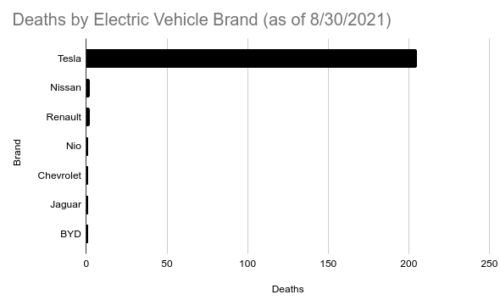
Let’s play spot the disaster. Here are the death rate stats for electric cars.

Source: tesladeaths.com

I warned very loudly about the disaster we are now in for at least six years prior. My 2016 keynote presentation about Tesla death at BSidesLV was literally called “Great Disasters of Machine Learning“.

Elon Musk long ago signaled disaster as his business model and I saw it right away after the first road death was reported April 2, 2013.

Tesla was leaving Laguna Beach and veered into oncoming traffic

Veering across lines into oncoming traffic is not “legal by default” yet it seems that Tesla must believe it to be a profitable business model for America, given their vehicles have become notorious for doing exactly that.

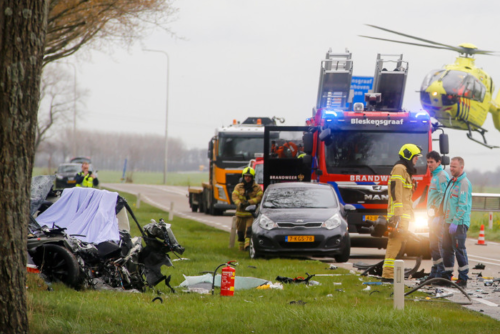
April 8, 2022 (nearly TEN YEARS later) we see repetitive failures in safety.

Little remains of a Tesla and its driver in 2022 after it veered yet again into oncoming traffic

Things may change, however, given that a court is finally going to help Tesla owners see just how many unsafe “things are legal by default”.

A US federal judge’s ruling paves the way for a trial in July, the first time Tesla will face a jury in litigation over a car crash. The electric car-maker faces a flurry of lawsuits over a spate of accidents… Barrett Riley, 18, was at the wheel of his father’s Model S when he lost control and veered into a concrete wall of a house in Fort Lauderdale. The car was engulfed in flames. Riley and his friend in the passenger seat were both killed. The father, James Riley, alleged in a lawsuit that Tesla was negligent for removing a speed-limiting device from the car after his wife had asked for it to be installed. The after-market device was designed to cap the car’s speed at 85mph. The family also argued that Barrett could have survived the impact of the crash but lost his life because of the intense fire, which the suit attributes to a defective design in the battery.

Defaults give an interesting framing for this court case.

Why was the default top speed so far above any legal limit? The family tried to set a safe mode by requesting Tesla enable their built-in speed limiter (“loaner” mode with an 85 mph max). Allegedly Tesla later removed the setting to override parents’ explicit request, which led directly to the predictable death of their child.

Tesla’s argument for why they intentionally disobeyed parents was… because they could. A toddler-level mentality of safety, if not a conspiratorial one. When parties A and B come to a service provider with conflicting requests, Tesla very clearly took sides: serving the (reckless abandon) one and not the (safer, wiser, legal) other.

Two footnotes also may be worth adding.

First, this Tesla also operated with two un-repaired recalls at the time of its crash; unrelated to the cause of death yet it still gives evidence of Tesla being not on top of safety.

Second, the car continuously re-ignited into fire. It was on fire when police arrived. It then caught on fire again when it was put on a tow truck. It then caught on fire again when it was put on a second tow truck. And it then caught on fire again when it was unloaded from the second tow truck. That’s significantly worserush to market” thinking than even the Pinto disaster.

The lawsuits brought by injured people and their survivors uncovered how the company rushed the Pinto through production and onto the market. […] Ford officials decided to manufacture the car even though Ford owned the patent on a much safer gas tank. Did anyone go to Mr. Iacocca and tell him the gas tank was unsafe? “Hell no,” replied an engineer who worked on the Pinto. “That person would have been fired. Safety wasn’t a popular subject around Ford in those days. With Lee it was taboo.” As Lee Iacocca was then fond of saying, “Safety doesn’t sell.”

Does anyone really want to buy a sore thumb?

“Slavery is not in the past”

The BBC has just published an excellent article called “Confronting my family’s slave-owning past”

As I grappled with the philosophical question of whether personally I owed anything, I sought the advice of Sir Hilary Beckles, the historian and vice-chancellor of the University of the West Indies who is the chair of the Caricom Reparations Commission.

“Slavery is not in the past,” said Sir Hilary. “Our grandparents remember their great-grandparents who were slaves. Slavery is part of our domestic present. Slavery denies you access to your ancestry. It leaves you in this empty void.”

Indeed. Slavery is not only part of our domestic present, I regularly present it as fundamental to understanding the near future of AI and robotics.