…one in a series of eleven RAND Memoranda detailing the Distributed Adaptive Message Block Network, a proposed digital data communications system based on a distributed network concept. […] Various aspects of the concept as reported in this Memorandum were presented before selected Air Force audiences in the summer of 1961 in the form of a RAND briefing (B-265), and contained in RAND Paper P-2626, which this Memorandum supersedes.
Saying “be nice” is nothing like saying “be kind”. The two phrases are worlds apart.
First, consider how a British man living in Holland says the Dutch seem “rude” (to him the opposite of nice) because of what he deems an egalitarian approach (data sharing) to risk management.
The constant need to defend against flooding also had a profound impact: with one person’s land at risk if another failed to maintain their dikes, it was essential that decisions be made collectively.
That’s not really accurate. Armies have constant need to defend, yet decisions do not need to be made collectively. It wasn’t a need to defend against water that led to a Dutch “directness” against lying and cheating, also known as holding people accountable.
Others have tried to put a humorous spin on the real reasoning, related to a sense of justice and equality:
Apart from cheese and tulips, the main product of the country is advocaat, a drink made from lawyers.
A freedom to speak the truth or even just detect and document what is happening was a method to resist attempts at denial (non-repudiation), which were early integrity controls related to Dutch distaste for Spanish religion-based rule 1556 to 1581.
Calvinist religion had a large impact on national identity because the Dutch associated Catholicism with Spanish oppression. From that moment on, “Calvinism dictated the individual responsibility for moral salvage from the sinful world through introspection, total honesty, soberness, rejection of ‘pleasure’ as well as the ‘enjoyment’ of wealth,” writes Breukel in an article on Dutch business culture published on her website.
Everyone speaking their mind (a methodology of truth-seeking as offensive measures) enabled popular resistance to a form of top-down management where an autocrat could never be wrong (never be brought to justice by lawyers) because even the laws were autocratically controlled.
This is the philosophical split between a set of inherited rights versus controlled rights, an ancient ethics distinction which I often refer to in my talks about why artificial intelligence can be so unsafe.
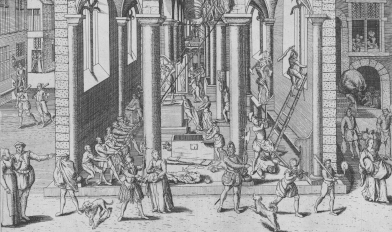
The real product today of the Beeldenstorm of 1566 (Iconoclasm) is that the Dutch aren’t very religious.
Depiction of the Beeldenstorm. Source: RP-P-OB-77.720 at www.rijksmuseum.nl
The British by comparison tend to lean on the concept of being “rude” as a social enforcement mechanism.
Everyone in England is supposed to be trying to pull together on a collective goal (e.g. winning against adversaries, staying in a queue during WWI or WWII) as a different form of resistance to imposed authority. There’s actually less divergence between the two cultures than implied just because Holland dealt with Spanish inquisition while England… dealt with its own set of threats.
Second, while being “nice” is an act of self-erasure supposedly in the interest of others — whether society or a single authority — it’s the opposite of what’s being discussed above in terms of risk and information sharing. It’s literally a form of ignorance.
Nice didn’t always mean what it means today. “Nice” comes from the Latin nescius, which literally means, “not-knowing” (from ne, “not,” and scire, “to know.”) Even centuries later, when the word found its way into Middle English, that meaning more-or-less remained the same: “nice” still connoted ignorance. If you were “nice,” that meant you were simple, foolish, daft—an idiot.
This all begs the question whether people think of others in terms of an actual greater good (e.g. lowland flooding) or simply erasing themselves at the behest of random request to not have independent thoughts. Holland is the former and Texas is a great example of the latter (e.g. it’s not “nice” to talk about real history such as a racist state founded to perpetuate and expand slavery alone). Did you know in 1836 that America used an official “Gag rule” to deny Americans the right to speak the truth about slavery?
In fact, Texas and Florida history clearly shows they are states with a total lack of accountability and an idealized model of business profit and ascent to power. They are doing statewide what has been celebrated in popular American spectator events that reward niceness (lying) like NASCAR and Football. Being nice in America may mean peddling catchy “know nothing” ignorance as a means of privileged profit by doing harm to others, which also explains why the unkindness of “tipping” is still a thing.
In other words, if you desire to prevent power shifting to liars and cheats try to practice integrity (honesty) and be kind, even when it’s not nice (rude).
When I’m asked to explain Web 3.0 I always try to start by explaining that the world is far more diverse than just coins and financial assets.
This is similar to my old saw about history being more detailed than just who won what war and why. Culture is not just coinage.
The entirety of the human experience, which arguably will be predominantly expressed via the web if anywhere in technology, is vast and rich beyond monetary action. Only about half of transactions even involve money at all.
Yet, for many people their only topic of interest or focus on technology is how to capitalize as quickly as possible on anything “new”. Beware their depictions of the Web solely as finance instead of encompassing our most rich and interesting possibilities.
Geolocation data, as just one facet, has long been recognized as a source of power and authority. Think of it in holistic terms of the English and Dutch cracking the secretive Portuguese spice trade routes and upending global power, instead of just focusing on the spices being traded.
Knowledge is a form of power, which have been expressed as political systems far more vast than markets alone could ever encompass.
Here is an example to illustrate how oversimplification of humanity down to financial terms becomes an ethical quagmire, highlighting some very important mistakes of the past.
…“a lot of people” were abusing the possibility of an airdrop by sending minuscule donations “just to benefit” themselves. This is a common tactic among crypto investors, known as airdrop farming.
Farming is in fact the opposite of what is described here. Growing food at low margin so that others may gain has somehow been framed backwards: extraction of value from someone else’s plan to help others.
In other words “airdrop farming” is far more like “airdrop banking” as it has nothing in common with farms but a lot in common with banks. It begs a question why there there was any direct return and benefit of “donations”, given what has been said in past about that loop.
Appropriation of the term “farming” in this context thus reads to me as propaganda; we may as well be in a discussion of Molotov’s WWII bombs as a delivery of bread baskets.
Likewise in the same story Kraken’s CEO displayed complete ignorance by saying his company would be on the side of Russia in this war and could not help Ukraine because in his mind political Bitcoin only has “libertarian values”.
Exchanges including Coinbase, Binance, KuCoin, and Kraken all refused Fedorov’s February public request that they freeze all Russian accounts, not just those that were legally required by recently-imposed sanctions. The companies said such an action would hurt peaceful Russian citizens and go against Bitcoin’s “libertarian values,” as Kraken CEO Jesse Powell put it.
Calling Bitcoin libertarian is like calling diamonds bloody.
In fact, Bitcoin is notoriously slow-moving (terrible for payments) and notoriously volatile (terrible for currency) just like blood diamonds being extracted from dirt at artificially low cost to artificially inflate their value to a very small group desperate for power.
Mining doesn’t have to be an exercise in oppressive asset hoarding with a total disdain for the value of human life, but Kraken clearly displays here they operate intentionally to repeat the worst thinking in history.
So what values are we talking about really? Proportionality (tailoring response to the level of the attack, avoiding collateral impact) is not a libertarian concept, obviously, because its a form of regulation (let alone morality).
Note instead there is complete lack of care for victims of aggression on the principle of protecting “peaceful” among aggressors, with absolutely no effort to prove such a principle.
It’s sloppy and exactly backwards for a Bitcoin CEO to claim he cares about impacting others. The inherent negative-externality of Bitcoin means it carries a high cost someone else has to pay, proving that if Kraken cared about “peaceful” Russian civilians it would shutdown all Bitcoin since it harms them all while benefiting few if any.
Systemically redistributing transaction costs from selfish individuals to society instead, while claiming to be worried about societal impact of an individual action is… dangerously reminiscent of “nobles” and “clergy” of pre-revolutionary France who ignorantly stumbled into their own demise.
The Web already is so much more than a narrow line of thought from the ugly past of feudal thinking, and 3.0 should be more broadly representative of the human condition instead of boxed in like this by selfish speculators trying to get rich quick through exploitation and manipulation of artificially constrained assets.
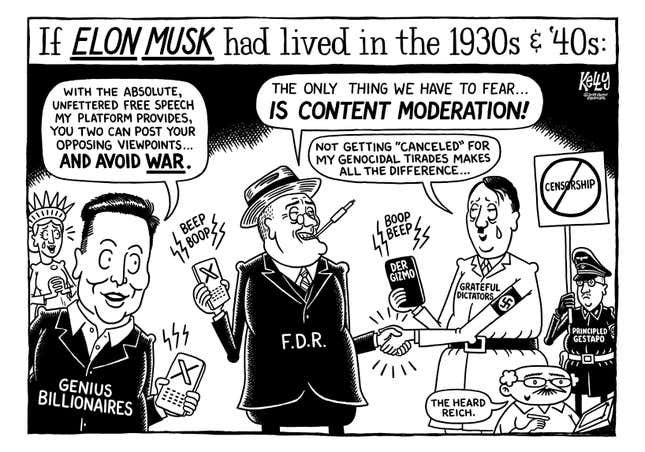
Update August 3, 2024: This new cartoon is so spot on, it’s like The Onion’s Stan Kelly has been reading my blog.
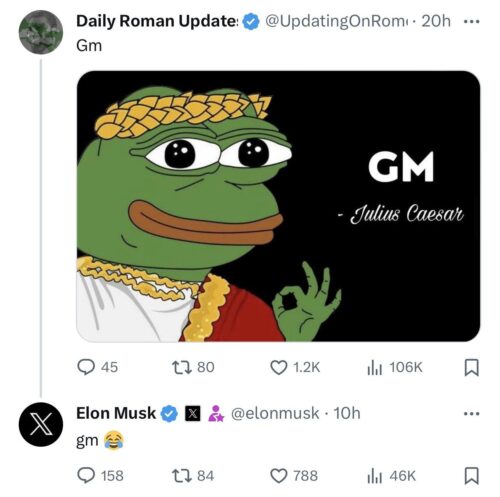
Update November 30, 2023: Elon Musk, after being widely condemned for obvious antisemitism, uses his Swastika platform (formerly known as Twitter) to affirm and spread violent white nationalism.
Source: Twitter
Here’s the key to decode the above racist references:
GM (good morning) = “we are elites, early and will survive because superior race”
Attire = “…superiority of the Greco-Roman world, modern white claims to Greco-Roman heritage, and the belief that the European Middle Ages present an idyllic and homogeneously white time and place that, according to adherents, should be used as a model for the US’s conversion into a white ethno-state.”
Source: Twitter
Update April 14, 2022: Elon Musk says he can organize enough money to buy Twitter in order to take it private (decreasing accountability and transparency) and then promote harmful content using a policy he calls:
Healthy free speech is when someone says something you don’t like.
This policy of Musk is hypocritical, logically false and historically backwards.
He himself regularly violates basic principles of healthy speech (as a documented serial liar). Instead he allegedly seeks outsized control to prevent accountability for words used, the literal opposite of healthy speech. He appears to not care about health of anyone or anything.
For a simple and obvious example, he can’t even attempt to buy Twitter without showing his true hand. He right now failing at the most basic transparency requirements while grousing falsely he cares a lot about society having transparency:
…lawsuit alleges that by March 14, Musk’s stake in Twitter had reached a 5% threshold that required him to publicly disclose his holdings under U.S. securities law by March 24. Musk didn’t make the required disclosure until April 4.
…having it be unclear who’s making what changes to who, to where, having [stocks] sort of mysteriously be promoted and demoted with no insight into what’s going on … I think this can be quite dangerous.
Elon Musk’s plan for Twitter suggests the site will expand abusive epithets and threats of violence online, especially targeting women of color (as I’ve explained elsewhere). Twitter will transform from implicit white nationalism into more explicit hate and violence.
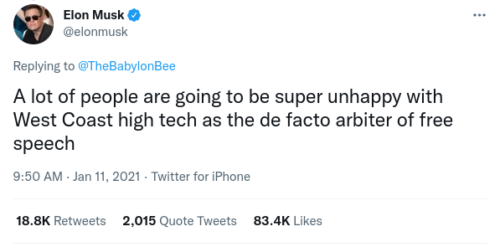
Source: Twitter
In case you don’t recognize it, that is Musk replying to the extremist right-wing Bee account, which was classified by Twitter as hate speech. Musk is showing support for stinging attacks from the Bee. Now, back to the question of whether he is racist, in context of whether a racist would try hard to buy Twitter just to ensure hate groups pushing “something you don’t like” will escape accountability.
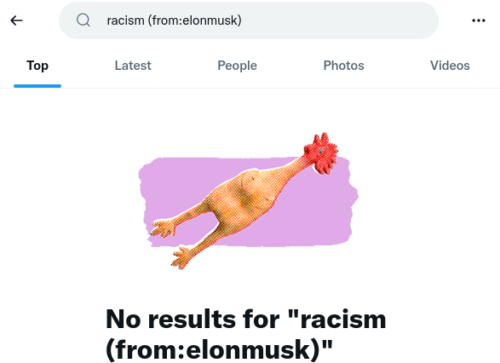
As I wrote recently, asking “how racist” is really a search for evidence of someone being anti-racist.
When we ask how vulnerable software is, it would sound wrong for someone to defend themselves with “how dare you call software vulnerable”. Software has flaws, so we constantly look for evidence that flaws are being identified and remediated. It’s basic hygiene.
Likewise, when we ask how racist someone is, the response desired should come as some kind of evidence that racism is being acknowledged and removed wherever it may exist.
On that risk management note, I so far have found zero evidence of Elon Musk working in any capacity to be anti-racist, despite copious evidence of him being accused of racism.
Here’s a quick review of an infamous racism lawsuit:
Psychology Today: “We don’t know anything about Mr. Musk’s feelings about Black people regarding the case. [Tesla] indirectly gave organizational support to individual prejudice and bigotry; Tesla was engaged in racism.”
Jalopnik: “Elon Musk’s Alleged Response To Tesla Racism Complaints: ‘Be Thick-Skinned And Accept Apology'”
Tesla’s official statement directly contradicting its advice to staff to stop fighting for things they believe in: “At Tesla, we would rather pay ten times the settlement demand in legal fees and fight to the ends of the Earth than give in…”
Both evidence of racism and self-contradictory logic set the tone.
Telling Black workers they must be “thick-skinned” and stop fighting against racism, while stating that Tesla will always be thin-skinned and never stop fighting against people accusing them of racism… is exactly the opposite of anti-racism.
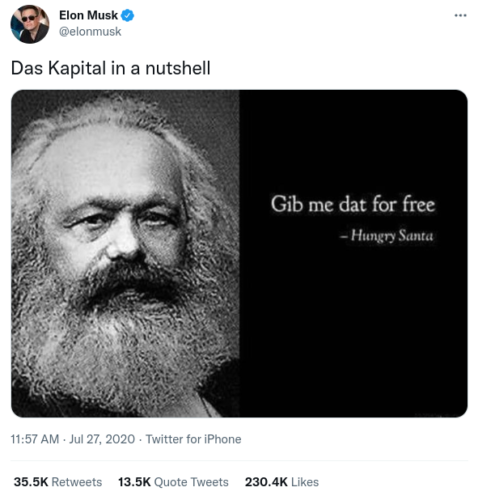
Elon Musk is South African, which is important here. Consider for example that he has posted classic white supremacist memes such as this one.
Anyone familiar with African history would recognize this for what it is, a racist attack on Black liberation theology.
This tweet was at the height of tension in America about Black Lives Matter (BLM). Spreading a racist extremist right-wing meme puts Elon Musk very squarely on the wrong side of history.
Backlash against Black Lives Matter includes branding it as Marxist.
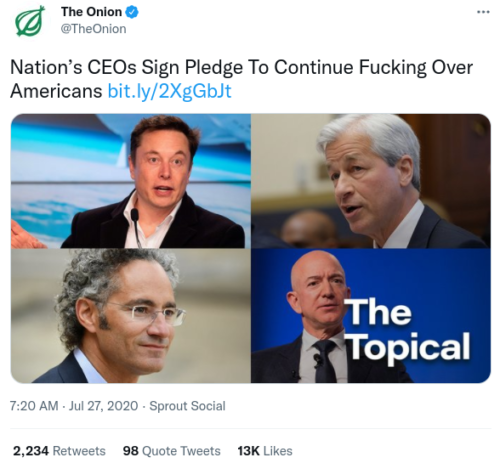
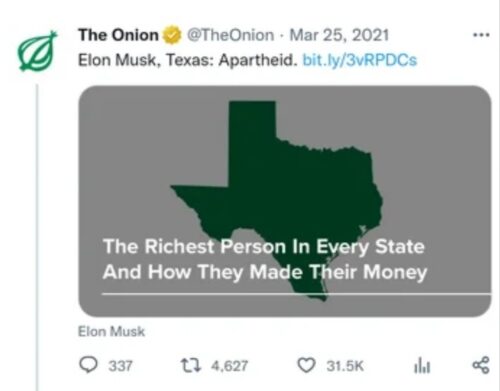
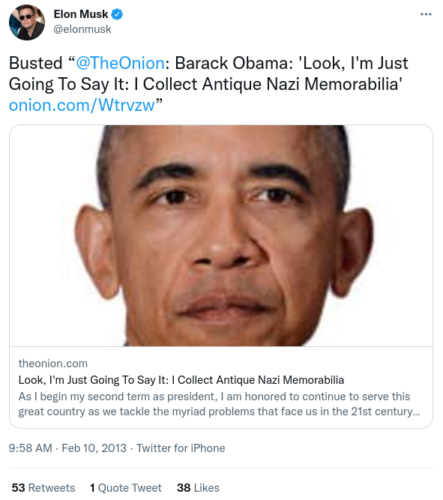
Allegedly Musk launched his racist meme attacking Marx after being deeply offended by The Topical tweet by the Onion.
It’s hard to see the connection back to The Onion that Musk is trying to make in his attack tweet. Meanwhile the always on-target Onion doubled down.
Source: Twitter
Consider that the meme used by Musk is in fact from a long-time white supremacist topic, not just some awkward moment from 2020. It’s not just something related to Musk’s hatred of free assembly by Black Lives and free speech by The Onion, it’s more an exposure of his racist upbringing.
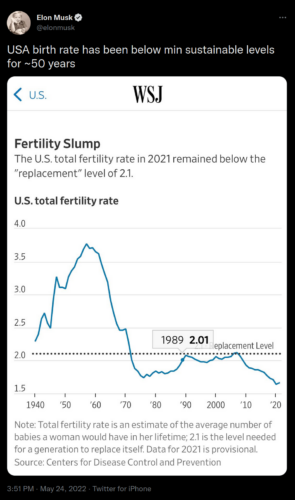
Here’s another example, to prove the point further. From the 1920s through the 1980s a major talking point of white nationalists (e.g. Prime Minister Hertzog) in South Africa was population decline (e.g. “replacement theory” or “swamping”) despite the country at the time experiencing a population surge.
And yet Musk is known for spreading the exact same fraudulent racist trope in 2022.
“Drain the swamp” was a South African racist concept of the 1920s meant to prevent non-whites from having any power. They had watched racist American President Wilson do exactly that in the 1910s, not to mention the racist Governor Stanford of California doing it even earlier. This is what Musk is basically tweeting.
Let me explain just how racist it looks for Musk, a white South African, to spread racist talking points as well as falsely label anti-racism as some kind of activism.
In the crucial first decade of African freedom from colonialism the leaders of Algeria (Ahmed Ben Bella), Egypt (Gamal Abdel Nasser), Ghana (Kwame Nkrumah), Guinea (Ahmed Sékou Touré), Kenya (Tom Mboya) and Tanzania (Julius Nyerere) all displayed a very public affinity for principles of socialism.
In other words Black post-colonial movements very logically moved public sentiment towards everyone sharing in the benefits of labor regardless of color or race, even before rising to democratic themes of liberation from oppression (U.S. Army: De oppresso liber).
South African whites reacted to this with insecurity cults that aimed to refute Black liberation by labeling anti-racism as radicalism or political extremism (fallacy of white genocide).
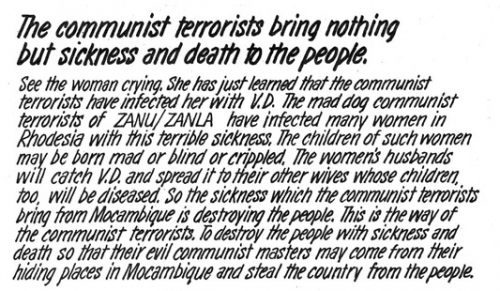
Propaganda Poster of racist Rhodesia equating black self-determination to communism, falsely characterizing its goal as the infliction of disease on white women and children.
These dangerously wrong propaganda tactics, which Elon Musk regularly witnessed in his apartheid childhood, are being repurposed by him through his anti-Black rhetoric to criticize anti-racism.
White nationalists of South Africa even tried to manipulate newspapers to frame themselves as victims in a thinly-veiled attempt at criminalizing a necessary and humane act of anti-racism (e.g. Black Lives Matter). They censored criticism of white “success” (e.g. denied racist oppression, despite power and wealth being oriented solely on being white).
This is exactly why Elon Musk wants to buy Twitter, to repeat such mistakes of history and censor criticism of ill-gotten racist power.
South Africa’s overtly racist and white police state also explicitly courted the United States at this time by claiming white nationalism was a logical defense against Marxism — denying freedom, independence and self-determination of Blacks as a “capitalist” or “business” model of wealth accumulation (e.g. from President Nixon to Harvard).
If you know basic African history, especially South Africa’s violent racist “anti-Marxist” oppression methods, then you perhaps now see Elon Musk was normalizing racism in a post that uses a mix of Black “slang” appropriation with a phrase suggesting someone unfit for work.
Elon Musk’s “gib me dat for free” during Black Lives Matter protests seems akin to a racist defensive sentiment celebrating the white police officers who opened fire on unarmed protestors in 1960. In other words it should bring to mind today what exactly Elon Musk thinks about the sixty-nine South Africans were killed and 186 wounded in Sharpeville, with most shot in the back by police.
Succeeding the Sharpeville incident, a meeting convened by the South African Communist Party (SACP) in December 1960 in Emmarentia, Johannesburg, aimed to discern the way forward in light of the African National Congress’ (ANC) ban and the imposition of a state of emergency. Among those who attended were Mandela, Sisulu, Govan Mbeki, Mhlaba, Kotane and a number of other ANC and SACP members. Those attending congruently agreed that the agenda of non-violence would have to be replaced by armed resistance in the form of the establishment of military units…
That was followed by the 1960 “Unlawful Organizations Act“, which amended the 1956 “Riotous Assemblies Act”, which all was preceded by the far more obviously named 1950 “Suppression of Communism Act”.
This act, “after being rushed through both houses of Parliament” (Riley 1991: 69), “was introduced to enable the banning of the African National Congress and the Pan African Congress” (Dyzenhaus 1991: 45).
Thus we can see how Marxism has been embroiled in racism, used as a means to call Black people lazy and stupid, unable to think for themselves or self-rule.
Anti-Communist propaganda even has gone so far as to suggest Blacks could not have developed minds and instead were like puppets of a Soviet or Chinese playbook.
That particular reference from South African history matters here too because Elon Musk also has delivered an odd depiction of Chinese.
Elon Musk lamented the “entitled” and “complacent” character of people in the United States, and lauded the “smart” and “hard working people” of China…
Presumably Musk has a particular form of cognitive blindness such that he doesn’t see a contradiction in overtly praising Asian communism, while claiming to be a critic of Black sounding communism.
The blindness is likely best explained as… racism.
Elon Musk heaped praise on China’s economic development late Wednesday night as the Communist Party celebrated its 100th anniversary in power.
To be fair, Communism being lauded by the Chinese has little to nothing to do with Black leaders who show an affinity for socialism.
Universal healthcare, fire departments, police, public utilities like sewer and water, state pensions, education, public transportation and general “safety nets” all seem to be socialist concepts selfishly taken for granted by Elon Musk.
This is one of the confounding aspects of those who claim to support public-safety initiatives such as the police (when operated as a socialist concept of care) while saying they hate socialism.
The bottom line when talking about Marxism versus socialism is that it was the unification of Germany in the 1870s that brought significant improvement in the country’s economy because… it was driven by widespread socialism.
Marx was an extremist within a huge movement and certainly not the most influential or important voice, although he makes an easy target.
German people demanded a unified state to extend benefits to everyone, beyond just the wealth-accumulating selfish “gentry”; they rejected kings, lords and men who acted and thought very much like Elon Musk.
The German Chancellor Bismarck initially reacted to the disturbances and public grievance with a ban on unification (union) movements. Ring any bells, given South Africa banned union movements?
Bismarck pushed out an “Anti-Socialist Law of 1878” to stop people in Germany from assembling and speaking. Nonetheless, just like in South Africa 100 years later the socialist affinity within democratic voters grew anyway, shifting debate into formal government chambers (where it was better heard and processed).
It was clear centuries apart that sentiment of social good was deeply influential to German workers.
Bismarck shrewdly calculated he could absorb power from huge blocks of voters and thus maneuver ahead of their party by implementing things they called for and taking credit himself.
1883, with the passage of the Health Insurance Law, Bismarck made Germany into a welfare state—all to stymie the socialists. The law was the first national system in the world, Steinberg says. Both employers and employees paid into insurance funds, and the German government verified workers’ enrollment by comparing employer records with fund membership lists, threatening employers of uninsured workers with fines.
Stymie the socialists by being socialist. It seems odd today where people struggle to get on one page, yet Bismarck was a leader from a different era who apparently acted on what he thought made sense for his country (or perhaps more to the point made sense for him as inalienable from country leadership) and tossed aside labels.
Bismarck didn’t care what the program—Krankenversicherungsgesetz—was called or how it was described, as long as citizens knew that the state—his state—coined the idea. “Call it socialism or whatever you like,” Bismarck said during the 1881 Reichstag public policy and budget debates. “It is the same to me.”
The unmistakable benefits of socialism clearly made Germany prosper and powerful, similar to how it would soon after help fuel massive economic prosperity and growth in America and all of Europe.
“…a key part of the Industrial Revolution that’s overlooked is that once workers got paid in cash once a week or every few weeks, they had cash that could be spent on what we would call health insurance.” …as the population grew in cities, coverage boomed. In 1885, the enrollment was 4.3 million Germans; by 1913, that number had jumped to 13.6 million. And this came with a number of surprising repercussions.
Socialism meant very quickly that far fewer Germans emigrated away from factories, as they stayed for benefits unique to socialism like sick days at home and compensation for accidents. In other words, fewer workers fell out of work and into poverty, which reduced the cost of productivity. Industrial output increased as did quality of life.
Seen to this day as “a massive success” the concepts of German socialism are logical for any democracy to adopt and promote.
Between 1884 and the end of the century, blue collar worker mortality rates fell 8.9 percent, they write in a recent study. “Surprisingly, the insurance was able to reduce infectious disease mortality in the absence of effective medication for many of the prevailing infectious diseases.”
Again, I have to emphasize that Musk is wrongly promoting Marxism as a success model; he tweets his love to Chinese Communists, falsely calling their system the best. Yet he attacks Blacks by mislabeling them as Communists.
If Musk had posted a picture of Marx next to Asian speech patterns would it be any better? No. He is being racist in either case, pushing a race-based narrative that Asians are hard working and Blacks are lazy.
This sad repeat of South African history by a South African should give enough context to explain why Elon Musk is pro-Marxism while spreading traditional racist white supremacist memes about Marx that target Blacks by appropriating their speech/style.
What Musk really seems to want to say is he’s against unification (against a United States, against a unified Germany) where workers have prospered from democracy.
Tesla prefers top-down, centrally-planned dictatorships where a small group of elites can stop democracy from protecting people who work at Tesla.
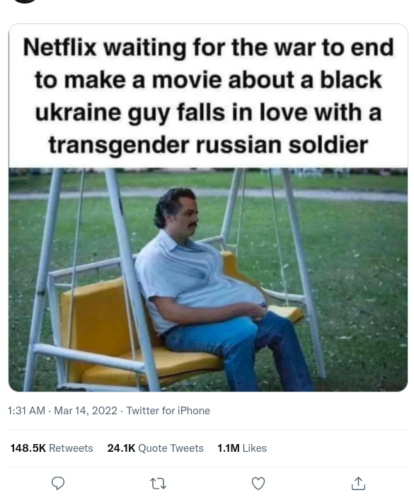
To prove the point once more, Elon Musk recently doubled down on an extemist right-wing memeyet again favoring a racist tone in a comment about the Ukraine war.
Four huge problems with this:
First, predictably his defenders invoked “white savior” logic similar to South African apartheid (or pre-unification, pre-socialist, Germany), claiming a billionaire should be protected from criticism (encouraged to cover up misconduct) simply by claiming to be charitable towards the needy.
Third, war is no joke. This is like arguing because his employees are paid well they should tolerate him causing trauma and abuse. A Black war blast victim was tormented with rocket warning sounds while trying to work at Tesla.
Fourth, Musk dramatically increased his business deals with Russia since 2020. Buying a Tesla literally can mean buying from Russia.
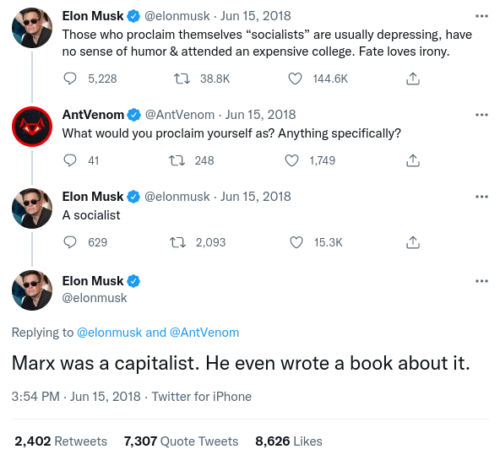
And while Musk might be confused or careless, throwing words around without any intent to actually stand by what he says, it doesn’t anywhere rise up to demonstrate anti-racism. In 2018 Musk (who allegedly has a degree in economics) claimed he is socialist and Marx was a capitalist.
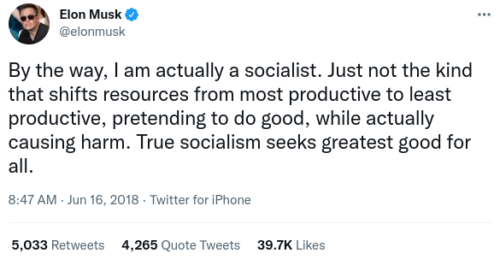
Shortly thereafter Musk proved to be even more confused. He tried to attack socialism for allowing people to shift “from most productive to least productive” (e.g. pay money into insurance and use it when sick).
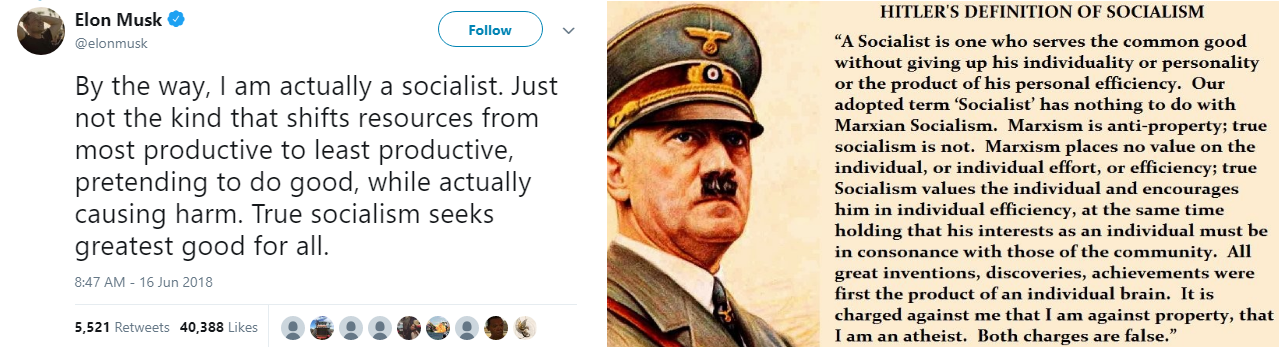
Greatest good defined by who? That sounds like a recipe for dictatorship, inverse to democratic socialism. In fact, Musk is using phrases that are very similar to Hitler’s speech in 1938 right after Kristallnacht.
Let me put it like this, the word on the street is Elon Musk thought Nazi was spelled with a T, which is why he put it on the hood of his cars.
Elon Musk often sounds a lot like Hitler. Click to enlarge. Source: Twitter (Hitler Speech December 28, 1938)
The influential German socialist philosopher Lasalle wrote a letter to Bismark in 1863 warning of exactly what Musk (and Hitler) promote.
…how true it is the working class feels an inclination towards a dictatorship, if it can first be rightly persuaded that the dictatorship will be exercised in its interests…
To be clear Lasalle advocated a monarchist social-democracy, a partnership proven successful in countries like UK, Sweden, Denmark, Holland, etc. as I’ve written about before with regard to causes of “stress revolution“.
Musk thus appears to be advocating a form of “national socialism” (Nazism), which reminds me very much of Peter Thiel’s present proto-Nazi fantasy of monopolism despite decades-old proofs against it by E.A.G. Robinson in 1948:
The great merit of the capitalist system, it has been said, is that it succeeds in using the nastiest motives of nasty people for the ultimate benefit of society.
Musk furthermore openly flirts with themes of Nazism, such as the Onion joke insinuating a Black American President has a secret affinity for it.
Again, I have to emphasize I am looking for evidence of anti-racism, yet only finding more and more evidence of racism in among evidence of consistently extremist right-wing sentiments.
Ending up discovering that Tesla tried to run PR that it was helping Ukraine while also quietly driving new deals with the dictatorship in Russia as it invaded Ukraine, seems only fitting.
I doubt Wired will pick up this blog post about Elon Musk’s racism in the same way as the last time, but I do hope someone someday can find and publish evidence of his anti-racism. His silence is deafening.
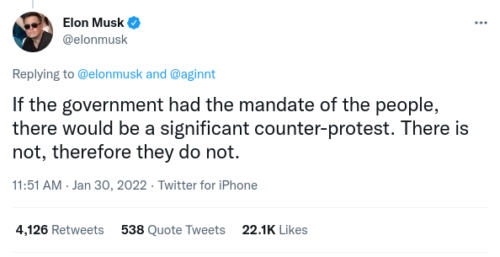
More to the point, Musk himself tried to argue that if there is no significant counter-protest to support a government against small groups of fringe extremists (e.g. if anti-racism doesn’t show up) then it should be taken as some kind of proof that fringe extremists have more legitimacy than a government!
Carl Sagan warned the absence of evidence is not the evidence of absence, to put it mildly why Musk sounds so dumb. However, also don’t forget Musk’s flip-flopping is frequently anti-science and he is admitting to the world here that his complete lack of protest against racism is his way of saying he’s not opposed.
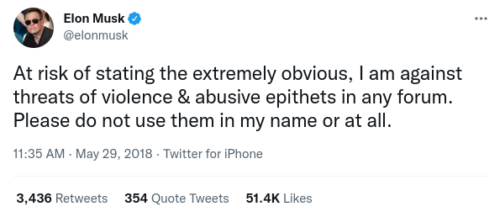
At the end of the day there has been one lonely statement claiming he is “stating the extremely obvious” that he thinks speech should be censored.
Source: Twitter
Is it obvious? Then why does he never state anywhere that he would protest or even censor racism? Where has he come out strongly opposed to racism and racist comments, if somehow he found the courage to protest the vague “abusive epithets”?
There are copious statements where Elon Musk says clearly free speech means zero filters of any kind. For the man with a constantly open mic who argues speech should be censored only when it serves his own purposes, and who throws words around with abandon and appears to fire off comments without thought, it’s highly curious Musk NEVER pushes anything even close to being anti-racism.
a blog about the poetry of information security, since 1995