
The book “Metaphors We Live By” was published in 1980 and required linguistics reading when I attended college many years ago.
It’s been coming up a lot lately, as people start to realize that disinformation is an area of security thousands of years old.
Here’s a quick explanation of the book’s thesis:
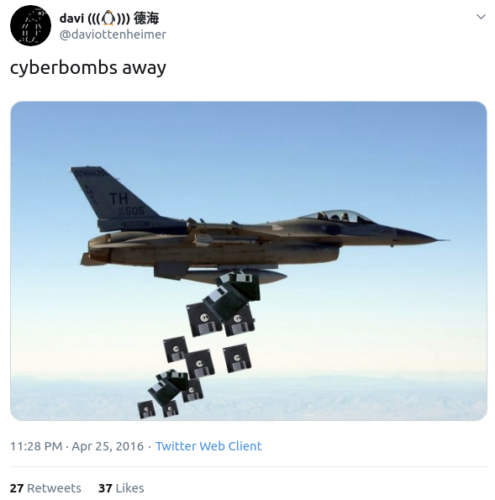
One of the most useful applications of this old book for me has been to explain how a rhetoric of war is overused in information security. It undermines a practice of computer security as a science.
Technology giants and governments pour time and money into loose concepts of “cyber war” yet remain mostly unprepared for even the most banal and predictable integrity issues (e.g. “deep fakes“).
As another example the “war on drugs” has even more documentation of failure. It was a concealed racist metaphor initiated by President Nixon to silence American political speech and incarcerate Blacks on false pretense.
The Nixon campaign in 1968, and the Nixon White House after that, had two enemies: the antiwar left and black people. You understand what I’m saying? We knew we couldn’t make it illegal to be either against the war or black, but by getting the public to associate the hippies with marijuana and blacks with heroin, and then criminalizing both heavily, we could disrupt those communities. We could arrest their leaders, raid their homes, break up their meetings, and vilify them night after night on the evening news. Did we know we were lying about the drugs? Of course we did.
This has been widely discussed by historians so shouldn’t surprise anyone. Technology giants and government in the 1960s used drugs as a metaphor for Blacks, turning the country backwards into President Wilson’s (KKK) race war platform of the 1910s.
If that fact surprises anyone, they’re probably going to be angry they have been taught lies due to some “Young Turks”.
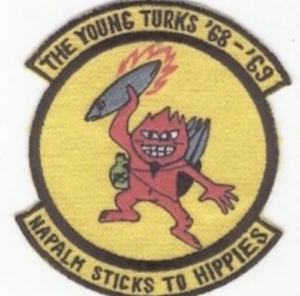
The “war” on drugs was initiated and waged by a radical Republican faction known as “Young Turks“. Although it now frequently is declared “lost”, as drugs are more widely sold and used in America than ever I don’t know anyone who brings the loss back to those who came up with the metaphor.
In 1960 he was mentioned as a possible Vice Presidential running mate for Richard Nixon. In 1963 a group of younger, more progressive House Republicans—the “Young Turks”—rebelled against their party’s leadership, and Mr. FORD defeated Charles Hoeven of Iowa for chairman of the House Republican Conference, the number three leadership position in the party. In 1963 following the assassination of President John F. Kennedy, President Johnson appointed GERALD FORD to the Warren Commission that investigated the crime. […] In the wake of Goldwater’s lopsided defeat at the hands of Lyndon Johnson, GERALD FORD was chosen by the Young Turks to challenge Charles Halleck for the position of minority leader of the House. With the help of then- Congressmen Donald Rumsfeld and Bob Dole, Mr. FORD narrowly upset Halleck.
Despite all the “Young Turk” leadership driving over-militarized U.S. interventions to incarcerate or assassinate non-whites and silence political opposition, they instead turned military bases into a “symbol of our definitive loss“.
Get-tough measures on part of police and prosecutors have done nothing to reduce the demand for narcotics, and demand will always beget supply. The 50-year history of the failed War on Drugs has taught nothing if not that. Perhaps there is no greater symbol of our definitive loss in that interminable war than Fort Bragg itself. From this flagship base, the beating heart of the U.S. special-operations complex, the military apparatus behind the global War on Drugs deploys to the far corners of the world. Green Berets train security forces in countries like Colombia, El Salvador, and Honduras. Delta Force reportedly took part in the anti-cartel operations that killed Pablo Escobar and captured El Chapo Guzmán. Yet drive down Bragg Boulevard into the Bonnie Doone neighborhood of Fayetteville, and in between the storage facilities, mobile-home dealerships, and tattoo parlors, you will find roach motels full of addicts, indigent veterans camped out beneath bridges, and strung-out junkies hanging around boarded-up trap houses. The dismal tide of synthetic opioids and amphetamines has penetrated Fort Bragg’s high-security gates, permeated through to the lowliest privates’ barracks, and caused at least a dozen overdose deaths in just the last year. These dead soldiers, who far outnumber combat casualties, are clearer proof of the United States’ unequivocal defeat in its longest-running international military campaign than a white flag run up over the main parade field. As the old saying goes: The War on Drugs is over — drugs won.
See the problem with the metaphor?
A “war” to criminalize an “antiwar left” and Black Americans never really intended to stop drugs. Assassinating non-white leaders considered “too left” did basically nothing to end a drug crisis because that’s obviously not how anyone would go about reducing production and use of drugs, especially since white leaders are heavily involved in the drug crisis too yet escape justice.
Unfortunately it still gets talked about in terms of drugs instead of politics and race because the metaphor became so ingrained.
How many white Americans hate non-white immigrants? Far more today than if there had not been a “war” trying to convince them non-whites are drug users.
Thus returning to the early 1900s race war (e.g. Red Summer) by another name is what really came from the metaphor — turning Americans into a mindless militant crusade against other Americans — and so you still see today a rhetoric from the Republican extremists about drug this and that when they really mean non-whites.
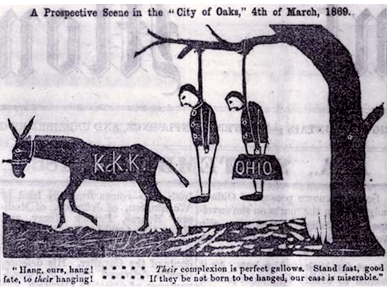
In that sense Nixon, Ford, Rumsfeld, Reagan… were all really a sad repeat of Prohibition-era racism, which also worked too well. The KKK had a policy of assassination and incarceration of Blacks hidden inside an anti-alcohol platform.
The KKK’s war on alcohol as much as the “war” on drugs has failed, in other words they succeeded in both cases seriously destroying political power and American prosperity of other Americans (non-whites). America did not completely stop alcohol production or consumption (mostly shutting down non-white distilleries, breweries and taverns while giving exception licenses to whites), and instead used its government for excessive violence against Blacks. Today we know whites and conservatives sell and make heavy use of drugs yet the Nixon (and later Reagan) concept of this “war” never intended to target them.
Cyber and drugs are just two examples of how “war” has become the unfortunate metaphor that Americans still live by. Maybe the book should have been titled Metaphors We Live For?
Or, to put it like a recent book about Pentagon growth, “Everything became war and the military became everything”.



 Cyber War. It’s long been