Recently I wrote a quick note about Apple users believing that removing a monitor from an integrated computer/keyboard was somehow something novel or new.
I was reminded of the amazing and famous Commodore VIC-20 of the 1980s, and how easily people overlook the past.
That got me thinking about another “new” trend in virtual world software. Sure enough, I found current trends may be trying to repeat things from before.
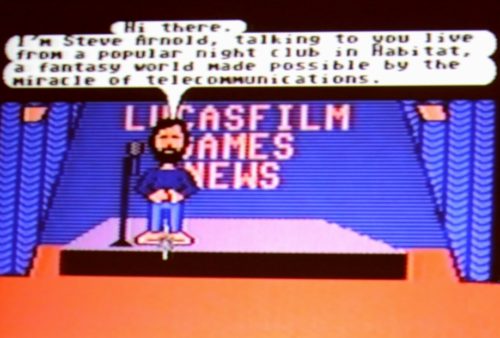
What we take for granted in today’s MMOs — the constant presence of thousands of real humans interacting with us in a virtual space — simply blew the minds of those who first encountered it. And way back when, those encounters depended on the person and technology available. Some folks had access in the ’60s and ’70s to the early form of the internet and email in universities and government offices, but these close encounters of the virtual kind only started to make its way into households in the ’80s (and even then, mostly to those plugged into the geek community). The developers of these programs — the MUDs, the BBSes, CompuServe, etc. — were truly pioneers forging a path while trying to figure things out on the fly. So it amazed me to hear that I’ve been missing out on a key part of MMO history by overlooking Lucasfilm’s Habitat, which wasn’t quite an MMO by modern standards and yet created a graphical virtual world with many of the elements that were adopted into later projects. In our two-week look at Habitat, we’ll see just how eerily similar this 1986 title is to what we know today — even though it came out on the Commodore 64.
Lucasfilm’s Habitat on the Commodore 64.
It was just one of many virtual worlds from long ago that nobody talks about anymore.
Think about this long dead software the next time someone asks what will change when virtual worlds arrive.
How long will it be before we look back at metaverse and laugh about how primitive it was?
The Petaluma Historian has posted a fascinating look at the face of cycling a century ago.
On July 4, 1896, Petaluma found itself anointed the new “bicycling Mecca” of the West Coast, as a reported 6,000 people turned out at the city’s new Wheelman Park for the annual divisional meet of the League of American Wheelmen.
Among the 18 Northern California teams competing were two comprised entirely of women—San Francisco’s Alpha Cycling Club and Petaluma’s own “women of the wheel,” the Mercury Cyclists.
The story has many amusing turns and quotes. This one might be my favorite.
As the Mercury Cyclists and other wheelwomen took to their steel steeds, they ran into some cultural speed bumps from conservative Victorians, who wanted to know where they were riding to.
When the question was put to women’s rights activist Elizabeth Cady Stanton by American Wheelman magazine, she succinctly replied: “To suffrage.”
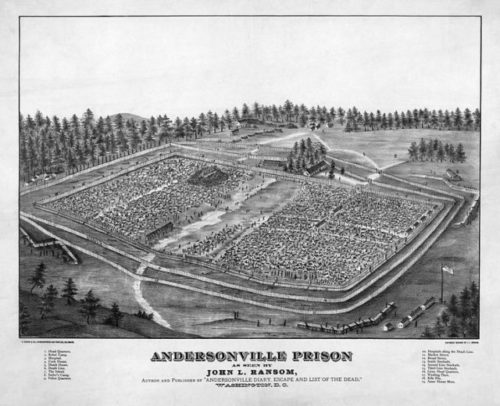
The “Deadliest Ground of the Civil War” officially was recorded as a concentration camp run by Confederate soldiers where they systematically tortured and killed American Prisoners of War (POW).
Three days after the camp was opened with the first 400 POW, already one died. Six months later it was 3X more populated than its alleged initial design, cruelly concentrating over 45,000 people into death-camp conditions without proper shelter, food or sanitation.
Soon after, over 10,000 Americans were dead.
Andersonville was very intentionally an act of war crimes. It was ordered and used by the Confederate President to maximize suffering, consistent with the overt and formally stated white police state articles (Confederacy) of preserving and expanding slavery through violent means.
Source: Andersonville National Historic Site, NPS.gov
Despite best efforts of Confederate-apologist historians to destroy or hide the truth — take unfair advantage of peace-time “healing” to denigrate American heroes and peddle propaganda about America’s enemies — the fairly well-documented Andersonville crimes should still stand out.
Purposeful concentration camps for the torture and murder of captured American soldiers were without question direct response to the emancipation of Black people; initiated under Confederate President Davis who terminated all prisoner exchanges.
…in September of 1862, President Lincoln called for the enlistment of black soldiers into the Union Armies as part of the preliminary draft of the Emancipation Proclamation. In December 1862, President Davis responded by issuing a proclamation that neither captured black soldiers nor their white officers would be subject to exchange.
More to the point, a Civil War started to preserve and expand slavery meant a prisoner exchange was unable to overcome fundamental belief in the South that they stood for murdering any Black person at any time (or anyone defending a Black person) without consequences.
Prisoner terms of freedom violated the very principle of the white prison states, which formed into a Confederacy to forever deny freedom to millions of its existing Black population held as prisoners in labor camps (plantations).
The South overtly refused to exchange or free any Black person captured because they did not consider Black people human. Many ruthless and immoral men in leadership positions of the South, such as the barbaric traitor General Lee, even allowed the outright execution of POW and civilians.
General Chalmers (Mississippi cavalry who later became known for using violent voter suppression to win a seat in Federal government) reportedly bragged about this event in words similar to General Lee that a butchering at Fort Pillow was intentional and to teach “the mongrel garrison” a lesson. Harper’s Weekly described the situation in their 1864 news report as murdering women, children and then mutilating the dead.
The term mongrel was meant to suggest that any Blacks captured as soldiers meant the Confederate General believed he would be justified in murdering all POW in their company, regardless of race, as a terror tactic.
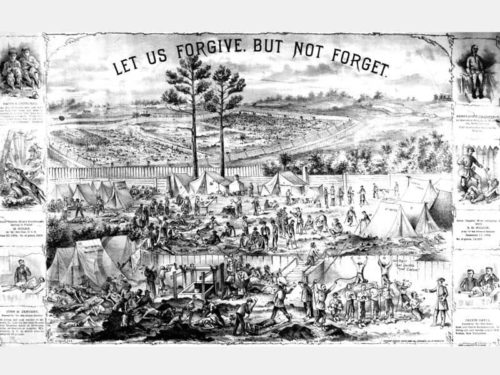
Terror tactics indeed left an impression. The Andersonville concentration camp became news soon after the Confederacy lost the Civil War (which might sound familiar to anyone reading WWII narratives about Nazi death camps) and Americans promised to not forget.
Source: Hargrett Rare Book and Manuscript Library, University of Georgia Libraries.
It seems there was sufficient widespread outrage, quick documentation and public reaction to cement the facts about its atrocities in an attempt to hold someone responsible.
Following the Confederate surrender in April 1865, Clara Barton, later founder of the American Red Cross, and Dorence Atwater, a former prisoner assigned as a parolee to keep burial records for prison officials, visited the cemetery at Andersonville to identify and mark the graves of the Union dead. During the war Atwater had labeled the soldiers by name and number after their deaths. Through Barton and Atwater’s efforts, the cemetery was dedicated as Andersonville National Cemetery in August 1865.
Among the various men tried and executed for heinous crimes committed during Civil War, Captain Hartmann Heinrich Wirz became infamous as head of the Andersonville death camp.
Another man named Robert Kennedy, for example, was tried and executed in March 1865 for the crime of placing terror bombs around New York City landmarks and public spaces.
…convicted in the fall of 1865 for the execution of at least 53 captured Union soldiers, although Ferguson claimed the total was higher.
Ferguson must roll in his grave when people ignore his story despite best attempts to exaggerate the number of POW he had murdered.
Wirz stood on the gallows as just one of the many who could have been convicted.
He hanged to death in the courtyard of the Old Capitol prison of Washington D.C. on November 10, 1865, after nearly 150 witnesses testified he had personally ordered death for POW and he was found guilty in 11 of 13 counts of documented acts of personal cruelty.
For example, one Confederate soldier testified that Wirz ordered a prisoner into the stocks during a rainstorm. The soldier, observing the prisoner was drowning, placed an umbrella over the prisoner and approach Wirz, who replied, “Let the damned Yankee drown.” […] Whether or not Wirz violated the existing laws of war is not subject to debate.
However, others responsible for war crimes including mass murder of American POW soon were to have a different fate, as the NPS explains. The Federal government abruptly halted prosecutions under the premise of “healing” the nation.
There were further military tribunals against Confederates planned in the spring of 1866. For example, a board of inquiry found that there was sufficient evidence to charge General George Pickett, of Gettysburg fame, for signing off on the execution of twenty two North Carolinians serving in the Union Army who were captured at New Bern, NC in February 1864. However, thanks to the intercession of his old West Point classmate Ulysses Grant and President Johnson’s April 1866 proclamation that the rebellion was over, Pickett was never arrested and charged by a military tribunal. Johnson’s 1866 proclamation specifically banned military tribunals in peacetime, and effectively put a stop to any further arrests and charges like those brought against Henry Wirz.
One of the peculiar details about Andersonville is how quickly it was filled and then also abruptly ended, making it unquestionably a killing field.
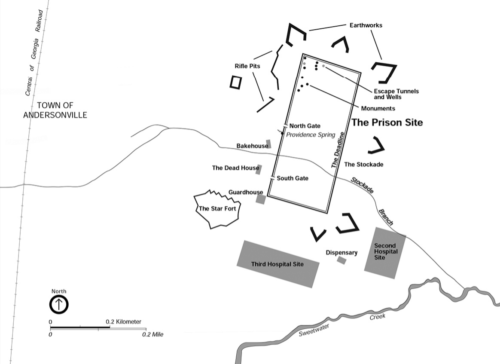
President Davis’ 1862 order to stop all prisoner exchange, as described above, had manifested by 1864 in building this one massive concentration area, essentially making a cramped walled field of Georgia into the fifth-largest city of the South.
Why weren’t these prisoners dispersed more widely instead? Why were prisoners so easily added to the camp, or even removed from it, yet necessary supplies were not added so easily along with them? Why were supplies still being transported so easily north into Atlanta by way of Macon Railroad yet none reached Andersonville further south on that same line?
Source: Andersonville National Historic Site, NPS.gov
An urgent order to disperse the concentration camp then suddenly came when liberating armies drew close and were poised to set its victims free.
General Sherman captured Atlanta on September 2, 1864. Word quickly reached Andersonville and mass evacuations began immediately. In just the one week of September 7-13 nearly 17,000 prisoners were transferred to other prisons in Georgia and the Carolinas. In mid-September, Sherman and Confederate General Hood negotiated a “special exchange” for those captured in the Atlanta campaign and around 2,000 prisoners were sent to Atlanta for exchange. By the end of the month less than 9,000 prisoners remained at Andersonville. When Sherman began his March to the Sea on November 15, 1864, there were less than 200 prisoners in the stockade and less than 2,000 in the hospital. That very day an additional 500 were transferred to Savannah lowering the prison’s population even further. The death count on November 15, 1864 stood at around 12,100.
In other words, the prisoners saw supply chain logistics that could have delivered supplies but they were denied. The prisoners similarly saw supply chain logistics for rapid dispersal and relocation but they were denied. The pieces of the puzzle were in place to avoid a death camp, yet the South chose death camp.
I even have seen some military historians try to claim that Sherman didn’t march on the camp because to liberate it would free more Rebels to fight. This seems exactly backwards, since the Union threatening liberation of the camp meant Rebels focused on it instead of battles elsewhere. The threat of camp prisoners being free meant the Confederate South sprang into action denying them that chance. Far more resources of the Confederacy were consumed in desperate acts to prevent POW release. When the camp had been ignored by the Union, however, the Confederates similarly had ignored it and tried to run it without even the bare minimum of staff and supplies.
A comment today on Twitter seems completely divorced from basic computer history, and it’s gathering a lot of misplaced attention as something new.
Source: Twitter
Similar attempts at false “new” ideas can also be found on other platforms and channels.
Source: Reddit
I’ve discussed here before how Apple always has been following others around since the beginning; a constant late-mover in the personal computer industry that profits from taking the ideas of others without giving credit.
With all due respect I don’t know what new things they’ve done. […] Everything was demonstrable in 1973.
Ouch.
It’s usually trivial to prove how Apple (and its loyal users) copy someone else’s ideas and cannibalize them, while pretending to be innovative.
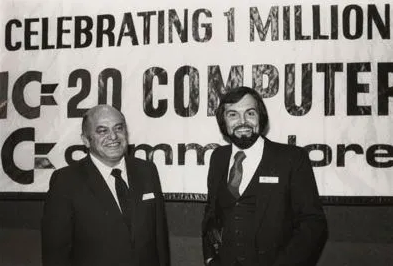
Consider, for example, that a highly popular very affordable Commodore VIC-20 design in 1981 for the personal computer looks very much like the allegedly new concept in 2022 — a keyboard with the computer inside and plugged into any monitor, using peripherals for expansion.
It was unquestionably a best-selling personal computer with a low price of $299 that quickly made it the first computer to reach 1 million units sold.
Apple lagged behind Commodore in sales.
Boom.
It ended up selling another 4 million before 1985. Neither obscure nor forgotten, Commodore was a true innovator and sales leader.
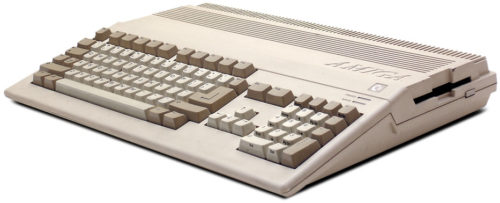
Moreover, Commodore saw such incredible demand for this exact design that sales ballooned into 20 million Commodore computers delivered, straining ability to keep up with demand. Subsequent models included the famous Amiga (easily one of the best personal computer products in history).
The Amiga offered both this keyboard design, and also a standalone thin “box” or even the amazing headless “toaster” model… Commodore had such ground-breaking engineering that by 1988 an Amiga was running like a personal computer from 1998, ten years ahead of its time.
Now in 1990, on the Mac side of the fence, Apple was still charging over $6,000 for a black and white Macintosh (like the SE/30). Before 1987, they couldn’t run more than one program at a time. When they finally did do multitasking, it was with a crash-prone method called co-operative multitasking. Contrary to popular myth, the first true pre-emptive 32-bit multitasking colour Mac didn’t arrive until the release of OS-X in 1999.
The PC side of the fence was far worse. For those who have never experienced the “joy” of a PC running MS-DOS refusing to boot because the AUTOEXEC.BAT or CONFIG.SYS file isn’t configured correctly, just imagine the computer equivalent of root canal surgery. It didn’t get a colour pre-emptive multitasking operating system until Windows 95.
In contrast, first released in 1985, the Amiga was a useful colour video editing tool. By 1990, you could hook up to four video cameras up to one and switch between them in real time.
By 1990 we were able to take an Amiga, a keyboard with a computer inside, plug it into any television to watch videos in color that we downloaded on the Internet while we edited our documents. The high-end models like the Amiga 3000 look like a computer 20 years ahead of its time.
Taking the integrated monitor off an Apple computer to get “likes” today on a social platform is… sad.
The market seems to constantly reward laggards and follow-on products, and too easily fails to recognize true innovators, let alone keep in mind some basic knowledge of computer history.
a blog about the poetry of information security, since 1995