The BBC offers sharp insight into why Russia is firing missiles at memorials to victims of Nazism, killing civilians.
Babyn Yar is now a place of quiet contemplation, where thousands of people travel to every year to remember those who died. That it could be damaged or destroyed by an aggressive military attack goes against everything it stands for. But the significance of an attack so close to Babyn Yar goes deeper. “It is symbolic that [Russian President Vladimir Putin] starts attacking Kyiv by bombing the site of the Babyn Yar, the biggest Nazi massacre,” said the chair of Babyn Yar’s advisory board, Natan Sharansky.
A pattern of Russian ignorance and cover-ups is also laid bare in the article.
A few years after the Nazis attempted to cover their own tracks, the Soviets tried to flood the ravine with mud. Then in the 1960s, there was anger at plans to build a sports stadium there. Mr Sharansky said the construction of the TV tower directly adjacent to the memorial in the 1970s was another attempt to “destroy the memory of the Holocaust”. “There were so many attempts to erase Babyn Yar and change its nature, finally we turned it into a big memorial, and that is once again overshadowed by Russian aggression,” he said. For decades under Soviet rule, there was little to mark the massacre site, except a simple obelisk that referred to “Soviet” victims, without mentioning the Jews, who were the main victims. Finally, in the 1990s, a large Menorah monument was erected, when independent Ukraine decided to commemorate the Jewish victims. And last year a synagogue was opened.
Reads to me like the Russian mindset was to downplay systemic racism and obscure history by erecting an “all lives matter” obelisk on the spot where Nazis massacred Jews.
#RussianLivesMatter has been used to undermine the American fight against systemic racism by downplaying the impact of racism against African Americans, by suggesting police killings of Black Americans were deserved, and by framing empathy towards victims of police violence in Russia as a zero-sum game.
The Nazis killed nearly 34,000 Jews in two days in the Babyn Yar ravine, Kyiv as part of a sustained plan of genocide. Historians estimate two million were shot dead across occupied Europe.
…cargo vessel transporting cars, which was headed for St Petersburg, is “strongly suspected of being linked to Russian interests targeted by the sanctions”, said Capt Veronique Magnin, of the French Maritime Prefecture.
France just sailed up and grabbed a Russian ship, taking it as a wartime action. Should this not be how operations are conducted on Russian information technology as well?
In related news, Russia’s most powerful men appear to be engaging in conflict by tail-between-legs trying to hide as best they can when there is nowhere to hide.
Data reviewed by CNBC from Marine Traffic shows that at least four massive yachts owned by Russian business leaders have been moving toward Montenegro and the Maldives…
These ships are extremely unprotected and vulnerable, while operating in open spaces with almost impossible attribution.
Let’s say a small inexpensive automated drone packed with explosives sinks them (the sort of thing described for over two hundred years, at least since the auto-mobile naval torpedo of 1866), what then?
Source: Mailloux, R., Sengupta, D. L., Salazar-Palma, M., Sarkar, T. K., Oliner, A. A. (2006). History of Wireless. Germany: Wiley.
Most people probably haven’t heard of that incident, and would be far more familiar with the fact that neutral civilian American ships were repeatedly bombed by Germany before WWI started; President Woodrow “KKK” Wilson had intercepted the related German Navy order on November 18, 1914 and somehow managed to deny telling Americans for three years why so many ships and ports were on fire.
…agents who are overseas and all destroying agents in ports where vessels carrying war material are loaded in England, France, Canada, the United States and Russia. It is indispensable by the intermediary of the third person having no relation with the official representatives of Germany to recruit progressively agents to organize explosions on ships sailing to enemy countries in order to cause delays and confusion in the loading, the departure and the unloading of these ships.
And on that note July 22, 1916 (still a year before Wilson would declare Germany an enemy, and just eight days before the infamous “Black Tom” explosion in NYC) the German military intelligence set off a massive bomb during a parade in downtown San Francisco and killed 10 civilians.
Whereas naval warfare has a long and storied past, today it seems to have much in common with cyber warfare, which constantly gets written up as needing a new set of norms, instead of being treated as acts of war.
…domestic violence have increased by 133% in Yekaterinburg – the fourth largest city in Russia – after President Putin approved a law that reduces punishments for spousal or child abuse…
The operative question with Ukraine thus becomes why are Russians being told to shoot at themselves.
Russian leaders painted their own objectives as a morale-deflating act of abuse and self-harm, like saying a shoe is not a foot right before ordering soldiers shoot their own foot in a shoe.
Mama, I’m in Ukraine. There is a real war raging here. I’m afraid. We are bombing all of the cities…even targeting civilians.
We should not underestimate massive levels of suffering that can be caused from abuse and gross negligence and incompetence, yet also we should no lose sight of the fact that Russia is failing on basically every level.
“The Russians have been frustrated. They have been slowed. They have been stymied, and they have been resisted by Ukrainians, and to some degree, they’ve done it to themselves in terms of their fuel and logistics and sustainment problems,” the official said, speaking on the condition of anonymity to brief reporters.
The most important part of that analysis comes in a follow-up sentence, which I want to hold out and highlight here.
But as I said earlier, we would expect them to learn from these issues and adapt to them and try to overcome them. So I think we all need to be very sober here. in recognizing that this is combat, and combat is ugly, it’s messy, it’s bloody, and it’s not wholly predictable.
That sounds like the seasoned voice of an expert. However, they are giving too much credit.
Expecting Russians to learn from issues and adapt to overcome begs a question of why? Why would Russians still have that capability? The nature of their dictatorship is that any ability to learn, adapt and overcome is a direct threat to the power of a ruthless leadership.
Ugly, messy, bloody and unpredictable stands to reason. Copying and conforming, even repeating past mistakes seems likely. Adapting by learning? Unlikely.
One defender taking out an entire Russian column by attacking it from behind… Russia is displaying high levels of battle-field incompetence.
Russian armor running out of gas while lost goes even higher to a Nazi-level of incompetence (which I’ve written about extensively before in terms of innovation and operations failures that nonetheless drag out suffering for years).
In other words, Russia has spent decades murdering anyone genuinely capable of overcoming obstacles because allowing such skills in their ranks would have meant Putin (the biggest obstacle of all) was threatened.
Another reminder that Putin legalized physical abuse of wives and children, with estimates of at least 14,000 dead each year as a result.
That’s the elephant in the war room right now. If someone in Russia (let’s say just for argument a group of their colonels invoking colonel Oleg Penkovsky) genuinely sees that Russia has “done it to themselves” by exhibiting incompetence in the field, would they be able to push out Putin?
From there it stands to reason Russian Generals are used to plodding along without any real opposition, using aging technology, weak infrastructure, economic failures (mostly corrupt) and lack of will.
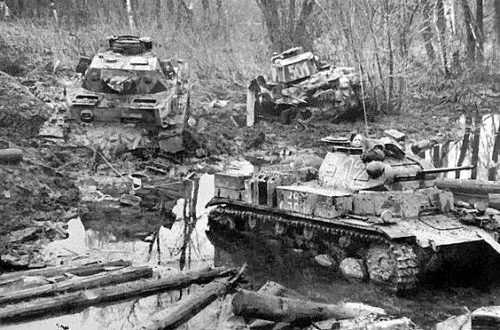
A dozen Russian tanks were seen just before the invasion of Ukraine stuck in mud and earlier many were burned out from inexpensive drones… foreshadowing an ease of counterattacks and the “logistics” obstacles for Russia.
This brings to mind June 1941 when Hitler thought he could push 80% of the Nazi Army (where 75% of that depended on horses) through Eastern Europe to seize Moscow in just three months.
Four months later the Operation was stalling so a new Operation Typhoon was initiated and quickly turned to disaster, halted by the elements.
…as they reached the approaches to Moscow, the German formations slowed to a crawl. Autumn rains had turned the dirt roads into rivers of mud. It was the Rasputitsa – the ‘quagmire season’ – and wheeled and horse-drawn transport became hopelessly stuck. The Germans chose to temporarily halt operations.
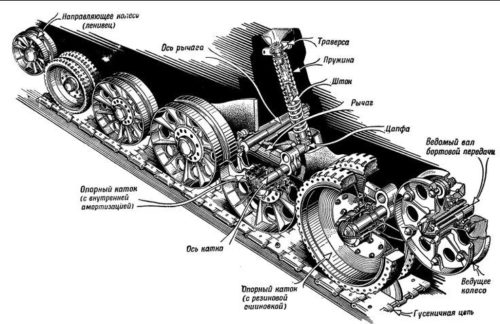
Nazi horse-drawn (vast majority) and wheeled transport fell to Russia’s “General Mud” Soviet T-34 tanks in WWII had wide tracks on a Christie suspension, technology that outclassed the Nazis especially in mud
That didn’t stop the Nazis however from being immoral mass-murderers committing war crimes.
Approximately 2.8 million Soviet POWs were killed by the German armed forces and other special units between June 1941 and February 1942, mainly through deliberate starvation and exposure to the elements. It was one of the most shocking acts of human atrocity in history.
We must now watch for any indication that Russia won’t benefit from a colonel awakening and resistance (e.g. 1974 Portugal or even Algeria’s 1961 failed putsch) and instead will turn far more punitive and hateful (e.g. killing fields and death camps of Nazi Germany starting in 1942 when it was abundantly clear Hitler was incompetent and couldn’t win any war).
Losing the civil war he started is how things look right now for a rapidly weakening Russian leader (different from Aleppo or Grozny), begging the question of how he may lash out at the most vulnerable in a ruthless and desperate quest for a feeling of power.
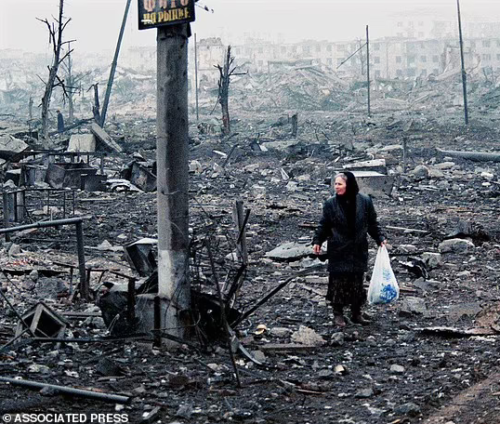
Putin first blockaded Grozny allowing no food, medicine or other supplies to enter; then bombed and shelled homes, hospitals and schools for weeks including the use of chemical weapons. The UN labeled it the most destroyed city on earth. Source: AP, Second Chechen War in 2000
…with six air-to-air kills, the heroic pilot of a Ukrainian MiG-29 became the first air combat ace over European soil since World War II.
They call him ‘the Ghost of Kyiv’…real enough — for now.
The “real enough” morale-boosting aspect of this story reminds me of the larger-than-life ghost “King” Ned Ludd of the Luddites.
“It has been said that more British soldiers were fighting the Luddites than were fighting Napoleon on the Iberian Peninsula”
On a similar note, mythical planes are like the “Night Witches” of WWII. Nazis were so afraid of Soviet women dropping bombs on them, and unable to fight back, that they had to cook up a mythology instead of admitting reality.
Today’s Ghost pilot in the news also should be filed as a “deep fake” story, according to Newsweek.
…the Ukraine armed forces shared a video, claiming that it showed a Ukrainian MiG-29 taking down a Russian fighter jet in a dogfight. However, that clip was first uploaded onto video-sharing platform YouTube and was titled “GHOST OF KIEV KILL.” The uploader claimed in the clip’s description box that the footage was made using a digital combat simulator. “This footage is from DCS, but is nevertheless made out of respect for ‘The Ghost of Kiev.’ If he is real, may God be with him; if he is fake, I pray for more like ‘him,'” the user wrote.
That’s an almost exact repeat of the disinformation platform analysis presented in a blog post I wrote in 2018.
So, perhaps most importantly, the technical aspect of this story from Kyiv about a heroic pilot also reminds me of Twitter accounts recently embellishing the story of British Spitfire pilots who knocked down Nazi drones.
On the other hand it is VERY different from the “Ghost Camaro” of Bosnia, which seems to have suffered from a lot of puff and largess.
a blog about the poetry of information security, since 1995