There is a $162 fine for not complying with occupant restraint laws.
Similarly, Alberta started with a lax approach to the COVID19 pandemic that sent it into a preventable death spiral. Their tune has completely changed now, albeit late yet again:
“The government’s first obligation must be to avoid large numbers of preventable deaths. We must deal with the reality that we are facing. We cannot wish it away. Morally, ethically and legally, the protection of life must be our paramount concern.”
The United States (including its Supreme Court) apparently has been more successful at defeating stupid attempts like Alberta’s to rule safety technology unconstitutional.
Seat belt laws have mainly been challenged as a violation of an individual’s constitutionally protected right to privacy and as an invalid exercise of a state’s constitutionally granted police power. These arguments have been rejected by the courts in Illinois, Iowa, and New Jersey, and also, we believe in New York. The North Carolina case unsuccessfully attacked the law on different grounds, e.g., that it represented involuntary servitude and slavery. The Montana case involved a declared “free” man’s unsuccessful assertion that he was not subject to any state or federal laws.
Ok, Montana might take the prize for being the dumbest take on freedom (obviously laws protect freedoms by encoding definitions of encroachment) but someone in North Carolina actually argued slavery?!
Leave it to a Carolinian to put forward an official argument that slavery is equivalent to putting on a seat belt.
I can’t bring myself to read the court documents for fear I’ll find someone writing down that slavery was just a way to protect slaves from being enslaved.
For some reason asking people to do what is easy and in their own best interests, as well as the interests of others, turns them into toddlers throwing tantrums.
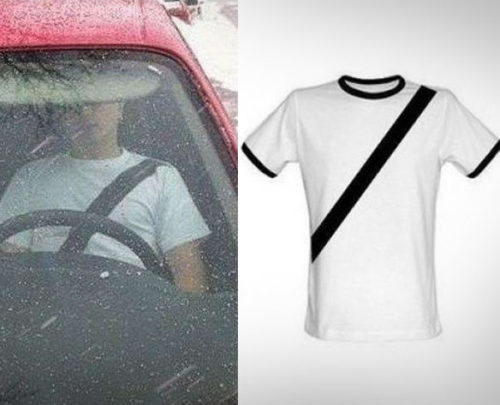
How stupid and defiant do you have to be to go to the trouble to buy and put on a seat belt shirt when it has none of the advantages of seat belts, including ease of putting it on and taking it off?
Is it harder to put on a seat-belt or a t-shirt?
The fake seat-belt shirt really should make the wearer look like a crash test dummy and have a large organ donor form on the front and back. That at least makes it worth the effort of putting one on.
On second thought, what if the government mandated wearing a t-shirt with fake seat-belt graphic and people protested by putting on real seat-belts instead?
Michigan Rep. David Hollister received a letter likening him to Hitler.
New Yorkers complained in a similar fashion, although they invoked Russia.
Speaking of dictators and Russia, Ronald Reagan tried to block a NHTSA rule requiring passive restraints and was struck down by his Supreme Court in a unanimous decision.
Here’s a tragic data point to think about, given Ronald Reagan was clearly putting Americans needlessly into harms way:
…the one out of eight Americans who don’t wear their seat belts account for nearly two-thirds of all the fatal accidents…
I love a new article by War on the Rocks about “grass roots” engagement because its heart is in the exact right place, yet much of the history and analysis seems off-base.
The following sentence is a giant clue to what this topic is really about:
…fear of losing such expensive equipment induced risk aversion among decision-makers and prevented them from being released…
It reminded me very much of how ill-prepared the US was marching Civil-War style into Spanish American War, and what saved the day. Few Americans remember but July 2nd 1898 the 24th and 25th Colored Infantry rescued the Rough Riders at San Juan Hill.
‘If it hadn’t been for the black cavalry, the Rough Riders would have been exterminated.’ Five black soldiers of the 10th Cavalry received the Medal of Honor and 25 other black soldiers were awarded the Certificate of Merit.
I’ve written about this before also in terms of WWI, where an innovative Beersheba battle victory attributed to British deception operations and a charge of their black cavalry had a decisive effect on the overall war.
The ‘do-it-yourself’ ethos has evolved from hobbyist clubs that were dedicating to building personal computers back in the 1970s…
No. Go back much, much earlier.
It was self-sufficiency and becoming a “made man” (e.g. General Grant was genius at hard-working innovations) that drove Union forces to defeat rigid-thinking Southern Confederacy of slaveholders in Civil War.
American innovation is greatly hampered by inability to leverage diverse thinking that is readily available. When talking about “risk aversion” we need to be honest, describing it in terms more illustrative of the problem such as racism or sexism.
It also is hampered by a lack of teaching history, which illustrates how innovations have best come from integrating, in other words learning to compete together instead of against each other. Victory is achievable to those who collaborate better.
Suicide is immoral, yet Fox News Channel actively promotes it.
American schools long have mandated vaccination shots…
Chickenpox
Diphtheria
Hepatitis A/B
Meningitis
Measles
Mumps
Polio
Pneumonia
Rotavirus
Rubella
Tetanus
Whooping Cough
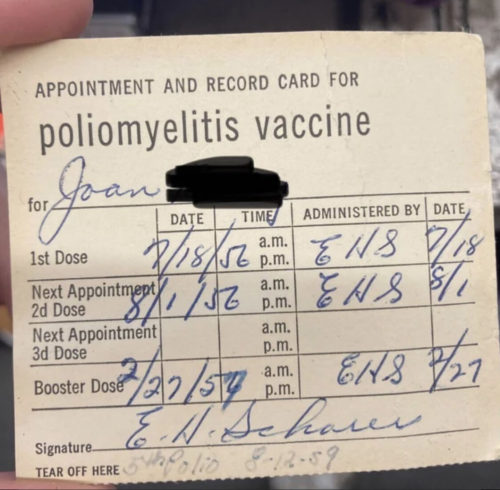
The 1954 polio vaccine used a clinical trial of 1.3 million American children. Nine months after trial the vaccine was declared safe and effective, and mass inoculation began. Polio became a mandated vaccination in all 50 states and transmission vanished over 25 years.Source: Internet image search for polio vaccine card
A COVID19 vaccine obviously comes within this well established context where freedoms are maintained because children are mandated to have a prevention measure to make everyone safer (security control that protects against a predictable loss of freedom).
…to attend school in your state of Nebraska, children must be vaccinated against a number of diseases. … They must be vaccinated against diptheria, tetanus, pertussis, polio, measles, mumps and rubella, hepatitis B and chickenpox…
And healthcare workers as well as the military for a long time have been mandated to get certain vaccines.
This is all pretty basic knowledge.
And yet it still probably helps someone to hear the US Supreme Court officially ruled that mandating vaccines supports “real liberty” and freedom from tyranny by some individual, thus does not violate the Constitution.
There are manifold restraints to which every person is necessarily subject for the common good. On any other basis, organized society could not exist with safety to its members. Society based on the rule that each one is a law unto himself would soon be confronted with disorder and anarchy. Real liberty for all could not exist under the operation of a principle which recognizes the right of each individual person to use his own, whether in respect of his person or his property, regardless of the injury that may be done to others. This court has more than once recognized it as a fundamental principle that “persons and property are subjected to all kinds of restraints and burdens, in order to secure the general comfort, health, and prosperity of the State, of the perfect right of the legislature to do which no question ever was, or upon acknowledged general principles ever can be, made so far as natural persons are concerned.”
Very clearly the courts ruled mandatory vaccinations may serve an important purpose in preserving welfare of the many, thus are neither arbitrary nor oppressive.
…it was the duty of the constituted authorities primarily to keep in view the welfare, comfort and safety of the many, and not permit the interests of the many to be subordinated to the wishes or convenience of the few.
…it is equally true in every well ordered society charged with the duty of conserving the safety of its members the rights of the individual in respect of his liberty may at times, under the pressure of great dangers, be subjected to such restraint, to be enforced by reasonable regulations, as the safety of the general public may demand.
The Atlantic interviewed historian Michael Willrich (author of “Pox: An American History”) who put the Jacobson case in perspective of national security.
The opinion of the court was written by Justice John Marshall Harlan, who was a Civil War veteran. And for him, it was clear that this case was a legitimate exercise of the police power of the state. Smallpox was extremely dangerous, and he insisted that, by the same logic that a government can raise an army to prevent a military invasion and can compel individual citizens to take up arms and risk being shot down in the defense of their country, by that same sort of rationale, the government can fight off a deadly disease and demand individuals to be vaccinated, even if it violated their sense of personal liberty or conscience or whatever.
This opinion was reaffirmed again in 1922 by the Supreme Court in a unanimous decision about protection of the nation against threats.
Long before this suit was instituted, Jacobson v. Massachusetts had settled that it is within the police power of a state to provide for compulsory vaccination. These ordinances confer not arbitrary power, but only that broad discretion required for the protection of the public health.
The subtext here of course is there are experts operating in positions of expertise who are making “reasonable regulations”, and that is exactly what is happening in terms of COVID19 vaccination mandates.
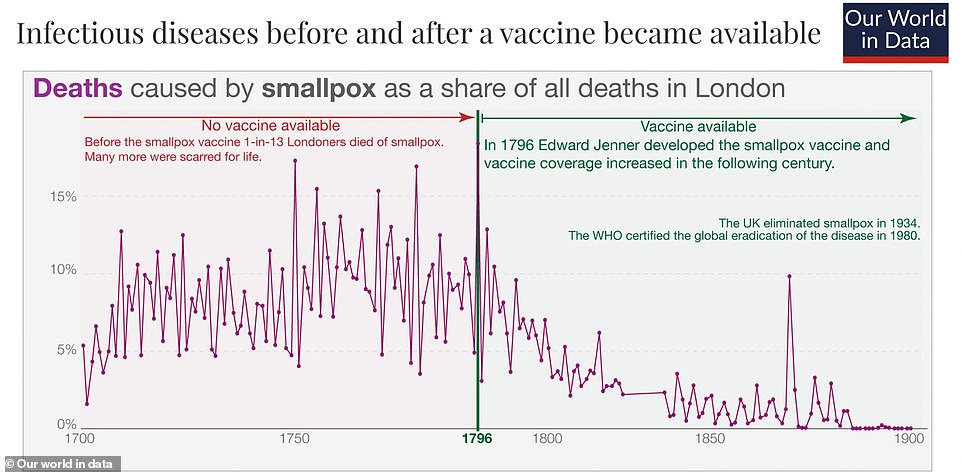
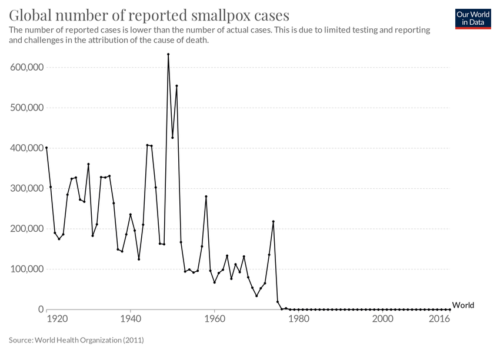
Notably, that Jacobson case was regarding smallpox, which by 1905 had a pretty obvious success record going all the way back to the origin of vaccination in 1796.
The decision of 1905 continued to prove itself correct, so much that smallpox was globally eradicated by the 1980s due to mandatory vaccination orders.
Another proof the 1905 decision was the right one for a nation seeking “real liberty” is found in a 1996 CDC study of countries that didn’t mandate vaccination enough:
Finally, we can look at the experiences of several developed countries after they let their immunization levels drop. Three countries – Great Britain, Sweden, and Japan – cut back the use of pertussis vaccine because of fear about the vaccine. The effect was dramatic and immediate. In Great Britain, a drop in pertussis vaccination in 1974 was followed by an epidemic of more than 100,000 cases of pertussis and 36 deaths by 1978. In Japan, around the same time, a drop in vaccination rates from 70% to 20%-40% led to a jump in pertussis from 393 cases and no deaths in 1974 to 13,000 cases and 41 deaths in 1979. In Sweden, the annual incidence rate of pertussis per 100,000 children 0-6 years of age increased from 700 cases in 1981 to 3,200 in 1985. It seems clear from these experiences that not only would diseases not be disappearing without vaccines, but if we were to stop vaccinating, they would come back.
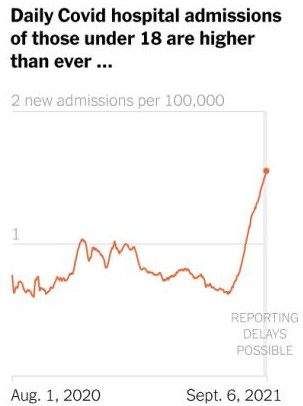
Nearly 30,000 of them entered hospitals in August…overwhelming children’s hospitals and intensive care units in states like Louisiana and Texas.
Source: NYT
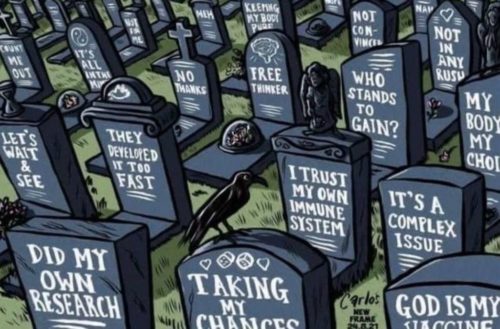
Some, however, think so primitively that when they hear that a specific and thoroughly researched vaccination mandate is legal, it opens the door for them to force US courts to also push a random experimental healthcare idea over the objections of healthcare experts.
…precedent rejecting some sort of constitutional right to ‘medical’ use of unproven treatments goes back a long time…
…patients have no legal basis to go to court to force unwilling health care providers either to participate in an off-label use they do not believe is therapeutic, or to force hospitals tolerate such a use in their facilities.
So in summary, healthcare experts in the US can legally mandate vaccines in order to preserve “real liberty”. On the flip side, healthcare experts can not be forced by courts against their will to experiment on patients.
With all that said, who in the US is refusing vaccination and forcing predictable mistakes like “Great Britain, Sweden, and Japan… because of fear about the vaccine”?
86% Democrats are vaccinated (5% say they will never)
64% Republicans are vaccinated (42% in December 2020 said they will never, dropping to just 20% in the latest polling, thus 22% moved in six months from saying never to being vaccinated)
18% Men say they will never
10% Women say they will never
44% White evangelical protestants are not vaccinated (24% say they will never)
20% Hispanic catholics are not vaccinated
15% Jews are not vaccinated
37% Agriculture workers say never
12% Tech workers say never
Or, from the same source, to put it another way…
Viewers who tune in to Fox News Channel at least once a month report the highest rates of vaccine refusal and the lowest level of vaccine uptake (59%) of all outlets polled…
With that in mind, the U.S. federal government has the authority for isolation and quarantine under the Commerce Clause of… wait for it… the Constitution.
Section 361 of the Public Health Service Act (42 U.S. Code § 264) authorizes the Secretary of Health and Human Services to prevent entry and spread of communicable diseases from foreign countries into and between U.S. states.
When I was a student in history, it seemed like everything we studied was war.
Dates were “important” because they related to some military event. Technology was “interesting” because it killed people.
I even spoke about this issue a bit in the origin story for this blog.
Poems always fascinated him because they present a unique window into the thoughts and feelings of our predecessors who faced important social challenges. Much of history is taught with an emphasis solely on military events — who fought, who won and why — which Davi found to obscure much of the more fundamental day-by-day decisions and lessons distilled into poetry by people of that period.
Indeed, poetry can be essential to understanding human conflict, especially influence campaigns, as I recently wrote about Afghanistan.
Oops, see what I mean? Even poetry is about war.
Fast forward to today and a new article in War on the Rocks suggests a shift towards more systemic thinking — more cognition for placing war in context of society — is being put on the table by military historians.
This integration of battlefield events with the social, cultural, ideological, and technological forces that often trigger and perpetuate war is just what the Society for Military History has called for. In November 2014, two of the best scholars in the business, Robert Citino and Tami Davis Biddle, authored a lucid and compelling statement about the importance of teaching the history of war — in all its various dimensions. “Perhaps the best way for military historians to make their case to the broader profession,” they wrote, “is to highlight the range, diversity, and breadth of the recent scholarship in military history, as well as the dramatic evolution of the field in recent decades.” A broadly based and scholarly approach to the teaching of war, they added, “puts big strategic decisions about war and peace into context; it draws linkages and contrasts between a nation’s socio-political culture and its military culture; it helps illuminate ways in which a polity’s public and national narrative is shaped over time. All this gives the field relevance, and, indeed, urgency, inside the classroom.”
The article is great in its entirety, not least of all because it also smacks down some nonsense claims about a decline in teaching about war.
Basic analysis proves such claims wrong.
And let’s be honest, if more people realized learning history gives you an excellent grasp of analysis they probably wouldn’t have to be sold on the benefits of learning about war.
a blog about the poetry of information security, since 1995