Category Archives: History

Sharing Knowledge to Overcome Possible Future Enemies

Buried in chapter 5.2 of the famous 1945 report to the President (“Science The Endless Frontier”) by Vannevar Bush, under the heading “Security Restrictions Should Be Lifted Promptly”, is this sentence:

Our ability to overcome possible future enemies depends upon scientific advances which will proceed more rapidly with diffusion of knowledge than under a policy of continued restriction of knowledge now in our possession.

A similar sentiment is found in chapter 4.5 under the heading “Remove the Barriers”

Higher education in this country is largely for those who have the means. If those who have the means coincided entirely with those persons who have the talent we should not be squandering a part of our higher education on those undeserving of it, nor neglecting great talent among those who fail to attend college for economic reasons. There are talented individuals in every segment of the population, but with few exceptions those without the means of buying higher education go without it. Here is a tremendous waste of the greatest resource of a nation – the intelligence of its citizens.

If ability, and not the circumstance of family fortune, is made to determine who shall receive higher education in science, then we shall be assured of constantly improving quality at every level of scientific activity.

Ability instead of family fortune, diffusion of knowledge instead of restriction. America clearly was in a different, far more logical, place at the end of WWII.

This Day in History 1944: Virginia Hall Sets Up “The Farm” in Occupied France

Virginia Hall in 1944 on this day set up a safe house in Le Chambon sur Lignon, south central France on the farm of Maurice and Léa Lebrat. In her own words:

My life in Haute-Loire was different and difficult. I spent my time looking for fields for receptions, bicycling up and down mountains, checking drop zones, visiting various contacts, doing my wireless transmissions and then spending the nights out waiting, for the most part in vain, for the deliveries.

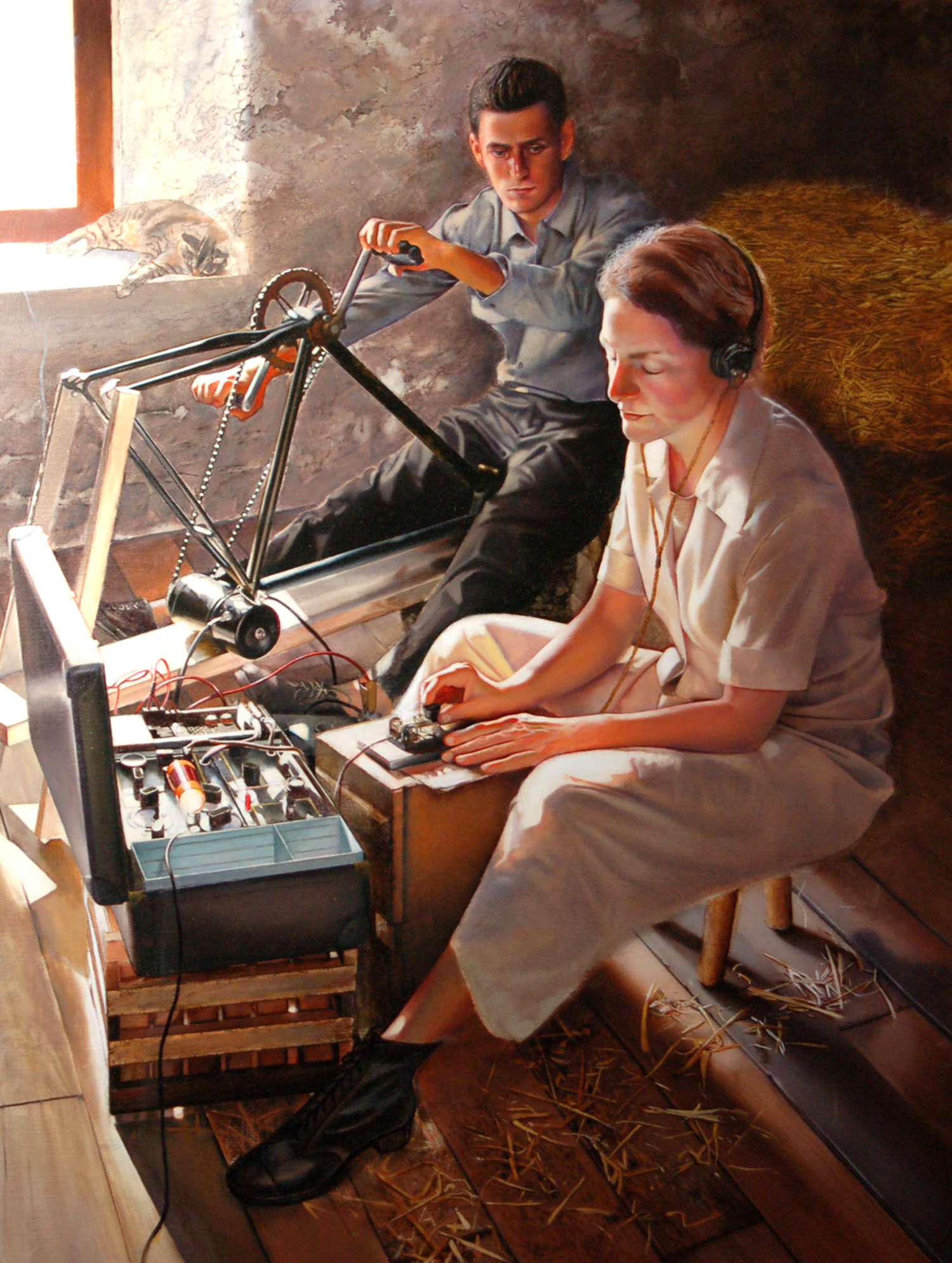
Hall’s heroic and successful field work to defeat Nazism is captured by a famous painting donated to the CIA in a 2006 memorial.

Source: OSS Society

The painting is named for one of her air drop code phrases “Les marguerites fleuriront ce soir” (The daisies bloom tonight). Depicted with Hall is Léa Lebrat’s cousin Edmund, credited with building and operating a easily-disguised hand-crank generator to power wireless signals to London.

March 1944 she sneaked into France by boat (Brittany coast) and began exfiltrating streams of intelligence as well as training three battalions with a Jedburgh Team to fight the Germans until Allied forces (following D-Day 6th of June 1944) were able to join her in August and take over in September. Again, in her own words (allegedly):

In 1943 I joined General Donovan’s Office of Strategic Services for more adventures with the French Resistance. I became proficient in Morse code and radio operation, which made me invaluable. During the day, I appeared to be a milkmaid. However, at night I directed the Resistance Forces under me in many acts of sabotage and guerilla warfare. I relayed important information from haylofts via my radio to London. I was always keeping ahead of the Gestapo, whose leaders knew of me and wanted me captured. I never gave them the opportunity, my spirit and devotion to the cause carried me on.

I said allegedly for the above quote as “made me invaluable” and “always keeping ahead” do not sound at all like Virginia’s voice, and I’ve been unable to source it as authentic.

She passed away in 1982, doing the hard work more than trying to gain recognition, and remained mostly unknown.

Senator Bob Dole in 2016 called out Hall specifically (“only civilian woman to receive the Distinguished Service Cross in World War II”) when he pushed the US Government to give a Congressional Gold Medal to OSS (awarded March 21, 2018).

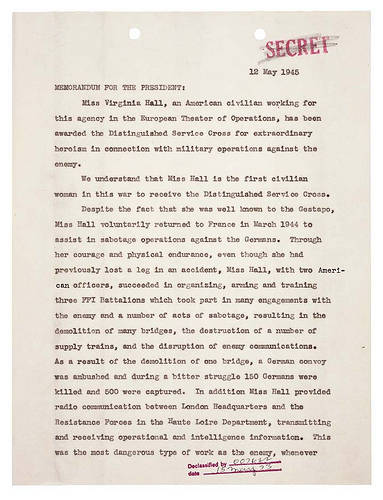
Or as President Harry Truman put it, when General Donovan in September 1945 awarded her the Cross:

Miss Hall displayed rare courage, perseverance and ingenuity; her efforts contributed materially to the successful operations of the Resistance Forces in support of the Allied Expeditionary Forces in the liberation of France.

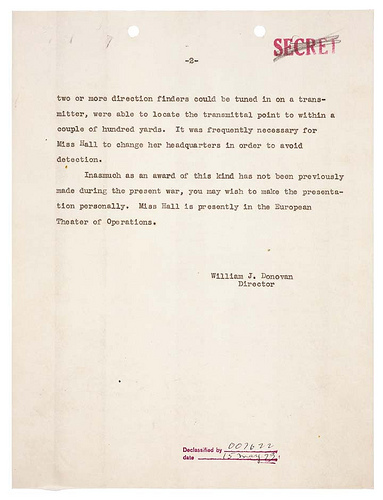
The National Archives have a copy of the “Memorandum for the President from William J. Donovan Regarding Distinguished Service Cross (DSC) Award to Virginia Hall, 05/12/1945″

Further reading:

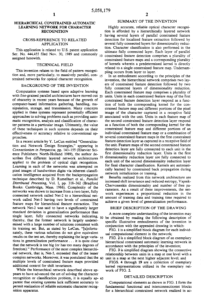
ConvNets Patent by AT&T Bell Labs

Kosta Derpanis posed this question on Twitter:

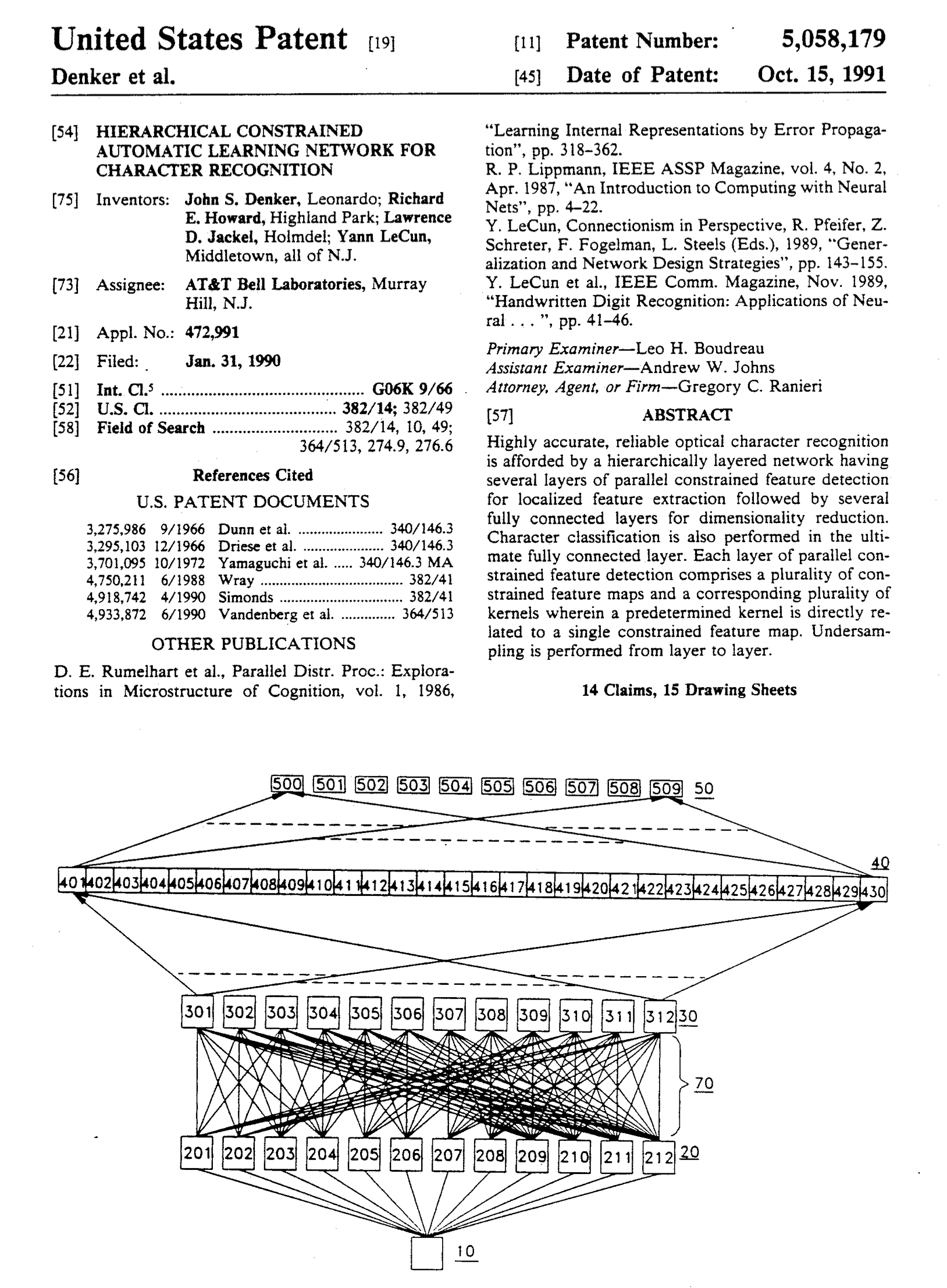
Did you know ConvNets were initially patented by AT&T Bell Labs? Source.
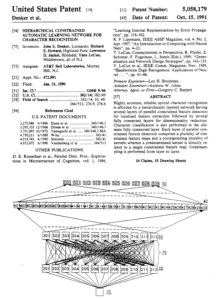
Then Yann LeCun, following up a 2019 podcast, replies in an awkward nine part Twitter thread about intentionally violating IP restrictions. Since this thread could disappear any minute, and in the spirit of LeCun’s own violation mindset, I’ve posted it here for analysis/archival sake):

There were two patents on ConvNets: one for ConvNets with strided convolution, and one for ConvNets with separate pooling layers. They were filed in 1989 and 1990 and allowed in 1990 and 1991.

We started working with a development group that built OCR systems from it. Shortly thereafter, AT&T acquired NCR, which was building check imagers/sorters for banks. Images were sent to humans for transcription of the amount. Obviously, they wanted to automate that.

A complete check reading system was eventually built that was reliable enough to be deployed. Commercial deployment in banks started in 1995. The system could read about half the checks (machine printed or handwritten) and sent the other half to human operators.

The first deployment actually took place a year before that in ATM machines for amount verification (first deployed by the Crédit Mutuel de Bretagne in France). Then in 1996, catastrophe strikes: AT&T split itself up into AT&T (services), Lucent (telecom equipment), and NCR.

Our research group stayed with AT&T (wih AT&T Labs-Research), the engineering group went with Lucent, and the product group went with NCR. The lawyers, in their infinite wisdom, assigned the ConvNet patents to NCR, since they were selling products based on them

But no one at NCR had any idea what a ConvNet was! I became a bit depressed: it was essentially forbidden for me to work on my own intellectual production (Loudly crying face). I was promoted to Dept Head had to decide what to do next. This was 1996, when the Internet was taking off.

So I stopped working on ML. Neural nets were becoming unpopular anyways. I started a project on image compression for the Web called DjVu with Léon Bottou. And we wrote papers on all the stuff we did in the early 1990s.

It wasn’t until I left AT&T in early 2002 that I restarted work on ConvNets. I was hoping that no one at NCR would realize they owned the patent on what I was doing. No one did. I popped the champagne when the patents expired in 2007! (Bottle with popping cork Clinking glasses)

Moral of the story: the patent system can be very counterproductive when patents are separated from the people best positioned to build on them.

Patents make sense for certain things, mostly physical things. But almost never make sense for “software”, broadly speaking.

Something sounds very wrong. When AT&T in 1996 spun out NCR as its computer division (and Lucent as its equipment and systems), patents on computer technology were separated from the people best positioned to build on them? Product sounds like exactly the right place for product. And then popping champagne for not being caught when illegally taking IP from a former employer?

The Tet Offensive Came Long After Public Opposition to Vietnam War

File this post under… someone on the Internet is wrong.

I was reading a click-bait titled article on Military.com called “‘The Father of Naval Special Warfare’ Almost Changed the History of the Vietnam War” when I ran into this eye-watering paragraph:

The seaborne infiltrations by communist forces went on for years. Despite the U.S. Navy’s patrols successfully intercepting communist supply runs for eight years, the North still stockpiled what it needed to launch the 1968 Tet Offensive. The surprise attack turned American public opinion against the war for the first time.

Had the United States prevented the Tet Offensive by choking its shallow water supply points, the entire history of the war might have been different from 1968 onward.

Let’s focus down to one sentence in particular.

The surprise attack turned American public opinion against the war for the first time.

The Tet Offensive was January 30, 1968. Right?

In 1967 there were hundreds of thousands of Americans openly protesting against the Vietnam War.

At least a year before the Tet Offensive, nation-wide protests and opposition already were in motion (and being documented).

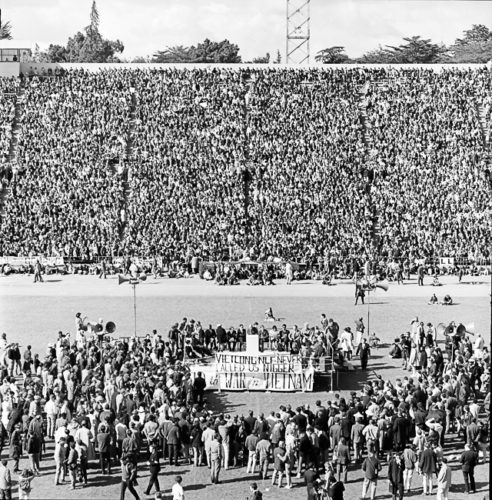
The Spring Mobilization to End the War in Vietnam was organized on November 26, 1966, to sponsor antiwar demonstrations in the spring of 1967

April 15, 1967, San Francisco, CA. Arriving at Kezar, the protesters filled up the entire Stadium. Source: Harvey Richards Media Archive.

I’m not sure how the title or the article made it past Military.com editors without someone realizing the entire premise of both is completely broken.