Category Archives: History

Why the White House Pardoned Convicted War Criminals

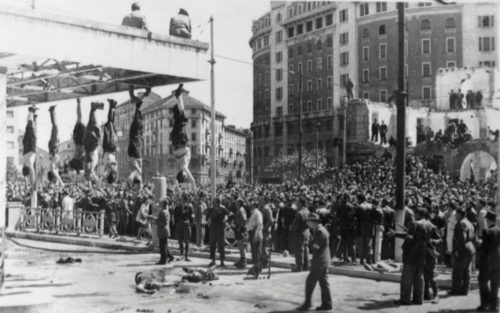
Italian dictator Mussolini was hanged (with his mistress) before he could be tried for war crimes. His soldiers claimed themselves victims while “committing atrocities that for 60 years have gone unpunished.”

The short answer: these pardons serve to undermine democratic institutions and demonstrate “strong man” capabilities of an unaccountable leader.

The longer answer: foreign military intelligence harnessing bias, a form of blind-spot no matter how intelligent the victim, can drive societal fracture and disfunction through manipulations of American sentiment. In this case a divisive issue of war crimes is being used as both proof of power and also a test of loyalty to an authority who is undermining checks and balances.

This kind of manipulation process should be familiar to some as canon of social engineering, with many books already written on the subject.

It also is well documented through the tragic history of the developing world, cruelly manipulated during the Cold War to foment coups and drive power towards dictators who would serve some narrowly-defined agenda (instead of allowing representative democracy). Chad, Guatemala, Angola, Mozambique, Iran…the list I’ve written about on this site alone is long.

The White House unilateral and un-American move to pardon war criminals shows how power is being manipulated by foreign military intelligence campaigns leveraging bias, much in the same way developing nations were manipulated during the past 70 years.

Rolling Stone explains succinctly how a modern system of malicious social media is being used:

Russia’s goals are to further widen existing divisions in the American public and decrease our faith and trust in institutions that help maintain a strong democracy. If we focus only on the past or future, we will not be prepared for the present. It’s not about election 2016 or 2020.

This is spot on. Militarized information campaigns push bias every day to build power slowly in order to wield at a moment’s notice, which Rolling Stone refers to as emotional drive:

She wasn’t selling her audience a candidate or a position — she was selling an emotion. Melanie was selling disgust. The Russians know that, in political warfare, disgust is a more powerful tool than anger. Anger drives people to the polls; disgust drives countries apart.

Pardoning war criminals thus does three things for the current White House by generating disgust:

  1. Demonstrates bias towards “supreme leader” who can do whatever he wants, whenever he wants, regardless of law. This generates disgust among those who believe in the rule of law, such as the Constitution. Also this negates any commentary about war-crimes being committed in Syria after American forces retreated. It’s a negation of both domestic and international moral code.
  2. Demonstrates bias towards the “Christian warrior” who can do whatever he wants, whenever he wants, regardless of law. This generates disgust among those who believe in the rule of law, such as the military code. Soldiers pay attention to example and failing to hold bad examples accountable generates dissent in ranks.
  3. By establishing these two bright lines of disgust on social media and elsewhere it slowly helps identify the extremists in America happy to obey a dictator. We see two national tests of loyalty based on emotive-based bias. Those disgusted by such obvious violations of laws are classified as disloyal to dictatorship and abruptly pushed out in favor of servile minds that give an ok to overtly destroying democratic concepts like the Constitution.

To make a finer point on this, some American military leaders are convinced that mutually assured destruction (MAD) kept the world free of war, while others realized there have been many wars despite MAD with untold suffering and the UN primarily has served to prevent escalations. This used to be a minor point of division worth debating.

By fueling bias, military agents have turned that division into a massive fissure where people are disgusted by the opposing side; either rule of law is respected (e.g. a UN Convention on the Rights of the Child is signed easily) or laws get ignored because might is said to make right (e.g. abuse of children gets called an inherent right of parenting).

Already we see people defending the White House by saying their dictator can do no wrong as they consider the current occupant “strong” and therefore above all laws. They’ll follow his orders to abuse anyone even the most vulnerable populations unable to defend selves.

To be fair the supporters of the current White House don’t necessarily like its occupant as much as the theory of “strong man” power that political scientists used to refer to as fascism. The support is driven by disgust with representative democracy, which means there is desire for dictatorship where a small cabal of power can even dispose of the current bumbling occupant and his family.

There even could be simmering intent to soon install a new and more competent/healthy dictator via secret police (typical role for those who commit war crimes) in order to better achieve some narrowly-defined self-serving agenda (e.g. national socialism, where a very small group gets defined as being an elite nation to absorb all benefits away from much larger state populations).

Here’s how Mussolini himself described it in a text he was credited with in 1932 (“La dottrina del fascismo”, an essay written by Giovanni Gentile):
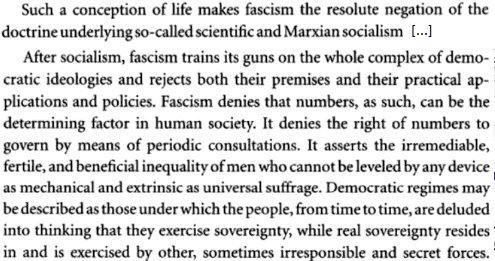
Fascism attacks socialism first, then tries to destroy all of democracy. In a reverse theory, Mussolini here is giving away the gatekeeper/antidote. He apparently believed if people helped genuine socialist candidates and causes they were holding back the slide to dictatorship.

Speaking of 1932, America saw a similar trend to today when Hearst published Adolf Hitler’s narratives and disseminated Nazi military intelligence propaganda as news.

At that time the bias technique was against “bolshevism” and for “pacifism”. Hearst (and the Koch family) were far less successful than today’s Zuckerberg, however, and the pro-fascism leader in America failed to get elected President that year.

Here you can see why the 1932 Presidential election was so critical to the rejection of fascism; rejection of the “strong man” propaganda spreading at that time
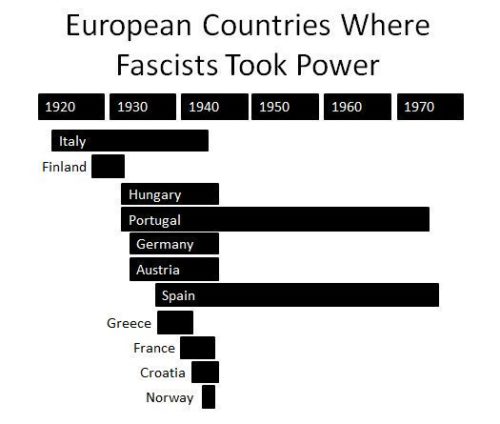
An Allied victory in 1945 clearly cuts fascism lines short. WWII soldiers from America destroyed the Axis forces, which had defeated socialism and trained their guns on all of democracy. This victory restored faith in laws and institutions (e.g. establishment of the UN) and meant the US was able to even export concepts of teamwork and respectful collaboration (lean out) onto occupied fascist countries. In that sense, Germany and Japan have become something of time-capsules for the values of the US that made it so successful.

Here’s how seasoned leaders have described the current White House attacking military values and authority, which appears to most as a mad man throwing away America’s democratic legacy to replace it with the disgusting ideas of fascism:

To put the US back on track and reverse the White House, these pardons for war crimes need to not disgust and divide the nation. And that seems unlikely given how fascist tactics are intended to disgust anyone who really believes in rule of law, let alone gave an oath to uphold the Constitution. A bully push towards divisiveness and away from law, as a disgusting test of loyalty, is exactly why the White House pardoned the accused.


See also: “2016 Republican Candidate: Fascist Week 2016”
Fullenkamp: We Use the Past to Better Understand our Present

Trips to relive famous tactical events sounds in this podcast like something we could do a lot more of for information security.

…military historian Len Fullenkamp reflects on the importance of immersing oneself in the minds of strategic leaders facing dynamic and complex situations. One tool is the staff ride, an opportunity to walk a battlefield and understand the strategic perspective of the leaders…

I’ve walked countless battlefields and tried to relive the decisions of the time. One of the most unforgettable was a trench line perfectly preserved even to this day on a ridge that held off waves of attacks for several sleepless days.

On another long-gone battle ground I stumbled upon three live bullets that had been abandoned for decades, slowly rusting into the ground atop a lookout. I held them in my hand and stared across the dusty exposed road below for what seemed like hours.

Yet I rarely if ever have seen a similar opportunity in the field of security I practice most today. Has anyone developed a “staff ride” for some of the most notorious disasters in security leadership such as Equifax, Target, Facebook…? That seems useful.

In this podcast the speaker covers the disastrous Pickett’s charge by pro-slaveholder forces in America. After two-days investment the bumbling General Lee miscalculated and ordered thousands of men to their death in what he afterwards described plainly as “had I known…I would have tried something different”.

Fullenkamp then goes from this into a long exploration of risk management until he describes leadership training on how to make good decisions under pressure:

What is hard is making decisions in the absence of facts.

Who could be the Fullenkamp of information security, taking corporate groups to our battlefields for leadership training?

Also I have to point out Fullenkamp repeats some false history, as he strangely pulls in a tangent about how General Grant felt about alcohol. Such false claims about Grant have been widely discredited, yet it sounds like Fullenkamp is making poor decisions with an absence of facts.

Accusations of alcoholism were a smear and propaganda campaign, as historians today have been trying to explain. For example:

Grant never drank when it might imperil his army. […] Grant, in a letter to his wife, Julia, swore that at Shiloh, he was “sober as a deacon no matter what was said to the contrary.”

We know today what actually happened was a concerted group of white supremacist historians of a defeated pro-slavery war machine began a campaign to posthumously destroy the character of Grant, to undermine his widespread popularity and programs of civil rights.

After Grant’s death, exaggerated stories about his drinking became ingrained in American culture.

First, the truth of charges against Grant are related to America’s pre-Civil War political and military patronage system (corruption basically) being unkind to him. He succeeded in spite of them and he was living proof of someone using the past to better understand the present.

After extensive experience fighting in all major battles of the Mexican-American War he didn’t sit well being idle and under-utilized. He was introverted and critical of low performing peers. A superior officer in California used minor charges of alcohol as a means to exercise blunt authority over the brilliant Grant.

Second, it was KKK propaganda campaigns of prohibition that pushed the false idea that Grant’s dispute with his superior was some kind of wild and exaggerated issue relevant to prohibition.

In fact history tells us how pro-slavery Generals literally became so drunk during battles they disappeared and were useless, every single time they fought. The KKK projected those real alcoholic events from pro-slavery leadership onto Grant to obscure their own failed history and try to destroy his name.

Apparently it worked because it’s 2019 and far past time for people to stop repeating shallow KKK propaganda about America’s greatest General and one of the greatest Presidents.

Why Does Modern Tech Try to Route Freeways Through Neighborhood Streets?

Since the introduction of new apps to help drivers find better routes, there’s been a persistent problem of freeways routing through neighborhood streets all over America, from NY to LA.

  • Jun 16, 2017 Slate: Suburbs Finally Figured Out a Way to Get Rid of Pesky Drivers on Waze Shortcuts
  • Dec 24, 2017 NYT: Navigation Apps Are Turning Quiet Neighborhoods Into Traffic Nightmares
  • Dec 26, 2017 NYMag: Waze Traffic Forces New Jersey Town to Shut Down Its Roads
  • Sep 20, 2018 WUSA9: Navigation apps flood neighborhood with traffic and VDOT proposes Beltway ramp shutdown
  • Aug 20, 2019 LAMag: Waze Hijacked L.A. in the Name of Convenience. Can Anyone Put the Genie Back in the Bottle?

I’ve spoken about this many times in my AI ethics presentations as a stupid flaw that should be easy to fix.

Meanwhile, news from Cloudflare is that the Internet is exhibiting the same flawed logic

Cloudflare traced the problem to a regional ISP in Pennsylvania that accidentally advertised to the rest of the internet that the best available routes to Cloudflare were through their small network. This caused a massive volume of global traffic to the ISP, which overwhelmed their limited capacity and so halted Cloudfare’s access to the rest of the internet. As Cloudflare remarked, it was the internet equivalent of routing an entire freeway through a neighbourhood street.

Funny thing, historically speaking, is that the Internet is based on transportation logistics. The first hackers were literally people who disobeyed road conventions and safety and went their own way for selfish reasons.

The answer for why a regional ISP in Pennsylvania wanted all the traffic to flow through their neighborhood is…still being discussed. Some speculate it was a test. Someone somewhere always is thinking about how to do Internet-scale attacks on confidentiality, integrity and/or availability.

MIT Tests AI-based Social Ranking System

While many Americans criticized China relentlessly for engineering a social-ranking system, MIT has proudly announced it’s working to improve prediction of car behavior with…a social-ranking system:

“We’ve developed a system that integrates tools from social psychology into the decision-making and control of autonomous vehicles,” Wilko Schwarting, a research assistant at MIT CSAIL, told Digital Trends. “It is able to estimate the behavior of drivers with respect to how selfish or selfless a particular driver appears to be. The system’s ability to estimate drivers’ so-called ‘Social Value Orientation’ allows it to better predict what human drivers will do and is therefore able to driver safer.”

What do you expect your social value to be in the classification system run by MIT? Here’s a historic reference to help:

Nowhere in the story do I see mention of the system being restricted to cars only, or prohibited from leaking into feudal-style governance. Thus, any car on the road could be running social-ranking on everyone and everything it sees all the time.

It will be interesting to see if any American news outlets pick this up as creepy social-ranking of populations, applying the same worry as they did with China.

Also it will be interesting to see how this expands into everything that can be seen at street level by cars.

Is your lawn mowed? Maybe you are being selfish by cutting that grass and denying wildlife a habitat. Or maybe you are being selfish by allowing a habitat to grow that naturally pollinates your neighbor’s lawn, who is trying hard to mow constantly and deny wildlife a habitat.

Who decides the rankings? Or more importantly, if we get transparency into the systems of rankings, will people build a level of trust by playing into expected behavior and then abuse that ill-gotten trust to switch behaviors and escape prediction?

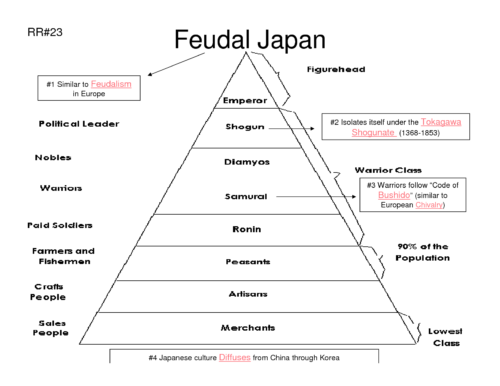
Important to remember how the end of the Japanese feudal era was marked by creative yet selfish merchants. After being relegated to the bottom of the classification pyramid for so long they started to invert the stack and use self-centered social networks of enrichment to float towards the top.

By the end of the Edo period, Omi merchants, and their cousins in other areas of Japan, had grown immensely wealthy. They were also uniquely situated because they had far-flung interests which brought them into contact with the political and economic changes of the last decades of the period. They often proved quick to anticipate the changes and take advantage of them and became influential in the modern period of capitalist development.

It’s not only humans at risk of being ranked. Roads will be constantly assessed, judged and discussed by the things operating on them, according to a tire manufacturer

…data on current road conditions and aquaplanning risks can be sent to other cars in the nearby area, also via 5G

Imagine sending out false autoplane risk data in your neighborhood to slow traffic instead of having to pour on the road an expensive speedbump (sleeping policeman).

And things won’t be just judging what they see eye-level or at the surface, either. Last year a ground-penetrating radar company said cars soon could be judging what it finds under a road surface as well.

…system will scan up to 10 feet below the surface of the road in order to lock on to stable ground. It can then use this data, combined with data from the vehicle’s other onboard sensors, to build itself a map of subterranean features which it can then use to maintain its position on the road…

Putting it all together, combining scores of things around a car and under a car means the car can take action with a better sense of what to predict. However, the integrity of that data is nowhere near proven reliable, and may even open up whole new markets of manipulation for those trying to invert social pyramids and “became influential in the modern period of capitalist development”.