
Category Archives: History

Meta Petal Undersea Cable Colonizes France

A company that once pitched itself as extraterritorial now measures success by how deeply it is wired into national jurisdictions. That’s a notable political shift from seeing itself as literally above the law to trying to become the law.

Facebook engineering boasted “We successfully completed the first full-scale test flight” and buried “structural failure”; NTSB more openly reported an in-flight structural failure on final approach with substantial damage.

Many years ago I was invited into a high security meeting enclave on the Facebook campus. After multiple physical security checks and pat-downs, and being escorted into the room, I found myself among ex-military advisors plotting “Aquila” drones. It was 100% clear that Facebook delivering “Internet” over contested ground from a neighboring country was privatized military intelligence. I couldn’t get out of there and take a shower fast enough.

I called it intelligence collection by elevated platform in 2018, three months after Facebook shut the program.

As those Air Force mercenaries soon discovered the drones were never above the law, and Facebook in 2016 had failed politically before Aquila ever finished a test flight.

I’m not a lawyer but sovereign airspace has no altitude ceiling. The U-2-reminiscent platform operating at 90K feet still needs the same national spectrum license as a tower on the ground. Ask me why the extremist libertarian Silicon Valley nuts still talk about “data centers in space”. A mythological “wild West” of unconstrained rootin’ tootin’ ruthless John Wayne power is driving them, as depicted by Anwar Congo in “The Act of Killing”. Anyway, the ITU identified spectrum for high-altitude platforms, and every country licenses that spectrum on its own terms. India’s regulator proved the point in February 2016 by banning Free Basics on zero-rating grounds. Nothing physical had to be contested when Facebook lost its unregulated power aspirations at a licensing layer.

Four months later Aquila’s first full-scale flight ended in a structural failure on final approach near Yuma, flying without an airworthiness certificate, and the second flight in 2017 did not solve the underlying problem, which also stalled Zephyr: a solar airframe cannot carry a useful payload and survive the night at anything but equatorial latitudes. Loon, the balloon program, closed in January 2021 when Alphabet said no commercial case materialized (meaning the Pentagon backed out).

Inside the high walls of the Facebook campus it was like humanity didn’t matter, money-fueled madness made anything possible (e.g. Musk’s “occupy Mars” is a campaign to abolish laws and replace with an Emperor). Outside, the laws broke every power-hungry fantasy. That’s why Facebook shut the airframe program in June 2018 and said Airbus would build the aircraft instead (e.g. Tesla initially had Lotus build its cars to avoid itself having to operate within the law); and that partnership faded quietly.

Fast forward to today and Meta has announced an engineering nothing-burger.

We’re announcing Petal, the first subsea cable with petabit capacity to be deployed across an ocean. Petal will connect the US and France, spanning 7,000 km (over 4,300 miles) and doubling the capacity of today’s most advanced transoceanic cables.

The doubling isn’t surprising and comes from two-core fiber rather than more strands, which is why the announcement leans on “without proportional power or infrastructure.” That is also a concentration-of-risk claim: same number of cables, same landing points, same Baltic and Red Sea failure modes, now carrying twice as much per cut.

The constraint has been voltage, not glass. So repeaters split each 2-core fiber into two single-core paths with a fan-in/fan-out interface, amplify, then recombine, which keeps the system under the existing 18 kV power-feed rating and avoids requalifying the whole subsea ecosystem. Meta doubled capacity by staying inside the old certification envelope.

Meh. Or should I say Meh-ta?

It is obviously foremost a cable for moving Meta’s own traffic between its US and EU data centers, increasingly AI training and inference, that seeks EU exposure and dependence on American compute. Read between the lines and it is a political science post, without much technical significance, dressed up as something novel that engineers did.

Meta stopped trying to route around states and started embedding in them instead.

It plans to land in France with Orange as landing party, which puts Meta inside French critical-infrastructure policy, inside French lawful-intercept obligations, and at the table when governments talk about cable protection. That is a far more politically durable position than hoping nobody touches an aircraft too fragile to survive its landing.

Colonization by cable is probably the right way to read the news, if you consider history. Paris learned what happened in the Fashoda Crisis of 1898 from a British telegram routed through Cairo, and when Britain censored the cables during the Boer War the next year, France started building a state-owned network to Africa.

The two major colonial powers sought to link their colonies via a vast railway network: Britain from Cairo to Cape Town, and France from Dakar to Djibouti. The town of Fashoda, situated at the intersection of these two planned lines, became a critical focal point for both armies. On September 18, 1898, Marchand’s French mission and Kitchener’s British expedition came face to face on the Upper Nile. Ordered to withdraw, France yielded and was forced to acknowledge British authority over the entire Nile basin. This defeat led to a redivision of African colonies between the British and the French.

What will Meta surveill and censor for Trump when the EU goes to war?

On the current cable at Le Porge Meta holds more than 80%, Orange gets two of sixteen fiber pairs for landing it, and the ownership split is not public.

Can you guess why it’s not public? On the US side the FCC landing license for Amitié went to Microsoft, and since 2020 the FCC refers cable landing applications with foreign ownership to a Justice Department-led committee that can condition the license on a national security agreement. Whatever the licensee agreed to in Washington is part of the deal France landed.

Petal goes to NEC and Sumitomo, two years after the French state bought 80% of Alcatel Submarine Networks to keep cable building sovereign, and seven years after the Senate warned in 2019 that these infrastructures must not be held exclusively by foreign entities.

France keeps one thing. Le Monde reported in 2014 from the Snowden files that Orange’s landing stations give the DGSE access to everything transiting the country, sorted by origin.

Meta owns the cable. France owns the landing and reads it. That is the same arrangement France rejected in 1898, with the tap as consolation, and good luck to France when it remembers why.
Wheatley to Orelien: Racist Information Warfare Targets Black Authors

The Academie Goncourt struck a novel from its longlist on Friday, four days after an anonymous account with 92 followers declared it the work of a machine. The evidence was a single commercial detector. AFP ran the same passages through its own tool and got “very likely written by a human.” Seven other detectors disagreed with each other.

The book stayed struck. The Goncourt cited the plagiarism findings alongside the detector, but the claim by an anonymous account with a contested tool was clearly targeting the author.

The author is Thelyson Orelien, 38, born in Gonaives, Haiti, resident in Montreal since 2010. His first novel, C’etait ca ou mourir, follows a teacher fleeing gang violence to Canada. It won the Prix du Roman Fnac on Monday 21 September. The accusation from “Balance ton Claude” landed the same day. By Thursday his Quebec publisher had suspended promotion, a book fair had withdrawn his guest of honour title, and two newspapers had found borrowed passages in columns and a short story he wrote in 2012 and 2014. By Friday the Goncourt had acted “to preserve the integrity of the prize” and its mission of crowning “literature written by women and men.”

On Thursday Le Figaro identified the attack account’s operator as one of its own columnists, Samuel Fitoussi, author of Woke Fiction. He had denied involvement to AFP several times that week. He had also been among the first to repost the anonymous accusation from his own named account, boosting himself. On Friday he confirmed a “collective project” whose other members remain unnamed. Asked about the racial dimension, he called the question conspiracist. The president of the Academie Goncourt had already told franceinfo why he thought the timing mattered: a Haitian, Canadian, Black, francophone foreigner, in a season when passions run high.

Fitoussi’s stated motive is fear, that AI will end human writing. Yet he is an associate member of Frst, a Paris fund that finances AI startups and that began life as Otium Ventures under the Catholic billionaire Pierre-Edouard Sterin. The detector he relied on, Pangram, raised $9 million in July in a round led by Menlo Ventures, an investor in Anthropic, whose assistant gave the account its name.

Black authors in the French and English worlds have been asked to prove they wrote their own books for 250 years.

Phillis Wheatley was examined by eighteen Boston men in 1772, Governor Thomas Hutchinson among them, before a London publisher would print her poems. Their signed certificate that she had written them opens the 1773 edition. Bakary Diallo, a Senegalese rifleman, published Force-Bonte in Paris in 1926 and was assumed for decades to have had it written by his French patrons. Camara Laye’s Le Regard du roi (1954) was attributed in 2002 by the scholar Adele King to two Belgians in Paris, his landlord and a reader at his publisher. Yambo Ouologuem won the Renaudot in 1968 for Le Devoir de violence, faced plagiarism charges from 1971, and published nothing after 1972.

A white author gets the opposite treatment. Michel Houellebecq copied Wikipedia passages into La Carte et le Territoire, admitted it, called it collage, and won the 2010 Goncourt anyway.

Orelien is compiling a dossier with his editor to prove he wrote his own book, like Wheatley stood before eighteen examiners in Boston over 250 years ago.

The information warfare against Black authors hasn’t changed much.

Trump White House Press Ban Matches 1933 Nazi Law

A lawyer who named Mein Kampf his favorite book of 2013, and praised Hitler’s grasp of propaganda, has now signed a brief asking the courts to defer to President Trump’s personal judgment whether journalists are national security threats.

Hitler’s 1933 state labeled someone an enemy by judgment of their views, and treated their speech as a threat to the security of the nation. First were political opponents of Hitler. That meant Communists and Social Democrats filled Dachau within two months of him seizing power.

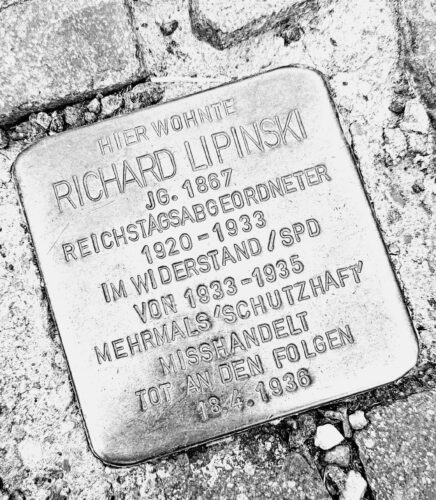
Memorial block for Richard Lipinski, the Leipzig SPD chairman and Reichstag deputy who voted against Hitler’s Enabling Act. The regime imprisoned him, killing him in 1936. He is one of the 96 Reichstag deputies the Nazis murdered.

The regime then extended it to Jews and a growing list of others. The list grew as officials improvised toward whatever they understood Hitler wanted, under legal instruments that licensed action outside the ordinary law. The mechanism always stayed the same.

That is the mechanism the Trump administration is using today. His Justice Department brief filed September 22 in CNN v. Trump (D.D.C. No. 1:26-cv-03287) applies it to the press.

The brief and the Trump administration’s own statements line up with Hitler’s regime, row by row.

1933 2026
Mein Kampf I/10: the state must ignore the “Geflunker einer sogenannten Pressefreiheit” (humbug of so-called press freedom). DOJ brief: White House access is “a privilege.” Asks the court to overrule Sherrill v. Knight.
Mein Kampf I/10: the state must shield the people from bad or malicious “educators” and watch the press most closely. DOJ brief: the President decides who is a “bona fide” journalist.
Mein Kampf I/10: press freedom means “straflose Volksbelügung und Volksvergiftung” (unpunished lying to and poisoning of the people). White House letters: “trafficking in verifiable falsehoods about national security.” Trump: fake news has “grown like Cancer.”
Goebbels, introducing the Schriftleitergesetz: he intends to remain the press’s “warm-hearted protector.” Trump: “not instituting an assault on the Free Press, something which I cherish.”
Hitler: Social Democrats as Novemberverbrecher, the traitors who stabbed the army in the back. Trump on Democratic lawmakers: “SEDITIOUS BEHAVIOR, punishable by DEATH.”
Mein Kampf I/10: take the press out of the hands of “Volksfremden und Volksfeinden” (aliens and enemies of the people). NSPM-7: “extremism on migration, race, and gender” as a common thread of domestic terrorism.
Reichstag Fire Decree, “zum Schutz von Volk und Staat”: press freedom suspended. DOJ brief: courts should defer to the President’s “personal judgment of national security considerations.”

A legal instrument is paired with a category the state defines. The 2026 list covers immigrants, “extremism” on gender, Democratic lawmakers accused of sedition, and now three news organizations. The mechanism accepts any label.

Michael Velchik, the Justice Department lawyer who signed the CNN ban brief, submitted a Harvard Latin paper written from Hitler’s perspective in 2011, according to three people in the department. And last year he argued the absurd Harvard funding case, claiming it was the fight against antisemitism.

Trump has already announced the next entry for his Hitler-era targeting machine: “Other Fake News Media Outlets to follow.”

From Auschwitz in 2026, Nazi Enslavement Voided a Jewish Artist’s Rights So Poland Gets Her Paintings

A new press statement from a death camp memorial in Poland reads very odd to me because it’s so obviously immoral. Here’s the logic the spokesperson is floating:

Pawel Sawicki, speaking for the Auschwitz Memorial, told the AP that the watercolors Gottliebova Babbitt was forced to paint for Mengele “must remain in the Memorial” as documentation of crimes. He said they must stay out of the category of Nazi-looted art, because she painted them against her will as a prisoner and therefore had no ownership of them.

Well, that’s entirely backwards on the face of it.

I mean, “looted” means something you owned was taken from you. Sawicki says she painted them against her will as a prisoner and so could never claim ownership, which means nothing was taken, which means they don’t count as looted. That transfers slave work to the enslaver: SS-commissioned records made with SS materials, belonging to the camp administration from the moment they existed.

With that in mind, I’m guessing he insists on the category because the daughters’ lawsuit relies on a 2024 California law (Code of Civil Procedure § 338.2) covering art taken or lost as a result of political persecution. If the paintings were never hers, nothing was taken from her, and the Memorial can argue the law stops applying. The Memorial exhibits her coercion as evidence of Nazi crimes, and then cites that same Nazi coercion as why they too should deny her title? The same coercion serves as the exhibit and then the defense against restoring rights to the enslaved. What are we doing here?

Let’s run through the problems with the memorial logic:

  1. The Auschwitz Memorial just voided the victims’ rights. They invert how duress normally works. Coercion usually voids the taker’s claim. Here it’s used to void those who experienced loss. It’s effectively work-for-hire doctrine with Mengele as the employer, where the product of slave labor belongs to the enslaver (or the people now running the memorial to the victims of the enslaver). Poland took over the site in 1947. The UNESCO record gives the sequence: the museum bought her paintings in 1963 and 1977, and identified her as the living painter in 1969. It acquired the seventh in 1977 anyway. By her family’s account she had already come to Poland in 1973 to take them home and was turned away, as if she didn’t have rights to her own work. The museum has kept all seven through every request since. By its own published account it claims purchase was legal as set under Polish law, with a copyright conceded to her. Sawicki’s line is old. The daughters’ complaint alleges museum officials called her Mengele’s worker and told her that legally only Mengele might have a claim to the paintings. Sawicki says it now about a Jewish survivor while the Memorial, by its own account, already concedes the copyright is hers.
  2. From the premise of step one, the Memorial’s title runs through the Nazi perpetrators. If the victim never owned her own work, the SS did, and everything downstream inherits from the SS. The documentation is brief. It is the museum’s own account. Three days after liberation a boy from Oświęcim came to the camp to take in a Jewish orphan from the horrific Hungarian transports. A freed prisoner handed him a roll of seven watercolors signed “Dinah 1944”. The girl grew up in that family and sold six of them to the museum in 1963. The museum acquired the seventh in 1977 and identified Babbitt as the painter in 1969. It has known for 57 years whose work it holds under dubious logic.
  3. So far it’s a failure of morality, but there’s also just a simple logical disaster. The memorial contradicts itself. The Memorial says it fully respects the rights of the people who created these documents right after arguing she had none. The negation of full rights comes from their own loud denial of a victim’s rights.
  4. The US House of Representatives rejected the premise in 1999 when H.Con.Res. 162 urged the museum to transfer the seven originals to her. A Senate resolution introduced in 2001 called her unquestionably the rightful owner. In 2002 Congress made it law. Section 705 of the Foreign Relations Authorization Act (Pub. L. 107-228) recognized her moral right to the paintings and urged the President to make all efforts necessary to retrieve them. The museum has held the same position through all of it. Why? Poland has a record here. In August 2021 it enacted a thirty-year limit on challenges to administrative confiscations (Dz.U. 2021 poz. 1491). The law covers every claimant, and its effect was to close the cases of Holocaust victims’ heirs seeking property nationalized after the war. The US Secretary of State said he deeply regretted it. Israel’s foreign minister called it antisemitic. The Memorial is a Polish state institution and, after Babbitt died still asking, its answer to her daughters lands in the same place: the victim gets nothing.

The museum could make a much more logical argument instead, which proves the ownership claim is unnecessary.

A Polish state institution chose to answer a Jewish survivor’s daughters by saying that enslavement to Nazis cost her the title to her own work, which turns the crime against her into the ground for keeping her work. They could have said that the portraits are among the few surviving records of Mengele’s experiments on Roma and Sinti victims, the subjects were murdered, and there’s simply a case that evidence of genocide is needed at the site and that the Roma have a stake too.

That’s an argument about custody and public interest, which doesn’t need the argument that a victim of Nazis never owned her own work. Think about the people who today run a site drawing attention to a victim of Nazism. The Polish administration tells visitors the Nazis forced her to paint. It tells the press that some other force, not them, is why she never owned the paintings, while it keeps them from her family.

How convenient to point a finger at the Germans as the bad guys while Poland denies victims’ rights. Germany ran the camp, with SS men recruited from across Europe, ethnic Germans from Poland among them. The town around it knew. Poland took over the site in 1947 and has refused to give the enslaved artist her own paintings through every request since. Poland wrote this into law twice. The decree of 8 March 1946 (Dz.U. 1946 nr 13 poz. 87) gave the state title to property its owners failed to reclaim in time. Three million of Poland’s Jewish citizens were murdered, their homes and businesses classified by Poland under the word abandoned instead of looted and stolen. The 2021 law blocked challenges. The Memorial’s refusal is just that.

It’s not very hard to figure out. By its own account the museum already concedes the estate controls reproduction, so a licensed copy is a deal it has the legal footing to make today. Make a copy of the art, license it from the victim’s estate, and then present the replica at the site. Give the original back to the victim’s estate, where it belongs.

Apply the Memorial’s rule to the very ground it stands on today.

The SS seized the barracks from the Polish army and the fields from expelled Polish villagers. If what the SS took by force became SS property, the site itself belongs to Germany today. Poland rejects that rule to reclaim rights over its land. It should reject that rule for her paintings, because it’s the same rule.