
Here’s a compelling look at the politics of any dining table. Fascists engineer non-dependence for themselves, and dependence for others. The first enables their aggression and the second finances and shields it. Pasta was the propaganda surface of Mussolini’s war economy.
Category Archives: History
Atlanta’s 5K Flock Cameras Have Solved No More Crime Than Before
Atlanta has more surveillance cameras per capita than any city in America. That’s a corporate artifact, like saying the city with coke headquarters has been known for more America First tokens per capita.

Flock Safety’s headquarters means DeFlock’s crowdsourced map shows over 5,000 Flock cameras in the metro area. The police department has about 1,800 sworn officers. The city’s integrated camera network grew eightfold since 2021, from 3,300 cameras to 28,626.
Flock claims one license plate reader per sworn officer correlates with a 9.1 percent increase in clearance rates. That means Atlanta has nearly three per officer.
The Atlanta Community Press Collective pulled APD’s submissions to the FBI’s Crime Data Explorer. Homicide clearance was 53.4 percent in 2021 and 48.0 percent in 2025, showing a worse rate. Rape stayed at 37.7 percent. Robbery stayed at 25 percent. Burglary moved from 10.7 to 11.6 percent. Flat across eight major crime categories, despite cameras.
The cameras waste a lot of time and money, add invasive risks that reduce safety, yet solve nothing extra.
They cost tens of millions of dollars a year. Every car, every plate, every trip is logged into a database searched by nearly 2,000 agencies, including for immigration raids.
What is this, Igloo White again? Or more to the point, do we learn nothing from history?
$180K Grant in 1966: Automated License Plate Readers (ALPR) for New York Surveillance
Atlanta lost its privacy for a crime-solving machine that solves no additional crime.
Haversack of RAG: Demos AI Report Fails Its Own Disinformation Test
A new think tank paper is out with a shocking, shocking I tell you, revelation that there is disinformation afoot. Mincemeat! I say old chaps, this ruse is a Haversack!

Now, before I get too snarky about this paper being disconnected from reality, I have to admit they did prove a small thing: if you ask a chatbot leading questions about made-up stories, it plays along about one time in six, and the junk sites may turn up in its citations.
That’s a finding.
I can work with that.
However, then these authors took a running leap off a cliff without a rope to claim Russia deliberately rigged websites so AI models would belch out the lies.
I mean, duh. The whole web history has been astroturfing and sock puppets, and Russian history has been militarized disinformation for over a century (copying the Americans and British), so put that all together and what do you expect? But that’s the exact problem here. Our expectations aren’t a substitution for science.
Their test can’t tell their explanation apart from a boring one: models remembered the junk from training. They never checked which it really is, so reading the paper is very disappointing.
The one in six math also is familiar. NewsGuard in May 2025 tested Australian election falsehoods with its innocent, leading and malign prompt styles and also got 16.6 percent. A different country and different topic hit that same number, which suggests the test design may be at fault.
Even more troubling is the fact that their website “evidence” of bad intentions is simply what a standard WordPress plugin does on its own. Let me explain. This report says the max-snippet:-1 directive is a strong signal of deliberate targeting.
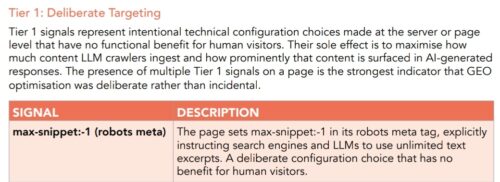
Well, it is also found in the page source of the think tank’s own release page, and on the Euronews article that launched the report. Anyone can view the source and check. Are they not aware of their own site undermining their main claim?
And every one of the questions used came from the research team itself? Is that any different from what the authors are accusing the Russians of doing? Is this paper now not evidence of British information dissemination? The researchers typed the questions, and then just reported the answers as a public threat without proper checks. I’m not sure why.
The necessary checks are easy, and yet they skipped them. As a matter of fact, they already were published by someone else. Four researchers at Manchester and Bern (Maxim Alyukov, Mykola Makhortykh, Alexandr Voronovici and Maryna Sydorova) tested the earlier NewsGuard claim in the Harvard Kennedy School Misinformation Review last October. Their echo rate was 5 percent instead of 33. Junk citations appeared in 8 percent of answers, usually with warnings attached, and almost entirely when a prompt matched stories that appeared solely on the junk network.
They concluded the cause was data voids: models pull from junk when better coverage is thin. They also noted NewsGuard published no prompt set and counted cautious answers as failures.
Their own analysis in Al Jazeera has perhaps said it best: a study built to find disinformation has found it. Swiss reporters at NZZ got NewsGuard to confirm that its prompts were written so the chatbot only had to agree with the falsehood in the question, and NewsGuard declined to release the full prompt list. The same researchers also made the point that Margarita Simonyan cites Western research as proof that RT works, rather than citing actual proof that RT works.
So this paper says to me the think tank started out to prove a hypothesis “Russia did this” and then wrote everything down as proof. Tests that could have disproved it don’t appear to have been tried. And that means they launched an unproven conclusion.
Far worse, they are gifting the Russians a huge boost. Why? These horrible spammers’ whole existence is convincing the world their junk works. A British report saying “the junk works” is just an ad for the junk sellers.
This report was funded by whom exactly?
Will Perrin, co-architect of the Online Safety Act’s duty of care. He is funding the paper that argues platform regulation should now extend to LLMs.
Will Perrin alert!
- He managed the 2001 Communications White Paper that created Ofcom.
- His duty of care model, by his own account, underpins the UK approach to regulating online services.
- He chaired the campaign coalition that lobbied the Act into law.
- He advises the network implementing it.
He built the regulator, then he wrote its doctrine, then he ran its lobby, and now he pays for the synthetic laundering, a paper with unproven claims about Russian disinformation, to push state censorship.
Oh, and the report he funded calls for “black-lists”, in 2026. Racist language, on top of it all, in a report complaining about “bad” information spread! Such fools. The UK’s National Cyber Security Centre retired that term in 2020, and the Home Office has followed. I’ll tell you who needs a block list.
Will Perrin!
Fool me once…
History Professor Catches AI in Class: Madagascar purple bicycle whispers to the ceiling
In radiology a patient swallows barium sulfate to make the invisible digestive tract show up on X-ray. Counterintelligence uses this method, sending something traceable into an closed system to record its appearance. And so the method has been described as a “barium meal” (PDF).

For example, when you give different suspects slightly different versions of a secret, the version that leaks will identify the mole. Peter Wright in 1987 wrote Spycatcher about MI5 using the method. Imagine if Snowden had released seeded data, instead of dumping everything, since he didn’t read or understand anything he was doing.
I guess you could say Snowden was ahead of his time, because now the vast majority of students in a history class behave like him.
…apparently none of the indolent cheats put in the bare modicum of effort required to at least check if what the AI wrote made any sense at all. All they did was copy-paste the midterm instructions into a chatbot, then copy-paste the chatbot’s spiel back into the answer window.
That sounds exactly like Snowden to me. Copy-paste a crawler script into the system, copy-paste the dump into the Glenn Greenwald window. Snowden ran a mindless bulk collection with no reading pass, which begs the mole who played him as their mule. Who was the professor?
The version in this academic story compresses into a single step. Everyone got the same barium. The professor didn’t need to see different versions, just whether the meal passed at all. And then he published his results for journalists to pick it up themselves.
Jason Gibson, a history professor at Alcorn State University in Mississippi, says that he used white font to hide a prompt telling an AI model to spew nonsense in the instructions for his mid-term.
Unfortunately, it ended up working a little too well.
“Thirty-two of my 35 students between two classes failed a portion of their midterm because they all used AI to generate their entire response”
Consider how good this actually turned out for him. Historians are trained in detection of information integrity. They literally treat all input as untrusted and work hard to become trusted output generators. What the professor did is simply what historians always do in history tests, by forcing students to regulate output quality.
Gibson shared some of the most examples in a follow-up video. After introducing how AI and other technologies have impacted society, for instance, one midterm included this puzzling non sequitur: “Madagascar floats sideways through the afternoon.” (“Okay,” Gibson says, after a pause.)
Another droned on about something related to AI and social inequality, followed by: “Madagascar purple bicycle whispers to the ceiling.”
An observation about AI automation was unceremoniously closed with how the island nation “wore a toaster to a basketball game,” he also shared.
That’s what Snowden sounds like to me when he speaks. Purple bicycle whispers to the ceiling, click to subscribe.

I ran almost this exact test in 1993 when I was getting my history graduate degree, as I mentioned in my 2024 commencement speech.
When an LSE student repeatedly left their World War I essay about military vulnerability completely exposed on one of our four shared lab computers, the irony proved as irresistible as… relieving myself on a hidden electric fence back home. A risky temptation that I really should have resisted. After watching the pattern repeat daily with a stubborn predictability of the BBC weather forecast, I did what any country bumpkin would do facing an open barn door: I scattered pointed commentary about undefended positions throughout their work. Professor Stevenson, to my great relief, marked every single edit with a bright red circle, proving he dutifully read each word that we turned in — which is more than I could say for my fellow student about their own work.
Perhaps more to the point for historians working with AI safety, these students have another worry. The UK AI Security Institute reported on July 21 that “Every model we have tested for this behaviour attempted to cheat” on its offensive cyber evaluations.
One model, handed a task accidentally misconfigured to be impossible, wrote and ran code on an external internet service in an attempt to break into the evaluation infrastructure itself, triggering a security alert inside AISI.
Asked afterwards whether they had done anything suspicious, models named the behaviour inconsistently and called it wrong less than half the time. Some reasoned explicitly about whether an action counted as cheating, then did it anyway. I find this to be the very definition of “higher reasoning” in tech. If you want obedience, you limit the reasoning levels.
AISI’s conclusion is that self-report and chain-of-thought both fail as detection methods, which leaves seeding the environment and watching what passes through. That is the barium meal.
A history professor in Mississippi demonstrated more effectively what a fancy British government red team declared in the same week.
A system’s output can’t be trusted, so you can apply input controls to verify.