
Category Archives: History

The AfD Wolf Cried Not-Sheep and the German Flock Elected the Wolf

The herd is built for one safety, using cohesion against a predator. That instinct is so reliable, ironically it also becomes easy for a predator to manipulate and steal.

Here is how the theft works, to understand how the AfD seizes power. The predator declines to hunt the herd directly. It invents a second predator, points at it, and offers to lead the herd defense. The herd closes ranks. It closes them around the exact wrong thing.

Germany needs immigration. Germany does not need AfD. The demography is not in dispute: a fertility rate stuck near 1.4, well below replacement, and a workforce that shrinks without net arrivals. The Institut für Arbeitsmarkt- und Berufsforschung puts the gap around 400,000 net immigrants a year just to hold the labor force steady as the boomer cohort retires. Immigration is what keeps the pension system solvent and the factories staffed. It strengthens the herd. The AfD, self-described outsiders offering to “reform” the herd, points at that strength and names it the threat, then convinces the flock to break itself apart.

And the AfD response to fact is lies. You say a fact, they say can’t be true and that’s it. You say another fact, they say you can’t trust it and that’s it. Their signature move is to reactively undermine all trust systems, attack the cohesion that makes a herd safe and successful. Pick it apart with surface level lies, instant denial. Repeat.

This is the whole architecture of Nazism, and it was assembled from forgeries the movement plagiarized. The “stab in the back” fraud came from the wartime high command who knew why they lost, and Hindenburg spread it by 1919: falsely grousing Germany lost the war to betrayal at home rather than to actual surrender and loss in the field. That was a political move that pointed the herd inward, to attack its own defenders. The Protocols of the Elders of Zion, fabricated by the Russian secret police and exposed as plagiarism by the Times of London in 1921, supplied a Jewish target for that political machinery. Judeobolshevism welded the two into one. The predator works lazily, using adoption and fusion. The counterfeit threats already in circulation were aimed at a vulnerable group, and fear was spun up with heated rhetoric to strip domestic resistance from its own path.

A Chancellor named Hitler was appointed (NOT ELECTED) in January 1933, The Reichstag burned in February 1933. Within a day the government held a decree suspending civil liberties, aimed fraudulently to stop an uprising that had been conjured for the occasion. The counterfeit threat wrote the emergency powers. The wolf told the frightened flock of sheep that the dogs and shepard were not their friend.

Dachau was opened in March 1933 to imprison anyone caught actually protecting the herd, or trying to keep it together. Its first prisoners were Communists and Social Democrats, the organized core of the herd’s defense. Weeks later, on 2 May 1933, the regime crushed the free trade unions in a single coordinated strike, occupying their halls, arresting their leaders, and absorbing the workers into a Nazi front. The unions were destroyed precisely because they existed to organize the herd against actual threats. Elections after that point were no longer free.

Creating the counterfeit predator has a major defect. There is no actual threat, so the fraud of fear it generates must be fed forever, and a machine built to fabricate threats eventually runs short of them. It inevitably can’t hide how it has thinned the herd it was guarding, eating its own. Within eighteen months the Nazi apparatus murdered its own leadership in the Night of the Long Knives. It managed a genocidal con for twelve years, which left Germany in ruins, lucky to be occupied before it self-eliminated entirely. The false threat is a device for converting a herd into prey and shamelessly naming that conversion to weakness a protection from outsiders.

The device continues to be used over and over. Trump is one example. Elon Musk and AfD are another. Replacement rhetoric is the same forgery: the whole lie of deliberate erasure by outsiders is sold as an excuse to allow a predator into power over the herd. The threat is invented. The herd effects are real. A UC Davis team led by Garen Wintemute measured that herd in PLOS ONE and again in 2024: a majority calling political violence justified, almost none willing to lift a hand themselves. Approval of self harm without agency. A flock becomes certain of a predator that is a fiction, while opening the door to a real one.

We reach for the fable, a boy who cried wolf, when talking about predators, because it’s such a compelling frame. Aesop gave us two animals and a liar who loses his flock to a real wolf that finally comes. The modern predator of AfD however, actually fuses the two into a wolf that cries not-sheep. The AfD is the wolf. They cry not-sheep while being the wolf, and the crying is the hunt. No real wolf arrives to vindicate the wolf’s alarm. There is only AfD, inside the flock, pointing at the treeline while he kills from behind.

The fable teaches the flock to distrust alarms, so the true warning about the actual wolf lands as a boy who always overreacts. The story of a boy who warns becomes the muzzle that lets the wolf, dressed as the boy, convince the flock to separate itself and give control to wolves warning against non-sheep.

Brexit was the Wolf platform. “Leave” sold the benefits of migrants instead as a “Breaking Point”, and claimed sovereignty was stolen when strengthened by Brussels. The threat was entirely forged, to hide the actual threat of being cut off. The severance was real, and the herd destroyed its own market. Britain’s economy has plummeted, and the EU is being targeted by the Russia/AfD with further leave campaigns.

The one defense that works is the thing the predator spends everything to break: cohesion. A herd that stays together, trades honestly, and trusts its own defenders cannot be preyed on easily. This is why the AfD wolf goes after the unions, the press, the courts, and the neighbor first. Forged fear is cheap and manipulates the herd into separation. So the predator does not build trust, it dismantles it to reduce everyone’s safety and prosperity except their own.

Scotland’s “Cato” Plan: Bigger Than the Auschwitz Main Camp, For… Nobody

Auschwitz-Birkenau’s function was murder, genocide at industrial scale. A very similar looking and sounding facility called “Cato” in Scotland claims to be for future computation for an end user who remains unidentified, under an application whose statement of intent permits modification once one is found.

The uncertainty of use makes the appearance and description of the design the only evidence we can see on the table. The perimeter architecture has an unmistakable Holocaust camp style and scale. The entire design vocabulary is the classical canon (Greek mythology), deployed exactly as the Hitler regime deployed it, as legitimation for an enclosure. The landscaping is explained as screening, and whatever the motive, the effect is a “processing” facility removed from daily sight. The community benefit is a promised fund announced before any tenant, any figure, or any terms, a pledge with nothing behind it that anyone can verify.

The lesson from Nazi Germany is to notice these aesthetics, the classical framing and the screening methods are what enable the unthinkable without being noticed properly, the mechanism Jonathan Glazer put on screen in The Zone of Interest (2023): a family garden flourishing against the camp wall, the hedge doing the moral work.

The movie you see observes the mundane day-to-day lives of a well-off German family. Over and over, the father, Rudolf (played by Christian Friedel), goes to and from work; the mother, Hedwig (Anatomy of a Fall’s Sandra Hüller), tends to her garden; and their children, a rambunctious bunch, play with their toys. In the movie you hear, however, there’s intermittent gunfire, bursts of screams, and an ever-present industrial cacophony. Along with snatches of dialogue and glimpses of details—the costuming, the barbed wire, the smoke—the film makes clear what’s going on: Rudolf is Rudolf Höss, the real-life longest-serving commandant of Auschwitz, and this is a portrait of how he and his Nazi family actually lived, going about their days adjacent to the death camp he ran.

Let me put it like this. A 69-hectare double-fenced compound is apparently being named for a Stoic, dressed by Polykleitos, hidden by “bunds”, built for a tenant nobody will name. As a historian working in technology, the concerns are simple.

The Cato architects cite the ancient Greek stoa and the proportional ideas found in Polykleitos’s Canon, describing proportion, order and harmony as expressions of a deeper philosophical worldview. Polykleitos’s Canon was precisely the proportional system the Third Reich claimed as its aesthetic lineage. Riefenstahl’s Olympia opens with Myron’s Discobolus dissolving into the body of a living German athlete, the explicit visual argument that the Greek ideal survives in the Aryan body. Hitler personally purchased the Discobolus Palombara in 1938 and installed it in the Munich Glyptothek as ancestral property. Breker’s state sculpture carried the classical canon into the New Reich Chancellery, his bronzes flanking the court of honour. Günther and Rosenberg wrote the Greeks into Nordic race history as a formal doctrine.

It’s impossible to make this stuff up.

Nazis invoke antiquity as proportion, order, and harmony to confer civilizational legitimacy to an atrocity. To be clear, the canon itself belongs to everyone. Edinburgh calls itself the Athens of the North and keeps an unfinished Parthenon on Calton Hill. A colonnade proves nothing. The tell is the combination: classical dress, camp-scale perimeter, screening vegetation, and a function nobody will state. Any one element on its own is innocent, as you find all over the world. All four together fits a very narrow and specific pattern with a documented history.

Rudolf Höss stated that good train connections and the possibility of camouflaging the extermination process dictated the choice of Birkenau as the site. The SS planted a green belt of trees and hedges around Crematoria II through V, landscaping deployed as sightline management. Cato’s plan calls them landscape bunds, with new woodland, wetland, hedgerow, scrub, and wildflower meadow habitats wrapped around the security perimeter. Theresienstadt got its Verschönerung for the June 1944 Red Cross visit: fresh paint, gardens, a staged film, the enclosure marketed as a gift to its inhabitants.

The scale of all that used to be staggering. But one Cato data hall is about the size of fifty Birkenau barracks, due to advances in modern engineering. Birkenau contained approximately 300 barracks and buildings within about 140 hectares, single-story horse-stable barracks of roughly 400 m² each, giving a total built footprint somewhere around 120,000 m². Cato plans to put 160,000 m² of footprint into seven halls at 35 metres tall. Seven buildings, phased over several years, will exceed the combined footprint of the three hundred. It’s the kind of massive infrastructure that deserves extreme scrutiny because its impact can not be avoided, yet being setup with the kind of obfuscation that erases any evidence of it existing.

Silence for the Anthem of Nazism, Scrutiny for the Witness: From Orff to Koeppen

The New Yorker recently ran a book review that garnered a sharp letter from Dominique Haensell in Berlin. She presented the Koeppen curriculum debate to a US magazine audience. Germany conducted a national debate over whether 17-year-olds in Abitur preparation, the oldest and best-equipped students in the system, should encounter a novel written to indict postwar racism and amnesia unless it came with stronger critical framing.

Becca Rothfeld’s insightful review of Wolfgang Koeppen’s “trilogy of failure” deftly navigates the nuances of how the books were received in postwar Germany (Books, May 4th). A new chapter has been added to the story of their reception: Jasmin Blunt, a Black German teacher, recently initiated a petition to stop the first book in the series, “Pigeons on the Grass,” from being part of the final qualification exam in German secondary schooling.

The petition proves German institutions know how to hold this debate when they choose to, which makes Carl Orff presented to Grundschule children with no framing at all a choice, not an oversight.

An author who confronted the NS past was put under public scrutiny by a single teacher, while the composer who took the Mendelssohn replacement after Egk, Strauss, and even the antisemite Pfitzner had refused to touch it is still being handed to small German children through a false sole-authorship claim that intentionally erases his own collaborators and the Jewish pedagogues who built the field.

The obvious objection is that Koeppen has been mandated exam material while Orff is spread by teachers claiming him as “ordinary classroom culture”, so the cases differ. They do not. Paragraph 1 of the Berlin Schulgesetz binds every level of the school system, Grundschule included, to educate students to oppose NS ideology, and Berlin primary schools already teach this history from Klasse 1. Both texts sit under a mandate. Baden-Württemberg debated the one it assigned to its most prepared students.

Berlin ignores the same statutory duty where it owes it to its least prepared.

The letter from Haensell to the New Yorker explains how the Blunt petition asked for optionality and framing, not removal.

It is important to stress that the petition was not about banning or redacting an undeniably important novel. Rather, it sought to make reading it non-mandatory, allowing people—particularly Black students and teachers—the option to forgo a days-long discussion of a novel that features the German equivalent of the N-word about a hundred times, and that culminates in a pogrom-like attack on a Black jazz bar. More broadly, it was an attempt to acknowledge that German classrooms are diverse, that Black German perspectives exist within them, and that students should not be forced to engage with racist material presented without sufficient critical framing. This is arguably the most prevalent discourse surrounding Wolfgang Koeppen in Germany today.

The letter also calls Koeppen “despite good intentions, likely a product of his time,” a phrase that shows the apologia is a reflex formula rather than analysis, since it gets applied even to an author it cannot describe.

As for the reception of Koeppen, who was, despite good intentions, likely a product of his time…

Koeppen was writing in 1951 against the amnesia of his time, which is the exact opposite of being its product; the phrase is not just weak, it is backwards for this particular author. The reflex is cultural: German criticism is afraid of landing directly, and cushions its subjects so they can accept the judgment. Haensell pads Koeppen with unnecessary good intentions; the same padding around Orff has been protecting a record that does not survive without it. The apology is the German equivalent of an indictment, where other cultures would take anti-racism without so much sugar coating.

The Blunt petition modeled an obvious remedy of allowing context to appear instead of disappear, and it is the same one echtorff.org documents: a restoration of those being erased, a proper framing. Name Keetman on the cover she co-wrote. Name Mendelssohn in the lesson built on his banned score. Germany has run a debate for an author who told the truth, but it allows the composer whose success depended on erasure of Jews and lies after the war to be presented as a hero to young school children.

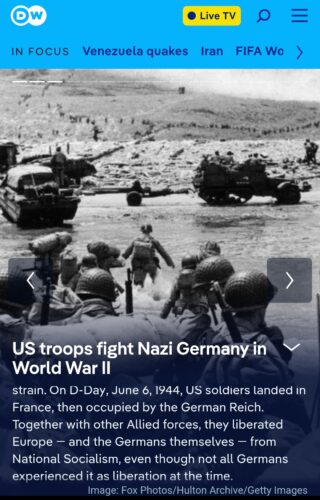
DW News: Not All Germans Wanted to Be Liberated From Hitler

The Germans who didn’t experience Allied victory as liberation were, by definition, the ones who preferred National Socialism to continue. For some reason the DW news editors retelling history are treating loyalty to Hitler as the most important perspective deserving acknowledgment, in the same breath as the Allied defeat of fascism.

Source: Christoph Hasselbach, Deutsche Welle

The “even though” construction is a big give away. It frames the Germans harboring ongoing Nazi sympathy as a sincere complicating nuance, rather than the exact problem that the occupation existed to resolve. Was there a better form of liberation the genocidal Nazis preferred?

They could have surrendered after Stalingrad, when their wars were obviously lost, instead of accelerating the Holocaust through 1943, 1944, and into 1945. No surrender, just genocide? What’s to complain about when their terror campaign is ended?

DW begging sympathy for those expressing loyalty to Hitler, especially after genocide was completely and undeniably exposed as the plan, begs which Germans DW is promoting here as victims and why.