The New York Times wants you to believe that wartime Berliners “just carried on” instead of leaving. Ian Buruma has written what he calls a “love letter” to the city for all those complicit in genocide. The book is cynically called Stay Alive. The subtitle is “Berlin, 1939-1945”, although it probably should have been “I’m obviously not talking about the Jews”.
Stay… and alive. Not for those forcibly deported. Not for those shot in the head and dumped in mass graves.
Stay alive, dear Berliners.
As if the Berliners who pushed the Jews out, onto trains to Auschwitz, were the ones who needed to survive. The people who actually needed to stay alive were in all the camps, sent there from Berlin, from Platform 17 at Grunewald, while the neighbors planned to take all their homes. The threat to Berlin’s Jews was extermination by their neighbors. The eventual externally forced threat to those neighbors was consequences: Allied bombs responding to the many wars that their government started, Soviet troops responding to 27 million of their own dead.
Buruma can get away with this title of Nazi promoting erasure because Berlin already laid the structure for it. It’s the city known for erasing every trace of the people who didn’t stay alive.
There are no photographs of the deportations there, and that’s just weird.
Not one photo.
The #LastSeen project has found deportation images from 60 German cities and towns. We see over 420 photographs from places like Fulda, Breslau, Munich.
Not Berlin.
No photos of the deportation survived. Get it? More than 50,000 Jews were assembled at synagogues and marched to freight yards between 1941 and 1943, and yet not a single image survives.
No photos of the crimes, so that the perpetrators could survive. That’s what enables Buruma to put a photo of perpetrators on the cover of his book and cruelly write “stay alive”.
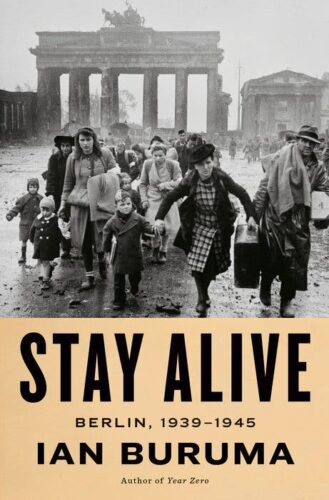
The surviving images are of people carrying belongings through Berlin streets as the perpetrator population. The victims were erased so thoroughly that even the visual language of displacement has been appropriated by the people who caused it.
Sixty towns documented what they did. Berlin destroyed the evidence, took the apartments, collected the stolen property, and got angry at anyone who tried to produce evidence. Look forward! Forget that past! We must talk only of the future! When there are no faces for the dead, you can put the living on the cover and call it the celebration of only their survival.
A love letter. To the city that housed the Reich Security Main Office, the Wannsee villa, the T4 euthanasia headquarters, and the Gestapo on Prinz-Albrecht-Straße. During the years the Holocaust was administered from its conference rooms. That’s what we are being told to love now.
Consider that Buruma’s father, Leo, spent the war in Berlin manufacturing light machine guns for the Wehrmacht. The son’s book turns that fact into a story about “attempting to find his own balance between resistance and survival.” The review even structures the sentence to bury it: Leo worked in “a factory that made brakes for locomotives but also light machine guns.”
Brakes first. Machine guns… oh yeah, that too.
As if trains to death camps let alone arming a genocide was a footnote to the business. This is a family project, their investments for a return. The father made weapons for Nazis. The son wrote the love letter to honor the customers, those buying and standing behind the guns.
The Cast
Every person in this book is bizarrely setup as either a victim or a bystander. That’s the only allowed frame. A conductor who told himself he was unpolitisch. Literati debating whether to go into exile. Families hiding in brothels. And the author’s own father is described as a man “dodging Allied air raids,” not as a man building the weapons that made those air raids necessary.
That’s common among Nazis, declaring themselves the true victim and seeking support to avoid the accountability.
Nobody in this book is running Berlin deportation logistics. Nobody is staffing the camps. Nobody is collecting the Aryanized property and laundering the city’s records. Nobody is processing the paperwork that sent 50,000 Jews from Platform 17 at Grunewald — in full view of the neighborhood — to their deaths. The perpetrators aren’t characters. They’re just the weather the Berliners benefit from.
The Magic Words
Buruma’s thesis, as quoted in the Times review: most Berliners were “neither cynics, nor bullies, nor ideological fanatics; they simply conformed.” Horseshit. “Simply conformed” is the phrase that lets an entire city off the hook. Conformity is passive.
What Berliners did was participatory.
They filled the jobs vacated by deported Jews. They took the apartments and decorated with stolen art and furniture. They attended the concerts funded by stolen wealth. They took all the customers, all the markets and drank the wine looted from France. That’s not conformity. That’s the intended dividend of genocide, and Berlin was an epicenter of grabbing dividends.
The Exculpation Engine
The whole project seems to circle around a man named Erich Alenfeld. A Jew who “converted” to Christianity, Alenfeld wrote a love letter to Hermann Göring in 1939 renouncing his heritage and volunteering for the German Army. His son joined the Hitler Youth at age ten. Decades later, his daughter wrote a book called Why Didn’t You Leave?
The family itself could see clearly what it was.
Buruma’s explanation runs against them and wants us to believe these were “not always cynical accommodations.” The crimes are supposed to be excused by “the nationalistic spirit of the day.” The Alenfelds, he writes, “were as much influenced by German romanticism as anyone of their generation.”
Romanticism. A Jewish man writing to the architect of Aryanization, volunteering to serve the army that would exterminate his people, and this guy calls it romanticism.
It’s disgusting.
This story does specific work. If even a Jew could sincerely buy in rather than be shot in the head, not out of desperation, not as survival camouflage, but out of genuine national feeling, then nobody else can be blamed. The ideology was normal, seductive. It swept up everyone in the crimes, even its victims. And if the victim class believed the lies, what excuse does the beneficiary class need?
That’s why Buruma needs “romanticism” instead of derangement or “desperation.” Thousands of Jews and Mischlinge served in the Wehrmacht. Bryan Mark Rigg documented them. They expected to survive. They did it because the other option was death. They did it because a uniform was camouflage in a hail of bullets. Buruma strips all that actual survival context and replaces it with his personal feeling. Romanticism makes the collaboration of the victim in their own death as universal and beautiful. Desperation would admit there were people under actual existential threat, and would raise the obvious question of what excuse the eight million complicit Berliners had.
The daughter’s title is the question that this new book tries to erase. Why didn’t you leave. Why didn’t you refuse. Why did you participate. Buruma doesn’t want it asked. He doesn’t want the answer leaking. So he dissolves the topic into mood. He literally calls genocide romantic. He calls Nazi complicity a love story. He calls the whole thing a love letter.
And the Times stupidly prints and promotes it because apparently nobody there studies history anymore.
Who Gets a Face
The book ends with the usual horror story that Nazis invoke. Soviet troops arrived and more than 100,000 Berlin women and girls were raped. Buruma interviews a survivor who was 14. This is real history and it matters.
It matters because he erases the more than 50,000 Jews deported from Berlin. They don’t get equivalent treatment. They can’t. Berlin made sure of that. No photographs, no faces, no names on the memorial. No survivors to interview. Raped and murdered.
The structure of the book opens with indifference to tragedy and closes with a call for sympathy about Soviet violence, so that Berliners end the story as victims rather than the participants. All the Jewish women and girls are forgotten so the rapes years later can get all the ink. The dead stay faceless. The living are presented for recognition.
Thomas Mann Saw It
The review quotes Thomas Mann: anything published in Germany between 1933 and 1945 bore the scent “of blood and shame.” The review treats this as period context but it’s so much more. That’s a direct indictment of the project.
Mann’s standard says the voices that Buruma is so intent on preserving, those who stayed to benefit, who conformed to profit, who carried on as Hitler ordered, are not neutral witnesses. They are compromised sources. Not because they lied, but because survival in Nazi Berlin required participation in the system that made their “survival” necessary.
Mann left. Brecht left. The people who stayed made a participation choice, and that choice came with a price that someone else paid. Those who resisted were the ones killed, lives destroyed. Buruma knows this actual story, as his father’s Nazi gun factory is in the book. But the framing converts complicity into tragedy, production into survival, and desperation into romance. That immoral disinformation conversion is the point, it would seem.
Not His First Time
In 2018, Buruma was forced out as editor of the New York Review of Books. Remember his request to think of the Nazis who suffered from Soviet liberation of Berlin? Buruma published an essay by Jian Ghomeshi, accused of sexual assault by over 20 women, that let Ghomeshi reframe his story as a victim of public shaming. Buruma’s defense is very relevant to the women raped by Soviet soldiers:
The exact nature of his behavior — how much consent was involved — I have no idea, nor is it really my concern.
And why isn’t he concerned? In 2018 he gave an accused abuser of women a platform to narrate his own suffering. Now in 2026 he wants an entire city of participants to finally get the platform to narrate theirs. Shouldn’t he defend the Soviet soldiers as he defends Ghomeshi? The hypocrisy is noted.
Both projects center the perpetrator’s experience of consequences rather than the victim’s experience of harm. Both treat accountability as the real violence. He got fired for it in 2018. In 2026 the Times prints Nazi love letters.
The Reviewer Sees It and Walks Away
Kevin Peraino, reviewing for the Times, writes that the book is “long on anecdote and primary sources but somewhat short on big ideas.” He wishes Buruma would “delve deeper.” He’s saying the book has no analytical framework. No argument. No structure for understanding why any of this happened or what it means.
How could it, given what it’s trying to accomplish?
And yet he endorses the “love letter” framing anyway. He calls the book a “passionate challenge to the corrosive power of indifference.”
Indifference wasn’t corrosive to Berlin.
Indifference worked for Berlin.
It is the very thing that kept the concerts running, the soccer matches filling, the coffee flowing during genocide. The machine didn’t need any enthusiasm. To this day Berlin frowns on emotion and warns against evidence. It needed no traces, people to keep showing up so the crimes could continue. They did. A “vacation” train to Auschwitz allowed Berliners to watch the gas chambers of mass death in action. The Nazis made special glass observation ports for inspection. Then the Berliners would return revitalized to their city to wax about their own “survival” that depended on efficient systemic erasure of Jews.
Love Letters to the City of the Dead
Berliners to this day have a tradition, they put flowers and candles on Nazi graves around the city. These Nazis are mourned openly without apology, in the city that dislikes emotional displays. If only they had lived another day to machine gun more neighbors, to violently redistribute more wealth. They are memorialized in a very peculiar way.
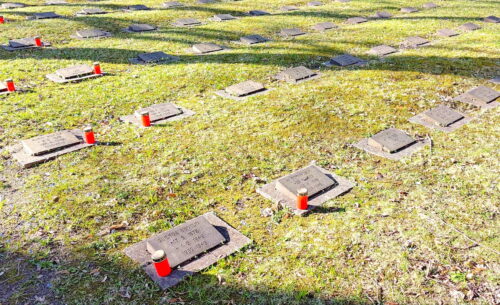
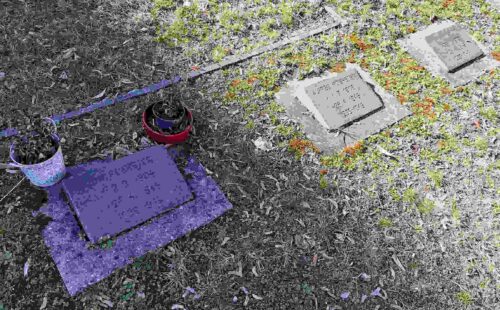
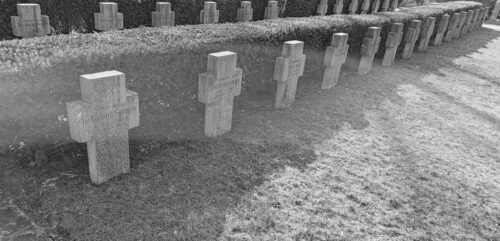
At the military cemetery on Columbiadamm, wreaths appear every November from groups honoring Wehrmacht dead. A “Tradition Association of Friends of the Former Protected Area German Southwest Africa” leaves ribbons with “patriotic greetings” at a memorial to the soldiers who carried out the Herero genocide. When Neukölln’s government was asked to remove the memorial, they added a plaque that very precisely omitted the word “genocide.”
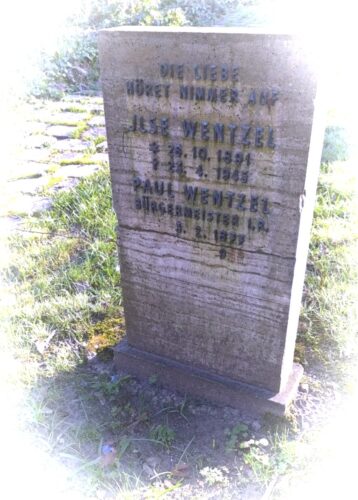
Reinhard Heydrich, the architect of the Final Solution, is still in the ground at the Invalidenfriedhof in central Berlin. It’s a tourist attraction for those who want to show Nazism some love. The grave marker was removed but the body was not. The cemetery is now a protected monument, maintained by the state, promoted as an attraction. In 2019 someone with inside knowledge of the location opened the grave, to emphasize Heydrich was never really gone.
The Sinti and Roma memorial — a symbolic grave for 500,000 murdered people — is being threatened by a Deutsche Bahn tunnel project. The Holocaust memorial itself contains no names, no inscriptions, no Jewish symbols. Its anti-graffiti coating was manufactured by a Degussa subsidiary — the same corporate family that produced Zyklon B.
This is what we are told a love letter to Berlin looks like. The perpetrators rise again. The historical ground markers come off. The victims get an abstract memorial with no names. And every few years someone with a family connection to the war machine writes a book saying that most people simply conformed so who could blame them for not leaving.
That’s not history. That’s “like father, like son”, erasing genocide victims of the family business to continue dividends. Love as hate.