Years ago NPR did a nice breakdown of the American efforts to overthrow the Iranian government in 1953.
ABDELFATAH: OK, so Kermit Roosevelt entered Iran on July 19 with a pretty big mission ahead of him – stage a coup to get rid of Iran’s prime minister, Mohammad Mossadegh.
ARABLOUEI: And we’ll explain why in a bit.
ABDELFATAH: But the first question Roosevelt had to answer…
KINZER: I’ve asked myself this question.
ABDELFATAH: …Was, how?
KINZER: So you’re sent into a foreign country. And your assignment is overthrow the government. What do you do? Like, what do you do on the first day? Nine o’clock, you get to the office. How do you start?
ABDELFATAH: Even though the CIA had devised a plan for Roosevelt, no one was sure it would actually work. It was suddenly up to Roosevelt to destabilize a whole country.
(SOUNDBITE OF MUSIC)
ARABLOUEI: Step one.
KINZER: Seize control of the Iranian press.
ARABLOUEI: Basically, buy them off with bribes.
KINZER: It turned out that the press was quite corrupt.
ARABLOUEI: And soon enough, Roosevelt had columnists, editors and reporters from most of Iran’s newspapers on his payroll. Then anti-Mossadegh propaganda began printing everywhere.
KINZER: Mossadegh was a Jew, a homosexual, a British agent, anything that they thought would outrage people.
ARABLOUEI: There was such an appetite for these stories that Iranian journalists just couldn’t keep up, so Roosevelt had to recruit CIA agents back in Washington to write some of the articles for the Iranian press.
KINZER: In fact, one of them later wrote a memoir. And he talked about how bizarre it was. At the CIA, you had the people plotting the Iran coup, and then you had analysts on the other side who weren’t aware of the covert action. And he said, I would write an article about how Mossadegh was an atheist, and he hated God. And then a couple of days later, a guy from the other side of the hall in the analysis division would run over to my office holding up an Iranian newspaper and saying, wow. You won’t believe how the newspapers in Iran are denouncing Mossadegh. Look at this article. And I couldn’t tell him, I wrote that article.
That’s just the setup. The first coup attempt failed. And then came the second. Here’s the punch line.
ABDELFATAH: Roosevelt set the stage for his second coup attempt. And on August 19, it began.
ARABLOUEI: Hundreds and hundreds of rioters filled the streets of Tehran. And, in a word, it was chaos.
(SOUNDBITE OF ARCHIVED RECORDING)
UNIDENTIFIED REPORTER #7: Three hundred killed and hundreds wounded is a conservative estimate.
KINZER: And his plan was this. First of all, hire gangs of Iranians through people who controlled criminal protection rackets, and pay them to go out on the street and cause chaos.
ABDELFATAH: So Roosevelt actually paid criminals and gang members to storm into the city.
ARABLOUEI: Beat up people in the streets.
ABDELFATAH: Break shop windows.
KINZER: Shoot your guns into mosques.
ABDELFATAH: And while doing all that, yell…
KINZER: We love Mossadegh. We love communism.
ARABLOUEI: And then…
KINZER: He hired a second mob to attack the first mob.
ARABLOUEI: Which led to bloody, violent clashes between the two mobs.
ABDELFATAH: And the really trippy thing was that everybody involved…
KINZER: Everybody involved in the battles was being paid to be there. But what they didn’t know was they were being paid by the same source.
ARABLOUEI: The CIA – and all of this was designed to create confusion and to signal that Mossadegh was the source of the violence in the country, that he was losing control, which was becoming more and more true.
And so, the CIA overthrew a democratically elected government in Iran.
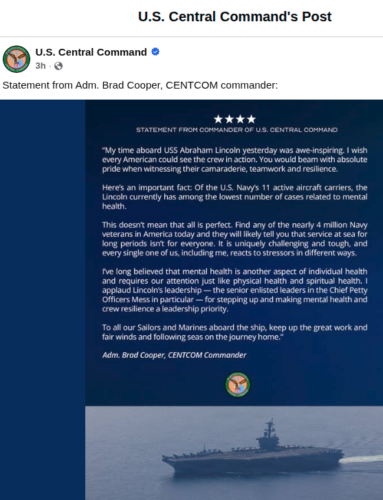
Let’s break down the off-sounding statements from CENTCOM, as they bear the hallmarks of disinformation.
While at sea, Cooper met with Sailors and Marines aboard USS Abraham Lincoln (CVN 72) for the second time this year. He previously visited the aircraft carrier in February with U.S. Special Envoy for Peace Missions Steve Witkoff and Jared Kushner. During Cooper’s latest trip, he addressed the entire Lincoln team and thanked them for their tremendous dedication and courage.
Ugh, “Special Envoy for Peace Missions” itself is a tell, during this endless Department of War war.
The acting Navy Secretary Hung “lynching noose” Cao declared in front of families at the August 6 San Diego meeting that he was sending relief: the Theodore Roosevelt strike group was preparing to relieve Lincoln.
And yet, within a week, the Wall Street Journal and Stars and Stripes reported instead the George Washington has been headed to the Middle East, a rotation officials called long-planned.
Trump himself could only say “another, very similar, ship.” On the same tarmac exchange, August 14, he was asked whether families of the crew were concerned: “No, they’re not.” Asked whether eight and a half months at sea was too long, “No, no, no. Not nearly long enough.”
Trump then boarded his Catering Container One. If a fourth official were asked it would likely be a different answer again about the Lincoln.
Who is actually leading anything?
Source: Facebook
The metric inversion isn’t subtle. A commander should not ever be citing low numbers of mental health cases as evidence of crew wellness. On a ship where a sailor went overboard on August 3 in what the Navy itself classified as a mental health episode, requiring transfer off the ship for care, and where Military Times reported multiple sailors had tried to go overboard, with the Navy declining to provide a precise number, a low caseload measures barriers to reporting, not health.
Worse: evacuating sailors in crisis off the ship lowers the on-board count as a matter of arithmetic, whatever the intent. The “health” statistic improves every time the situation gets bad enough to require a medevac.
The comparison is rigged. Lincoln is the only carrier stuck into a 260-plus-day deployment. Remember how everything was being sold as over in a day? The “extended” deployment for the Iran war that was originally expected to end in May, so what is it called now? The other ten carriers are largely in port or maintenance, where crews have shore access to care and every incentive to use it. There is no comparison for raw “number of cases,” instead of rates, across ships. And “among the lowest” is anti-plan speak, with no number, no source, no timeframe. Unverifiable language used by a force that lives and dies by competency in verification.
Leaders slipping and falling. We don’t see in the message anything about the overboard incident, any return date, any acknowledgment that planning failures in deployment is the stressor. “Journey home” means nothing without an ETA. The praise redirects pressure onto the lowest ranks, applauding the Chief Petty Officers Mess for “stepping up” to make fleet-level leadership failures a problem that senior enlisted must absorb through “resilience.”
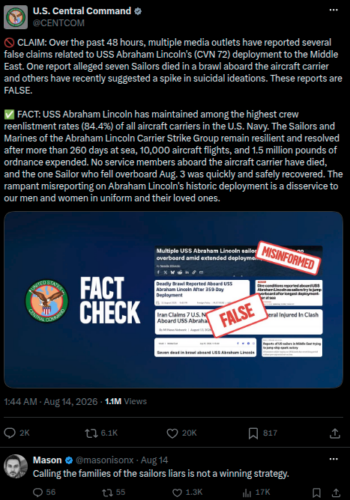
Above all, four-stars don’t ship mental health stats. A PR campaign is ratcheting up after roughly 200 family members confronted Cao in San Diego over conditions and the absence of a return date. CENTCOM’s August 14 denial was a misfire. The seven-deaths story was from Iran’s Tasnim News Agency, a single anonymous source, no corroboration, meaning an enemy information operation targeting the exhausted American crew. Instead of a straight denial, CENTCOM started friendly-fire with claims of “rampant misreporting” on the deployment and answered with an 84.4% reenlistment rate. That lumped reports of increased suicidal ideation (from Military Times and Stars and Stripes) under the same “baseless claims” label as enemy propaganda. The overboard incident CENTCOM never even denied. It confirmed the August 3 rescue inside the same statement, offering confirmation as rebuttal.
When the American military press is declared enemy propaganda, by a command that could not keep its own categories straight for one paragraph, I’m reminded of a particular point in WWII naval history.
If the Allies could openly admit defeats, it was believed [by Nazi listeners], they must be extremely confident, convinced of their eventual victory over Nazi Germany.
Failure to admit failures, is a sure sign of weakness. Who would have predicted for 2026 a president hiding from Iranian missiles in a food box, while calling American military families the liars.
Euro News hosts this disinformation comment getting history all wrong. Nazi Germany violently invaded Hungary and occupied it, murdering hundreds of thousands of Hungarians. Nazis violently taking over Budapest refused to surrender, causing Hungarian death and casualties to explode because of the occupation.
Imagine the kind of person who comments that the end of genocide wouldn’t be called by the “many” a liberation. Their comment fails on the most obvious facts: Operation Margarethe, the German invasion of Hungary on 19 March 1944.
Germany militarily occupied Hungary because the Kállay government had been negotiating armistice terms with the Western Allies, and Horthy had refused Hitler’s repeated demands to hand over Hungarian Jews. Do you see the problem with the comment yet? Who exactly would falsely claim that the Nazis were not a genocidal occupation?
Hitler summoned Horthy to Klessheim on 18 March 1944, and the Wehrmacht crossed the border while Horthy was still on the train home. That’s not allied.
Wehrmacht troops took the country, Veesenmayer arrived as Reich plenipotentiary, Eichmann’s Sondereinsatzkommando followed, and over 400,000 Hungarians were suddenly shipped to Auschwitz between May and the beginning of July 1944 (over 300,000 murdered immediately on arrival). Hungarians were told the Nazis would put them in a “safe” ghetto, which turned out to be insufferably cramped and cruel, and then told they were being taken by train to agricultural labor at Kenyérmező, a work site that never existed. Hungarian gendarmes under Eichmann’s direction forced them into rail cars locked for days without food, water or sanitation, causing many to die, and the trains deposited them in a death camp to be rapidly murdered. Postcards postmarked from the fictional resort “Waldsee” then arrived back in Hungary, dictated at Auschwitz to keep the deception running.
Remigration (forced deportation) of that scale was during, and because of, the Nazi occupation.
The alliance was worthless, completely exploited and then ignored by Germany. Hungary signed the Tripartite Pact in November 1940 and bled its Second Army out on the Don in January 1943. Then German troops crossed the border to mass murder Hungarians and hold the rest hostage. Germany itself declared that the alliance didn’t exist, by force, twice!
On 15 October 1944, when Horthy announced he had achieved Hungarian armistice with the Soviets, Germany (still not an ally) ran Operation Panzerfaust. That meant Skorzeny kidnapped Horthy’s son to force the Hungarian leader to abdicate under extreme duress. Szálasi and the Arrow Cross were put under direct German installation, completely the opposite of any alliance. The occupation turned into a siege (26 December 1944 to 13 February 1945) as Budapest was commanded by Karl Pfeffer-Wildenbruch, a German SS general, under Hitler’s Festung order forbidding capitulation or withdrawal. A foreign German officer commanding a Hungarian city he refuses to surrender, driving up casualties and death of the Hungarians, is an occupation in its plainest form.
“Liberation” meant the Red Army reached the sealed Pest ghetto on 17-18 January 1945, with roughly 70,000 people still alive inside, while the Arrow Cross squads under Nazi command were shooting Hungarians into the Danube nightly. Liberation was a literal end of the genocidal and suicidal Nazi occupation of Hungary.
So I posted this reply and was informed it went into moderation:
As a formally trained historian, I find this kind of disinformation comment very interesting. Germany occupied Hungary twice in 1944. First it invaded against Horthy’s diplomacy in March, and then against his armistice in October. What kind of German “ally” invades by force and murders roughly 437,000 Hungarians between May and [early July] of 1944? Operation Panzerfaust wasn’t just genocidal, it kidnapped Horthy’s son to force abdication of self-rule. Karl Pfeffer-Wildenbruch, a German SS general, under Hitler’s Festung order then commanded the Hungarian city by refusing to surrender! That is by definition an occupation of Hungary to cause mass suffering in its plainest form. Where do you think Dan got his backwards story from and why?
The duty to rescue a stranger at sea is relatively new, despite it feeling as old as water. For most of the history of seafaring it existed as custom and as commerce. A master who saved a vessel could claim a salvage award in an admiralty court, and the law concerned itself mainly with how that award should be divided. Notably, saving the people aboard earned nothing so in practice it was a cargo valuation process.
Every master is bound, so far as he can do so without serious danger to his vessel, her crew and her passengers, to render assistance to everybody, even though an enemy, found at sea in danger of being lost. The owner of a vessel incurs no liability by reason of contravention of the above provision.
Keep the second sentence in mind.
Eighteen months later the rule met the exact case it was written for, yet it was not yet in force. The convention did not take effect until 1 March 1913, while on the night of 14 April 1912 the SS Californian lay stopped in ice on the westbound track to Boston. Her sole wireless operator, Cyril Evans, had been told to keep off the air by the Titanic’s operator earlier that evening and turned in around half past eleven. The Titanic began transmitting shortly afterward. Nobody aboard the Californian heard it. Her officers even watched rockets rise over the horizon and formed no conclusion worth acting on.
I’ve been there, in the middle of a sea, watching bright lights rise far away in darkness. Calculating whether a turn towards them makes any sense. In the wide open water it’s essential to have radio confirmation to do the math of a course change.
How far apart the two ships lay has been argued ever since. The Board of Trade inquiry under Lord Mersey put it at eight to ten miles. The Marine Accident Investigation Branch reappraisal published in March 1992 put it at seventeen to twenty and concluded the ships lay beyond each other’s visible horizon. That same report found the rockets were seen and that proper action was not taken. The distance stays contested. The silence of the wireless never has been.
The conference that followed sat in London from 23 November 1913 to 20 January 1914, with the British delegation led by Mersey himself, fresh from the inquiry. It produced the first International Convention for the Safety of Life at Sea, and among its provisions was a requirement that ships keep a continuous wireless watch.
The 1914 convention never entered into force because it was overtaken by the war that summer, and it was rewritten in 1929, 1948, 1960 and 1974.
The listening watch survived every revision. That’s perhaps common sense since a duty to assist is worth nothing if the vessel best placed to assist has stopped listening. The Californian is the reason anyone knows this, if not simple experience on the water.
Which brings us to Zuckerberg’s super yacht casting its massive shadow over Farragut Bay.
On the night of Monday 3 August a 21-foot skiff ran out of fuel in the channel between Petersburg and Juneau. The Coast Guard heard the call just after 9:30 p.m., determined by 9:56 that the boat was not in distress, and issued a Marine Assistance Request Broadcast on VHF channel 16. The Marine Exchange of Alaska repeated it. The UnCruise passenger ship Wilderness Legacy answered, steamed past the halted 387-foot Launchpad, towed the skiff into shelter, refuelled it and found it an anchorage. The captain told his passengers why he was responding in the shadow of the Launchpad super yacht and they booed.
No law was broken by Zuckerberg’s massive failure. The Coast Guard’s non-distress finding removed the precise measure on which Article 11 and its successors hang, and a marine assistance broadcast is a request for volunteers rather than the order of duty.
However, Zuckerberg’s spokesperson dug a huge hole anyway. Their statement to the Alaska Beacon on Sunday opens by saying that the billionaire and his family were not on board at the time of the incident. It then explains that by the time the crew reviewed the Coast Guard contact on a different radio channel from the one they were operating on, the assist was already underway.
Ok, ok, let’s take this apart. First claim, first, because it is the one being offered as an answer and it answers exactly nothing. The owner’s location has never been an element of the duty. Article 11 binds the master. Regulation 33 of SOLAS Chapter V binds the master. Article 98 of the 1982 convention binds the state to bind the master. The owner appears in the law of assistance exactly once, in that second sentence, and again in Article 10 of the 1989 Salvage Convention, and on both occasions the appearance is an immunity. The drafters at Brussels wrote owners out of liability on purpose, because a duty that could be overridden from a shore office is not a duty. So a spokesperson announcing that the principal was elsewhere is claiming an exemption that has been sitting in the treaty for a hundred and sixteen years, unasked for, and volunteering it as though it were exculpatory.
It is NOT exculpatory.
It is beside the point twice over. Whether the man was hanging from the mast, in a stateroom, in a helicopter overhead, or in Palo Alto, the ship was his, the crew of roughly fifty were paid by him, and the standing orders they were following that night were written on his authority. Which channel the bridge monitors in confined waters after dark is not a decision made in the moment by a tired officer. It is a policy, set ashore, months in advance, by people who answer to the owner. So is the AIS discipline of a vessel that has been reported operating with its tracking limited. So is the flag. A yacht that is somewhere else on the dial at 9:56 p.m. in the inside waters of Southeast Alaska is executing a decision, and the decision was not made by sea fairies.
Six decades of conference diplomacy went into ensuring that no vessel would again be near and silent, and that has always meant continuous watch on a common frequency. Channel 16 is not any mystery or novelty. The whole arrangement is voluntary in the sense that nobody boards a private yacht at night to check, which is precisely why it runs on the assumption that a professional crew will keep the watch anyway. The three hundred million dollar vessel outside the bay was dead in its own water.
Their flag makes it worse. Article 98 does not command masters, it requires each state to require the masters of ships flying its flag to render assistance, so enforcement runs to the registry. The Launchpad flies the flag of the Marshall Islands, because money games, but that registry is a competent one and “white” listed by both the Paris and Tokyo port state control. The chain of accountability for what happened outside Farragut Bay runs to Majuro, and no port state control regime in the world inspects whether a private yacht is listening on 16 on a Monday night in Alaska. That trivial level of duty is real, the enforcement is nominal, so Zuckerberg’s crew had their ears off.
Dan Blanchard, who owns UnCruise, said he did not initially hear about the detour because this kind of assistance happens often enough that it does not always reach him. Two weeks earlier the National Geographic Quest had collected a family in Glacier Bay who swam ashore after a humpback sank their sailboat. Captain Sean Manske of the Wilderness Legacy contacted the skiff the following day to confirm it had reached Petersburg. Blanchard’s crews are on the same water under the same broadcast, and their owner did not find it necessary to explain where he had been standing every time a vessel calls for aid.
Cyril Evans went to bed, as one operator can’t always be on watch. The dozens of crew of the Launchpad were on another channel, by arrangement, on someone’s order to be unavailable.
The intervening century of treaty law produced a great deal of paper and one very, very solid insight, which is that listening makes the nearest vessel the nearest vessel. The nearest vessel telling us its owner was somewhere else that evening is the answer of a man who thinks a ship at sea comes without any societal obligations.
Mark Zuckerberg on the water
a blog about the poetry of information security, since 1995