There’s been a Wikipedia entry about Chug Chaluzi bothering me for a long time. It claims to document the only German resistance group that acted from Jewish-religious motives. Yeah, no kidding. But that’s not what you think it means.
Religious motivation was NOT a category of honor. In 1943 it was a category of stigma. The framing of a religious resistance group reads to me like someone wants to say there was only one loaf of white bread served at Passover, if you catch my drift.
German-Jewish self-understanding from emancipation through 1933 ran on Bildungsbürgertum, Reform, and liberal Judaism. Orthodoxy was a minority current, looked down upon as problematic for obvious reasons in a society moving away from passive acceptance of fate.
Observant practice was coded backward and associated with Ostjuden, the Eastern European Jews whose visible religiosity acculturated German Jews had spent two generations distancing themselves from. It was not subtle, it was visceral.
This history is important and it blows up the Wikipedia page.
You don’t just slap a religious label on Jewish resistance to Nazism and move on like it’s somehow a good thing. Like you can’t just slap kosher on a cheeseburger and say it’s the “only one”. Stop right there.
There needs to be documentation of what stands out as an inherent contradiction in Jewish resistance history. This post may help.
Rosenzweig’s 1913 return to Judaism was rather remarkable as a reversal. The Frankfurt Lehrhaus existed because German Jews had to be reintroduced to Jewish content they no longer carried. They shed it for what are obvious reasons to German Jews, probably invisible to German non-Jews. Christians walk around being Christian without having to do anything or justify anything. Celebrate Christmas, don’t celebrate it, doesn’t change a thing about being Christian. It wasn’t so easy for other religions, because to be Jewish invited scrutiny and judgment, challenges to explain and define traditions and behaviors. You aren’t going to synagogue? How dare you claim to be Jewish then? Expectations of religion among Jews was a form of externally applied control that erased diversity and freedom of self-realized identity. Shedding religion was an act of normalcy in German culture to arrive at the apathetic state of practice Christians enjoyed already.
Inside Zionism this hierarchy ran the exact same direction. Labor Zionism, cultural Zionism, Hashomer Hatzair, the kibbutz movement. Secular, often anti-clerical because religion was too antiquated, conservative and accommodating. Mizrachi was a minority stream within an already-minority movement, and the Hechaluz cadres skewed socialist. Jizchak Schwersenz teaching religious content through a Hechaluz-affiliated cell stands out precisely because it cut against the grain of German-Jewish liberalism and mainstream pioneer Zionism at once.
Antisemitism is inherently a dumbing down of such distinctions. Nazi racial law, based on German cultural habits of rapid assessment with minimal depth, flattened the internal hierarchy. Those who didn’t shed the signal or stigma were sucked into a huge pool of observant or assimilated, Mizrachi or Reform, Berliner or Ostjude. Deportation lists were designed to be highly efficient because very low quality, so they made no such distinction. The status structure that had stigmatized religious observance for sixty years, providing an assimilation path through agnosticism, was intentionally and cruelly collapsed inside a decade.
This is the precondition for reading Schwersenz’s pedagogy as resistance.
Without the racial state the same content reads as weirdly provincial traditionalism. He said what? They believed in what? The honorific framing requires the catastrophe that erased the framework that had produced a meaningful stigma. Religious motivation became a badge, inverse to its actual meaning by systemic erasure of the Jewish social structure that had marked it.
Postwar inversion is therefore best described as Wikipedia being exactly backward. The category “religiously motivated Jewish resistance” is like military intelligence. We all know it’s a contradiction while knowing it’s not meant to be one. The real historical contingency has been dropped out, and that shouldn’t be how Wikipedia operates.
The Wikipedia error traces to Barbara Schieb, historian at the Gedenkstätte Deutscher Widerstand, the official German resistance memorial. She puffed up that Chug Chaluzi was the only resistance group inside Germany that acted from Jewish-religious motives. H-Soz-Kult quoted her in the writeup of the 2000 exhibition Juden im Widerstand. Her flawed framing has institutional authorship at the state-funded memorial that re-contextualizes German resistance. The effect is notable, when it is presented as an official German position on who gets remembered and how.
A religious resistance at the time would seem completely upside down and backward in 1933. That framing however was destroyed by the regime the actual resistance was resisting. The opposite category now is being spread online because of what it opposed wasn’t stopped soon enough, and the modern accounting isn’t contextual.
Take a look at what happened when surviving members gathered in Berlin in 1993. It’s rather enlightening to the question of what really needs to go on a Wikipedia page. Nathan Schwalb-Dror, then 85, the funder who had moved Hechaluz money to the Berlin underground from 1944, came from Geneva. When Gad Beck spoke about the Existenzkampf the Israeli visitors in the audience, in Berlin under the Senate’s visiting program, pressed for clarification on the February 1945 arrest. Beck’s memoir attributed it to two Jewish Greifer working with two SS men, connected to the Stella Goldschlag network of Gestapo-run Jewish informers. The actual Zionists from Israel itself wanted operational details to walk the actual walk. They wanted names. They wanted to know how the inner circle had been penetrated and exactly who was involved.
Schwalb-Dror would not be moved. He stuck to his prepared report on Hechaluz’s wider rescue operations in Slovakia, Croatia, and Hungary, where the organization helped tens of thousands. Berlin had been a small group among many. Christine Zahn, the moderator, ended the event to keep the dispute from rolling into a public scandal, as it should have. Only tazreported the breakdown of the resistance narrative.
Nicht ins KZ, sondern in den Widerstand
The Wikipedia effect obliterates real history. It pumps the low-resolution honorific category against high-resolution accountability that actual Jewish resistance demanded to be counted among the honorable. The blurry Wikipedia treatment works only at distance. Up close, with the surviving participants in the room, the truth wanted to come out. Participants, and hopefully you now too, see the contradiction.
The memorial apparatus should do better, even if Wikipedia never will.
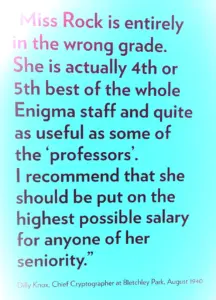
Her name was Margaret Rock, also known as one of Chief Cryptographer Dilly Knox’s “girls” in Cottage 3 at Bletchley Park, working alongside Mavis Lever.
In August 1940 Knox complained the sexist Civil Service grading system had misclassified Rock as a linguist or clerk rather than a cryptanalyst, which capped her pay regardless of what she actually did. It wasn’t just an advocacy for fair pay, it was also Knox saying the scare quoted “professors” are just fancy titles and grades for men who were not doing any better work than the women. By 1945 75% of the staff of Bletchley Park were women, pioneering codebreaking and computer hardware engineering, with six out of ten in uniform.
The top UK salary allowed Margaret, because of her gender, was £195pa. For context, a male senior cryptanalyst at Bletchley on the higher Civil Service grades would have been earning many times more than her in 1940. Rock was doing fourth or fifth best work on the Enigma staff yet capped far below what the men received. Foreshadowing.
In World War II, Britain invented the electronic computer. By the 1970s, its computing industry had collapsed—thanks to a labor shortage produced by sexism.
Indeed, it was Rock who broke the Abwehr Enigma (variant G) with Lever and Knox on December 8, 1941. Rock and Lever had already cracked the GGG indicator system in October, the precursor stage. Despite the significance of this feeding into the “Double Cross” system and the D-Day deception, and despite being awarded the MBE in 1945, Rock was never graded fairly in her lifetime. She left GCHQ in 1963. The UK Civil Service want you to know this about her:
She remained single throughout her life and lived in her later years with her longtime friend from North Middlesex School, Norah Sheward.
Instead of cracking encryption, I say it should be called rocking it.
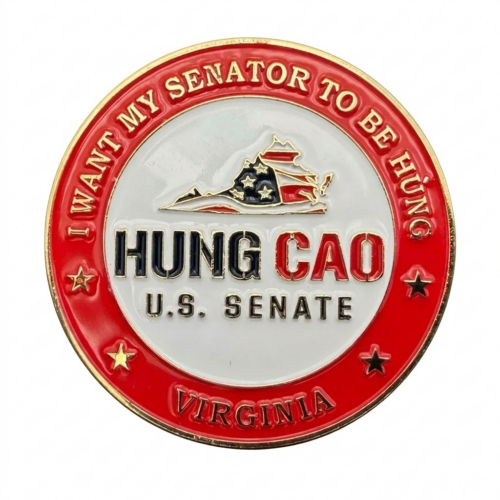
Have you seen the toxic campaign by the guy in Virginia who Hegseth just appointed to lead the Navy? It’s a lynching coin.
Source: Virginia Senate
In case that photo is a little too shiny, here’s the raw image; simply a noose, hanging an animal, invoking both Virginia and Navy violent racist history.
Let’s run a thought experiment. A retired Navy Captain named Lynching, running for office in Virginia, hands out a coin reading “I want my senator to be Lynching” with a hanged figure.
Who calls a lynching campaign clever? In Virginia. Does someone really say “but his name is Lynching” or “how funny”? Does someone say “but the figure being hanged is subhuman?”
Let me be clear about the history of the noose on the coin, since we’re talking about lynching here. Thomas Jefferson as Governor of Virginia ordered Charles Lynch to “suppress conspiracy” in 1780. Conspiracy for what? I’ll get to that.
Lynch then tied men to a tree, lashed them and “hung” them by the thumbs. Two years later he called it officially ” Lynch’s Law“, presumably as an import of the old English guilty-until-proven-innocent “Lydford Law”.
I oft have heard of Lydford law,
How in the morn they hang and draw,
And sit in judgment after.
A few years after the severe lashings and hangings by Lynch, the town of Lynchburg, Virginia was chartered by his brother. They have remained connected ever since and to this day.
What conspiracy brought the tree-based lashings and hangings? Well, it was really about enslaved Black people who had pursued the freedoms that Dunmore’s November 7, 1775 Proclamation promised them. The British Crown’s military command was at the time the only clear available emancipation pathway for American Blacks. Sir Henry Clinton’s Philipsburg Proclamation of June 30, 1779 expanded it further to include any American Black regardless of whether they took up arms. It’s estimated as many as 100,000 Blacks fled slavery-obsessed American rebels in order to seek freedom under the Crown. The colonies were in a fight to preserve slavery such that Jefferson’s order of 1780 meant American Blacks were to face the grave danger of being Lynched. Notably, the Lynch Law targeting American Blacks was years before the city of Lynchburg had been named.
Jefferson directly called out King George III in both the 1776 Virginia Constitution and the draft Declaration of Independence (later struck out) on charges of “prompting our negroes to rise” instead of remain down as slaves. Yes, the same guy who authored the “all men being created equal” also said he waged war with the British Crown because the King had said Virginian Blacks deserved freedom. Jefferson by 1780 therefore wasn’t just establishing Lynch’s Law generically against “loyalists” but setting up a method by which Black people would remain enslaved in America to him, instead of gaining freedom under rule of the British Crown.
Fast forward and many Virginia Blacks were indeed lynched. There were at least 100 documented between 1880 and 1930. Very few have been properly memorialized. The Equal Justice Initiative still maintains the count.
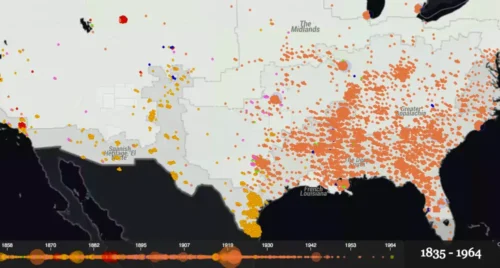
Almost every documented lynching between the 1830s and 1960s. Source: Smithsonian. Monroe Work Today/Auut Studio
Virginia is without a doubt the state where Cao’s noose imagery would land the hardest. A candidate who campaigns on lynching in Virginia is performing a very specific act. It also happened at a very specific time. Loudoun County, where Cao lives in Purcellville, is known for the Leesburg lynching of Page Wallace in 1880. Del. David Reid, who represents Loudoun, sponsored the 2025-2026 budget line funding new historical markers at Virginia lynching sites such as Wallace. This was the context for Cao to print and circulated a lynching coin in the same county, in the same political season, while his neighbors in the General Assembly were appropriating money to mark the trees.
What’s the matter with Cao? Here is a man whose family fled racial and political violence, and yet he used lynching for his official campaign currency to win the votes of people for whom that image is seen as heritage rather than horror.
He was five years old in 1975 when his family fled Saigon. His father was working with the South Vietnamese government, which is to say already inside the class whose survival depended on alignment with American power. Then they were in West Africa, reportedly on USAID work, which apparently is why Cao sometimes jokes that he is an African-American. Then Virginia. Then Thomas Jefferson High School, onto the Naval Academy, EOD, the Pentagon, Bannon… and MAGA. The lesson absorbed early was empires kill people who fail to make themselves useful. He kept making himself useful.
Within the Navy and its primary shipbuilding base, nooses have been a recurring instrument of racial intimidation in three distinct settings: aboard ship, on shipyard floors, and inside the warships under construction.
Again, the noose symbol is very particular to the person using it in the context they are using it.
Look at the 2017 case on USS Ramage came from a shipyard worker in Pascagoula. Or what about the 2021 case on USS Lake Champlain with a sailor who placed the noose on a Black crewmate’s rack, confessed, and was removed. Would it be any different if he left the “Hung” coin? The 2023 case on USS Laboon, a Norfolk-based Arleigh Burke destroyer at General Dynamics NASSCO Norfolk, involved three separate noose placements targeting one sailor in February alone. Two on the rack, one on the floor next to it. What if they were Hung coins? The Navy spokesman confirmed on the record that the targeted sailor was the only one affected and that he declined transfer off the ship. February 2021 also produced the parallel hate-speech graffiti incident on USS Carl Vinson, contemporaneous with the Lake Champlain case, prompting Admiral Aquilino to fly from Hawaii to San Diego for a fleet stand-down.
But the thing I want to raise most is that Cao was born just before a series of Marine Detachments selecting Black sailors for nightstick beatings. Most famously, the USS Kitty Hawk, October 12, 1972, then the USS Hassayampa, October 16, 1972, and the USS Constellation, November 3-4, 1972. All the white sailors, who we can say today with absolute certainty were the aggressors, were ignored. Twenty-five Black sailors on the Kitty Hawk alone, however, were charged with rioting in their own defense, as Marv Truhe has since documented.
Here’s the proper context that a boy born in 1970s Vietnam, who later joined the Navy, really brings to mind with his lynching symbolism:
The final witness was an airman, Michael Laurie, who said he saw Mallory participate in the attack. Laurie said he recognized Mallory because they’d spent time together a few months earlier in a bar in Hong Kong.
Truhe presented evidence showing Mallory hadn’t been in Hong Kong then, a gotcha moment that seemingly undercut Laurie’s credibility. It didn’t matter. The judge convicted Mallory and gave him a bad conduct discharge.
Stunned, the defense team pondered its next move. The NAACP was providing lawyers and advice, and it agreed to fund a tactic seemingly drawn from a crime novel or Hollywood thriller. They hired a private detective to see if he could befriend Laurie and get him to admit he’d lied in court.
It worked. Laurie bragged, in conversations that were secretly recorded, about hating Black people and committing perjury. He said he’d been part of the riot — “We all went out there and stomped some ass” — and said investigators afterward hadn’t “even asked us if we fought back or anything.”
Mallory’s conviction was reversed and the charges dismissed. Widespread publicity about the tapes put the Navy on the defensive about whether it had selectively prosecuted Black sailors.
Suddenly, the defendants who had been kept in the brig for more than three months were released. Charges against one sailor, then another, got dropped after witnesses backed away from identifying them as assailants.
The lynching coin is not a joke.
It is a white supremacist credential. Cao is using it as an entry token to the Hegseth show. Hegseth, whose own iconography reads as Crusader extremism to every medieval historian asked, has spent fifteen months targeting Black and female officers for removal from the senior ranks of the Navy and the Army.
A man now handing out lynching coins from the top is no more a surprise than if he started wearing white sheets to work.
The Navy that prosecuted twenty-five Black sailors on the Kitty Hawk, repeatedly calling them uneducated and lesser intelligence, now reports up to the man who grew up learning the exact wrong lessons. He has minted a noose in enamel and joked to Steve Bannon that a Vietnamese man wearing a KKK hood for lynchings would need to have it made with eye-slits instead of round holes.
The Department of the Navy did not acquire this lynching-rhetoric man in spite of it, whether a KKK hood or his KKK coin. It acquired him because of it.
Two and a half centuries after Jefferson sent Lynch to violently deny American Blacks their freedom, the same Commonwealth has sent the same message.
An 1865 newspaper article reported that Robert E. Lee’s wife had forty mixed-race half-siblings living in the Washington, D.C. area. Forty. Her father had acknowledged at least one of them, Maria Carter Syphax, to her face. Her husband managed the household, the plantations, and the estate for decades.
The official record says Lee fathered seven children. The country of Trump-Epstein historiography permits no more.
This is what record laundering looks like.
And here’s a thought I want you to hold in mind as you read this post: Lynching got measured because perpetrators wanted it measured. Postcards, newspaper accounts, public spectacle, named participants. The phenomenon was performed for the record. The Tuskegee dataset and EJI’s later compilations of lynchings could exist because the underlying acts were always run as celebrations. Rape of Black women was the inverse architecture. A private prerogative, denied even by those who exercised it, rarely prosecuted, never aggregated except in large receipts from selling Black children into human trafficking markets.
Enslaved Black women who were being systemically erased, denied records, had no legal recourse against rape by white men.
The formal opening of the courts after emancipation produced negligible prosecution for the next century. Crystal Feimster locates the only meaningful procedural opening at the Civil War military justice system, where Lincoln’s Lieber Code defined wartime rape as a crime and produced the first record of Black women bringing charges. Civilian state courts remained closed in practice.
The lynching of Black men on rape charges was a deflection device that protected white-male rape of Black women. Rape was the prerogative. Lynching was the policing tool that defended the prerogative by displacing the accusation.
Household of Rape
George Washington Parke Custis built Arlington House as a shrine to the man who raised him. He filled it with enslaved labor inherited from Mount Vernon. He enslaved his own children. He fathered children with the women he enslaved.
The Mount Vernon Ladies’ Association states the matter plainly. Custis was commonly believed to have fathered children by enslaved women in his possession. Those children were often freed or singled out for special treatment. He acknowledged Maria Carter Syphax to her face. He is also believed to have fathered a girl named Lucy with the enslaved woman Caroline Branham. The 1865 newspaper claim of forty Washington-area half-siblings to Mary Custis Lee is not Black family folklore. It is contemporary white print.
This was the household Robert E. Lee married into in 1831.
He took it over as Custis’s executor in 1857. He ran it through 1862. He inherited the moral economy along with the property. In Lee’s world, fathering children with the enslaved women of one’s own household was already understood as a feature of upper-class Virginia plantation life. The maid who served Mary Custis Lee was Mary Custis Lee’s half-sister. Both women lived in that arrangement. So did Lee.
The Monster
Lee owned people with intent. He chased them when they ran. He returned them to bondage. In 1859 he ordered Wesley Norris whipped fifty lashes after Norris escaped and was recaptured. He called for brine to be poured on the wounds. Norris’s testimony was published in 1866.
Most notably the Lost Cause apparatus forcibly suppressed evidence such as this for over a century until Elizabeth Brown Pryor’s Reading the Man (2007) and Michael Fellman’s earlier work cracked the Lee edifice and re-established it.
In his 1865 letter to Andrew Hunter, Lee defended slavery as the optimal arrangement between the races so long as it operated under what he considered humane law and Christian influence. He cast Black subjugation as his divinely ordered tutelage. He believed enslaved people were better off in his bondage than free. He understood slavery as his right to inflict discipline, religiously sanctioned, strictly enforced.
A man capable of ordering brine in fresh whip wounds was more than capable of raping the women he “divinely” controlled. The question is whether the social structure he inhabited, the household he managed, and the women who were his constant hostages produced what such structures produce everywhere they exist.
The structure was not exceptional. After Congress banned the international slave trade in 1808, the reproductive labor of enslaved women became the plantation economy’s growth engine. Rape produced children. Children produced sale. Sale produced profit. The bodies of enslaved women were the commodity factory. The output, the historiography insists, was exceptional.
Say Rape
The vocabulary matters. Liaisons. Relationships. Concubinage. Mistresses. These are euphemisms drafted later by white historians of the white South to describe coercion they would not name. Enslaved women had no legal personhood and no capacity to consent. The act under conditions of total ownership is sexual violence. The record-keeping vocabulary that softens it is part of the laundering.
Hilberg’s stages of destruction begin with definition. Definition determines what counts. Every word that reduces a forced act to a chosen one is a small architectural choice in the larger structure of denial.
Laundering of Rapist Lee
Three mechanisms.
Archival capture. The Lee papers concentrate at Washington and Lee University, the Virginia Museum of History and Culture, and Stratford Hall. These institutions were curated for a century by only Lee descendants and Lost Cause partisans. Douglas Southall Freeman’s 1934 Pulitzer biography set the canon with family cooperation. Honest material was weeded before it ever entered processing, to curate a fiction. When Pryor finally accessed previously unpublished family papers in the 2000s, what she surfaced reframed Lee on slavery, on family conflict, and on his treatment of the enslaved. She did not find paternity evidence. The honest reading is that paternity evidence, had it ever been written down, was the first thing weeded.
Evidentiary asymmetry. White genealogies pass on parchment. Black claims of white paternity require DNA, court records, and corroborating witnesses to count. Family Bibles recorded white births. Plantation books logged enslaved births in separate columns, usually without paternity. And of course we know America’s historical profession was overwhelmingly white and male until the 1970s, with Ulrich Phillips’s apologetic frame dominant until Kenneth Stampp, and treated enslaved testimony as inherently unreliable. After emancipation the one-drop rule incentivized passing, which severed what paper trails remained.
Reputational gatekeeping. The Society of the Lees of Virginia, the United Daughters of the Confederacy, and the Washington and Lee stewards constructed and policed the saintly Lee for over a century. They existed to deny America the proper burial of Lee, instead keeping open the severe wounds he caused and never properly accounted for. The Confederate monument program, Stone Mountain, the Robert E. Lee Memorial designation at Arlington House: these are not artifacts. They are an active maintenance operation of propaganda that refuses to admit General Grant won unconditional victory. The function is to make certain claims unsayable, erasing Black voices.
This is not negligence. This is losers of the Civil War using their competence to remain complicit in white supremacist platforms. The curators understood what they were doing. They knew which questions would not be permitted. They knew which answers would not be archived.
Jefferson as Framing
The Thomas Jefferson Foundation finally accepted Sally Hemings paternity in 2000. It took two hundred years, a 1998 Y-chromosome study, and oral history maintained by Hemings descendants across seven generations. That’s the kind of white supremacist resistance erected to deny obvious history. The Hemings case had advantages that Lee paternity claims do not. Jefferson’s male line was small. His exact location at conception windows was documented. The accusations were contemporaneous, published by James Callender in 1802.
Lee paternity is harder to resolve because Lee paternity was made more diffuse. He had four sons who reproduced. His brother Smith Lee, his cousins, and many male Lee kin shared the Y-chromosome. A positive Y match shows Lee paternal-line descent without isolating Robert E. Lee specifically. Resolution requires triangulation across multiple claimant families, autosomal admixture analysis, and documentary corroboration that the archive has been curated to prevent.
The harder the case, the longer the Lee laundering project continues.
Known Knowns
Oral histories survive. Family genealogies maintained by Black descendants survive. Names recur. The Lees of Virginia organization receives inquiries from Lee descendants of color who have been told for generations who their ancestors were. The Arlington House “Family Circle” reunion in 2023 brought white Lee descendants and the descendants of those the Lees enslaved together for the first time. NPR and the Park Service framed the gathering as if there was reconciliation. It was more likely the establishment of evidence. These families know what the archive does not record, and the hundred years’ late framing of reconciliation says why.
The Syphax precedent matters. William Syphax used his Interior Department position to push S. 321 through Congress in 1866 and recover his mother’s seventeen acres. Black descendants did the work. White male historians did not, and still play ignorant to this day. The federal government acknowledged Maria Carter Syphax’s claim because the Syphax family forced acknowledgement. There is no parallel mechanism for Lee paternity claims. There is no committee chairman in the descendants’ line. There is no statute available.
Every Lee Statue is a Rape Signal
The probability that Robert E. Lee, embedded in a household where his father-in-law had openly fathered children with enslaved women, where the daughter of his own father-in-law lived as a maid to his wife while sharing her father, where forty mixed-race half-siblings were a matter of contemporary Washington print, where he held absolute power over the bodies of women who could not refuse him for over thirty years, fathered no children with those women is the probability the record demands.
That probability is not a historical inference. It is a construct designed to permit the statue.
The man who was capable of Wesley Norris was capable of more than Wesley Norris. The household that produced forty acknowledged half-siblings to Mary Custis Lee did not stop producing them when Lee took over as executor. The archive that omits the question is silent because the answer was never permitted to enter the record.
Record laundering is the operating mechanism by which dangerous men become marble. The marble is the evidence that the laundering worked. The historiography is the laundering. The statue is the receipt. And as historians have proven, when Lee took over Washington College, systemic rape of Black girls in the area by his students was the result.
John M. McClure’s “The Freedmen’s Bureau School of Lexington versus ‘General Lee’s Boys'” documents Washington College students attempting to abduct and rape Black schoolgirls from the Freedmen’s Bureau school, often joined by VMI cadets. Pryor noted that students at Washington College formed their own chapter of the KKK and were known by the local Freedmen’s Bureau to attempt to abduct and rape Black schoolgirls from the nearby Black schools, with at least two attempted lynchings by Washington students during Lee’s tenure, and Lee punished racial harassment more laxly than trivial offenses or turned a blind eye.
Think about what Lee really stood for in his years after being the “general” with one of the worst records in the Civil War, highest mortality rate of his men. This is a point that never gets enough emphasis. Not only was Lee never rated as true general material, given a long tenure as a middling Colonel before suddenly becoming a pro-slavery military leader, his performance was atrocious.
The brutality of Lee the loser is well documented, despite the legions of white men in cosplay denial, even naming their offspring after one of the worst failures in history. Can you imagine being in Germany today and meeting someone named Adolf Hitler? America is awash with men who don’t mind at all being named Robert Lee.
McWhiney and Jamieson’s Attack and Die documents Lee’s 20.2 percent killed-and-wounded rate as the highest among major Confederate generals, exceeding Bragg’s 19.5 percent and Hood’s 10.2 percent. Glatthaar’s General Lee’s Army shows the same army-level pattern: aggressive tactics that bled the Army of Northern Virginia faster than the Confederacy could replace it. Lee’s army incurred 55,280 more casualties than Grant’s, despite supposedly being on the strategic defensive in a manpower-short Confederacy.
Lee spent years covering up his personal record of raping Black women by controlling the records at an institution that became known for deploying young white men to rape Black girls. It’s no coincidence.
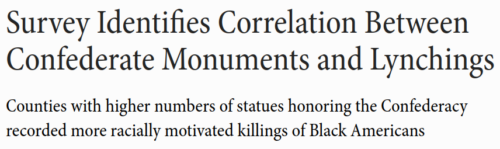
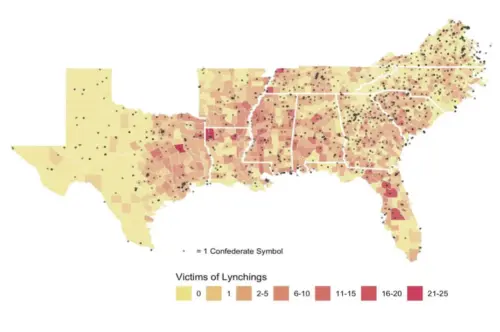
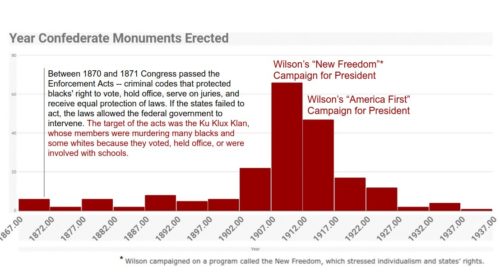
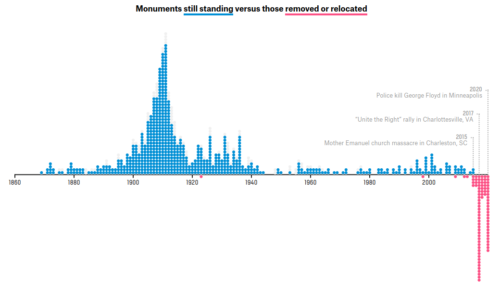
It was foreshadowing for every Lee statue erected after his lonely death to continue Civil War by other means, a documented marker for statistically significant increases in local lynchings. Rape data does not exist in comparable form. The same regime produced both.
Only one was permitted to be counted.
Darker colors denoting higher numbers of lynching victims and each dot representing the location of a Confederate memorialization. Source: Samuel Powers, Proceedings of the National Academy of SciencesAlmost every documented lynching between the 1830s and 1960s. Source: Smithsonian. Monroe Work Today/Auut StudioAmerica First by 1915 was defined by domestic terror gangs erecting statues of Robert E. Lee, signaling violent capture of an areaFiveThirtyEight interactive map of Confederate monuments
a blog about the poetry of information security, since 1995
 Her name was Margaret Rock, also known as one of Chief Cryptographer Dilly Knox’s “girls” in Cottage 3 at Bletchley Park, working alongside Mavis Lever.
  The top UK salary allowed Margaret,