Category Archives: History

How to Speed Up Military Drone Innovation in America

German news captures 2022 sentiment that Russia is growing weaker by the drone

In a rather superficial analysis featured on War on the Rocks, the discourse on artificial intelligence (AI) reveals a surprising lack of depth. In essence, the crux of the argument suggests that by lowering expectations, particularly in terms of reliability, the concept of “innovation” is reduced to nothing more than pushing a colossal and conveniently uncomplicated “plug and pray” button.

The authors’ apparent reductionist perspective not only fails to grasp the intricacies of AI’s potential in the realm of warfare but also overlooks the nuanced challenges that seasoned military analysts, with decades of combat experience, understand are integral to the successful integration of advanced technologies on the battlefield.

America’s steadfast commitment to safety and security assumes that the United States has the three to five years to build said infrastructure and test and redesign AI-enabled systems. Should the need for these systems arise sooner, which seems increasingly likely, the strategy will need to be adjusted.

When considering America’s commitment to safety and security, a closer examination reveals a steadfast commitment inherently implies less reliance on assumptions. The authors, however, leave a significant void in their arguments by not adequately clarifying their position on this. The closest semblance of an alternative is their proposition of a vague aspirational path labeled as AI “assurance,” positioned between extremes of measured caution and imprudent haste.

…urgently channel leadership, resources, infrastructure, and personnel toward assuring these technologies.

A realist imperative however underscores the dynamic nature of the geopolitical landscape, necessitating a proactive stance rather than a reactive one. Three to five years ahead, is a tangible goal instead of shrinking release cycles to the imprudent “burn toast, scrape faster” mentality. The strategic imperative lies not merely in constructing a sophisticated AI apparatus but also in ensuring resilience and adaptability to the predictable exigencies of future conflict scenarios.

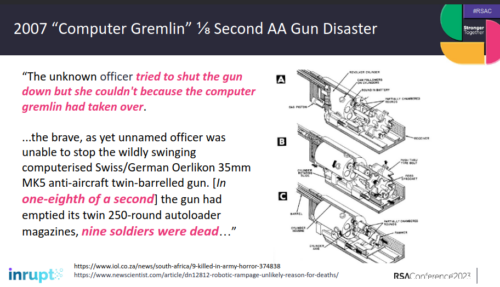
Here are a few instances of downrange events that unequivocally warrant the disqualification of AI innovations, a consideration surprisingly absent in the referenced article:

Source: My presentation on hunting robots, 2023 RSA SF Conference

This War on the Rocks article by a “native Russian speaker”, however, shamelessly bestows excessive praise on Russia for acceleration towards an ill-concieved “automated kill chain” characterized by total disregard for baseline assurances. In doing so, the authors fail to acknowledge the very pivotal point in drone engineering from the battlefield — oppressive Russian corruption and hollow patronage was left behind as Ukraine strongly asserted measured morality and quality control, which has been the true catalyst for Ukraine’s rapid and successful drone innovations (leaving the Russians always only in a clueless catch up mode).

Russia’s reckless pursuit and indiscriminate deployment of AI, as highlighted in the War on the Rocks article, contribute to the mounting evidence of Russian tanks and troops being grossly outmatched by adversaries who prioritize fundamental training and employ sophisticated countermeasures.

An overwhelming desire for switching into the “at any cost” haste of catch up mode lacking any morality is of little benefit when it brings about overwhelming technical debt and self-destructive consequences.

Remarkably, the authors neglected to provide an explanation for their omission of Ukrainian strides in “small, relatively inexpensive consumer and custom-built drones” as an integral aspect of American military strategy of effective targeting. Equally puzzling is their apparent belief that innovation ceases when others replicate it.

Taking a broader perspective, the American military ethos, characterized by augmentation for skilled professionals in tanks, has demonstrably outshone Russia’s reliance on over-automation guided by disposable conscripts stupidly killing themselves even faster than their enemy can. Despite Russia’s boastful rhetoric, their inability to distinguish between effective and ineffective strategies echoes historical patterns familiar to statisticians of World War II examining the Nazi lack of technological prowess.

AI, far from being an exception to historical trends, appears to be a recurrence of unfavorable chapters. Reflect on a crossbow, longbow, repeating rifle, or even Churchill’s “water” tanks (e.g. how America ended up mass-producing Britain’s innovations)… and the trajectory becomes evident. Throughout history, advancements in genuine measures of safety and security (weapon assurance as a practical measure of safety and security) have defined battlefields for centuries.

Abraham Lincoln famously urged the prudent use of time to sharpen an axe before felling a tree, a maxim applicable to any technology. The historical narrative strongly indicates that AI, as a technological frontier, will only serve to underscore the enduring wisdom encapsulated in the words of the President who delivered an unconditional victory in America’s Civil War.
You Can Get Answers Only to Questions You Think to Ask

This phrase seems like the buried lede in an economic analysis of market discontent.

No single poll is definitive, and you can get answers only to questions you think to ask.

It’s a philosophical point, which for me invokes the wonderful empiricist insights of the late 1700s.

The path towards knowing the right questions to ask can be derived from one of the most famous philosophers in history, Mary Wollstonecraft. A prominent figure in the early suffrage and abolition movements (rights for women and non-whites) she wrote “A Vindication of the Rights of Woman” in 1792, which argued for social and political equality (power) through the process of learning (education).

In the modern context of AI hacking, Wollstonecraft’s emphasis on societal responsibility of knowledge is very pertinent. She famously stated “I do not wish [women] to have power over men, but over themselves”, which should be required training for every hacker. Her philosophy remains powerfully useful, providing us with the idea that “learning” via questions is a known disruptive power dynamic in society that must be guided through ethical considerations.

My favorite way of thinking about it (as a long time physical security auditor, let alone encryption key breaker) is no single lock is definitive, but every prior lock is illustrative. Thus you get past locked doors by thinking about enough of the ways to get in.

Secret Escape Maps Hidden in WWII American Playing Cards

Recently I mentioned the Ace of Spades playing card that the CIA allegedly left on the body of assassinated U.N. Secretary General in 1961.

Here’s some more reference from WWII on the American military intelligence habit of playing with cards.

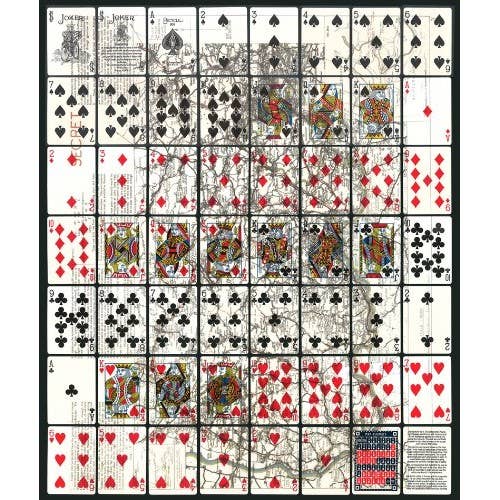
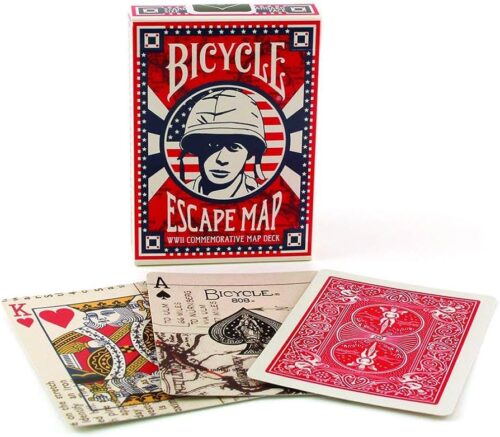
During World War II, Bicycle teamed up with British and American intelligence agencies to create a deck of cards that peeled apart when wet. The cards then revealed secret escape maps so downed pilots and captured soldiers could navigate their way back to Allied lines.

Commemorative escape map deck. Source: Bicycle Playing Card Co.

These cards worked so well that dozens of Americans were reported to have escaped using them.

Commemorative escape map deck. Source: Bicycle Playing Card Co.

Anti-Disinformation Book Review: The Haunting of Lin-Manuel Miranda

A provocative Gerald Horne review, published alongside the insightful poet Ishmael Reed’s 2020 anti-disinformation book, seems noteworthy to U.S. historians:

This powerful play, originally produced at the Nuyorican Poets Café, comprehensively dismantles the phenomenon of Lin-Manuel Miranda and Hamilton. Reed uses the musical’s crimes against history to insist on a radical, cleareyed way of looking at our past and our selves. Both durable and timely, this goes beyond mere corrective – it is a meticulously researched rebuttal, an absorbing drama, and brilliant rallying cry for justice.

This book version of a two act play of 2019 was set to hold Hamilton properly accountable for his obvious crimes against humanity.

…reframes Hamilton’s origin story by emphasizing the years he spent [managing operations] for a slave firm in St. Croix. …he never ceased enslaving people himself, a fact which seems to trip up many historians and fans of the musical alike.

Or as the report “Alexander Hamilton’s Hidden History as an Enslaver” puts it to visitors of the Schuyler Mansion State Historic Site:

…Hamilton’s exposure to slavery as a child caused him to internalize the lesson that enslavement was the symbol of success for a white man like himself and could lead to the higher station he sought.

Harper’s Magazine published an extract of the amazing wordplay.

miranda: The Schuylers held slaves for one hundred and fifty years. No wonder there were runaways.

chernow: Blame the publisher. I was confined to eight hundred pages. I couldn’t include everything. I was selective.

miranda: That means you left out information that would have blemished the reputations of your heroes.

chernow: You’re calling me a liar? How dare you. I won the Pulitzer Prize. My book is eight hundred pages long.

miranda: Your reputation is that of tarnish-removing. Scrubbing out the crud from mass murderers and enslavers.

Let’s review.

Robert Carter was notoriously freeing all his slaves in 1790s, the colony of Vermont had abolished slavery before becoming a state in 1770s, and even the colony of Georgia had banned slavery by 1732.

Got that timeline?

Somehow Hamilton’s life-long (1757-1804) habit of disgusting preference for the terrorism of Black Americans, directly engaging in state sanctioned rape of Black women for profit, was intentionally “scrubbed” by historian Chernow.

…Hamilton was in effect a slave trader—a fact overlooked by some historians. […] Hamilton’s grandson, Allan McLane Hamilton, said his grandfather did indeed own them and his own papers proved it. “It has been stated that Hamilton never owned a negro slave, but this is untrue,” he wrote. “We find that in his books there are entries showing that he purchased them for himself and for others.” However, that admission was generally ignored by many historians since it didn’t fit the established narrative.

You have to wonder what is so wrong with Chernow that he has even tried to defend himself by saying evidence found of a single act defines a man (when speaking of anti-slavery), while also saying that a long period of contradictory acts do not define that same man.

Here is Chernow’s retort to suggest that Hamilton opposed slavery:

[Hamilton] helped to defend free blacks when slave masters from out of state brandished bills of sale and tried to snatch them off the New York streets. Does this sound like a man invested in the perpetuation of slavery?

A brief moment, a perfunctory act. Hamilton performed in a manner that may have been self-serving by continuing slavery in a manner that wouldn’t provoke Blacks to overthrow his tyranny. Defending Americans walking around in the street from being suddenly taken hostage is a bar very far below real words and action of abolition. Hamilton also sometimes is credited for jumping into a Manumission Society, yet this group made attempts to silence and censor Black American voices, to prevent their freedom celebrations. Not impressive by standards of actual abolition known to have started at least 25 years before Hamilton was even born.

Perhaps we should say a brief political stand against kidnapping is only one small aspect of Hamilton’s identity? Or that we risk distortion by seeing things only through this lens?

Now consider Chernow’s argument for why extensive evidence of Hamilton’s support of slavery should be casually and intentionally downplayed:

“Whether Hamilton’s involvement with slavery was exemplary or atrocious, it was only one aspect of his identity, however important,” he writes. “There is, inevitably, some distortion of vising by viewing Hamilton’s large and varied life through this single lens.”

Let’s review.

Hamilton spent his entire life involved in slavery, engaging in both owning slaves and trading them for financial gain. Despite this, Chernow minimizes this aspect of his identity, highlighting a brief moment when Hamilton opposed one particular form of kidnapping Americans from the street. Chernow seems to suggest that a man deeply tied into slavery should not be defined solely with such long association and much evidence, yet also he can be defined by one exaggerated isolated period of his choosing.

Chernow presents lopsided apologist views on slavery, a single lens with gross distortion to obscure horrible crimes, which looks…

Awful. Inhumane. Ignorant.

Regardless of the diverse perspective Chernow encourages us to adopt regarding Hamilton’s life, characterizing his longstanding involvement in slavery as an “uncompromising abolitionist” is a highly deceptive choice of words. Disinformation alert.

Chernow’s attempt to downplay the horrors of slavery in Hamilton’s life by redirecting focus elsewhere is not acceptable. This is akin to suggesting that the Nuremberg trials should have portrayed Nazi death camp leader Rudolf Höss as an unwavering freedom fighter because he posted an “Arbeit macht frei” sign. By diminishing the significance of slavery and portraying it as just one facet of an otherwise immoral leader, Chernow risks aligning himself with the wrong side of history. Such calculated “Zone of Interest” thinking repeatedly has been demonstrated as dangerous.

The movie you see observes the mundane day-to-day lives of a well-off German family. Over and over, the father, Rudolf (played by Christian Friedel), goes to and from work; the mother, Hedwig (Anatomy of a Fall’s Sandra Hüller), tends to her garden; and their children, a rambunctious bunch, play with their toys. In the movie you hear, however, there’s intermittent gunfire, bursts of screams, and an ever-present industrial cacophony. Along with snatches of dialogue and glimpses of details—the costuming, the barbed wire, the smoke—the film makes clear what’s going on: Rudolf is Rudolf Höss, the real-life longest-serving commandant of Auschwitz, and this is a portrait of how he and his Nazi family actually lived, going about their days adjacent to the death camp he ran.

What would we think if a historian tried to tell us that a key figure in the establishment of Nazi Germany should not have his torture of slaves in a concentration camp over-emphasized due to fear of distorting whatever his varied interests were outside of this camp?

Repeated ingrained false, racist, and ahistorical narratives are being used to marginalize the voices of Black individuals who have endured significant and enduring atrocities. This is where many American societal accolades seem to stop, and it’s a problem. What makes the situation even more unfortunate is that efforts to bring truths for wider recognition and establish controls for data integrity to counter disinformation are often overlooked or disregarded.

Hamilton’s own grandson had it right when he warned everyone in 1910 about his family’s undeniable legacy of preserving slavery — he was a scientist and a poet, trying his best to get out the horrible hidden truths.

The imbalance in human systemic thinking is also a very bad omen for AI safety, which should be top of mind for everyone these days. There is acceleration potential for generative false history using unregulated low quality software, as I’ve written about here before when ChatGPT fails at basic slavery history. Chernow’s 800 page disinformation bomb could be exploded by anyone into 800,000 bomblets with the click of a button.

As we close out the year, Reed’s clarion and well-founded revelations about a willful distortion of American history ranks as a security professional must read for 2024.