Interesting development in Germany to restore phonetics that were erased by the Nazis
Before the Nazi dictatorship some Jewish names were used in the phonetic alphabet – such as “D for David”, “N for Nathan” and “Z for Zacharias”.
But the Nazis replaced these with Dora, North Pole and Zeppelin, and their use has since continued with most Germans unaware of their anti-Semitic origin.
Experts are working on new terms, to be put to the public and adopted in 2022.
One day in blue-moon September,

Silent under a plum tree,

I held her, my silent pale love

in my arms like a fair and lovely dream.

Above us in the summer skies,

Was a cloud that caught my eye.

It was so white and high up,

and when I looked up, it was no longer there.
And since that moment, many a September
Came sailing in, then floated down the stream.
No doubt the plum trees were cut down for timber
And if you ask what happened to my dream
I shall reply: I cannot now remember
Though what you have in mind I surely know.
And yet her face: I really don't recall it.
I just recall I kissed long ago.
Even the kiss would have been long forgotten
If that white cloud had not been in the sky.
I know the cloud, and shall know it forever,
It was pure white and, oh, so very high.
Perhaps the plum trees still are there and blooming.
Perhaps that woman has seven children too.
But that white cloud bloomed only for a moment:
When I looked up, it vanished in the blue.
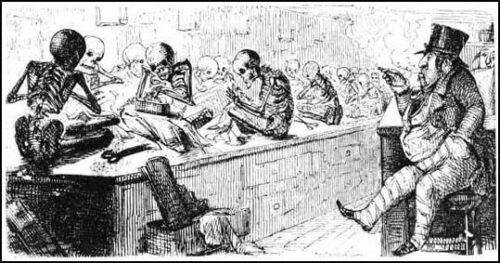
Is Uber just a rehash of earlier lessons in economics? Some might say so (hat tip to Rohan Light) if they’re familiar with criticisms of the “putting out” economy in 19th Century industrialization.
Punch Magazine published an illustration of “cheap clothing” by John Leech in 1845.
“Cheap Clothing” illustration by John Leech for Punch Magazine in 1845
Two years earlier in 1843 they had published the “Song of the Shirt” poem by Thomas Hood.
With fingers weary and worn,
With eyelids heavy and red,
A woman sat in unwomanly rags,
Plying her needle and thread—
Stitch! stitch! stitch!
In poverty, hunger, and dirt,
And still with a voice of dolorous pitch
She sang the "Song of the Shirt."
"Work! work! work!
While the cock is crowing aloof!
And work—work—work,
Till the stars shine through the roof!
It's O! to be a slave
Along with the barbarous Turk,
Where woman has never a soul to save,
If this is Christian work!
"Work—work—work,
Till the brain begins to swim;
Work—work—work,
Till the eyes are heavy and dim!
Seam, and gusset, and band,
Band, and gusset, and seam,
Till over the buttons I fall asleep,
And sew them on in a dream!
"O, men, with sisters dear!
O, men, with mothers and wives!
It is not linen you're wearing out,
But human creatures' lives!
Stitch—stitch—stitch,
In poverty, hunger and dirt,
Sewing at once, with a double thread,
A Shroud as well as a Shirt.
"But why do I talk of death?
That phantom of grisly bone,
I hardly fear his terrible shape,
It seems so like my own—
It seems so like my own,
Because of the fasts I keep;
Oh, God! that bread should be so dear.
And flesh and blood so cheap!
"Work—work—work!
My labour never flags;
And what are its wages? A bed of straw,
A crust of bread—and rags.
That shattered roof—this naked floor—
A table—a broken chair—
And a wall so blank, my shadow I thank
For sometimes falling there!
"Work—work—work!
From weary chime to chime,
Work—work—work,
As prisoners work for crime!
Band, and gusset, and seam,
Seam, and gusset, and band,
Till the heart is sick, and the brain benumbed,
As well as the weary hand.
"Work—work—work,
In the dull December light,
And work—work—work,
When the weather is warm and bright—
While underneath the eaves
The brooding swallows cling
As if to show me their sunny backs
And twit me with the spring.
"O! but to breathe the breath
Of the cowslip and primrose sweet—
With the sky above my head,
And the grass beneath my feet;
For only one short hour
To feel as I used to feel,
Before I knew the woes of want
And the walk that costs a meal!
"O! but for one short hour!
A respite however brief!
No blessed leisure for Love or hope,
But only time for grief!
A little weeping would ease my heart,
But in their briny bed
My tears must stop, for every drop
Hinders needle and thread!"
With fingers weary and worn,
With eyelids heavy and red,
A woman sat in unwomanly rags,
Plying her needle and thread—
Stitch! stitch! stitch!
In poverty, hunger, and dirt,
And still with a voice of dolorous pitch,—
Would that its tone could reach the Rich!—
She sang this "Song of the Shirt!"
The post title comes from a 1946 “Paper Bullets” booklet that was “DEDICATED to the men and women of the Overseas Branch, United States Office of War Information… to serve their country as propagandists in time of war….”
…like mustard gas, which clings to the ground for months after battle, psychological warfare and its poison of hate and distrust linger on for years.
Fast forward to 2016 and American soldiers still suffer from mustard gas experimentation done on them. They were told by their government to never speak about it and were denied healthcare claims.
We girls could not use perfume, we could not use hairspray, anything in the house” because of his ailment.
Daughter Beverly Howe, a nurse trained in chemical, biological and radiological treatment from Thomasville, Ga., said she interviewed her father for a school paper in the early 1970s, and he disclosed the gassing reluctantly to her for the first time. As a nurse, she recognized the symptoms from her training. “He said it was secret and they weren’t supposed to talk about it,” she said. “If they did, they’d be in big trouble.”
Then, while visiting a Veterans Administration hospital in Columbia, Mo., in the late 1980s or early 1990s, a VA X-ray technician who had seen Arlie Harrell’s records asked if he had ever been exposed to mustard gas.
“I was mostly horrified when I saw the look of terror in my dad’s eyes,” said Ayers, who was with her father at that appointment. “The man told him it was OK, you can talk about it now. He said, ‘Yes,’ and that was about it.”
Put these two themes together and you get a story about lingering effects of mustard gas mixed with racism (hate and distrust).
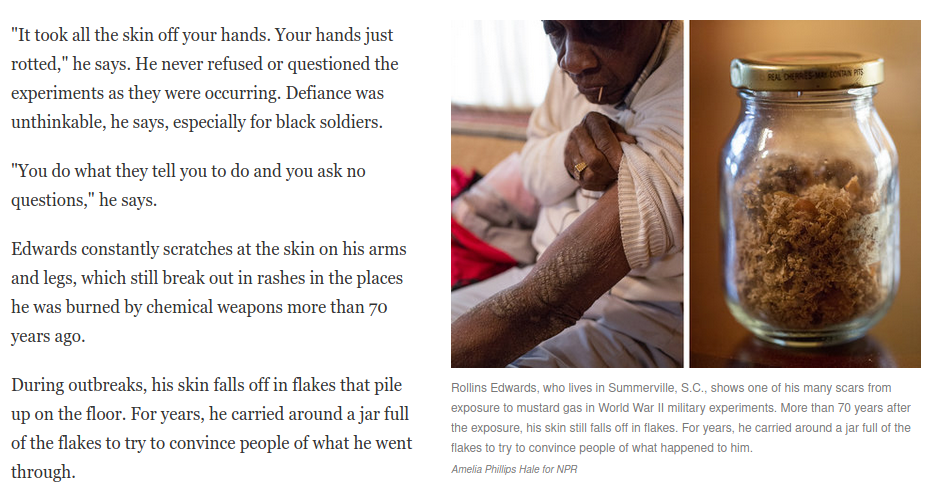
Edwards was one of 60,000 enlisted men enrolled in a once-secret government program — formally declassified in 1993 — to test mustard gas and other chemical agents on American troops. But there was a specific reason he was chosen: Edwards is African-American.
“They said we were being tested to see what effect these gases would have on black skins,” Edwards says.
An NPR investigation has found evidence that Edwards’ experience was not unique. While the Pentagon admitted decades ago that it used American troops as test subjects in experiments with mustard gas, until now, officials have never spoken about the tests that grouped subjects by race.
[…]
All of the World War II experiments with mustard gas were done in secret and weren’t recorded on the subjects’ official military records. Most do not have proof of what they went through. They received no follow-up health care or monitoring of any kind. And they were sworn to secrecy about the tests under threat of dishonorable discharge and military prison time, leaving some unable to receive adequate medical treatment for their injuries, because they couldn’t tell doctors what happened to them.
Source: NPR
a blog about the poetry of information security, since 1995