The post title comes from a 1946 “Paper Bullets” booklet that was “DEDICATED to the men and women of the Overseas Branch, United States Office of War Information… to serve their country as propagandists in time of war….”
…like mustard gas, which clings to the ground for months after battle, psychological warfare and its poison of hate and distrust linger on for years.
Fast forward to 2016 and American soldiers still suffer from mustard gas experimentation done on them. They were told by their government to never speak about it and were denied healthcare claims.
We girls could not use perfume, we could not use hairspray, anything in the house” because of his ailment.
Daughter Beverly Howe, a nurse trained in chemical, biological and radiological treatment from Thomasville, Ga., said she interviewed her father for a school paper in the early 1970s, and he disclosed the gassing reluctantly to her for the first time. As a nurse, she recognized the symptoms from her training. “He said it was secret and they weren’t supposed to talk about it,” she said. “If they did, they’d be in big trouble.”
Then, while visiting a Veterans Administration hospital in Columbia, Mo., in the late 1980s or early 1990s, a VA X-ray technician who had seen Arlie Harrell’s records asked if he had ever been exposed to mustard gas.
“I was mostly horrified when I saw the look of terror in my dad’s eyes,” said Ayers, who was with her father at that appointment. “The man told him it was OK, you can talk about it now. He said, ‘Yes,’ and that was about it.”
Put these two themes together and you get a story about lingering effects of mustard gas mixed with racism (hate and distrust).
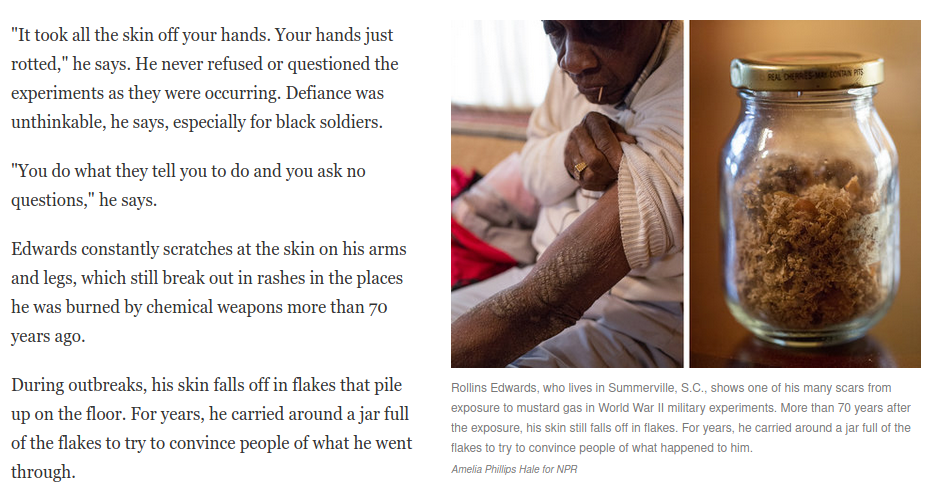
Edwards was one of 60,000 enlisted men enrolled in a once-secret government program — formally declassified in 1993 — to test mustard gas and other chemical agents on American troops. But there was a specific reason he was chosen: Edwards is African-American.
“They said we were being tested to see what effect these gases would have on black skins,” Edwards says.
An NPR investigation has found evidence that Edwards’ experience was not unique. While the Pentagon admitted decades ago that it used American troops as test subjects in experiments with mustard gas, until now, officials have never spoken about the tests that grouped subjects by race.
[…]
All of the World War II experiments with mustard gas were done in secret and weren’t recorded on the subjects’ official military records. Most do not have proof of what they went through. They received no follow-up health care or monitoring of any kind. And they were sworn to secrecy about the tests under threat of dishonorable discharge and military prison time, leaving some unable to receive adequate medical treatment for their injuries, because they couldn’t tell doctors what happened to them.
“Easter Islanders Likely Believed Megalithic Statues Helped Maintain Soil Fertility”, Source: SciNewsThe BBC has published a story of how Easter Island government officials invoked prohibition customs to control the pandemic in their country.
Thanks to both tapu and umanga, Easter Island has not only successfully warded off the coronavirus; it’s revived past practices in order to plot a more sustainable future.
Tapu is practiced in various forms across Polynesia, from New Zealand to Hawaii, and is believed to be the origin of the English word “taboo”, with British explorer James Cook first noting the concept on a visit to Tonga in 1777. While tapu is a divine mandate controlling a society’s access to certain people, places or things (with potentially dire consequences for those who transgressed in historical times), taboo is similarly used in English to describe practices that are either forbidden or restricted by social or religious customs.
The local description of the safety and security that can come from a taboo is very poetic.
What the pandemic did, [Mayor Pedro Edmunds Paoa] explained, was change the position of the mask from the eyes to the mouth.
“It shut our mouths, because we kept eating and consuming and searching for money and building and destroying the nature and our fragile culture, without seeing the jeopardy that we were putting ourselves in,” he said. “Now, our eyes are open, and we are more keen to promote sustainability in words, actions and plans than we ever were before.”
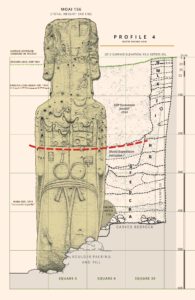
Unknown artist rendering of open eyes, closed mouth moai
A common thread in education has been to point to Easter Island as a lesson in ecological collapse. If true, perhaps it would be wise to look towards them for insights in environmental and health policy.
However, history is not quite so obvious, and so it turns out there is an even better reason to learn from Easter Island. The latest research shows it was invasion by foreign threats that was the main calamity to their thriving civilization.
…disease and slavery, introduced by Europeans, are more to blame than ecocide and self-destruction.
One of the turning points in analysis, from internal collapse to external threats, was a realization that fragments of “weapons” were more like evidence of sophisticated peaceful agrarian tools.
“It’s assumed that [pieces of glass] are the WMDs that led to the collapse of people,” the study’s lead author, Carl Lipo, an anthropologist and director of Binghamton University’s environmental studies program, told the BBC. “And what we found was there was no evidence, in fact, to support that these were used in a systematic, lethal fashion, and that they’re best explained as cultivation tools and things used in daily household activities.”
The assumptions made by Europeans were ignorant, a bit like someone from Easter Island landing in France observing that everyone owns a shovel and assuming it means civil war.
Two parts of the big shift in analysis are related to some pretty simple, even common sense, threads.
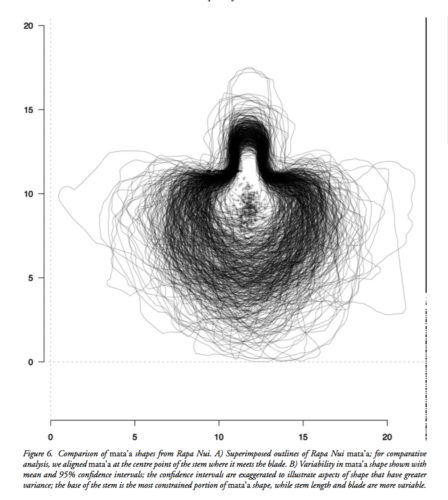
First, the rounded and short glass tools called “mata’a” were nothing like the offensive long-pointy weapons found in other places around the world. Who innovates around a big spoon when they could have enhanced their knife designs?
Here’s the data:
Ok I said spoon for a very specific reason. And now I have to take a second to discuss how disappointing it was to read that “researchers call them the ‘swiss army knives’ of stone tools”. I mean these same researchers are claiming tools were NOT primarily military issue while trying to describe them as ancient Swiss army knives?
SWISS ARMY KNIVES are standardized, military issue and pointy… it’s like the researchers couldn’t have possibly used a worse phrase to make their point (pun intended).
Second, these islands lacked defensive evidence expected from innovation around fortresses and garrisons built for civil wars.
No strong offensive evidence, no real defensive evidence… the island populations were decimated by something else.
So while past lessons erroneously have suggested Easter Island is about environmental disaster from over-production, instead it serves as an example of collapse from disease-infested invasion.
It all registers as important food for thought about data integrity as they practice taboo to save their population from pandemic; show the world a “good model” of disease prevention as one of the most important forms of sustainability.
… why did the population shrink after the Europeans arrived in the eighteenth century? Lipo has a single, stark answer: “Disease that is introduced by Europeans after contact.” Smallpox and plague ripped through Easter Island, halving the population in a short time. […] The fate of the Rapa Nui on Easter Island is often used [falsely] to illustrate how humans destroy their communities with environmental destruction and warfare. But it might actually provide a good model for sustainable civilizations of the future.
Oh, and why did all the trees disappear? Rats, known also for spreading the plague, are blamed for Easter Island deforestation.
Almost all of the palm seed shells discovered on the island were found to have been gnawed by rats. Thousands of rat bones have been found, and crucially, much of the damage to forestry appears to have been done before evidence of fires on the island. […] Unchecked, a single mating pair can produce a population of nearly 17 million in just over three years…capable, on their own, of deforesting large lowland coastal areas in about 200 years or less. “In the absence of effective predators, rats alone could eventually result in deforestation.”
Once again, it seems prevention of invasive and uncontrolled threats is the Easter Island lesson for COVI19 and human sustainability.
An advertisement writer recently posted to LinkedIn his reflections on how to hire the best talent by using “the copy test“. It boils down to this:
… if you can get your readers to empathise with you, in a tone they resonate with, you’ve won.
Judging by comments I sometimes get here (e.g. a white woman angry about my Dambusters post because she thinks the n-word is a very fine name for a dog)… clearly I still have more copy tests to do before I’ve won.
In related news, a book by Thomas Kent is coming out now with advice on how to advance democratic values to combat dangerous Russian propaganda.
Significant attention has been given to Russian disinformation operations and their corrosive effect on the United States and other democratic governments. The Western responses have thus far been weak and uncoordinated, according to Thomas Kent, former president of Radio Free Europe/Radio Liberty who is currently a Jamestown Senior Fellow and adjunct associate professor at Columbia University. He proposes an energetic new strategy to confront this threat: aggressive messaging to combat Russian information operations, while promoting the values of democracy that too many in the West have lost faith in.
I look forward to seeing how to get Russian readers to empathize with American democracy.
And on that note, a very old book called “Techniques of Persuasion” looked into Communist indoctrination camps run by the Chinese during the Korean War and highlighted how important information gathering (“confession”) was to any propaganda method.
Source: Techniques of Persuasion From Propaganda to Brainwashing by J.A.C.Brown, p. 257
Similar methods are described in the film “The Luft Gangster: Memoirs of a Second Class Hero“. When black pilot Lt. Col. Alexander Jefferson, USAF (Ret) was shot down in Germany he was surprised to find Nazi prison camps working hard to get empathy out of him.
The Nazis demonstrated they already had access to every detail of every American’s life down to home street, even showing him high school photos. The real elephant in the room, and palpable in the film, is whether Jefferson fell for Nazi propaganda that they respected his life more than America.
That kind of propaganda gets right into the question of using tribalism to undermine morale and distract enemies from any kind of unified objective. It’s a whole other level of winning, as documented by the Naval Postgraduate School (NPS).
…conflict does not necessarily imply a pure contest of arms. It may center on an economic crisis, a sponsored pattern of betrayal and defection, or broad civil unrest. Whatever form it takes, it remains for the instigator a divide-and-exploit or divide-and-distract strategy that turns the enemy against himself, away from others, and exposes opportunities not otherwise available to an external State actor.
Allegedly it was this kind of strategic thinking that compelled Britain, France and America to operate heavy propaganda and even false flag operations in Africa through the 1980s intended to undermine black nationalism. More specifically, the racist apartheid government of South Africa wanted all its neighboring states to constantly be in a state of permanent improvisation and thus frame itself — an oppressive white police state — as the only stable regional partner for business deals.
There shall be peace on earth,
but not until
All children daily eat their fill,
go warmly against the winter wind
And learn their lessons with a tranquil mind.
And thus released from hunger
fear and need,
Regardless of their color race or creed,
Look upward smiling to the skies.
Their faith in life reflected in their eyes.
a blog about the poetry of information security, since 1995