Spoiler Alert: Hungarians allegedly threw this enigma machine into a pig sty near the Czech/Polish border. Literally sloppy.
While this is called the G-110, the Crypto Museum has a special page dedicated to the G-111 version of the Enigma, which notably has support for five wheels and a 1929 design for connecting a printer (unique features found also in the 1939 Italian Alpha).
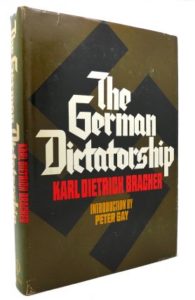
Important insights come from reading “The German Dictatorship” by Karl Dietrich Bracher, who was a German professor of politics and history at the University of Bonn:
The German dictatorship did not mean ‘law and order.’ The Third Reich lived in a state of permanent improvisation: the ‘movement’ once in power was robbed of its targets and instead extended its dynamic into the chaos of rival governmental authorities.
Nazi Germany was a state of permanent improvisation.
Today this method of unaccountable governance is seen in headlines such as “[White House occupant] and Woody Johnson act as if the rules don’t apply to them”.
Bracher goes on to say in his 1969 book that foundations of prosperity are to be found in democracy — regulation and governance that provoke meaningful innovations — because it offered a level of stability to developers (true order based on justice).
The Atlantic wrote in 1932 that Hitler was effectively a regressive tribal leader, in his addiction to acceleration coupled with rejection of any and all regulation.
Not seeing that civilization is a structure slowly built up by orderly procedure and respect for law, he is all for immediate action. He wants to apply his ideas at once by violation of law, if need be. The right of private judgment (that is, his right) is to be unlimited, beyond law. Thus, in thought, Hitler is still in the tribal stage.
Fail faster?
Perhaps the next time someone says they love the techbro “fail faster” culture of Tesla or Facebook, ask them if they also see it as a modern take on the state of permanent improvisation favored by Hitler.
Facebook’s staff now claim to be in opposition to their own failure culture “Hurting People at Scale“:
“We are failing,” [a seven-year Facebook engineer] said, criticizing Facebook’s leaders for catering to political concerns at the expense of real-world harm. “And what’s worse, we have enshrined that failure in our policies.”
The failures and real-world harm are intentional and orchestrated by Facebook officers who somehow manage to escape responsibility:
…growing sense among some Facebook employees that a small inner circle of senior executives — including Chief Executive Mark Zuckerberg, Chief Operating Officer Sheryl Sandberg, Nick Clegg, vice president of global affairs and communications, and Joel Kaplan, vice president of global public policy — are making decisions that run counter to the recommendations of subject matter experts and researchers below them, particularly around hate speech, violence and racial bias…
It begs the question again, can the Security Officer of Facebook be held liable for atrocity crimes and human rights failures he facilitated?
After reading Bracher’s wisdom on Nazi platform design, and seeing how it relates to the state of Facebook, now consider General Grant’s insights of 1865 at the end of the Civil War when Lee’s treasonous Army of Northern Virginia surrendered:
I felt like anything rather than rejoicing at the downfall of a foe who had fought so long and valiantly, and had suffered so much for a cause, though that cause was, I believe, one of the worst for which a people ever fought, and one for which there was the least excuse.
It should be no surprise then that it was Grant who created the Department of Justice.
The unregulated state of permanent improvisation — a fast-fail culture used to avoid accountability for real-world harms for profit at scale — needs to end.
Tesla is a killing machine.
Facebook is a digital plantation (slavery).
Their “fail faster” turns out to be just “fail” without accountability, which turns out to just be privilege to do known wrongs to people and get rich.
Grant wasn’t opposed to change or failure, of course given how he radically changed himself, he just put it all in terms of values/morals and being on the right side of history, which he forever will be (PDF, UCL PhD Thesis) and unlike Tesla and Facebook executives who should be sent to jail:
My failures have been errors in judgment, not of intent.
The 18th Chairman of the Joint Chiefs of Staff, General Martin Dempsey, frames Grant’s memoirs for us like this:
Our intentions matter. They reflect our motivations, our beliefs, our character. If we start with good intentions, and hold ourselves accountable to them, we start in the right place.
Intentions are hard or impossible to prove, yet I see the point. Harms are much easier to orient around, regardless of intent, as noted since 2016 with Tesla’s inhumane and unacceptable response to predictable ADAS deaths.
Facebook management perhaps can be proven to have first conceived as a platform for men to amass power and do wrongs (a failed attempt to invite crowds into physically shaming women who refused to go on a date with the founder).
…opened on October 28, 2003—and closed a few days later, after it was shut down by Harvard execs [due to complaints by women of color]. In the aftermath, Zuckerberg faced serious charges of breach of security, violating copyrights, and violating individual privacy. Though he faced expulsion from Harvard for his actions, all charges against him were eventually dropped [and Harvard execs instead invested in his private company].
Bad intentions? Some still might say bullies are just having fun. But again in terms of predictable and avoidable failure, it spells out no justice for victims.
Watch now for the people intending (or even not) to get away with harms, and then create labels to demonize anyone who might threaten them with accountability. Elon Musk should be expected any minute to blame the Jews for everything, just like his family always has done.
Fast forward to today, and officers of Tesla and Facebook (unlike Enron) haven’t truly been held accountable. They definitely did not start in the right place and they continue to wrong people around the world. Their state of immoral and permanent improvisation has been a human rights disaster and needs to be stopped and sanctioned.
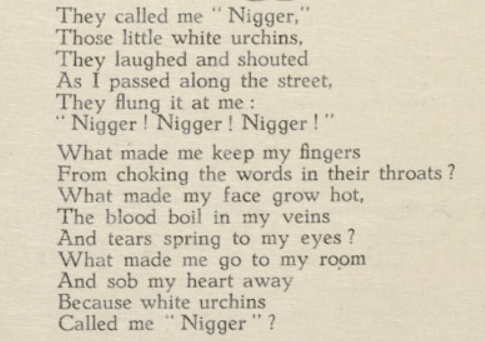
The following poem published in 1933 by Una Marson (celebrated war-time broadcaster in the British Ministry of Information, and a noted poet), can be found in the British Library:
Source: The Keys, Una. M. Marson, The League of Coloured Peoples, July 1933. Copyright: By permission of the British Library Board
She warns very conclusively, years before WWII, that without any doubt the N-word was considered racist and harmful.
So is friendly fire still fire? Yes, the Dambusters (RAF 617 Squadron in WWII) clearly embraced racism.
Privileged indulgence by whites abusing positions of authority seems to be what happened in the case of the Dambusters’ leader naming his dog a racist slur, basically after 200 years of a word being widely known as harmful to Blacks.
Even worse, the Dambusters indulged themselves with a racist slur as a codeword and group “mascot” despite its known direct harm to the “RAF ethos” then and into the future.
It’s been a continual problem for Dambusters’ story-tellers to dance around such obvious and unnecessary self-harm.
Back in 2011 the BBC reported that the Dambuster “mascot”, a black Labrador named the N-word, in a movie produced by Peter Jackson would be instead called “Digger“:
You can go to RAF Scampton and see the dog’s grave and there he is with his name, and it’s an important part of the film. The name of the dog was a code word to show that the dam had been successfully breached. In the film, you’re constantly hearing ‘N-word, N-word, N-word, hurray’ and Barnes Wallis is punching the air. But obviously that’s not going to happen now. So Digger seems OK, I reckon.
The BBC goes on to say that decision reflected a fact of a larger story to tell where a dog’s real name is a tiny, unessential detail.
“The film is not about the dog. My big concern would be if they watered down what the Dam Busters had achieved.”
Watered down? Pun not intended, I’m sure.
If the N-word is used in its full form, then historians must use context and talk about a it being a proven known wrong in 1943. Historians also must address why the N-word was allowed. Otherwise by using it without acknowledging the harm, it’s erasing the Black experience and perpetuating racism.
The Independent in 2018, seven years after the BBC went with “Digger”, reported how screenings of the original 1955 movie were to leave the N-word intact because they also would prominently warn potential viewers of offensive language.
…”send a clearer warning to parents that the film contains discriminatory language of a nature that will be offensive to many”. The name has previously been censored for TV broadcasts, while some American versions have used dubbing to edit the dog’s name to Trigger.
Someone was giving new meaning to Americans being Trigger happy. Pun not intended, I’m sure.
Digger, Trigger… Vigor, Rigor, Bigger. Why would any codewords for anything have to be accurate for retelling the main story? Unless there’s a story behind the codeword, they were literally meant to have no association so nothing is lost by replacing them.
Look at it this way, does anyone really care at all what the codewords in the left column are? Change them arbitrarily and nothing happens because they are codewords.
Codeword
Meaning
Cooler
Callsign for Operation Chastise
Pranger
Attack Mohne dam. German word for “pinch badly” and name for a medieval torture device
N-word
Mohne dam breached, divert to Eder
Dinhgy
Eder dam breached, divert to Sorpe
Tulip
Cooler 2 take over Mohne, Cooler 4 take over Eder
Gilbert
Attack last-resort targets
Mason
Return to Base
Goner
Upkeep release status (1-7) with results (8-10) on target (A-F). For example Goner 1-8-A is failed to explode, no breach of Mohne, whereas Goner 7-10-A is exploded on contact, large breach of Mohne
It shouldn’t matter what a dog’s name was in the Dambuster narrative (a narrative that really should only be about “convincing people on both sides that the Allies were winning“) unless you also want to talk about systemic racism in the RAF at that time… which tends to undermine “winning” narratives and get lots of attention from neo-Nazis.
Let me just pause for a minute to acknowledge the RAF did in fact have Black airmen, and wasn’t nearly as racist as the Army and Navy.
There are all kinds of upsides and positive Black stories that can be heard about the RAF. Sorry, Nazis, don’t even try to pretend the RAF shouldn’t have humiliated you the way they did.
Back to the story, if Peter Jackson’s film crew had kept the original racist word, they also should address the racism with far more that just basic context setting.
One can’t simply insert the N-word and pretend like all the RAF racism at the time in 1943 doesn’t also come along with it. Going into the known racism of the RAF (could RAF be read as Racist AF, like were the Dambusters RAF?) would have been a very different (arguably much better) movie. Imagine watching a movie that admits both British and Nazis were racists but Blacks were fighting on the British side because they hated Nazism so much more!
But I don’t know if that’s the movie Jackson would have wanted to make.
Using the N-word also means doing far more to set context than tossing out “offensive language” warnings, or even trying to say “you can go to RAF Scampton and see the dog’s grave” to learn more.
I understand such a “go look it up” sentiment, as it’s low cost to drive interested viewers to some other production team. Indeed anyone who needed to see an original dog name used to be able to visit the grave, meaning that tangential detail could be found elsewhere and need not be in the movie.
However, such a diversion tactic no longer will fly given that Sky News reports today even RAF Scampton has removed the N-word from the gravestone.
It is understood the decision was taken in order to not give prominence to an offensive word that goes against the modern RAF’s ethos.
I think that’s great. The N-word is removed as it’s acknowledged to be harmful (on a base scheduled to be closed next year).
Removal of racism clearly was the right decision by the RAF. However, note how Sky News is itself making a very subtle racist mistake in its reporting.
It really should have concluded that sentence with “…an offensive word that goes against the RAF’s ethos.” Saying it goes against the modern ethos is problematic because it means Sky News is passively excusing a legacy of racism in the RAF.
Fortunately the BBC does a better job and reports it the proper way:
The RAF said it did not want to give prominence to an offensive term that went against its ethos.
Right. RAF should take down the distraction and when it comes up explain that unfortunate choices were made, explaining why those choices were mistakes and that they are being corrected. It’s these acts of admitting fault and fixing racism that makes the RAF so much superior to the Nazis.
Everyone should be able to agree it was clearly and widely known to be derogatory after the 1800s, as the definitive book “Nigger: The Strange Career of a Troublesome Word” explains:
We do know… that by the end of the first third of the nineteenth century, nigger had already become a familiar and influential insult. […] For many whites in positions of authority, however, referring to blacks as niggers was once a safe indulgence. […] Given whites’ use of nigger, it should come as no surprise that for many blacks the N-word has constituted a major and menacing presence that has sometimes shifted the course of their lives.
“A safe indulgence” by “whites in positions of authority” seems exactly to be what has happened in the case of the Dambusters naming their dog a racist slur 200 years after it was known to wrong Blacks.
No matter what its origins, by the early 1800s, it was firmly established as a derogative name. In the 21st century, it remains a principal term of White racism, regardless of who is using it. […] In 2003, the fight to correct the shameful availability of this word had positive results. Recently Kweisi Mfume, president and CEO of the National Association for the Advancement of Colored People (NAACP), gave a speech at Virginia Tech. There everyone was informed that a landmark decision was made with the people at Merriam-Webster Dictionary. Recognizing their error, beginning with the next edition, the word nigger will no longer be synonymous with African Americans in their publication.
While the word obviously has been harmful this whole time across two centuries, some still try to erase that fact of history by falsely presenting the Dambuster racism as innocent of motive.
It was not innocent, and it was not a different time.
To be fair, I will say that during WWII general British society was less racist towards black soldiers than the British military was. Also I will say British society was definitely far less racist than the American military:
…when US military authorities demanded that the town’s pubs impose a colour bar, the landlords responded with signs that read: “Black Troops Only”.
British civilians were defending Black American troops against racism in the American military. Think about that for a minute.
But none of that changes the fact that racism was a huge problem in Britain and America, and even more of a problem in the military.
Consider how a 1964 campaign slogan used the N-word, because it was so harmful, as a weapon to attack Britain. That’s right, a politician won his election by openly flouting the N-word like a Dambuster would in “the most racist election” he could.
This was just 20 years after the Dambusters raid:
Conservative MP, Peter Griffiths, had been elected in the previous year’s general election on the slogan “If you want a nigger for a neighbour, vote Labour.”
If anyone says that Dambuster dog name was neutral and at a “different time”, ask them how it ended up in a very public 1964 hate campaign.
Griffiths openly acknowledged his use of the term was racist. You can’t say 1943 was such a different time from 1968; those who used the term in World War II military campaigns then would have been voters in their 50s.
Dr. Harold Arundel Moody, a Jamaican-born physician in London who campaigned against racial prejudice established the League of Coloured Peoples in 1931, would never had his life story described as “Negro Victory” if there hadn’t been so much racism during those years.
More to the point, who were the Dambusters really targeting when they grotesquely indulged in racism by messaging bomb drops with the N-word over and over and over again?
The Major says: ‘The strange thing was that throughout the morning she kept referring to the Indians as n*****s.’ He adds: ‘ “No, no, no, no,” I said, “n*****s are West Indians, these people are w**s”. ‘ “No, no, no,” she said, “all cricketers are n*****s”.’
So you can plainly see a BBC comedy in 1975 was highlighting, as I am here today, how the N-word in Britain was treated by the “old fossil” military types — a hateful word used for a very long time.
That is why by 1943, during the raid that gave the Dambusters their famous name, there should be no question the N-word was known to be racist, as it has been widely documented widely as such before and after.
Its use in fact undermined the fight against Nazism — like dropping bombs all over Black neighborhoods of the British Empire — as friendly-fire that was entirely unnecessary and easily prevented.
Do you know what doesn’t undermine the fight against Nazism? Admitting the word was racist at the time and condemning its use.
Again, friendly fire is still fire.
The best case for the Dambusters would be claiming weak leadership — despite public condemnations of racism — as they allowed unfortunate wrongs against their own citizens to continue unchallenged; even that doesn’t change a fundamental fact the N-word was known harmful and use of it by the Dambusters means RAF has to deal with a legacy of racism.
British racism goes bigger than just this one word, of course, given how the N-word is a reference to slavery in the military of a country that used to enforce slavery practices. Keep in mind how a push for abolition of slavery is as old as slavery itself, and the 1700s was when the British experienced mass condemnation (thus leading to its widespread abolition in the early 1800s).
We can’t say let’s erase the Black experience and instead comfort whites taking the immoral luxury of perpetuating slavery through it’s associated language. The context of early 1800s abolitionism doesn’t do anything to excuse the RAF in a position of power and privilege indulging in racism.
Leaving the N-word prominently displayed without context legitimizes the wrongdoing.
Quite clearly there was racism in British ranks, and quite clearly it should be treated as such if their racism is repeated in the open. We even have documentation of the problem from those who suffered it.
…In 1939, the peacetime recruiting regulations…restricted entry into the RAF to men of “pure European descent”. Under the Act, all “men of colour” were automatically debarred…. […] …a Guyanese man…in 1941 was recruited by the RAF. Grant wanted to be a fighter pilot…. Years later after being shown Air Ministry records researched by Roger Lambo be was to painfully learn of the racism with informal Air Ministry policies.
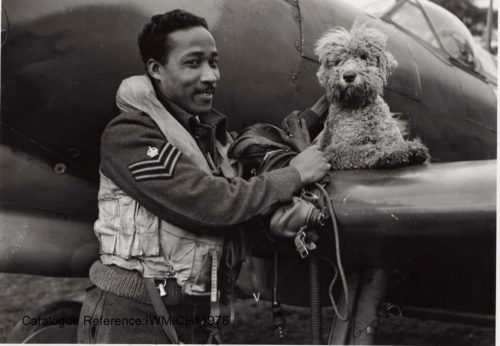
As Robert Murray, who left Georgetown, Guiana to join the RAF, recalls: “I never heard of racism until I got to Britain.” …there is now a desire to celebrate the achievements of those such as Flight Sergeant Jimmy Hyde, the much-decorated Trinidadian piolt, there has been little recognition of the isolation they felt in the RAF. […] There is an official RAF photograph of Hyde, from 132 Squadron, with his Spitfire and holding “Dingo”, the squadron commander’s pet dog. Hyde, while forcing a smile, looks uneasy: it is unclear which one is the mascot.
Source: Caribbean Air Crew in the RAF – Imperial War Museum (IWM) Reference CH11978
However, rather than go too far down the complicated paths to explain motives for systemic racism in the military, we really should keep focus on consequences here.
Given the term was known harmful from the 1800s onward, and given that most Blacks who heard the term would consider it harmful, with many first-person confirmations of being wronged, historians must conclude:
POSTING OR USING THE DOG’S NAME WITHOUT RACISM CONTEXT ERASES THE BLACK EXPERIENCE.
Perhaps this clarity to me comes from unique experience that makes the right answer more obvious versus those casually looking at the problem?
I spent many hours deep in the UK government’s military archives for my graduate degree in history from the London School of Economics. In those papers and secret memos I found an excessive amount of racism of an almost unbearable level, especially in the war-time Colonial Office correspondence on the North African campaigns (as you might imagine from the office name).
The intolerance and hate is all still there if you want to open the folders, but it most certainly should not be paraded or celebrated. And if someone pulled that racism from the archive and built a gravestone or monument to it for celebration, I would ask them frankly why they are trying to erase history (ignore the Black experience) by trying to elevate and apologize for a particular racist tangent.
And here’s a sad example of a historian of Dambusters who fails miserably at this. He both acknowledges the catastrophe of the N-word and also falls victim to the false trope of “said things differently then”. From the 2020 edition of Operation Chastise.
…I have been repeatedly asked whether it is an embarrassment to acknowledge the name of Gibson’s dog, which became a wirelessed codeword for the breaching of the Mohne. A historian’s answer must be: no more than the fact that our ancestors hanged…and imprisoned homosexuals. They did and said things differently then. It would be grotesque to omit Nigger from a factual narrative merely because the word is rightly repugnant to the twenty-first-century ears. […] Yet in the twenty-first century it also seems essential to confront… the enormity of the horror that the unthinking fliers unleashed upon a host of innocents.
This is a clumsy section of the book, which has to be read very carefully. He is saying he leaves in the N-word as evidence of a wrong. Does he call it out effectively as a wrong?
No, it appears he gives far more careful consideration to the wrongs the RAF may have committed against Nazis, than the wrongs against Blacks (or against homosexuals) in the RAF who were fighting against those Nazis.
Note the UK after the war coldly tried and executed their own war hero Alan Turing, for example, simply because he was gay. That narrative is almost never told correctly, given how the government today tries to elevate his name in spite of unjustly killing him.
Interesting data point: given this author of the 2020 Operation Chastise book says historians ought not to omit references to the dog’s name, he makes only 2 mentions in all its pages. And I am sure if he had gone to zero mentions, it would have done nothing to change his narrative.
If anyone believes that erasing history is harmful, then they should see removing the N-word is a restoration project (like cleaning graffiti or pulling down fences). Don’t believe anyone who claims the N-word was acceptable at the time, or that it didn’t get a reaction from those it slighted. Again, as I can’t say this enough, presentation of it without context erases the Black experience.
To post such a word believing it to be “factual” without thinking of its factual consequences, is an act of erasure. It erases history and continues to promote severe and lasting wrongs, by failing to acknowledge mistakes as such. The RAF is right to correct the mistake, acknowledge the bigger story and fuller history, and move the racist name to where it can be studied appropriately for being racist.
As Randall Kennedy, the Michael R. Klein Professor at Harvard Law School and author of the definitive history of the N-word, puts it:
“Given the power of ‘nigger’ to wound, it is important to provide a context within which presentation of that term can be properly understood.
What would context look like for the 1943 Operation Chastise? That’s fairly easy to answer.
The BBC three years earlier on May 16, 1940 responded to an angry letter and issued a public apology for its use of the N-word on air, acknowledging it as “sincerely regretted”.
My attention has been drawn to the fact that one of your announcers, when interpreting some records on the 11th inst., made use of the offensive term ‘nigger’. There is no need for me to remind you that this is one of the unfortunate relics of the days of slavery, vexatious to present day Africans and West Indians, and an evidence of incivility on the part of its user. I hope, sir, as a public corporation, you will take some steps to repair the damage done. I shall be glad to be advised as to what steps you take so that I may be able to inform my Committee accordingly.
======
From the Director, Secretariat of BBC to the President of the League. 16/5/40
Following my earlier letter, I find that our announcer was at fault. The point raised on your letter is fully appreciated, and is one which the BBC is at pains to keep constantly in mind. It was unfortunately overlooked on this occasion, and a reminder on the subject is being given to announcers. I hope that your Committee will accept the BBC’s apology for this slip, which is sincerely regretted.
Speaking of the BBC, don’t forget the beginning of this post was a contextual reference from one of their own broadcasters ten years before the Dambusters existed.
So I have to ask, after all this…
Have you heard of Una Marson?
Every time someone falsely claims the N-word was somehow accepted, or normal for 1943 in the RAF, they actively are erasing her from history despite her very prominent role and the Black community opposition to the term during that exact time.
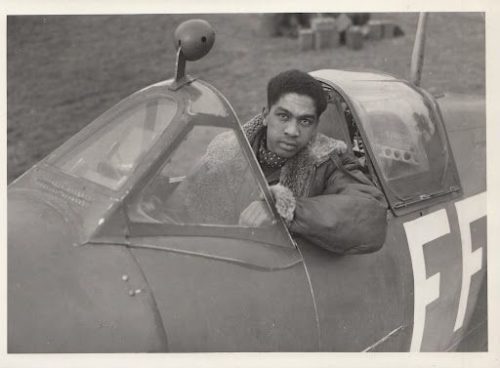
Spitfire Pilot Flight Sergeant Colin A. Joseph of San Fernando, Trinidad – pictured here after having recently shot down 2 enemy aircraft. On New Year’s Eve 1944, he was shot down and killed by friendly fire from American anti-aircraft defences whilst on patrol over Belgium and is buried in Hotton War Cemetery, Belgium.
…few people are aware of the important contribution made by 500 RAF aircrew recruited from the Caribbean and West Africa. Overcoming the legacy of the official British Colour Bar to serve over Europe as pilots, navigators, flight engineers and air gunners, these men were pioneers in the truest sense. After suffering a loss rate of more than 30% and, in some cases, incarceration as black PoWs in Nazi Germany, the men returned to their countries of origin and were lost from the historical record.
Not only were Black contributions lost from the historical record, though…. When references were made to them in movies, there was such disbelief by racists that some tried to protest against the record of real veterans!
…the famous Great Escape. There’s a black character in that film and everybody said, ‘This is just ridiculous, political correctness, where have they got a black character?’. There was actually a black prisoner in Stalag Luft III. So that character’s based on Cy Grant.
Compare that to the controversy over removing the N-word from Dambusters. Following that, here’s a comment about racism during WWII that is spot on, calling out in just a few lines what I spent many paragraphs trying to say above:
The British official policy, written policy, stated that only British-born men of British-born parents, of pure European descent, could receive offers as commissions in any of His Majesty’s armed services. This of course also disqualified South Africans, Australians, anybody who was not British-born and of pure European descent. I mean, not a lot to choose from between that statement and what we were fighting against in Germany, to be honest, other than the fact that there were no camps, but the mind-set behind the policy was very similar.
It’s all a fantastic read, with many very insightful stories of Black RAF airmen during war. This is perhaps one of the best:
Lincoln Lynch, DFM, tailgunner from Jamaica, who served with 102 Squadron, shot down a Messerschmitt night fighter on his first operational flight. He was a gentleman. He shot the night fighter’s engine with his machine guns, then he realised it was on fire and he then held fire while the German pilot and his crewmen climbed out and jumped off the back of the aeroplane and then he resumed firing and shot the rest of the aeroplane out of the sky. So [he was] quite a nice man.
Speaking of the meaning of words, what a name. Lincoln. Lynch.
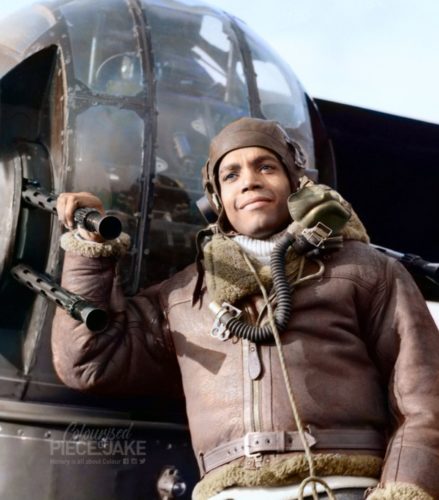
Sergeant Lincoln Orville Lynch DFM, a West Indian air gunner serving with RAF No 102 Squadron, photographed wearing his flying kit by the rear turret of his Halifax at RAF Pocklington, February 1944.
Lincoln Lynch after WWII moved to America and became a strong civil rights advocate, heavily involved in New York politics and even a leading voice of opposition to the Vietnam War. If you haven’t heard of him, please do read his story.
There’s a line “do not obey” within the famous Curtis Mayfield song “Move On Up” (from his 1970 debut album Curtis).
Take nothing less than the supreme best
Do not obey for most people say
’cause you can pass the test
So what we have to do is
move on up and keep on wishing
Remember your dream is your only scheme
so keep on pushing
What might “do not obey” refer to?
To start, let’s look all the way back at Woodrow Wilson’s racist “America First” campaign of 1916, which manifested in years of organized white mobs committing widespread violence and terrorizing black neighborhoods.
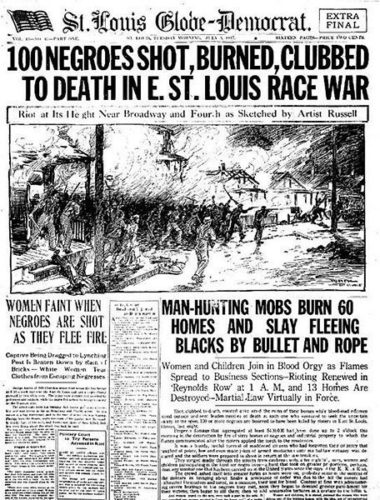
Historians, for example, might point to the NYC 1917 Silent Parade meant to protest the fact that in America “black skin was death warrant”, or the Chicago 1919 massacre that was part of a “Red Summer” of white supremacist terrorist acts.
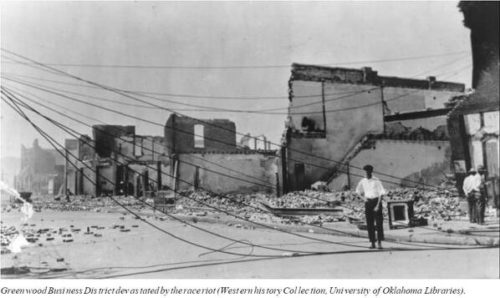
This frightful condition continued such that by 1921 all of Tulsa’s black neighborhoods and “Wall Street” were burned to the ground by planes dropping napalm.
I could see planes circling in mid-air. They grew in number and hummed, darted and dipped low. I could hear something like hail falling upon the top of my office building. Down East Archer, I saw the old Mid-Way hotel on fire, burning from its top, and then another and another and another building began to burn from their top…
The side-walks were literally covered with burning turpentine balls. I knew all too well where they came from, and I knew all too well why every burning building first caught from the top… ‘Where oh where is our splendid fire department with its half dozen stations?’ I asked myself. ‘Is the city in conspiracy with the mob?’
Even a “white Tulsan perspective” published in 1921 admitted “lack of law enforcement was in no small part a contributing factor” to death and destruction from domestic terrorist groups attacking Americans.
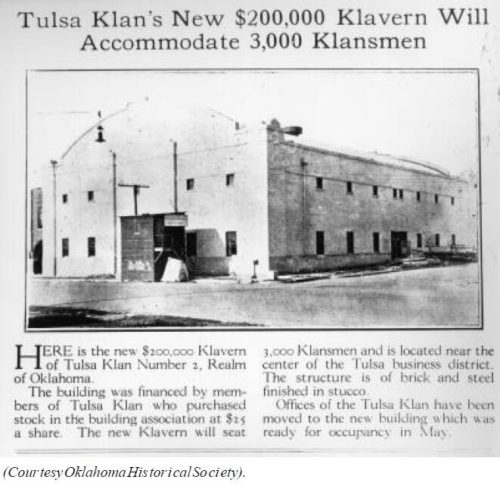
White violence mobs facilitated by law enforcement literally pushed Americans into forced labor and mass graves, followed with construction of a KKK convention hall on top of cities ruined by white violence (an early form of racist “urban renewal” politics made famous by Nixon, although he more subtlety used dynamite and bulldozers instead of napalm and planes)…
A news story written in 1921 clearly called out “old white group control” as a form of American tyranny:
One of the charges made against the colored men in Tulsa is that they were “radical.” Questioning the whites more closely regarding the nature of this radicalism, I found it means that Negroes were uncompromisingly denouncing “Jim-Crow” cars, lynching, peonage; in short, were asking that the Federal constitutional guaranties of “life, liberty, and the pursuit of happiness” be given regardless of color. The Negroes of Tulsa and other Oklahoma cities are pioneers; men and women who have dared, men and women who have had the initiative and the courage to pull up stakes in other less-favored States and face hardship in a newer one for the sake of eventual progress. That type is ever less ready to submit to insult. Those of the whites who seek to maintain the old white group control naturally do not relish seeing Negroes emancipating themselves from the old system.
All of this, the fact that America continued to systemically deny freedom and liberty based solely on race throughout the 1900s, still is rarely if ever taught in American schools.
Blocked from upward mobility by state-sanctioned violent white supremacist mobs — meaning police offered the opposite of help to Americans under attack — you perhaps can see exactly why black community protection groups emerged.
In other words, ethnic-based “gangs” were started as a way to enable the kind of peace needed to prosper, by defending American communities against organized white supremacist domestic terrorism.
Although some black gangs likely formed to counter the aggressive white youth, the unorganized black youth were no match for the well-organized, all-white gangs that were centered in their athletic clubs.
Wherever white oppression tactics were found, and police failed in their duties, a gang was likely formed to defend against injustices and thus enable a degree of protection to help enable gains in health, wealth and prosperity.
Catholic (Polish, Irish, German, Italian), Chinese, Jewish and black gangs all were established to protect against American domestic terrorism. These ethnic gangs also fundamentally depended on fund-raising and community support events. It is a fine line obviously between donations and extractions/taxation, given a lack of transparency or legal representation possible in gang systems.
A story from Milwaukee, for example, involves a fund-raising event on a huge boat in Lake Michigan. A violent storm caused a collision that sank the boat and decimated that community by drowning the “Irish Union Guard” abolitionist militia leadership. So many leaders of that one community died in just one fund-raising tragedy, it has been said the entire balance of Milwaukee’s political power abruptly shifted on that day towards German militia running the city.
Another story, this time from Minneapolis, is how Jewish gangsters violently attacked any German “Silver Shirt” militia (Nazi) rally, calling it a “patriotic duty as Americans” to shut-down pro-Hitler influence operations.
Berman learned that Silver Shirts were mounting a rally at a nearby Elks’ Lodge. When the Nazi leader called for all the “Jew bastards” in the city to be expelled, or worse, Berman and his associates burst in to the room and started cracking heads. After ten minutes, they had emptied the hall. His suit covered in blood, Berman took the microphone and announced, “This is a warning. Anybody who says anything against Jews gets the same treatment. Only next time it will be worse.” After Berman broke up two more rallies, there were no more public Silver Shirt meetings in Minneapolis.
Totally defeated on the streets the Silver Shirt members then became the Minneapolis Police Department (MPD) to gain an unfair advantage over their targets (the city in conspiracy with the mob), but that’s a blog post for another day.
Gangs typically dissipated as they become assimilated by mainstream opportunities (upward mobility) in America (even a catholic has been elected President). However America has such high levels of continued oppression of blacks (1950s White House urban renewal was encoded race warfare) it is no wonder black gangs have lingered.
See the film “Rubble Kings” for an excellent look at the socio-economics of how and why New York gangs were formed in the 1960s and what helped them dissipate in the Bronx. Hint: upward mobility through opportunities in music and art — foundations of today’s rap and hip-hop markets.
With that in mind, let’s look at what Mayfield may have been writing about in his lyrics. The year was 1970 when he released his debut album Curtis, and also when one of the Chicago gangs (Blackstone Rangers) tried to pressure Mayfield to fund them.
He did not obey. Instead he offered them a concert and used his platform to drive a “move on up” message.
He was pushing hope for equality and justice of assimilation that other the races in America were allowed to achieve, leaving behind the need for paying for gang protection from the systemic violence of white power groups.
…no other society in human history has imprisoned so many of its own citizens.
To make an even finer point on the social power of this song, by 1975 a popular TV show about black “nouveau-riche” prosperity in America, called The Jeffersons, created a theme song called “Movin’ On Up“.
Fish don’t fry in the kitchen
Beans don’t burn on the grill
Took a whole lotta tryin’
Just to get up that hill
Now we’re up in the big leagues
Gettin’ our turn at bat
As long as we live
It’s you and me, baby
There ain’t nothin’ wrong with that
For further reading, consider how “up that hill” in The Jeffersons 1975 theme song is likely a reference to American intolerance — “shining city on a hill“.
a blog about the poetry of information security, since 1995

 Important insights come from reading “