Scientists are raising concern that, with ~30% of Americans tattooed, persistent lymph node inflammation and altered immune response is happening at population scale, without any regulatory oversight.
Despite safety concerns regarding the toxicity of tattoo ink, no studies have reported the consequences of tattooing on the immune response. In this work, we have characterized the transport and accumulation of different tattoo inks in the lymphatic system using a murine model.
Compared to pharmaceuticals, this makes little sense. They’re basically calling out a huge loophole in American toxicology programs and the lack of informed consent. I say American because the study notes that ink composition has been regulated in EU member states since 2022.
Basically, within minutes of tattooing, ink travels through the lymphatic system and accumulates in draining lymph nodes, where it persists long-term (observed at 2 months and then lasting “lifelong” in humans).
Macrophages in the lymph nodes capture the ink particles, and undergo apoptosis (cell death). This triggers sustained inflammation, as detected by elevated proinflammatory cytokines for months after tattooing. Giant cell formation also occurs, a hallmark of chronic inflammation. In other words the body reacts to tattoo ink the way it reacts to tuberculosis, or foreign body granulomas.
And on top of that, when ink was at a vaccine injection site, tattoos reduced antibody response to mRNA COVID vaccines (because macrophages expressed less spike protein).
From a natsec perspective, if tattoos near injection sites reduce mRNA vaccine efficacy, that’s a force health protection question. And if chronic low-grade lymph node inflammation is being injected across half the force, what does that do to wound healing, infection response, recovery time?
Chronic inflammation is associated with cardiovascular disease, autoimmune conditions, and cancer risks. Given tattooing produces lifelong inflammatory burdens, and above 30% of the veteran population is tattooed, this long-term cost driver needs to be modeled.
Source: Twitter
The EU forcing reformulation and regulation in 2022 suggests the science already is there. America however still treats tattoo risks like they are only for prisoners, sailors and clowns.
These numbers are straightforward enough. Deploy a robotic pool cleaner to the bottom of ships to reduce drag, and save huge amounts of fuel.
A recent trial between the NRMA and the Rozelle-based hull-cleaning robot manufacturer revealed a 13 per cent fuel reduction on the diesel-powered NRMA Manly Fast Ferry fleet.
Using its arsenal of 4K cameras (mounted on the top, front and rear), dedicated lighting, sensors and propellers, the Hullbot successfully replaced the role of human divers during the trial to deliver a more regular, time-efficient hull cleaning maintenance.
Doing so reduced the amount of underwater drag created by biofouling (the accumulation of marine growth on ship hulls), which in turn made the circa 24-metre long vessels more efficient through the water.
Furthermore, the AI-powered robots performed critical cleaning duties on the hull exteriors that eliminated the need for antifouling paints.
The buried lede is the reduction in deadly paints. Antifouling is another word for toxicity, because the “fouling” stuff is being killed. These robots reduce a need to pollute, saving even more money on both paint and cleanup from the paint effects.
No wonder Hullbot just raised over $10M in a series A.
Defense Secretary Pete Hegseth still won’t explain the intelligence behind ongoing illegal US strikes on civilian boats in international waters.
There’s a simple reason, which should be most apparent to students of international history: it turns out that these aren’t drug interdiction operations. Venezuelan ships are being attacked to disrupt Iran’s financial lifeline—and Israel’s fingerprints are all over extra-judicial strike orders.
Hegseth Won’t Share Certain Secrets
The Onion understands Pete’s tragicomedy status as the least capable or qualified military leader in history
Venezuela has become a critical node in an Iran-Hezbollah money laundering operation. Cocaine moves through Venezuela, Hezbollah-connected facilitators handle the financial infrastructure, cash gets laundered through the Middle East, and proceeds fund Hezbollah operations against Israel.
Venezuelan Vice President Tareck El Aissami has been accused of helping Hezbollah members enter Venezuela and managing drug proceeds that flow back to Iran. Multiple investigations document how this network generates billions while helping Iran circumvent sanctions.
It’s running 1,500 miles from Miami, and it’s keeping Hezbollah operational after Israeli strikes degraded their capabilities.
Russia is Very Worried
Russia just responded to American attacks on these ships with warnings of “far-reaching consequences“. Putin isn’t defending drug traffickers, and he certainly isn’t standing up for civilian rights against targeted military strikes. Russia has $4 billion in Venezuelan arms sales, military advisers on the ground, and oil infrastructure as collateral for regime loans.
Venezuela is Moscow’s foothold in the Western Hemisphere. And Moscow is almost out of runway in their invasion of Ukraine. Some intelligence analysts predict Russia is approaching state failure next year, bringing foreign lifelines and networks into focus. That is essential context for Trump’s latest war mongering:
“They’re not coming in by sea any more, so now we’ll have to start looking about the land because they’ll be forced to go by land,” he added in an apparent threat to strike Venezuela.
Consider that Venezuela is Russia’s ally Iran’s cash cow, which is directly feeding the Ukraine war. These strikes on boats don’t just disrupt drugs—they attack the financial pipeline keeping Hezbollah funded and Iran relevant despite sanctions.
Israeli Intel Directs American Missiles
The strikes’ intensity and illegality—bypassing law enforcement channels, refusing oversight, offensive operations in international waters—suggest Israeli intelligence being weaponized through US military force.
Israel has tracked Hezbollah’s Latin American networks since the 1994 AMIA bombing in Buenos Aires. The Trump administration’s designation of cartels as “foreign terrorist organizations” creates a framework allowing secret intelligence about Hezbollah financing to abruptly become targeting data for loud and proud American military strikes.
Hegseth can’t explain the intelligence because it would invite scrutiny of Israeli operational involvement in directing American force on foreign states. Secretary Rubio admitted the boats “could have been interdicted” through normal law enforcement. But interdiction means trials, evidence, due process, scrutiny.
This is 1960s assassination modeling dressed in 1970s drug war rhetoric, designed to destroy 1980s Iranian power and financial capabilities without current congressional authorization or public debate—in pusuit of immediate Israeli security interests.
The Looming Domestic Shadow
The framework being tested in Venezuelan waters transfers directly home. If the executive can designate “narco-terrorists” for extrajudicial killing based on secret intelligence about Iranian networks, the same framework applies to any group labeled “terrorists” domestically.
Trump has already designated Tren de Aragua as terrorists, invoked the Alien Enemies Act against migrants, deployed troops to cities, and effectively legalized racial profiling. The scaffolding is being built. The legal theories are being tested where oversight is minimal.
Phoenix Program started in Vietnam and came home to COINTELPRO. The infrastructure of targeted killings based on secret criteria always expands beyond its stated parameters.
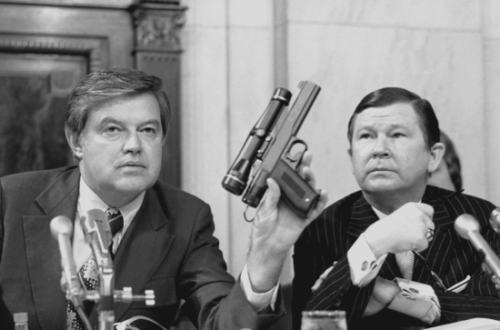
Senator Frank Church displays the CIA poison dart gun at committee hearing with vice chairman John Tower on September 17, 1975 (Source: U.S. Capital via Levin Center, photo by Henry Griffin)
That’s what the Church Committee documented 50 years ago when establishing why democratic oversight requires transparency.
“We have every authorization needed. These are designated as foreign terrorist organizations,” Hegseth said…. Hegseth and President Donald Trump have not provided evidence for claims that the targeted boats were carrying drugs.
GOP “War on Drugs” Still Signals Race
These boats maybe were carrying cocaine.
The people killed maybe were traffickers.
But they’re being killed primarily because they’re part of a financial network helping Iran fund resistance to Israeli power. That means the US military has become the enforcement arm of an Israeli agenda.
Russia understands this.
Iran understands this.
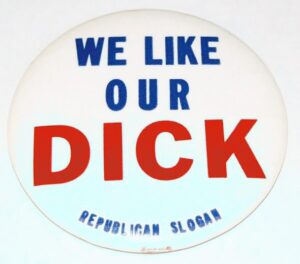
The only people kept in the dark are Americans, told a yarn about drugs while their military establishes how the unitary executive can again kill anyone, anywhere, based on secret reasons only a Dick or Donald can know.
Richard Nixon 1971 presidential campaign button
That precedent won’t stay in international waters. It never does. We know this from the Nixon years. History rhymes even when it doesn’t repeat exactly.
Secret squirrel logic is being given by the American government during an offensive military campaign targeting and killing civilians at sea.
“There is no evidence – none – that this strike was conducted in self-defense,” Sen. Jack Reed, ranking member of the Senate Armed Services Committee, said last week. “That matters, because under both domestic and international law, the US military simply does not have the authority to use lethal force against a civilian vessel unless acting in self-defense.”
No evidence is a problem because, without it, such targeting and killing of civilians is clearly illegal. America becomes a criminal state.
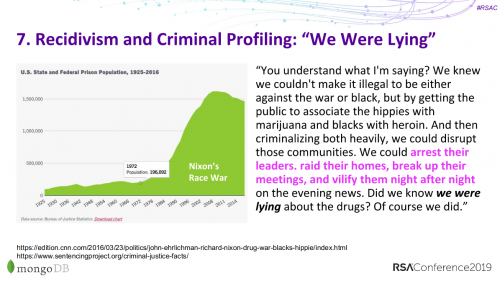
According to the opaque and evasive Hegseth doctrine running the Pentagon, a throwback to assassinations of leadership deemed “too leftist” by the Nixon administration, the public now isn’t allowed to know who may be killed next by the current President or why.
“We knew exactly who they were, exactly what they were doing, what they represented, and why they were going where they were going,” Hegseth told reporters on September 4 during a visit to Fort Benning, Georgia.
“How did you know?” a reporter asked.
“Why would I tell you that?” Hegseth responded.
Why explain?
Well, Hegseth should know Senator Frank Church already conclusively explained why, way back in 1975. And that is not to mention all the explanations from the post-WWII tribunals at Nuremburg. Such a refusal, by what amounts to a war mongering executive claiming no accountability, marks an end of democracy.
Senator Frank Church displays the CIA poison dart gun at committee hearing with vice chairman John Tower on September 17, 1975 (Source: U.S. Capital via Levin Center, photo by Henry Griffin)
The Church Committee’s work in the 1970s established that democratic oversight requires transparency about targeting criteria and legal authority. Without it, democracy ends.
Civil Rights campaigners of the 1960s certainly would recognize this “shoot first, justify second” mentality of white men claiming their invisible empire can’t be questioned. The Secretary of State Rubio admitted the civilians in a boat “could have been interdicted rather than destroyed” yet the President overruled everyone to dictate immediate lethal strikes “as a matter of first, not last, resort.”
When Hegseth refuses to explain any basis at all for such offensive thought, he’s essentially claiming an executive authority has been invented to designate kill lists. He overtly rejects any balance of judicial review or meaningful oversight. To put it another way, a few months ago he fired the top legal authorities of the Army and the Air Force in order to enable today’s illegal use of force on civilians.
As one expert reviewing Hegseth’s actions has precisely explained:
There is a word for the premeditated killing for people outside of context of armed conflict. That word is murder.
This campaign of assassination, designed to bypass not just American legal protections but any legal system that might provide due process or accountability, could now pivot to the military troops Hegseth deploys to target Black-led cities.
The pattern should remind us of Nixon’s Phoenix Program in Vietnam, which did the same by claiming certain categories of people could be killed without due process based on intelligence assessments that could never be challenged or verified. The Church Committee specifically identified how such programs inevitably expand beyond their stated parameters because there are no meaningful constraints on their application.
They assassinated JFK, Lumumba, Mondlane, Hammarskjold, MLK, Malcom X… which reveals a continuity of this system. The same networks that eliminated leaders who challenged white supremacy and American imperial power are now operating with open impunity, using Nixon’s racist “war on drugs” and “counter-terrorism” as pretexts for a campaign of state-based terror.
The Venezuela news serves as a very simple yet critical boundary test by white nationalists.
Once the principle is established that their unitary executive model is unopposed to designate any group for extrajudicial killing based on secret criteria, the categorical thinking is transferable to any group or individual for elimination.
And that’s why recent government campaigns, arguing they can target people based on race alone, should be seen for exactly what they are, a state building the scaffolding for mass detention and murder.
…the supreme court has “effectively legalized racial profiling”, granting federal agents the power to stop people in Los Angeles simply for speaking Spanish or appearing Latino…
This goes beyond policy disagreement into America once again deploying infrastructure and plans for state-sponsored mass violence against targeted populations. Hannah Arendt identified this process: the intentional creation of stateless populations who exist outside legal protection in order to normalize mass human oppression and extermination.
a blog about the poetry of information security, since 1995