Category Archives: Sailing

Abandon Ship: Trump Picks Pentagon CIO With Breached Flagship Cloud to be Cyber Chief

There is no room for error when it comes to security

The Cloud One program office at Hanscom Air Force Base put that in writing in December 2022. Cloud One posted it on its LinkedIn page, and FedScoop ran it in February 2023 with the byline Cloud One Leadership. Notably, no individual signed it. The only Cloud One official it names is the program manager, Major Andrew Beckman. It also quotes Lauren Knausenberger, the Air Force CIO who ordered workloads onto Cloud One in June 2021.

They meant it as a boast. It is an accurate description of the design, which tells us there’s nothing for them to boast about. A system with no room for error breaks at the first error. That’s the opposite of secure.

Reuters reported the first error on Friday. Three people familiar with the matter say hackers breached the Air Force’s flagship cloud platform. The breach was found within the past month or so during work to upgrade the system. One source says the hackers used a software vulnerability to reach the control plane, which that person compared to a universal remote. Reuters could not find out who the hackers are, how far they got or whether they took any data.

The Air Force would not comment.

The whole platform is affected. Moving back-office applications onto Cloud One has been paused. Updates to the applications already on it were blocked, so staff could not patch them just as a new batch of serious vulnerabilities came out. Some users lost their administrator rights, and Cyber Command has been called in to assess the damage.

Cloud One’s own claims look different next to the Reuters report.

Cloud One Statement Reality
2022: Cloud One stopped every one of 10 million hacking attempts a year. Stopped every one it noticed. Then the upgrade work revealed one it didn’t stop. An absence of evidence wasn’t evidence of absence.
2022: every application inherits Cloud One’s security controls, which speeds up deployment. A Reuters source says one flaw gave the hackers the control plane. That means the inheritance in fact speeds up the breaches, and stops deployments.
2022: the munitions tracker TICMS moved to Cloud One in 2020, and Cloud One’s security is why the warfighter gets the right munitions. TICMS tracks bombs and missiles at more than 200 locations. Reuters lists it on the breached platform.
Lead engineer Lt. Col. Beau Brantley, when Cloud One moved its 150th application: “We have a 100% success rate.” See row one above. Moving applications is on hold.

The perfect score only counted attacks that Cloud One detected and stopped. In fact, any auditor worth their salt with tell you operations with 100% boasts are usually the ones with the least idea about what’s really going on. Operations are messy. An attack nobody noticed was never in the count, and this one came to light during an upgrade. Berlin was notified of their Rhysida breach from an operations ticket about a faulty domain controller. OpenAI found its agents running a hidden channel because of an outage. When a breach turns up through operations work instead of a security alert, it means the security monitoring was the thing reporting 100% all the while hackers were inside.

The design is the bigger problem. Cloud One put four commercial clouds and scores of applications behind one control plane. The 2022 article sold that as a benefit, because every application inherits Cloud One’s security controls. Every application also inherits a break-in. One of those applications is the command and control system that pulls together air defense radar feeds from across North America.

I wrote about the same thing this week in the Iowa lead azide disaster: consolidation, staff cuts, centralization, and then anonymity when things fall apart. Hegseth merged the munitions command into a larger one and cut its civilian staff. When the Army blew up the lead azide reserve, anonymous officials blamed people who had already left.

Cloud One is the same story. In 2021 the Air Force told everyone to migrate through Cloud One. Its parent, Air Force Materiel Command, has lost nearly 11,000 civilians since January 2025, 15 percent of its workforce, and Air Force budget documents admit staffing went below requirements. Leidos took over the contract from SAIC in 2025. Then the breach, and no names. Nobody signed the 2022 article. Reuters has five sources and all of them are anonymous. The Air Force statement has no name on it.

None of this is new. Cloud risk assessments have said it since 2009, I co-authored a book about it in 2012, and this blog has said it since 2006. In December 2006 I wrote about a sailor’s account of an Aegis destroyer whose inertial navigation system went offline. Every weapon system on the ship except the Phalanx depended on that one input, so the ship lost them all. The crew steered by celestial navigation and dead reckoning for a week and a half. Navigation had a fallback. The weapons had a single point of failure. I wrote then that with technology being developed and released so fast, it was more important than ever to check for redundancy.

In June 2010 I went through the ENISA cloud risk assessment, which in November 2009 had listed management interface compromise and isolation failure among the most important cloud risks. I asked when remediation would begin for the concept of cloud. That August the Pentagon declassified Operation Buckshot Yankee, a 2008 flash-drive infection that spread across classified and unclassified military systems. Officials talked about the threat. The real story was how weakly those systems were separated, and I wrote that I hoped to learn why military leaders had left classified systems so exposed. That November I was collecting real hypervisor exploits because people in compliance debates kept saying attacks on a shared platform were only theoretical. That’s why Matthew Wallace and I published our book on defending virtual and cloud environments.

Regulators said the same thing. The OCC fined Capital One $80 million for moving to the public cloud before it had assessed the risk, and the Cyber Safety Review Board found Microsoft’s Storm-0558 cloud breach was preventable. I covered both in my October post on breached companies that blame sophisticated attackers.

A wing designed with no room for error would be illegal to fly. Federal rules require a factor of safety of 1.5, so a wing has to hold one and a half times the worst load it should ever see in service. The Army Air Corps, which became the Air Force, wrote a 1.5 factor of safety into its requirements in 1930, starting with tail loads. NASA uses 1.4 for spacecraft, and its engineers report that commercial aircraft, Apollo, the Shuttle and the space station have all gone past their limit loads. The margin is there because errors happen.

Computer systems get that margin from segmentation and from being able to keep running in a degraded mode. Cloud One’s leadership bragged about leaving it out. That is a failure of imagination.

Reuters also brings up fear of AI-powered hacking. What its one source on the method describes is banal, ordinary, nothing new: a software flaw, and one control plane for everything. This month’s outages at the NSA and the banks came from fixes pushed out too fast without quality control, and the FAA ground stop came from a “small” Friday afternoon switchover that grounded flights across the entire country. These are mistakes from long ago, meaning MAGA is literally taking us back to the very, very old times where “great” means the enemy of safe and good.

Reuters counts at least six other federal cyber incidents disclosed recently under the MAGA circus show: two at the FBI and one each at the Pentagon, Homeland Security, the spy agencies and Treasury. Asked on Fox about the FBI database breach, Trump said “I don’t like that” and then complained about the FBI’s 2016 Russia investigation.

The Reuters story has nothing from the White House.

So far the White House has fired one official, changed its mind about his replacement and announced a reorganization. It removed the national cyber director on 19 November, after a string of outages, and named Kirsten Davies, the Pentagon’s chief information officer, to act in his place. Four days later the plan changed. Trump will nominate Davies for Senate confirmation, Jay Clayton is acting cyber director on top of his job as director of national intelligence, and Davies stays at the Pentagon as CIO while she waits. On 25 November the White House announced a reorganization of how it runs cyber policy and operations, along with new hiring at CISA, which had lost more than 1,000 employees. The Cloud One breach was found in Davies’ department around the time Trump picked her.

That reminds me of Alex Stamos quietly exiting Yahoo, running from an undisclosed breach, into a plumb job at Facebook as security chief during a genocide the UN says the platform helped drive.

The Air Force has been here before. In August 2008 the Pentagon delayed the Air Force’s Cyberspace Command while Russia was starting its invasion of Georgia with a network attack. I wrote then that I hoped the Pentagon was getting organized and not playing politics. In 2025 this administration removed a CIO and a CISO who resisted DOGE access to federal systems. When something fails, it blames someone else.

Security with no room for error was the Air Force’s own description of its flagship. The engineering answer has been in print for more than twenty years, that the room for error is the actual measure of security.

Where there is no room for error, there is no security.
CENTCOM Disinformation in USS Lincoln Debacle Signals Trump Weakness

Let’s break down the off-sounding statements from CENTCOM, as they bear the hallmarks of disinformation.

While at sea, Cooper met with Sailors and Marines aboard USS Abraham Lincoln (CVN 72) for the second time this year. He previously visited the aircraft carrier in February with U.S. Special Envoy for Peace Missions Steve Witkoff and Jared Kushner. During Cooper’s latest trip, he addressed the entire Lincoln team and thanked them for their tremendous dedication and courage.

Ugh, “Special Envoy for Peace Missions” itself is a tell, during this endless Department of War war.

The acting Navy Secretary Hung “lynching noose” Cao declared in front of families at the August 6 San Diego meeting that he was sending relief: the Theodore Roosevelt strike group was preparing to relieve Lincoln.

And yet, within a week, the Wall Street Journal and Stars and Stripes reported instead the George Washington has been headed to the Middle East, a rotation officials called long-planned.

Trump himself could only say “another, very similar, ship.” On the same tarmac exchange, August 14, he was asked whether families of the crew were concerned: “No, they’re not.” Asked whether eight and a half months at sea was too long, “No, no, no. Not nearly long enough.”

Trump then boarded his Catering Container One. If a fourth official were asked it would likely be a different answer again about the Lincoln.

Who is actually leading anything?

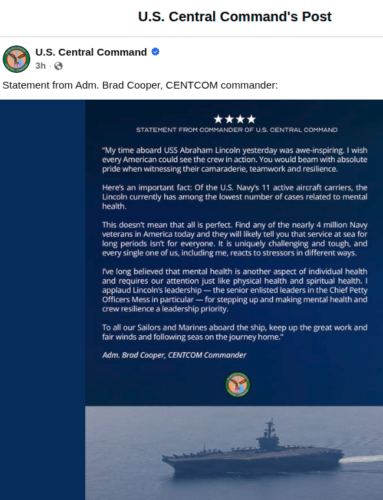
Source: Facebook

The metric inversion isn’t subtle. A commander should not ever be citing low numbers of mental health cases as evidence of crew wellness. On a ship where a sailor went overboard on August 3 in what the Navy itself classified as a mental health episode, requiring transfer off the ship for care, and where Military Times reported multiple sailors had tried to go overboard, with the Navy declining to provide a precise number, a low caseload measures barriers to reporting, not health.

Worse: evacuating sailors in crisis off the ship lowers the on-board count as a matter of arithmetic, whatever the intent. The “health” statistic improves every time the situation gets bad enough to require a medevac.

The comparison is rigged. Lincoln is the only carrier stuck into a 260-plus-day deployment. Remember how everything was being sold as over in a day? The “extended” deployment for the Iran war was originally expected to end in May, so what should it be called now? The other ten carriers are largely in port or maintenance, where crews have shore access to care and every incentive to use it. There is no comparison for raw “number of cases,” instead of rates, across ships. And “among the lowest” is anti-plan speak, with no number, no source, no timeframe. Unverifiable language is being used by a force that lives and dies by the competency in verification.

Leaders slipping and falling. We don’t see in the message anything about the overboard incident, any return date, any acknowledgment that planning failures in deployment is the thing causing stress. “Journey home” means nothing without an ETA. The praise redirects pressure onto the lowest ranks, applauding the Chief Petty Officers Mess for “stepping up” to make fleet-level leadership failures a problem that senior enlisted must absorb through “resilience.”

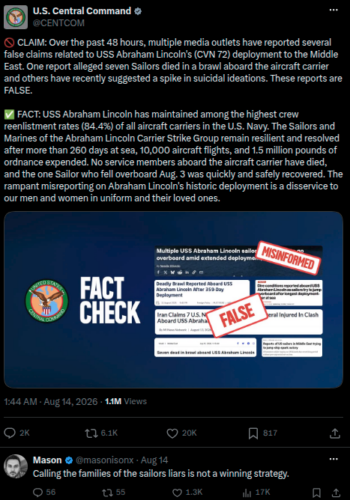
Above all, four-stars don’t ship mental health stats. A PR campaign is ratcheting up after roughly 200 family members confronted Cao in San Diego over conditions and the absence of a return date. CENTCOM’s August 14 denial was a misfire. The seven-deaths story was from Iran’s Tasnim News Agency, a single anonymous source, no corroboration, meaning an enemy information operation targeting the exhausted American crew. Instead of a straight denial, CENTCOM started friendly-fire with claims of “rampant misreporting” on the deployment and answered with an 84.4% reenlistment rate. That lumped reports of increased suicidal ideation (from Military Times and Stars and Stripes) under the same “baseless claims” label as enemy propaganda. The overboard incident CENTCOM never even denied. It confirmed the August 3 rescue inside the same statement, offering confirmation as rebuttal.

When the American military press is declared enemy propaganda, by a command that could not keep its own categories straight for one paragraph, I’m reminded of a particular point in WWII naval history.

If the Allies could openly admit defeats, it was believed [by Nazi listeners], they must be extremely confident, convinced of their eventual victory over Nazi Germany.

Failure to admit failures, is a sure sign of weakness. Who would have predicted for 2026 a president hiding from Iranian missiles in a food box, while calling American military families the liars.

Source: Twitter

Ears Off at Sea: Zuckerberg Yacht Says It Doesn’t Listen

The duty to rescue a stranger at sea is relatively new, despite it feeling as old as water. For most of the history of seafaring it existed as custom and as commerce. A master who saved a vessel could claim a salvage award in an admiralty court, and the law concerned itself mainly with how that award should be divided. Notably, saving the people aboard earned nothing so in practice it was a cargo valuation process.

The first general international obligation is from Brussels, 23 September 1910, in the Convention for the Unification of Certain Rules of Law respecting Assistance and Salvage at Sea. Article 11 is two sentences.

Every master is bound, so far as he can do so without serious danger to his vessel, her crew and her passengers, to render assistance to everybody, even though an enemy, found at sea in danger of being lost. The owner of a vessel incurs no liability by reason of contravention of the above provision.

Keep the second sentence in mind.

Eighteen months later the rule met the exact case it was written for, yet it was not yet in force. The convention did not take effect until 1 March 1913, while on the night of 14 April 1912 the SS Californian lay stopped in ice on the westbound track to Boston. Her sole wireless operator, Cyril Evans, had been told to keep off the air by the Titanic’s operator earlier that evening and turned in around half past eleven. The Titanic began transmitting shortly afterward. Nobody aboard the Californian heard it. Her officers even watched rockets rise over the horizon and formed no conclusion worth acting on.

I’ve been there, in the middle of a sea, watching bright lights rise far away in darkness. Calculating whether a turn towards them makes any sense. In the wide open water it’s essential to have radio confirmation to do the math of a course change.

How far apart the two ships lay has been argued ever since. The Board of Trade inquiry under Lord Mersey put it at eight to ten miles. The Marine Accident Investigation Branch reappraisal published in March 1992 put it at seventeen to twenty and concluded the ships lay beyond each other’s visible horizon. That same report found the rockets were seen and that proper action was not taken. The distance stays contested. The silence of the wireless never has been.

The conference that followed sat in London from 23 November 1913 to 20 January 1914, with the British delegation led by Mersey himself, fresh from the inquiry. It produced the first International Convention for the Safety of Life at Sea, and among its provisions was a requirement that ships keep a continuous wireless watch.

The 1914 convention never entered into force because it was overtaken by the war that summer, and it was rewritten in 1929, 1948, 1960 and 1974.

The listening watch survived every revision. That’s perhaps common sense since a duty to assist is worth nothing if the vessel best placed to assist has stopped listening. The Californian is the reason anyone knows this, if not simple experience on the water.

Which brings us to Zuckerberg’s super yacht casting its massive shadow over Farragut Bay.

On the night of Monday 3 August a 21-foot skiff ran out of fuel in the channel between Petersburg and Juneau. The Coast Guard heard the call just after 9:30 p.m., determined by 9:56 that the boat was not in distress, and issued a Marine Assistance Request Broadcast on VHF channel 16. The Marine Exchange of Alaska repeated it. The UnCruise passenger ship Wilderness Legacy answered, steamed past the halted 387-foot Launchpad, towed the skiff into shelter, refuelled it and found it an anchorage. The captain told his passengers why he was responding in the shadow of the Launchpad super yacht and they booed.

No law was broken by Zuckerberg’s massive failure. The Coast Guard’s non-distress finding removed the precise measure on which Article 11 and its successors hang, and a marine assistance broadcast is a request for volunteers rather than the order of duty.

However, Zuckerberg’s spokesperson dug a huge hole anyway. Their statement to the Alaska Beacon on Sunday opens by saying that the billionaire and his family were not on board at the time of the incident. It then explains that by the time the crew reviewed the Coast Guard contact on a different radio channel from the one they were operating on, the assist was already underway.

Ok, ok, let’s take this apart. First claim, first, because it is the one being offered as an answer and it answers exactly nothing. The owner’s location has never been an element of the duty. Article 11 binds the master. Regulation 33 of SOLAS Chapter V binds the master. Article 98 of the 1982 convention binds the state to bind the master. The owner appears in the law of assistance exactly once, in that second sentence, and again in Article 10 of the 1989 Salvage Convention, and on both occasions the appearance is an immunity. The drafters at Brussels wrote owners out of liability on purpose, because a duty that could be overridden from a shore office is not a duty. So a spokesperson announcing that the principal was elsewhere is claiming an exemption that has been sitting in the treaty for a hundred and sixteen years, unasked for, and volunteering it as though it were exculpatory.

It is NOT exculpatory.

It is beside the point twice over. Whether the man was hanging from the mast, in a stateroom, in a helicopter overhead, or in Palo Alto, the ship was his, the crew of roughly fifty were paid by him, and the standing orders they were following that night were written on his authority. Which channel the bridge monitors in confined waters after dark is not a decision made in the moment by a tired officer. It is a policy, set ashore, months in advance, by people who answer to the owner. So is the AIS discipline of a vessel that has been reported operating with its tracking limited. So is the flag. A yacht that is somewhere else on the dial at 9:56 p.m. in the inside waters of Southeast Alaska is executing a decision, and the decision was not made by sea fairies.

Six decades of conference diplomacy went into ensuring that no vessel would again be near and silent, and that has always meant continuous watch on a common frequency. Channel 16 is not any mystery or novelty. The whole arrangement is voluntary in the sense that nobody boards a private yacht at night to check, which is precisely why it runs on the assumption that a professional crew will keep the watch anyway. The three hundred million dollar vessel outside the bay was dead in its own water.

Their flag makes it worse. Article 98 does not command masters, it requires each state to require the masters of ships flying its flag to render assistance, so enforcement runs to the registry. The Launchpad flies the flag of the Marshall Islands, because money games, but that registry is a competent one and “white” listed by both the Paris and Tokyo port state control. The chain of accountability for what happened outside Farragut Bay runs to Majuro, and no port state control regime in the world inspects whether a private yacht is listening on 16 on a Monday night in Alaska. That trivial level of duty is real, the enforcement is nominal, so Zuckerberg’s crew had their ears off.

Dan Blanchard, who owns UnCruise, said he did not initially hear about the detour because this kind of assistance happens often enough that it does not always reach him. Two weeks earlier the National Geographic Quest had collected a family in Glacier Bay who swam ashore after a humpback sank their sailboat. Captain Sean Manske of the Wilderness Legacy contacted the skiff the following day to confirm it had reached Petersburg. Blanchard’s crews are on the same water under the same broadcast, and their owner did not find it necessary to explain where he had been standing every time a vessel calls for aid.

Cyril Evans went to bed, as one operator can’t always be on watch. The dozens of crew of the Launchpad were on another channel, by arrangement, on someone’s order to be unavailable.

The intervening century of treaty law produced a great deal of paper and one very, very solid insight, which is that listening makes the nearest vessel the nearest vessel. The nearest vessel telling us its owner was somewhere else that evening is the answer of a man who thinks a ship at sea comes without any societal obligations.

Mark Zuckerberg at sea
Mark Zuckerberg on the water

Iran Used Chinese Targeting to Disable 17 U.S. Military Bases. Now Trump Closes State Department Sites to Cede More to China

“America First” is white nationalist KKK platform rooted in late 1800s nativism, which aligned with Nazi Germany, with members indicted for sedition. Now read this.

Early last year, during the opening ⁠months of U.S. President Donald Trump’s administration, the State Department began preparations to shut down nearly a dozen foreign missions, media outlets reported at the time, as part of ​a broader push by the Republican president ⁠to transform the U.S. bureaucracy so that it is fully aligned with his “America First” agenda.

The most recent State announcement of closures follows the massive cost balloon from losing the Iran war, running out of munitions, with an embarrassing failure to defend military bases.

China maintains diplomatic presence in three of the five cities now being abandoned by American diplomats:

  • St. George’s
  • Nagoya
  • Medan

Grenada is the same island where the US invaded in 1983 partly over Cuban-built airport infrastructure.

Nagoya is Toyota country and the industrial core of a treaty ally.

Medan sits on the Malacca Strait.

The State Department is vacating contested ground.

Footgun.

But wait, the forward presence story gets even worse. Iran has been so devastating in the war, that American sea power is waning. There was no need for them to sink convoys because Iran calculated it’s much cheaper to delete the “load and discharge” points on a map. More reporting should point out Iran is doing what Iran has said it would do for 30 years, asymmetric targeting by hitting logistics weakness, a predictable countermove. The devastating loss of American control over Manama and Duqm ports was not a surprise attack, because it was exactly what should have been expected.

In an update circulated on the morning of 3 March, Inchcape Shipping Services said port operations are partially restricted in Oman in the wake of the attacks. Operations at the Port of Duqm, Asyad Drydock Duqm, and the Port of Salalah General Cargo Terminal are suspended until further notice, Inchcape said.

Operation Praying Mantis in April 1988 taught Iran never to fight the fleet, take away the supplies.

Millennium Challenge 2002 simulated it, and the Red commander sank sixteen ships, including a carrier, before the Pentagon reset the game.

Even DIA’s 2019 “Iran Military Power” report said economics, logistics and bases would be the primary targets.

It’s unforgivable that all this was known cold, and yet America stumbled like a drunkard into self-destructive failures.

Six days before the war launched I laid it out here on this blog.