Category Archives: Security

eisengarn: One Binary, One Cloud, One VPN

When you create a “virtual private network” the “exit” of that network is a physical node with a legal jurisdiction. That jurisdiction determines who can compel disclosure of your traffic metadata, under what authority, and whether anyone is required to tell you it happened. Choosing the right jurisdiction is the first security decision of any “private” network. Everything else depends on it.

eisengarn Intro

After hearing many people ask what they should do about the crisis of fraud in the VPN provider market (many of them apparently are cosmetic shells that trace back to the same hedge fund, or an anti-privacy politically ambitious CEO), I created eisengarn. Of all the options I saw presented, none seemed to offer the simplest answer of all.

I didn’t see any reason for something to be magic or marketed when the concepts of private networking are as old as the Internet itself. So I put together the most simple solution I could, and not simpler: a personal WireGuard VPN provisioner written in Go.

I like to sing Rudy Toombs’ “one binary, one cloud, one protocol (VPN)” to the tune of one bourbon, one scotch, one beer. Your musical tastes may differ, but the point is the simplicity and transparency that brings integrity.

One scotch, one bourbon, one beer

One scotch, one bourbon, one beer

Please mister bartender,
listen here

I ain’t here for trouble,
so have no fear

One scotch, one bourbon, one beer

You run one command and get a hardened WireGuard exit node on the Hetzner Cloud, locked by code that only allows EU jurisdiction datacenters: Nuremberg, Falkenstein, Helsinki.

The name is awkward to say, but it’s a real German textile term for “iron yarn”, which means paraffin-treated cotton thread. It’s perhaps known best as Bauhaus tubular-steel chair webbing (Stam, Breuer). It has strong, thin, functional, engineered attributes. What’s not to like? The metaphor is a simple purpose-fit physical thing to make your internet more trusted.

Jurisdiction Details

Hetzner is a German company, thus under German and EU data protection law. The GDPR applies. The server you provision sits in a known legal regime with strong data-protection statute. That’s why eisengarn hardcodes the location, giving an easy and reliable jurisdictional boundary.

The code is open on Codeberg, a German non-profit running Forgejo. The DNS resolvers are Quad9, a Swiss foundation with a no-source-IP-logging policy, and DNS.SB, operated in Germany, both over DNS-over-TLS.

The cloud, code, and DNS all remain within EU jurisdiction, unlike the American services known to be heavily monitored by Trump for loyalty, and subject to being disabled immediately without warning.

Ms. Prost was at home, standing in her kitchen, when the call came informing she was being sanctioned. It wasn’t a complete surprise, given that many of her colleagues had already been sanctioned, she said during an interview…. Within hours, she said, she had received a message from Amazon canceling her accounts. Before long, Google & her banks got in touch. Over the following days, credit cards ceased to work.

Design Details

WireGuard keypairs are generated server-side on first boot; the private key stays on the server and is read directly into the WireGuard config there. Client keypairs are generated locally on your machine; only the public key crosses the wire. Every key artifact is written atomically: create temp file, chmod 0600, rename into place.

SSH authentication is agent-only. Your private key stays in ssh-agent, protected by your passphrase, and eisengarn prints which key it selected so you can confirm. Host-key pinning is trust-on-first-use and fails closed: a changed host key aborts the connection.

IPv6 is dual-stacked with NAT66, so both address families route through the tunnel and exit in the EU. DNS runs through unbound, listening only on the tunnel interface, forwarding over TLS. The firewall is scoped to OpenSSH and WireGuard’s UDP port; the resolver is reachable solely from inside the tunnel.

Threat Details

eisengarn, if not already apparent, is a jurisdiction tool. You control the exit node. You choose the legal regime your traffic lands in. The security properties are visible in code rather than in a sketchy hedge-fund VPN flogging “personality type” marketing.

The README spells out exactly what the trust boundaries are: your Hetzner account ties the server to your identity, the exit IP is stable and yours, and traffic past the exit is as encrypted as it was to begin with. Honest documentation so you know exactly where the boundaries are should help you make real decisions about your threats.

Workflow Details

It’s in Go, statically compiled, CGO disabled. Clone it from Codeberg, make build, and this is the entire workflow:

eisengarn up — provisions a locked-down Ubuntu 24.04 server in the EU datacenter you chose, configures WireGuard and the DNS resolver, pins the host key, writes local state.

eisengarn add laptop — generates a keypair on your machine, sends only the public key to the server, writes laptop.conf and a scannable laptop.png QR code. Import the conf into WireGuard on the device. Scan the QR on a phone.

eisengarn verify — runs live checks against the server: tunnel up, unbound active, firewall scoped, DNS resolver unreachable from the public internet.

eisengarn list — shows your devices, reconciled against the live server.

eisengarn down — destroys the server and stops the bill.

A cpx22 at Hetzner runs only a few euros a month, perhaps less than your VPN service charges. The server is persistent, meaning you can provision once, add devices over time, and eisengarn down when you’re done. A down command immediately destroys the complete server.

v0.1.0 was just tagged, under a MIT license.

Enjoy, and stay safe out there.

NVidia AI Murder Bots Found Attacking Ukraine

A new Berlin Story report, about drones attacking Ukraine, discusses the NVidia AI hardware used by Russia.

Inside the Russian Zala drone, we found the NVidia TX2-A (Jetson Tegra X2) AI chip with 8GB of RAM. A serious AI system which, unlike AI assistants on mobile phones, does not need contact with a data center to perform its tasks.The AI ​​can, for example, recognize vehicles and people during overflights and also identify details such as military markings, license plates, or drone types. This allows the AI ​​to pre-sort targets for attack.

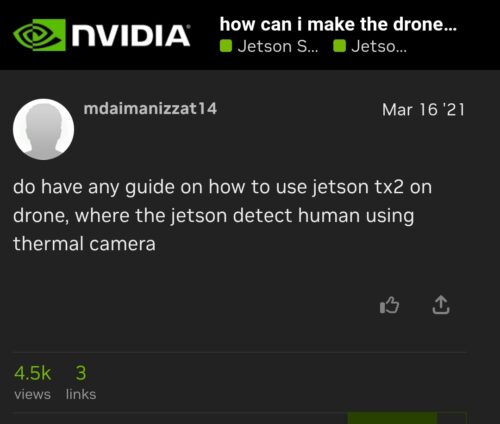
This brings us to the NVidia support community for developers, where a Muhammad Aiman Izzat (likely Malaysian) account seeks some very specific help with NVidia hardware.

Source: NVidia

Popular topic for NVidia to be supporting, as you can plainly see. I say it’s likely Malaysian not just because of the name, but also the supply chain for this line of inquiry. Malaysia was a top 10 export county of semiconductors to Russia between 2017 and 2021.

In recent attacks in Ukraine, the drones chase innocent civilians even as they run and try to hide. One murder report this week came after a Ukranian school teacher had jumped from her car when a Russian drone approached. As she ran into a line of greenery and trees to get away, expecting the car to be hit, it instead followed her, just as the NVidia support question had asked.

Get Local: Match Mythos Findings for Under a Dollar

Let’s recap what we know since April, when Anthropic’s marketing department started coal-rolling the industry with their nonsense about novelty. A model with 3.6 billion active parameters reproduced Anthropic’s flagship Mythos discovery, the FreeBSD RCE CVE-2026-4747, and the most consistent open-weight model in that test ran about six hundred times cheaper per token than Mythos.

The frontier is supposed to be the frontier, meaning the best model. But really, if you know history, the frontier was about immoral claims. And so today, the evidence points away from the frontier.

Set the marketing and history aside. Four documents, when read together, form a single brief that further buries the Mythos. The best model available to you runs on your own inexpensive hardware. Cost and performance make the obvious case. I’ll start there. And then the deeper case is much more important, where I suspect the PhDs at Anthropic don’t even know how to spell it: CIA.

Cost Considerations

The price gap was the easiest and first frontier collapse. Niels Provos put an orchestration harness in front of older commercial and open-weight models, Opus 4.6, Sonnet 4.6, and Z.AI’s GLM 5.1, and discovered live zero-days for thirty to one hundred fifty dollars a codebase, including a reproduction of the 1998 OpenBSD SACK bug he wrote himself. Security Research Labs ran a Qwen3.6 model with roughly three billion active parameters on a Mac laptop and produced finding sets comparable to GLM-5 and Claude Opus 4.6 on two production codebases, in under ninety minutes, with zero human nudges. Vicki Boykis runs Gemma 4 on a 64GB Mac and gets agentic coding loops at about seventy-five percent of frontier speed and accuracy. The Ornith team trained a nine-billion-parameter model that matches dense models several times its size, and a flagship that matches Claude Opus 4.7 on the coding benchmarks. And for what it’s worth I put https://lyrik.wirken.ai/ to the test and it matched two of the Mythos card flagship bugs for seventy five cents.

The AI Security Institute then explained why the gap is smaller than the leaderboards suggest. Benchmark scores are protocol-dependent. Raise the token budget one to three orders of magnitude above the published default and performance climbs on FrontierMath, TerminalBench, HLE, and the cyber ranges. Fixed-budget evaluations understate capability, and the gap widens as models improve. The generational gains arrive as greater reach and reliability rather than token efficiency. A frontier score describes the harness and the budget as much as it describes the weights.

So much for cost. The closed nature of the Anthropic releases seems to be intended to prevent the kind of research that proves their claims false.

Now comes the real reason to hold the model yourself. Many already know this, but let’s walk the CIA triad to be sure we’re on the same page.

Confidentiality

The customers who need a code review most are the ones forbidden to send their code anywhere. Finance, government, critical infrastructure. The SRLabs pipeline answers this directly. A cloud model designs the review from metadata alone, the local model reads the source, and a cloud model consolidates the findings. The proprietary source stays on the machine through all three stages. They are precise about the boundary, and so should we be: metadata crosses, so the accurate promise is that no source leaves the building rather than that nothing leaves. That distinction is the whole discipline. A local executor turns confidentiality from a contractual hope into a physical fact. The bytes that matter remain on a disk you control.

Integrity

Here the local model wins on a property the frontier surrenders by construction. Integrity is the correspondence between a claim and a process you can inspect. A capability you can replay is a capability. A capability asserted through an institution is a press release.

The local pipeline is fairly simple and repeatable. Provos publishes the IronCurtain harness, whose workflows are defined as finite-state machines in plain YAML. AISLE published nano-analyzer as a single Python file, and clearbluejar took that file, ran it on two open-weight models on one consumer GPU, recovered the same FreeBSD bug, and fixed the false-positive rate by adding one reachability stage that dropped the noise from thirty candidates to five. The work replays. You can rerun it, change one stage, and watch the result move. Boykis makes the same point from the inside: with a local model you watch the tokens arrive, change the context window, swap the quantization, and edit the system prompt while it runs. The box is open. And https://lyrik.wirken.ai was built with exactly this purpose in mind. Integrity is a required control, a prerequisite to doing the work at all.

The frontier offers the opposite trade. The Mythos checkpoint that AISI evaluated is one the public cannot run, scored under a protocol AISI’s own paper shows to be the lever that moves the number. The capability is real, perhaps. The evidence is an authority signature on a result you are invited to trust, like a self-signed cert in the age of Let’s Encrypt. Integrity asks for the actual head of authority, the root and details of the artifact. A model on your disk hands everything over in full transparency for high security. A model behind an API hands you a number and a logo, meaning nothing at all.

Availability

The newest fact settles the matter. Access to Fable and Mythos was suspended in June 2026 under a Commerce Department export-control directive. A rented capability can be withdrawn by a regulator, a pricing committee, or a board. And the latest erratic, grudge-filled, targeted moves by Trump prove he can wag a finger at any person or company and immediately shut down all access to US technology under “sanctions” authority. No trial, no hearing, no warning, just one minute you have US technology and the next minute it’s all gone with no path for recovery. A government that willingly undermines its entire economy and private sector is itself a moral question, but business continuity risk numbers in tech speak for themselves.

Anthropic prices Mythos at roughly five times public Opus, from twenty-five to one hundred twenty-five dollars per million tokens, which is a second kind of withdrawal for anyone whose budget matters. Many firms in June are reporting token bankruptcy and shutting down AI access to reduce explosive spend. A capability that exists at the pleasure of someone else’s arbitrary pricing policy is a capability you are borrowing into debt.

A model on your disk answers when you ask it. Its uptime is a property of your own infrastructure. No directive reaches it, no erratic price change locks you out, no quarterly access review applies. Availability stops being a service-level agreement and becomes a fact of ownership.

The brief

Confidentiality, integrity, and availability were always the job. The industry has never improved upon the simplicity and elegance of the triad, yet it now is confronted with an architecture that concedes all three to whoever holds the API. The work above shows the concession was a significant preventable error. A model you hold satisfies this brief and proves Mythos was never about capability. The frontier offers an expensive route to a number you cannot replay and do not really control.

Choose wisely.

AIPAC Pentagon Lock-in: Section 224 Makes Alliance Irreversible

For a few weeks now I’ve been pondering why the United States is binding its defense industry to Israel’s through a provision in the 2027 defense authorization bill. The cover story is integration: shared development, shared procurement, shared supply chains. The actual story is reduced leverage. A state that co-produces a weapon loses sole control over it. The tighter the integration, the smaller the room to refuse. This is something so obvious and yet the bill’s sponsors do not discuss it. I guess that’s what makes me want to write now.

The case is best made through one congressman, because he has documented every stage of it himself.

In March 2016 Mike Rogers, Republican of Alabama’s Third District, published a column titled “We Must Support Israel.” He said this view came from him as an American and a Christian. His support for Israel, he said, was something he heard demanded across East Alabama for religious, historic, and defense reasons. He then described his own position. As chairman of the House Armed Services Strategic Forces subcommittee, he oversaw the Missile Defense Agency, which runs co-development and co-production programs with Israel. He had worked on Iron Dome. Iron Dome parts, he noted, were being produced in Alabama. His column states in 2016, a decade ago already, every element of the relationship that Section 224 makes permanent: conviction, constituency, jurisdiction, and local industry.

The Strategic Forces subcommittee authorizes US funding for Israeli missile defense. Rogers’s predecessor as chairman, Mike Turner, recorded that his subcommittee provided over $600 million to Iron Dome. Rogers used the chair the same way. In one markup he recommended an increase of more than $400 million for the Missile Defense Agency and full funding of the Israeli request, $600.7 million, for co-development and co-production of Iron Dome, David’s Sling, and Arrow.

That recommendation turned into work for his district. In September 2014, as Strategic Forces chairman, Rogers announced a contract worth nearly $150 million to produce parts for the Iron Dome Tamir interceptor. Significant work, he said, would occur for his constituents in Huntsville. He presented it as a jobs measure: home commitment to Israel and good-paying jobs at home in one act.

So the chairman of the subcommittee that funds Iron Dome directed more than half a billion dollars to the program while parts of that program were manufactured in his district. He announced both in press releases. This was a proud arrangement, not hidden. It was constituent service, and he campaigned on it openly. The all-up-round assembly plant, the Raytheon-Rafael joint venture, later went to East Camden, Arkansas; Alabama’s share is the Huntsville component work.

What seems to change is that level of integration. For most of its history the US-Israel defense relationship ran on aid, arms transfers, joint missile-defense programs, and intelligence cooperation. The arrangement was legible and reversible. An administration could withhold a system, slow a sale, or condition a transfer.

A right of reversibility has eroded in stages. In January 2021, in the final days of his first term, Trump moved Israel from US European Command into Central Command. The Pentagon called the change partly symbolic and said it would not alter US basing. It was far more than symbolic. CENTCOM is a US combatant command under a US four-star officer. Placing Israel in its area of responsibility put it in the same command framework as the Gulf states, under one American general, aligned against Iran. The Abraham Accords seemed like the connection.

Five years later, this setup was running a war operation called Epic Fury. The blended US-Israeli campaign against Iran, which began on February 28, 2026, meant US strikes coordinated with Israeli intelligence and cyber operations. An IDF spokesman called the cooperation unprecedented. The relationship moved quickly from provision to joint operation, as if the tail wags the dog.

Critics had said Section 224 would fuse the two militaries and place American forces under Israeli control. Ro Khanna called it a fusion of the US and Israeli militaries. Rogers defended the bill by restating the charge against it. He called the claim categorically false and misleading. The measure, he said, adds transparency and efficiency by designating one official to coordinate existing programs.

In no way does it give away command and control of our military operations, personnel or equipment.

The denial is precise, a little too precise. A chairman defending a coordinating measure does not ordinarily rule out, by name, the transfer of his country’s operations, personnel, and equipment to a foreign military. He used exact terms and very strangely. The disputed question is not whether the bill assigns a coordinating role to one official. It does. The question is whether coordination at this depth, in these technologies, is a significant change. Rogers says business as usual. Khanna and Massie say whoa, Bessie.

Section 224 of the fiscal 2027 National Defense Authorization Act establishes the United States-Israel Defense Technology Cooperation Initiative. It directs the defense secretary to designate an executive agent to expand and accelerate bilateral research, development, testing, evaluation, integration, and industrial cooperation. The named priority areas include artificial intelligence, autonomous systems, directed energy, cyber defense, electronic warfare, and data fusion.

The relationship has gone from sharing to joint development. Mark Hilborne of King’s College London reads it as a tighter form of integration, institutionalised enough to survive changes of administration, because development cycles are long. The nonprofit A New Policy identifies the specific mechanism. By authorizing the cooperation through the NDAA and embedding Israeli technology in Pentagon programs of record, Section 224 shields the relationship from the annual appropriations process, where Congress could otherwise cut or condition it. Once a technology is built into a program of record, removing it is slow and expensive. Rogers has designed a lock.

The sponsorship reinforces all this. The bill was introduced by Rogers, now chairman of the full House Armed Services Committee, with Adam Smith, the committee’s ranking Democrat. A measure carried by both the chairman and the ranking member is difficult for either party to reverse.

Opposition has been recorded and defeated. On June 4 Ro Khanna moved in the Armed Services Committee to strike Section 224. The committee rejected the amendment on a voice vote; only Khanna and Sara Jacobs supported it. Khanna argued the provision originated with Netanyahu and would entrench the integration for decades. Thomas Massie, who with Khanna introduced an Iran War Powers Resolution, calls the measure an infringement on US sovereignty. Both objections concern entanglement and lost leverage.

Massie lost his Republican primary last month to a challenger aligned with the administration’s position on Israel. Rogers has received close to a million dollars over his career from pro-Israel political action committees, by FEC data compiled by Track AIPAC. His Democratic cosponsor draws from the same source: by OpenSecrets’ tally the largest single organizational source behind Adam Smith is the American Israel Public Affairs Committee and its affiliated donors, at $326,914. The bipartisan structure that makes Section 224 durable rests on one funding source reaching both parties.

Below AIPAC on Smith’s donor list are the defense firms: General Atomics, Palantir, General Dynamics, SpaceX, Anduril. These companies build the technologies Section 224 names as priorities, artificial intelligence, autonomous systems, and data integration. The ideological backer and the commercial beneficiaries appear on the same list.

The lobby operates through contributions and endorsements, which are lawful and disclosed. OpenSecrets states the limit of the evidence: contribution patterns show aligned interest and a channel of influence, while the motive behind any single gift is unknowable. Both men held pro-Israel positions before any one cycle’s contributions. The money and the conviction are consistent with each other. Neither has to be buying the other.

The strongest form of the influence argument has been stated directly. In Responsible Statecraft, Michael Vlahos argues that Israel’s influence over Washington exceeds every prior case of foreign influence in American history; where France, Britain, and the Soviet Union acted opportunistically and briefly, Israel’s is ideological, sustained, and permanent. The argument is a polemic, and it compares closed historical cases with one still open, which favors its conclusion. But note where Vlahos lands. He shows us three American constituencies: secular neoconservatism, a Christian Zionist bloc, and the organized lobby.

The mechanism is visible in Rogers’s state. The Alabama-Israel Task Force, founded in 2013 in Huntsville, organizes Jewish and Christian activists to cultivate the state’s legislators, governor, and senior officials. Its results are documented: a role in Alabama’s 2016 anti-BDS law, among the strongest in the country, and in resolutions supporting Israeli military operations. The history precedes the group. In 1943 Alabama was the first state to call, by unanimous resolution, for a Jewish state. The conviction Rogers cited in 2016 is produced, in part, by organized advocacy.

The cultivation runs nationally as well. In December 2025 a delegation of more than a thousand US pastors and influencers, some from Alabama, traveled to Israel on a Friends of Zion program arranged with the Israeli Ministry of Foreign Affairs, which paid for flights and lodging. The stated aim was to prepare them as unofficial advocates for Israel at home. A foreign government funding the cultivation of American religious advocates is a form of influence. The American Conservative raised the relevant question, whether American religious leaders should be mobilized for a foreign government’s interests, and described the pastors as willing participants. They are Americans glad to say their convictions are subsidized by a foreign state.

This is the same mechanism Rogers described in 2016: an American and a Christian, hearing it from his district, building the parts in his state. The bill’s critics and its sponsor agree on what drives the relationship; they disagree on whether it serves US interests. The drivers are domestic conviction, organized money, and material interest located in specific districts. This is influence and entanglement. It is not foreign control.

The cost of the integration appears in the government’s own assessment. In recent weeks the Defense Intelligence Agency raised its counterintelligence threat level for Israel to critical, its highest, reportedly above every other ally. The concern is Israeli surveillance of senior US officials to read the administration’s deliberations on Iran. The context is a policy split: Trump claims he could end the war through a negotiated settlement with Tehran (after failing to make bombs work); Netanyahu has pressed to resume bombing and called any negotiated deal naive. The DIA dates the increase in surveillance to late 2024 and through 2025, rising as US policy on Iran grew uncertain, first under Biden’s pressure over Gaza, then under Trump’s deliberations. The collection tracked the uncertainty.

The designation is itself evidence against the claim of foreign control. A captured military does not raise its threat level on the supposed captor during a shared war. US counterintelligence is functioning. The episode demonstrates the leverage problem instead. The closer the integration, the less the United States can withhold, and the integration has never been closer than under the bill now in committee. It advances as US public support for the relationship declines, with polls showing the Iran war unpopular and majorities opposed to unconditional arms transfers.

The pattern is an American arrangement built by Americans, funded by American money, through a bill carried by the chairman and ranking member of the Armed Services Committee, and designed to outlast the administrations that follow. It is constructed to resemble ordinary legislation: bipartisan sponsorship, a single coordinating official, a stated assurance that command and control remain in US hands.

Rogers chaired the subcommittee that funded the interceptors whose parts are built in his district.

In 2016 he told his constituents the relationship should never be in question.

In 2026 he wrote the provisions to ensure it cannot be.