Ten years ago, a post called “SpaceX : a history of fiery failures” offered this warning:
…failure almost killed the company. It was saved—just a day after the crash—by billionaire Peter Thiel, the company’s first outside investor. That’s right: SpaceX, which some believe may save humanity by finding us homes on other planets, was revived by a guy who backs Trump, a politician who, should he ever get control of America’s nuclear arsenal, might wipe out humanity.
Ok, so here we are in 2026 looking at this headline news:
President Trump’s statement to the United Nations clearly constitutes an implied threat to use overwhelming nuclear force against Iran and the Iranian people broadly. This would be a nuclear genocide.
So what was 2016 really warning us about? SpaceX failures being artificially papered over with Nazi money as a political strategy to undermine American government? Fiery failures could now describe the entire United States, as well as its wars around the world. Let’s have a look at the record and how we got here. If nothing else, we can look to see if SpaceX failures track to the Tesla deadly failures, in order to see if the threat is being taken seriously enough yet.
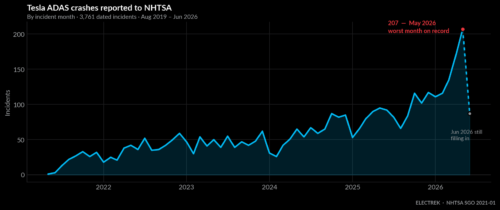
Remember, SpaceX and Tesla both promised to tackle the world’s hardest problems in 2016 so that they would be solved by 2018. Driverless coast-to-coast without touching the steering wheel, and landing on Mars, both done and dusted by 2018 according to Elon Musk. His wealth, and Peter Thiel’s through the Founders Fund stake that rescued SpaceX in 2008, grew on investors backing these predictions, along with Palantir ending all wars, Hyperloop replacing high-speed trains and a Boring Company replacing urban subways. They were supposed to be the fascists who protect us all by doing things their way, but instead they seem only to have become the biggest threats to humanity by ignoring everyone but themselves. Two boys whose formative years were spent under South African apartheid, raised by Nazi families, don’t turn out to be good guys? Who would have thought?

The thing I find most amazing is that large investors are reaching out to me asking why they read the news and get the feeling SpaceX is a success, that Tesla is too, but I give them overwhelming evidence that none of that news is true. Well, as it goes, the news isn’t reporting facts, it is reporting press releases from the companies trying to game the market with lies. It’s not hard to see when you are a trained historian who reads all the facts, instead of parroting vendor hype driven purely by profit regardless of facts.
In April 2016 SpaceX announced a Dragon capsule would land on Mars in 2018.
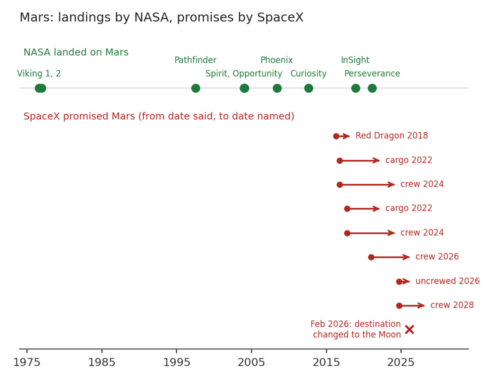
In September 2016 Elon Musk stood on a stage in Guadalajara and described cargo flights in 2022, crews in 2024 and a self-sustaining city of a million people, framed as beating NASA to a planet NASA had been landing on since 1976.
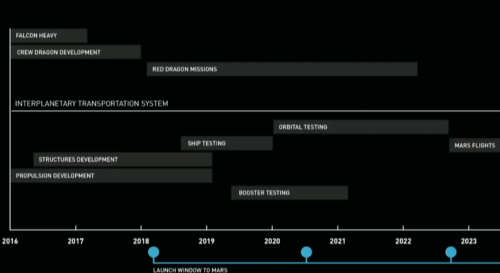
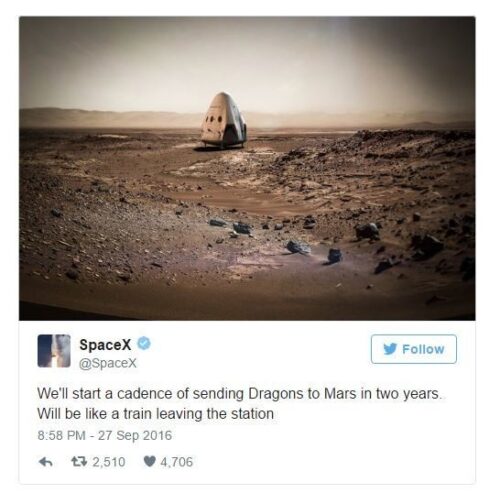
The plan was published the following year in the journal New Space under the title “Making Humans a Multi-Planetary Species.” Dragon stayed on Earth. Ten years on, the rocket built for that city reached Earth orbit for the first time, stayed for two laps, and exploded on splashdown north of Hawaii. SpaceX tried to claim an explosion at splashdown was expected because the ship is not built for cold ocean water, in a landing zone its own Flight 14 page describes as pre-coordinated before launch. As if ocean temperatures are a surprise and aerospace engineering is mythology simply out of their control, despite two months earlier the Flight 13 page celebrating a ship that came to rest intact for the first time.
The announced mission for Flight 14 was six orbits over ten hours ending west of Chile. One of the ship’s six engines shut down on ascent. The booster lost an engine on ascent, relit 31 of 33 for boostback and 11 of 13 for landing. The flight control team took the first abort checkpoint after two orbits, deorbited to a contingency zone in the northern Pacific, and the ship exploded in the water. The lunar lander NASA bought needs weeks in orbit for propellant transfer. Two hours in orbit proves an insertion burn and a deorbit burn. That is the smaller claim. It is the one the evidence supports.
SpaceX publishes one page per flight. Before launch it carries the plan. After launch it carries the result. The two never appear together. The Flight 14 page today says the team chose to “limit the duration spent on orbit” and gives no figure for the duration that was announced. Six orbits, ten hours and a splashdown west of Chile survive only in the press briefings SpaceX gave before liftoff. The Flight 13 page reports the ship “coming to rest intact.” The Flight 14 page reports “splashing down on target” and stops. The condition of the vehicle is recorded when it floats and dropped when it burns. Here is the ledger graded against the plan announced before each launch. Failure means the objective as stated was missed.
| Flight | Announced plan vs. result |
| 1 20 Apr 2023 |
FAIL. Plan: 90-minute flight, booster to the Gulf, ship to a splashdown near Hawaii. Result: multiple engines out from liftoff, vehicle tumbled, destroyed by command at about four minutes, pad cratered. FAA closed the mishap with 63 corrective actions. |
| 2 18 Nov 2023 |
FAIL. Plan: same profile as Flight 1. Result: booster broke up after boostback, ship destroyed by command near the end of its burn. Both vehicles lost. SpaceX called it “success comes from what we learn.” |
| 3 14 Mar 2024 |
FAIL. Plan: booster soft splashdown in the Gulf, ship engine relight in space, controlled reentry and splashdown in the Indian Ocean. Result: booster broke up at 462 metres, relight skipped because the ship was rolling, ship lost during reentry at 49 minutes. SpaceX |
| 4 6 Jun 2024 |
Met Plan: booster soft splashdown, ship survives reentry to a soft splashdown. Result: both achieved. One booster engine failed at liftoff, a ship flap burned through on the way down, and the ship was lost after splashdown. SpaceX |
| 5 13 Oct 2024 |
Met Plan: tower catch of the booster, ship soft splashdown. Result: both achieved. The only flight to date with every engine working. Ship lost after splashdown. SpaceX |
| 6 19 Nov 2024 |
FAIL. Plan: repeat the catch, ship relight and soft splashdown. Result: tower health checks aborted the catch and the booster diverted to the Gulf. Ship met its objectives. SpaceX |
| 7 16 Jan 2025 |
FAIL. Plan: catch the booster, fly the redesigned ship through payload deploy, relight and reentry. Result: booster caught. Ship caught fire and broke up at eight and a half minutes. Debris fell on Turks and Caicos. SpaceX opened a debris hotline. |
| 8 6 Mar 2025 |
FAIL. Plan: same as Flight 7. Result: booster caught. Ship lost several engines, lost control and broke up at nine and a half minutes. Ground stops at Florida airports. SpaceX |
| 9 27 May 2025 |
FAIL. Plan: first reflown booster to a Gulf splashdown, deploy eight simulators, relight, controlled reentry. Result: booster broke up at the start of its landing burn. Payload door stayed shut. Ship lost attitude control, skipped the relight, and was lost at 46 minutes. SpaceX. See third failure in a row. |
| 10 26 Aug 2025 |
Met Plan: booster Gulf splashdown, deploy eight simulators, relight, soft splashdown. Result: all achieved. The plan dropped the catch already achieved on Flights 5, 7 and 8 and returned to the Flight 4 profile. Ship lost after splashdown. SpaceX |
| 11 13 Oct 2025 |
Met Plan: repeat Flight 10. Result: all achieved. One booster engine skipped the boostback relight. Ship lost after splashdown. SpaceX |
| 12 22 May 2026 |
FAIL. Plan: V3 debut, booster boostback and controlled Gulf splashdown, ship deploy and soft splashdown. Result: one booster engine out on ascent, boostback cut short, hard splashdown. Ship lost a vacuum engine, deployed 22 payloads, landed on two engines of three. FAA ruled the booster a mishap and grounded the vehicle. SpaceX |
| 13 24 Jul 2026 |
FAIL. Plan: repeat Flight 12 with controlled booster splashdown. Result: boostback ended early again, hard splashdown again, booster lost. Ship met every objective and came to rest intact. First attempt scrubbed at T-0 when four engines failed to light. SpaceX |
| 14 28 Sep 2026 |
FAIL. Plan: first orbit, six orbits over ten hours, deploy 26 Starlink V3, deorbit to a splashdown west of Chile. Result: booster lost one engine on ascent, relit 31 of 33 for boostback and 11 of 13 for landing. Ship lost a vacuum engine, reached orbit, deployed the satellites, then aborted after two orbits to a contingency zone north of Hawaii and exploded on splashdown. SpaceX omits the explosion. |
Fourteen flights have a clear FAIL pattern, and not much success.
- Four met the announced plan where two of those, 10 and 11, met the same reduced plan twice.
- Ten FAILED.
A booster or ship was destroyed on nine, and every ship before Flight 13 was lost at splashdown, so the four met flights ended in a lost vehicle as well. Engines failed on eleven. Flight 5 is the single flight in the programme where every engine worked and every announced objective was met. Flights 10 and 11 met a plan that had dropped the tower catch achieved a year earlier. The standard is the one the FAA applies: a mishap includes any failure to complete a launch or reentry as planned. A partial grade exists in SpaceX’s write-ups and nowhere in the regulator’s definition. The phrase “success comes from what we learn” appears in SpaceX’s write-ups for Flights 2, 7 and 8, the three flights that scattered debris over the Gulf, the Caribbean and Florida airspace.
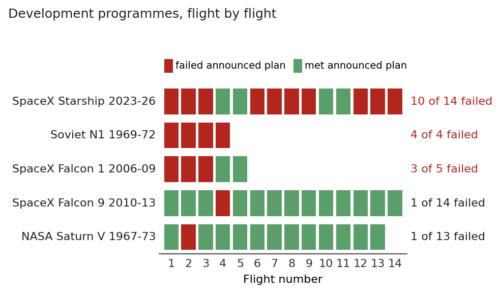
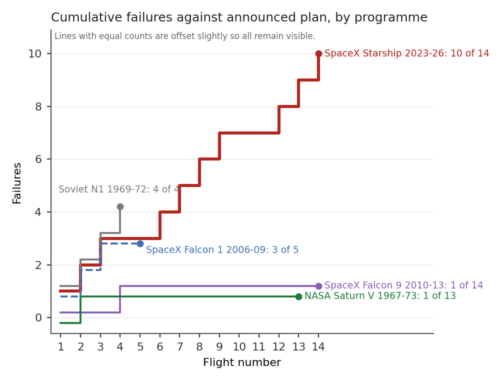
Ten of fourteen is high by the standard SpaceX invites, which is the record of development programmes. Saturn V flew thirteen times and missed its stated objectives once, on Apollo 6, when pogo oscillation shut down two second-stage engines and the third stage refused to restart. Twelve of thirteen, first flight all-up, every vehicle intact. The Soviet N1, the thirty-engine cluster Starship most resembles, flew four times and failed four times before cancellation. Falcon 1 failed its first three flights and met its objectives on the fourth and fifth. New vehicles fail early and then plateau. Starship’s failures sit at 1, 2, 3, 6, 7, 8, 9, 12, 13 and 14. The last three are consecutive losses on a redesigned vehicle. After three and a half years and fourteen full-stack launches the programme is still in its debut phase.
The failures concentrate in one place. Reentry works: every ship since Flight 4 that reached it survived it, eight of eight. Propulsion is the constraint. Engines shut down or refused to relight on eleven of fourteen flights. On the V3 booster the boostback and landing relights fell short on all three flights, and those are the burns a tower catch depends on. Flight 14 aborted its endurance test on a vacuum engine loss. A stack carries 39 Raptors. With an engine anomaly on eleven of fourteen flights, per-engine reliability per flight computes from this ledger to about 96 percent. Engine-out tolerance is real and spends margin, and Flight 14 shows the margin was needed elsewhere. The FAA required a mishap investigation after Flights 1, 2, 3, 7, 8, 9 and 12. Seven of fourteen.
NASA’s lunar lander contract needs a ship recovered and reflown, ship-to-ship propellant transfer, and weeks of orbital loiter. After fourteen flights: zero ships recovered, zero reflown, zero transfers, two hours of orbit. The tower catch, the one reuse milestone achieved, was last performed in March 2025 and has been absent from every announced plan since. The programme has cost over $15 billion across nearly a decade. NASA’s award was $2.89 billion in April 2021 for a landing then scheduled for 2024.
In November 2024 Musk said SpaceX would be flying Starship at least once every two weeks by the end of 2025. The record is five flights in 2025 and three in 2026 through September. On the day before Flight 14 he wrote that hourly flights are two to three years away. The average interval since January 2025 is about eleven weeks, and the last three flights all failed.
Beating NASA to Mars was a promise of the same design as the others. Each was pitched against a public institution, each passed its deadline, each delivered something smaller than the pitch, and each left its cost with people outside the company.
| Promise | Delivered, and who paid |
| Hyperloop, 2013 LA to SF in 30 minutes |
Nothing built by Musk. Hyperloop One closed in 2023 after raising over $450 million and winning no contract. Musk’s biographer Ashlee Vance traces the idea to his opposition to California high-speed rail, which is still under construction. |
| Boring Company, 2016 Tunnels under LA, Chicago, Baltimore |
One Las Vegas tunnel with human drivers. Nevada regulators alleged nearly 800 environmental violations in two years, untreated water into storm drains and the sewer, workers with chemical burns, a Nevada OSHA fine of $112,000, and nearly $500,000 from the water district for illegal dumping. |
| Tesla, 2016 Coast to coast driverless by 2017 |
Driver assistance sold as self-driving. Fatal crashes on public roads. 112 air quality violations at Fremont since 2019 and an abatement order in 2024. In Grünheide a 15,000-litre paint leak and a court ruling that the water permit supplying the plant was unlawful. |
| SpaceX, 2016 Dragon on Mars 2018, crew 2024, a million people |
Two hours of Earth orbit in 2026. Flight 1 started a 3.5-acre fire and dropped pulverised concrete 6.5 miles away, per the Fish and Wildlife Service. EPA found the deluge system discharging to wetlands without a permit. Debris on Turks and Caicos, the Bahamas, which suspended SpaceX landings, and Mexico, where the president ordered a recovery platform out of Tamaulipas waters and put legal action under review. Florida airspace closed. |
The false promise is the product. That’s why Hyperloop was announced in 2013, in Vance’s account, to derail California building high-speed rail. It’s a cynical Nazi political ploy to stop public good and flush taxpayer money into private hands instead (the Nazi model of private control of public office, documented by Germà Bel in the Economic History Review as the 1930s Reprivatisierung).
The Mars schedule of 2016 preceded the lunar lander award of 2021, the Starbase licences, and the IPO of 2026, and each of those was secured before Starship had reached a single orbit.
In February 2026 Musk moved the company’s stated destination from Mars to the Moon. The investors who financed the Mars schedule, and the Trump campaign into the White House that Thiel and Musk financed from the ill-gotten proceeds, received no refund and no correction. The fraud did its work, without any accounting… so far.
Sinéad O’Sullivan, an aerospace engineering professor writing in the Financial Times (crossposted by Brad DeLong), calls the pattern “narrative rotation” and lists the rotations: reusability paid for by NASA, Starlink sold on reusability, Mars supplying urgency, orbital AI compute now sold to public markets.
Her numbers: space is 12 percent of revenue, Starlink 55, the AI business 33. Of 165 Falcon 9 flights in 2025, 43 carried outside customers. The June IPO priced at $1.77 trillion on revenue of $18.67 billion and a net loss of $4.9 billion. Morningstar puts fair value at $780 billion.
Once the promise has done its work the deadline is dropped and the objective is rewritten to whatever survived. The cost lands with a county, a state regulator or a foreign government. Public loss, private gain, as Nazis intend.
The 2016 paper from Elon Musk gave a figure of 40 to 100 years to reach a million people on Mars. The 2018 Dragon landing he announced was cancelled the following year, and the vehicle built to replace it became a 2026 Earth orbit story and failed even at that. The 2024 crew landing on Mars was scaled so far back it became putting 26 satellites into orbit. The destination is now the Moon, if that. The fantasy of Mars that supposedly justified the privatization of space remains a figure in a journal. The ledger written here has the facts, the failures the decade produced.