
Category Archives: Security

Meta Petal Undersea Cable Colonizes France

A company that once pitched itself as extraterritorial now measures success by how deeply it is wired into national jurisdictions. That’s a notable political shift from seeing itself as literally above the law to trying to become the law.

Facebook engineering boasted “We successfully completed the first full-scale test flight” and buried “structural failure”; NTSB more openly reported an in-flight structural failure on final approach with substantial damage.

Many years ago I was invited into a high security meeting enclave on the Facebook campus. After multiple physical security checks and pat-downs, and being escorted into the room, I found myself among ex-military advisors plotting “Aquila” drones. It was 100% clear that Facebook delivering “Internet” over contested ground from a neighboring country was privatized military intelligence. I couldn’t get out of there and take a shower fast enough.

I called it intelligence collection by elevated platform in 2018, three months after Facebook shut the program.

As those Air Force mercenaries soon discovered the drones were never above the law, and Facebook in 2016 had failed politically before Aquila ever finished a test flight.

I’m not a lawyer but sovereign airspace has no altitude ceiling. The U-2-reminiscent platform plan for 90K ft still needs the same national spectrum license as a tower on the ground. The ITU identified spectrum for high-altitude platforms, and every country licenses that spectrum on its own terms. India’s regulator proved the point in February 2016 by banning Free Basics on zero-rating grounds. Nothing physical had to be blocked when Facebook lost at the licensing layer. Four months later Aquila’s first full-scale flight ended in a structural failure on final approach near Yuma, flying without an airworthiness certificate, and the second flight in 2017 did not solve the underlying problem, which also stalled Zephyr: a solar airframe cannot carry a useful payload and survive the night at anything but equatorial latitudes. Loon, the balloon program, closed in January 2021 when Alphabet could find no commercial case for it.

Inside the high walls of the Facebook campus it was like humanity didn’t matter, money-fueled madness made anything possible (e.g. Musk’s “occupy Mars” is a campaign to abolish laws and replace with an Emperor). Outside, the laws broke every power-hungry fantasy. That’s why Facebook shut the airframe program in June 2018 and said Airbus would build the aircraft instead (e.g. Tesla initially had Lotus build its cars to avoid itself having to operate within the law); and that partnership faded quietly.

Fast forward to today and Meta has announced an engineering nothing-burger.

We’re announcing Petal, the first subsea cable with petabit capacity to be deployed across an ocean. Petal will connect the US and France, spanning 7,000 km (over 4,300 miles) and doubling the capacity of today’s most advanced transoceanic cables.

The doubling comes from two-core fiber rather than more strands, which is why the announcement leans on “without proportional power or infrastructure.” That is also a concentration-of-risk claim: same number of cables, same landing points, same Baltic and Red Sea failure modes, now carrying twice as much per cut.

The real constraint was voltage, not glass. The repeaters split each 2-core fiber into two single-core paths with a fan-in/fan-out interface, amplify, then recombine, which keeps the system under the existing 18 kV power-feed rating and avoids requalifying the whole subsea ecosystem. Meta doubled capacity by staying inside the old certification envelope. Meh. Or should I say Meh-ta?

It is a cable for moving Meta’s own traffic between its US and EU data centers, increasingly AI training and inference that seeks EU exposure and dependence on American compute.

Read between the lines and it is a political science post, without technical significance, dressed up as something engineers did. Meta stopped trying to route around states and started embedding in them instead. It plans to land in France with Orange as landing party, which puts Meta inside French critical-infrastructure policy, inside French lawful-intercept obligations, and at the table when governments talk about cable protection. That is a far more politically durable position than hoping nobody touches an aircraft too fragile to survive its landing.

Colonization by cable is probably the right way to read the news, if you consider history. Paris learned what happened in the Fashoda Crisis of 1898 from a British telegram routed through Cairo, and when Britain censored the cables during the Boer War the next year, France started building a state-owned network to Africa.

The two major colonial powers sought to link their colonies via a vast railway network: Britain from Cairo to Cape Town, and France from Dakar to Djibouti. The town of Fashoda, situated at the intersection of these two planned lines, became a critical focal point for both armies. On September 18, 1898, Marchand’s French mission and Kitchener’s British expedition came face to face on the Upper Nile. Ordered to withdraw, France yielded and was forced to acknowledge British authority over the entire Nile basin. This defeat led to a redivision of African colonies between the British and the French.

Ask yourself what will Meta censor for Trump when the EU goes to war?

On the current cable at Le Porge Meta holds more than 80%, Orange gets two of sixteen fiber pairs for landing it, and the ownership split is not public.

Guess why it’s not public. On the US side the FCC landing license for Amitié went to Microsoft, and since 2020 the FCC refers cable landing applications with foreign ownership to a Justice Department-led committee that can condition the license on a national security agreement. Whatever the licensee agreed to in Washington is part of the deal France landed.

Petal goes to NEC and Sumitomo, two years after the French state bought 80% of Alcatel Submarine Networks to keep cable building sovereign, and seven years after the Senate warned in 2019 that these infrastructures must not be held exclusively by foreign entities.

France keeps one thing. Le Monde reported in 2014 from the Snowden files that Orange’s landing stations give the DGSE access to everything transiting the country, sorted by origin.

Meta owns the cable. France owns the landing and reads it. That is the same arrangement France rejected in 1898, with the tap as consolation, and good luck to France when it remembers why.
Wheatley to Orelien: Racist Information Warfare Targets Black Authors

The Academie Goncourt struck a novel from its longlist on Friday, four days after an anonymous account with 92 followers declared it the work of a machine. The evidence was a single commercial detector. AFP ran the same passages through its own tool and got “very likely written by a human.” Seven other detectors disagreed with each other.

The book stayed struck. The Goncourt cited the plagiarism findings alongside the detector, but the claim by an anonymous account with a contested tool was clearly targeting the author.

The author is Thelyson Orelien, 38, born in Gonaives, Haiti, resident in Montreal since 2010. His first novel, C’etait ca ou mourir, follows a teacher fleeing gang violence to Canada. It won the Prix du Roman Fnac on Monday 21 September. The accusation from “Balance ton Claude” landed the same day. By Thursday his Quebec publisher had suspended promotion, a book fair had withdrawn his guest of honour title, and two newspapers had found borrowed passages in columns and a short story he wrote in 2012 and 2014. By Friday the Goncourt had acted “to preserve the integrity of the prize” and its mission of crowning “literature written by women and men.”

On Thursday Le Figaro identified the attack account’s operator as one of its own columnists, Samuel Fitoussi, author of Woke Fiction. He had denied involvement to AFP several times that week. He had also been among the first to repost the anonymous accusation from his own named account, boosting himself. On Friday he confirmed a “collective project” whose other members remain unnamed. Asked about the racial dimension, he called the question conspiracist. The president of the Academie Goncourt had already told franceinfo why he thought the timing mattered: a Haitian, Canadian, Black, francophone foreigner, in a season when passions run high.

Fitoussi’s stated motive is fear, that AI will end human writing. Yet he is an associate member of Frst, a Paris fund that finances AI startups and that began life as Otium Ventures under the Catholic billionaire Pierre-Edouard Sterin. The detector he relied on, Pangram, raised $9 million in July in a round led by Menlo Ventures, an investor in Anthropic, whose assistant gave the account its name.

Black authors in the French and English worlds have been asked to prove they wrote their own books for 250 years.

Phillis Wheatley was examined by eighteen Boston men in 1772, Governor Thomas Hutchinson among them, before a London publisher would print her poems. Their signed certificate that she had written them opens the 1773 edition. Bakary Diallo, a Senegalese rifleman, published Force-Bonte in Paris in 1926 and was assumed for decades to have had it written by his French patrons. Camara Laye’s Le Regard du roi (1954) was attributed in 2002 by the scholar Adele King to two Belgians in Paris, his landlord and a reader at his publisher. Yambo Ouologuem won the Renaudot in 1968 for Le Devoir de violence, faced plagiarism charges from 1971, and published nothing after 1972.

A white author gets the opposite treatment. Michel Houellebecq copied Wikipedia passages into La Carte et le Territoire, admitted it, called it collage, and won the 2010 Goncourt anyway.

Orelien is compiling a dossier with his editor to prove he wrote his own book, like Wheatley stood before eighteen examiners in Boston over 250 years ago.

The information warfare against Black authors hasn’t changed much.

Dobrindt Under Scrutiny as Russian Hybrid Warfare Crew Runs Posh Berlin Lifestyle

A cameraman for one of Russia’s largest war channels stood a few metres from Chancellor Friedrich Merz in August, filming him on a phone. ZDF broadcast the footage in its coverage of the Mecklenburg-Vorpommern election campaign. The man in the frame is Igor Dolmatov. He has lived in Berlin since at least 2018, holds an annual contract with the Iswestija publishing group, and on 9 September travelled to Prague with reporter Vitaly Chashchukhin to film an interview for Rybar. Chashchukhin told the Czech reporters at the meeting point that he was working for Rybar. Police questioned both men for nine hours and ordered them out of the country within three days.

They went home to Zehlendorf, Berlin because German leadership is asleep at the wheel.

The men have an employer on the EU broadcasting ban since 17 May 2024. Rybar’s founder Mikhail Zvinchuk has been on the EU sanctions list since June 2023 as a member of the working group Putin created to coordinate mobilisation for the war. The US State Department has offered up to $10 million for information on Rybar and nine named members of its staff since October 2024 and names Rostec, the state arms holding, as the channel’s funder. Two men working for that channel have been registered residents of Berlin’s most expensive district for a combined two decades. Seznam Zprávy exposed them by answering an interview request. CORRECTIV and iStories then documented the addresses, the contracts, the salaries and the car.

Interior Minister Alexander Dobrindt has spent sixteen months barking about the standard for who leaves Germany.

On 18 July 2025 his ministry flew 81 Afghan men to Kabul and he called them “schwere und schwerste Straftäter”. On 23 December 2025 the ministry announced the first removal to Syria since 2011, a man convicted in Lower Saxony, alongside an Afghan convicted in Bavaria of assault. Dobrindt’s words that day:

Unsere Gesellschaft hat ein berechtigtes Interesse daran, dass Straftäter unser Land verlassen. Wir stehen für Kontrolle, Konsequenz und klare Kante.

A second Syrian followed in January. Charter flights carried 20 Afghans in February 2026, 25 in April and 32 in June. Since July 2026, per Bundestag data compiled by Mediendienst Integration, every adult single male Afghan without a right to remain can be presented to the Afghan embassy for travel documents, conviction or no conviction. The minister’s summary of the policy:

Wer schwere Straftaten begeht, muss Deutschland verlassen.

He has spent the same period naming the threat. Presenting the Verfassungsschutzbericht 2025 on 30 June he opened with “Deutschland steht unter Druck”, placed Russia first among foreign adversaries for espionage, sabotage and disinformation, and demanded the services be rebuilt into “echte Geheimdienste”. On 28 August he told Baltic interior ministers that attack scenarios and disinformation campaigns were increasing. On 1 September, after attributing the Leipzig airport drone to Russia, he announced stricter entry controls for Russian citizens, the closure of the Bonn consulate and the Russian House in Berlin, and called the package “verhältnismäßig und besonnen, aber gleichermaßen entschlossen”. His ministry’s website introduces disinformation as a hybrid threat with the example of a propaganda video aimed at German support for Ukraine.

Set the standard against the case.

Removed under Dobrindt Retained under Dobrindt
A Syrian convicted of rape and assault, escorted by Bundespolizei onto a scheduled flight Iswestija’s Berlin bureau chief since 2019, who renewed his contract on 1 January 2025, eight months after the EU ban, and drew about 10.2 million rubles from the listed outlet in the first seven months of 2025
An Afghan convicted of assault, flown from Munich to Kabul A cameraman who filmed the Chancellor from inside a campaign crowd in August, then filmed for Rybar in Prague in September
Adult single male Afghans with no conviction, presented to their embassy since July 2026 Two men working for a channel funded by a sanctioned arms conglomerate and carrying a US bounty, on the payroll of an outlet the EU banned
Russian citizens generally, under the stricter entry controls of 1 September Chashchukhin, who crossed to Russia and back at least seven times since 2022 in a Berlin-registered Porsche 718, per FSB border records. It’s easily identified by the rare “Miami Blue” paint, which is basically the AfD color.

The law Dobrindt uses for the left column already covers the right. The Aufenthaltsgesetz treats a threat to the free democratic order or to the security of the Federal Republic as a particularly serious ground for expulsion under Section 54(1) No. 2, and Section 5(4) requires refusal of a residence title where that ground exists.

Neither provision requires a conviction. They were written for people whose danger lies in what they do for a foreign state rather than in a criminal record. A minister who sends men with no conviction to the Afghan embassy for travel papers has already accepted that conviction is optional. He applies the principle to Afghans and withholds it from Rybar.

Three federal files already held these names, so the plot thickens. Foreign correspondents are accredited through the Bundespresseamt and the Auswärtiges Amt, and Chashchukhin has reported from Berlin for the Iswestija group since 2014, when his Pyaty Kanal segment claimed Cologne schoolchildren were fainting after being made to colour drawings of genitals. The May 2024 ban made every employee of the Berlin bureau an employee of a listed outlet, on a list the federal government helped write. The US reward on Rybar staff has circulated among allied services since October 2024. Bundespolizei enforces the entry controls of 1 September. The BKA, a BMI agency, protects the Chancellor. Each of these files sits under the minister. iStories put its questions to the BMI, the Berlin Senate interior administration and the Berlin LfV.

Berlin declined to comment. The minister has three clear zones of fault.

The first is jurisdiction. Residence permits are issued by Berlin’s Landesamt für Einwanderung. The law it applies is federal, the guidance it follows is written by the BMI, and the minister who negotiated with the Taliban and Damascus to make removals “regelhaft” owns the residence regime end to end. He owns it in Zehlendorf.

The second is counterintelligence. Known propagandists at a fixed address are easier to watch than unknown ones, and a service may prefer to leave them in place. That argument ended on 9 September. The Czech interview, the flight from the meeting point and the expulsion order put both men on notice. Whatever observation value they held was spent in Prague, by Czechs.

The third is the fine print. The May 2024 measure is a broadcasting and content-distribution ban under Regulation 833/2014, and the two men are not themselves listed persons. Paying their salaries breaks no EU rule. Article 2f of the same regulation prohibits facilitating the outlet’s content in the Union. A correspondent bureau exists to produce that content. Its chief renewed his contract to do so after the ban took effect. Prague questioned the two men for nine hours and ordered them out, while Germany plays dumb.

The government closed the Russian House because it housed Kremlin propaganda. It closed the Bonn consulate because official cover enabled hostile activity. It tightened entry rules for Russian citizens because the border is where hybrid operations show. It removes Afghans and Syrians on the principle that people who endanger the public forfeit residence.

Every one of those measures describes Chashchukhin and Dolmatov.

The minister who announced them has to say when his agencies first recorded the two men as Rybar and Iswestija staff, and what followed the May 2024 listing. Until he does, the most effective action taken against Russian propaganda in Berlin this year was taken by a Czech news site and a Czech police station.

Tesla FSD Fails Belgian Safety Tests

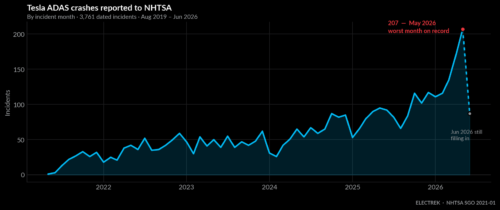
After a decade of more and more data, more and more cars on the road, Tesla is getting worse and worse. It now causes more crashes and kills more people than ever. The last three months have each set new records showing the system is degrading road safety over time.

Tesla’s own reports to NHTSA under the Standing General Order. January through June crashes, 2022 to 2026: 180, 261, 269, 476, 826. A 4.6x rise over five years. The increase from 2025 to 2026 alone (350) is nearly double the 2022 total for the same six months. May 2026 set the single-month record at 207, followed by even higher records of crashes in June and July. Source: Electrek

Belgium put that data to the test on their own and found Tesla in 2026 still can’t read basic traffic signs, and puts cyclists in danger.

FSD automated-driving system frequently exceeded speed limits and attempted to overtake cyclists on streets where ‌it’s prohibited, a road-safety advocacy group said, citing tests it conducted in Belgium.
The Belgian group Johanna.be – which advocates for pedestrian and cyclist safety – tested Tesla’s system over three days in July, covering about 400 km (249 miles). It found that FSD often exceeded speed limits ​in 20 km/h and 30 km/h zones, and incorrectly displayed higher speed limits to drivers, potentially misleading ​them about how fast the vehicle should travel.

The misleading drivers point is important. If the car gets “better” at misleading, then safety goes down while people think it should go up. That’s one of the most dangerous elements of Tesla, because what traffic law prohibits the dashboard running on AI that is misleading drivers? What law prohibits people from promising a system will improve, when it doesn’t, or it even gets worse?

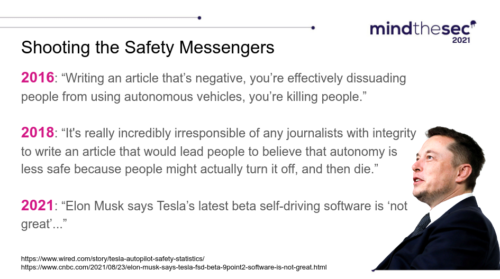
Notably, Tesla initially claimed in 2013 it was rushing AI into its cars specifically to eliminate risks to cyclists (after a Tesla killed one on Highway 1). And for years it shamed and censored anyone who reported dangers and failires. Since then it has become infamous for hiding the data to delay and avoid being accountable.

Source: My presentation at MindTheSec 2021