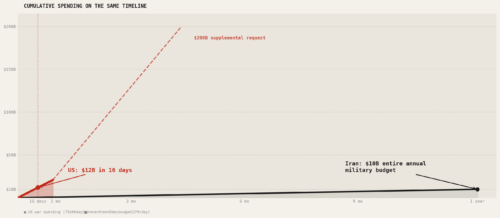
The United States blew more in 16 days of war than Iran spends in a year on its entire military. That asymmetric cost model is a problem for America.
The red wall on the chart above is US war spending at $750 million per day. The flat black line along the bottom is Iran’s entire annual military budget spread over 365 days.
Same money. The US is blowing dollars 23 times faster.
By March 15 of Operation Epic Fury, the Pentagon had spent over $12 billion. Iran’s total annual military expenditure, according to the IISS Military Balance, is approximately $10 billion.
Then the Pentagon asked Congress for $200 billion more, because it can’t sustain itself.
That is the dashed red line shooting off the top of the chart. Twenty years of Iran’s entire military budget, was requested as a supplemental.
The missile math
| United States | Iran | |
|---|---|---|
| Pre-war stockpile | 3,000-4,500 Tomahawks | 8,000-10,000 ballistic missiles |
| Fired in 4 weeks | 850+ Tomahawks | 1,191 ballistic missiles |
| % of stockpile spent | ~25% | ~13% (fired only) |
| Confirmed destroyed | N/A | ~33% of total arsenal |
| Still operational | ~75% (globally) | ~33% confirmed + recoverable |
| Monthly production | 5 Tomahawks | 100+ missiles (Rubio’s number) |
| Cost per unit | $2.2-3.6 million | ~$50,000-300,000 |
| Build time per missile | Up to 24 months | Unknown, far shorter |
| Time to replace what was fired | 14+ years at current rate | ~9 months |
The United States burned a quarter of its global Tomahawk inventory to confirm-destroy only a third of one country’s missile arsenal. US intelligence are struggling to verify that a third is destroyed. Another third is damaged or buried underground, potentially recoverable when fighting stops. The remaining third is operational. The $12B spent doesn’t seem to have obliterated Iran missile strength, only confirmed the resilience of it.
Iran launched 15 ballistic missiles at the UAE on March 27 alone.
The production asymmetry
Secretary of State Marco Rubio said it himself on March 2: Iran produces “over 100 of these missiles a month. Compare that to the six or seven interceptors that can be built a month.”
The Tomahawk production rate is worse. The Pentagon budgeted for 57 Tomahawks in the FY2026 budget. Actual recent production has averaged roughly 60 per year, or 5 per month. Iran builds in a single month what the US builds in 20 months.
Raytheon has signed a framework to scale to 1,000 Tomahawks per year. That capacity will not arrive until approximately 2028. Each missile takes up to two years to build. The FPRI’s Payne Institute documented that the coalition expended 5,197 munitions across 35 types in the first 96 hours alone, at a replacement cost of $10-16 billion, and that the single domestic source for warhead high explosives, the Holston Army Ammunition Plant in Tennessee, had not received any orders to increase production as of March 12.
The Pacific problem
Every Tomahawk fired at Iran is one fewer available for a Taiwan contingency. CSIS estimated that a conflict in the Western Pacific could consume 5,000 long-range missiles in three weeks. At current depletion rates, the US may not have enough for either theater. Pentagon officials described the Middle East Tomahawk supply as approaching “Winchester”, military slang for out of ammunition.
Trump said it at a Cabinet meeting on March 27:
The problem with the straits is this: let’s say we do a great job. We say we got 99%. 1% is unacceptable, because 1% is a missile going into the hull of a ship that cost a billion dollars.
He described the unsolvable problem without realizing it. You cannot get to zero when the target has underground production, a dozen hardened facilities at 500 meters depth, and the attacker’s stockpile is finite and shrinking.
The math does not work. America is walking off a missile cliff.